


 Home
HomeWhat Contractors Should Know About XHHW-2 Wire Ampacity Calculations
 GERITEL
 Jul 03,2026

You are on a job site. The plans call for a 100A feeder. You need to pick the wire size. The foreman wants an answer. The supplier is waiting for the order. You flip open the code book and stare at the ampacity tables.
Here is the question: do you know how to use them correctly?
Ampacity calculations are not complicated, but contractors make the same mistakes over and over. This article covers what you need to know about XHHW-2 wire ampacity—the right way to size wire, the traps to avoid, and the numbers that actually matter on the job.
1. What Is Ampacity and Why Does It Matter?
Ampacity is the maximum amount of current a wire can carry continuously without exceeding its temperature rating. Exceed the ampacity, and the wire overheats. Overheating damages insulation, increases resistance, and eventually causes failure.
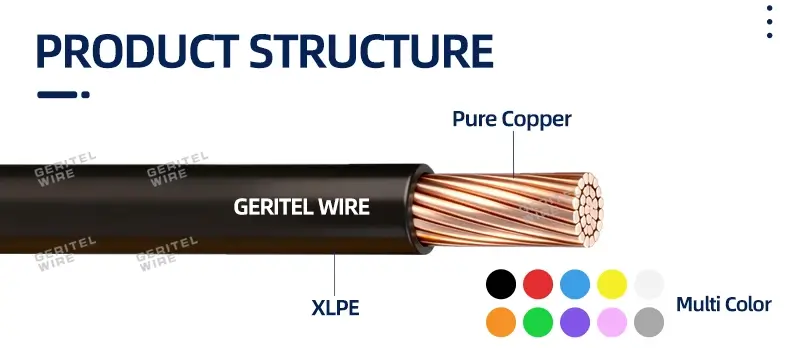
For XHHW-2, the conductor temperature rating is 90°C in both dry and wet locations. That is higher than THHN, which is only 75°C wet (unless dual-rated). The 90°C rating gives XHHW-2 more ampacity headroom in wet locations—a critical advantage in underground conduit, outdoor runs, and damp industrial areas.
But there is a catch: the ampacity of the circuit is not always the ampacity of the wire.
2. The 90°C Rating and the Termination Limit
This is where many contractors get it wrong.
XHHW-2 is rated 90°C. But most lugs and terminals—on breakers, panels, and equipment—are rated 60°C or 75°C. The circuit ampacity is limited by the lowest temperature-rated component in the system.
What this means: You cannot always use the 90°C ampacity column when sizing wire. If the terminal is rated 75°C, you must use the 75°C ampacity column.
| Termination Rating | Termination Rating |
| 60°C | Use 60°C ampacity column |
| 75°C | Use 75°C ampacity column |
| 90°C | Use 90°C ampacity column |
Most equipment terminals are 75°C. For an XHHW-2 ampacity table, the 75°C column is often the one that matters. Contractors who skip this step end up undersizing the wire.

3. Three Factors That Reduce Ampacity
Even after choosing the right column, three factors can further reduce the ampacity.
Factor 1: Ambient temperature. Ampacity tables assume 30°C (86°F). Above that, the ampacity must be derated. In boiler rooms, attics, and rooftop installations, temperatures can be significantly higher. For a 40°C ambient, the derating factor is 0.91. For 50°C, it is 0.82. Always check the ambient temperature where the wire will run.
Factor 2: Conductor bundling. When more than three current-carrying conductors are in the same conduit, cable tray, or raceway, their ampacity must be derated. The standard derating factors:
- 4-6 conductors: 80%
- 7-9 conductors: 70%
- 10-20 conductors: 50%
Factor 3: Continuous loads. For loads that operate for three hours or more, the wire must be sized at 125% of the continuous load. This is a common oversight on motor and lighting circuits.
4. Ampacity for Three Common Sizes
Here are practical ampacity numbers for three XHHW-2 sizes, using the 75°C column—since that is what most contractors will actually use.
8 AWG XHHW-2 Wire
- 75°C ampacity: 50A
- Typical use: 40-50A branch circuits, small sub-feeders, HVAC equipment
- Derating note: In a 40°C ambient with four conductors, the 50A ampacity drops to approximately 36A
4/0 AWG XHHW-2 Wire
- 75°C ampacity: 195A
- Typical use: 175-200A feeders, main distribution panels, large equipment
- Derating note: On a 200-foot run with a 175A load, voltage drop may require upsizing
- 75°C ampacity: 310A
- Typical use: Large feeders, service entrances, heavy industrial loads
- Derating note: The 90°C rating (350A) provides extra margin for derating—this is where XHHW-2's 90°C wet rating becomes valuable
5. A Practical Sizing Example
You need to size a feeder for a 100A continuous load. The run is 150 feet through a 40°C ambient. There are four conductors in the conduit.
Step 1: Continuous load. 100A × 125% = 125A.
Step 2: Temperature derating. At 40°C, factor is 0.91. 125A ÷ 0.91 = 137A.
Step 3: Find a conductor with 137A at 75°C. 1/0 AWG (150A) is the minimum.
Step 4: Bundling. Four conductors factor is 80%. 137A ÷ 0.80 = 171A.
Step 5: Find a conductor with 171A at 75°C. 3/0 AWG (185A) is the minimum.
Ampacity calculations are not just about picking a wire. They are about applying the correct factors in the right order. This is where XHHW-2 temperature derating comes into play. Many contractors skip the bundling factor and end up with wire that is too small.
For long runs, voltage drop may require a larger size. Always check voltage drop on runs over 100 feet. Proper XHHW-2 wire sizing ensures the installation will last.
FAQ
Q1: Can I use 90°C ampacity for XHHW-2 if the terminals are 75°C?
No. The circuit ampacity is limited by the lowest temperature-rated component. Use 75°C ampacity for 75°C terminals.
Q2: Does XHHW-2 have higher ampacity than THHN in wet locations?
Yes. XHHW-2 is 90°C wet. THHN is only 75°C wet unless dual-rated THWN-2. This gives XHHW-2 significantly higher ampacity in damp environments.
Q3: What is the most common ampacity mistake contractors make?
Using the 90°C column when the terminals are rated 60°C or 75°C. This results in undersized wire that can overheat at the termination point.
Q4: How do I check the ambient temperature for derating?
Measure the temperature at the installation location during the hottest expected conditions. Use the ambient temperature from the code tables, not a guess.
Need Help Sizing XHHW-2 Wire?
Tell us about your project—load, distance, and installation conditions. We will recommend the right wire size and send a quick quote.
Contact us
Dongguan GERITEL Electrical Co., Ltd.
Tel/WhatsApp/Wechat: +86 136 6257 9592
Tel/WhatsApp/Wechat: +86 135 1078 4550
Email: manager01@greaterwire.com
Website: www.geritelgroup.com
 XHHW-2 Wire and Raceway Systems: Installation Standards Explained



 Building 2, No. 40 Luxi 2nd Road, Liaobu Town, Dongguan City, Guangdong Province, China