


 Home
HomeTourism Infrastructure Upgrade Project (Palau Resort & Eco-Tourism Development)
 GERITEL
 Apr 10,2026

March 15, 2023. 2:17 AM.
My phone buzzed. It was a voice message from Project Manager Chen, anxiety audible in his tone: "The client just called. Their project in Palau is in trouble. Local electrical inspectors have detained the entire cable shipment—certification issues. Eight months left on the schedule, and they're panicking."
Three days later, I sat in the international departure hall of Shenzhen Bao'an Airport. Destination: Koror, Palau. The client was a Taiwan-backed international development consortium that had taken over an abandoned resort site on Babeldaob Island, planning to transform it into a 150-room eco-tourism complex. Total investment: $28 million. Target opening: 2024 peak season.
But now, their electrical contractor faced a nightmare. The previous supplier's "Australian-standard cables" had been flagged for questionable SAA certification at customs. Over 200 drums sat stranded at port, accruing thousands in daily storage fees, while construction lagged six weeks behind schedule.
First Contact: The Reality in Koror
Palau's international airport was smaller than I'd imagined. As customs officers inspected my sample case, I noticed an AS/NZS 3000:2018 electrical code summary on the wall—though a sovereign nation, Palau's electrical standards fully adopt the Australian-New Zealand system.
The client's site office was a container beside the construction zone. Mr. Lin, the project manager, early forties, hard hat on, dark circles under his eyes. No pleasantries. He spread a stack of documents: "Look at these. The previous supplier's certificates. We didn't know better—thought the SAA logo meant it was genuine. But Palau Public Utilities Corporation engineers checked, and the certification body isn't even on SAA's mutual recognition list."
I took the files. One glance revealed the problem. The "certification body" was a private Southeast Asian lab. They'd conducted tests, yes, but lacked formal SAA accreditation. In the AS/NZS framework, this equaled worthless paper.
"Here's the bigger issue," Mr. Lin gestured outside. "Forty percent of conduit is already embedded. If cable specs change, some must be excavated. Construction costs here are triple Taiwan's. Labor comes from the Philippines. Materials rely entirely on sea freight."
He paused. "But what we lack most is time. Dry season lasts six months. Miss it, wait until next year. Bank loan interest compounds daily."
Diagnosis: More Than Switching Suppliers
The next 48 hours, I walked the site with their electrical supervisor, Old Zhou. This was genuine tropical island environment: humidity consistently above 85%, intense UV, saline soil, and typhoon season to consider.
Pain Point One: The Certification Trap
The previous supplier's problem wasn't just forged certificates—it was the product itself. We randomly cut open a reel of "TPS Cable." Copper core oxygen content was high. The PVC insulation formulation was clearly mainland Chinese standard, lacking UV stabilizers for tropical environments. This cable would age and crack within three years in Palau, but by then, the supplier would be untraceable.
Pain Point Two: Specification Chaos
The client's original cable list came from a Taiwan designer, directly applying CNS standards. But Palau enforces AS/NZS. The two differ in conductor cross-sections, insulation thickness, color coding. Taiwan's "22mm²" corresponds to Australian "25mm²," yet Old Zhou had already encountered two specification mismatches.
Pain Point Three: Fire System Special Requirements
Strict insurance requirements mandated LSZH (Low Smoke Zero Halogen) Fire Alarm Cable for all public areas. The previous supplier's ordinary PVC fire-rated cable failed smoke density tests, rejected by insurers. "We nearly had to redesign the entire main building electrical system," Mr. Lin smiled bitterly.
Pain Point Four: The Logistics Black Hole
Palau lacks deep-water ports. Cargo must transit through Guam or Taiwan. Customs procedures are complex. The previous supplier promised "45-day delivery." Reality: 90 days, with damaged packaging. Several cable reels had water ingress and rust.
The Solution: From Firefighting to Trust Rebuilding
Back in Dongguan, I convened technical, production, and logistics departments. This wasn't a simple replenishment order—it was rebuilding supply chain confidence.
Step One: Certification Transparency
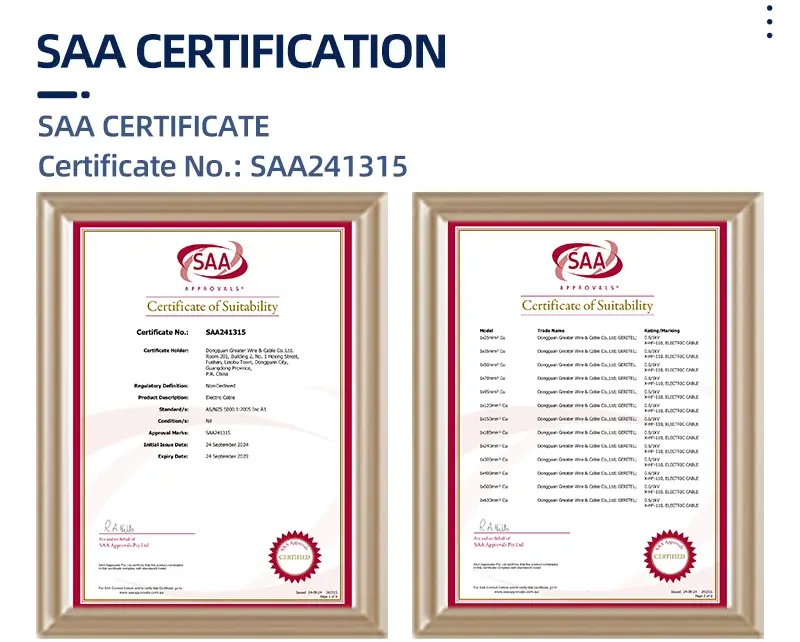
I sent our SAA certificate electronic copies to Palau Public Utilities Corporation engineers, with SAA official website verification links. Their confirmation came within two days: our certification body is a JAS-ANZ accredited SAA member, certificate numbers verifiable. This bought the inspectors' trust.
Step Two: Site Survey and Redesign
I returned to Palau with our electrical engineer, spending a full week remeasuring conduit routes, calculating loads, verifying AS/NZS codes. Key adjustments included:
Main Distribution: Original design used Taiwan-standard 30mm² cable, changed to AS/NZS Building Cable 35mm² XLPE insulated, reducing voltage drop
Guest Room Circuits: TPS Cable 2.5mm² twin + earth, flat profile suited to local light timber-frame construction
Kitchen & Mechanical: Multicore Flexible Cable 5C×4mm² for high-power equipment, oil and heat resistant
Grounding System: Station-wide Earthing Cable 10mm² green/yellow, copper purity ≥99.95%
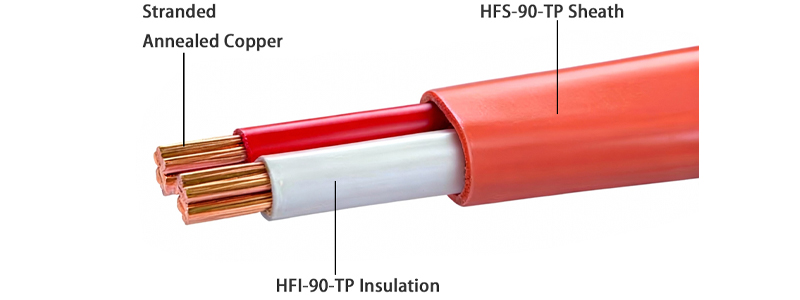
Fire Alarm: This was critical. We specified Fire Alarm Cable 2C×2.5mm², insulation and sheath both LSZH material, passing IEC 60332-3 flame retardance and IEC 61034 low-smoke tests. Each reel included independent material composition reports, directly insurer-recognized
Step Three: Solving Logistics
We partnered with a Shenzhen freight forwarder specializing in Pacific routes: cargo to Keelung, Taiwan, then weekly Palau service. All cables used steel-tape armored wooden drums, outer moisture barrier film and desiccants. I applied bilingual Chinese-English labels to each drum, noting AS/NZS standard numbers, SAA certificate numbers, production batches—"customs-friendly design" specifically for Palau clearance.
Execution: The Three-Month Battle
April 2023: Sample Confirmation
We air-freighted complete sample sets to Palau, including physical cross-sections of Fire Alarm Cable 2C×2.5mm². Mr. Lin's fire safety consultant, an Australian-retired engineer living in Palau, exposed samples to tropical sun for three days, then performed bend tests. "LSZH material is indeed more UV-stable than PVC," he wrote. "This is acceptable."
May 2023: First Shipment Arrival
I flew in personally to coordinate customs clearance. Palau customs officers had never seen such complete documentation: SAA certificates, certificates of origin, packing lists, material assay reports, even our Dongguan factory's ISO 9001 certification. Clearance took six hours. Mr. Lin said his previous fastest was three days.
During unloading, a forklift mishap damaged one Building Cable drum edge. We cut it open on-site—copper core and insulation intact—but I insisted on scrapping it. "In this environment, any potential damage could become a fault point in three years," I told Old Zhou. Mr. Lin later said this detail convinced him to transfer all subsequent orders to us.
June 2023: Construction Peak
Palau entered dry season. The site ran 24-hour shifts. Our technical support never stopped: Old Zhou called at 3 AM asking about TPS Cable stripping techniques in humid conditions, our engineer guided via video call; fire system Fire Alarm Cable shielding grounding issues arose, we provided detailed AS/NZS 3013 interpretations within two days.
July 2023: Replenishment and Adjustments
Construction inevitably brought design changes. Spa area added waterscape lighting, requiring additional Multicore Flexible Cable 7C×1.5mm²; main building backup generator installation urgently needed Building Cable 50mm² doubled-up. Our production line prioritized rush orders, from PO to Koror site in 28 days. Mr. Lin said the previous supplier would take 60+ days for similar situations.
Inspection: The Inspector's Nod
September 2023. Palau Public Utilities Corporation's chief electrical inspector, New Zealand-trained, conducted final acceptance.
He spot-checked Fire Alarm Cable termination points, tested insulation resistance, verified Earthing Cable grounding continuity. Then he asked a technical detail: "What's the oxygen index of your LSZH material?"
"32%. Exceeds AS/NZS 1660.5.6 requirement of 30%," I replied, handing over third-party test reports.
He nodded, signing the acceptance form. "I've seen too many Pacific island projects use cheap cable. Problems everywhere after three years. Yours," he patted the drum, "should last twenty."
Post-Opening: Real Feedback
February 2024. The resort opened. I received Mr. Lin's photo: overwater villas at sunset, lights coming on sequentially. The message: "Thanks. You saved this project."
Six months later, I revisited Palau for routine inspection. Old Zhou showed me the electrical room logs: zero faults. Transformer temperatures normal, distribution boards no abnormal heating, Fire Alarm Cable system self-checks all passed.
"Something you might not know," Mr. Lin mentioned over dinner. "Weeks before opening, a neighboring island resort had an electrical fire—half the main building burned. Our insurer happened to be reinspecting, saw our Fire Alarm Cable and grounding system, immediately reduced premiums by 8%. The savings cover your entire cable order's interest."
He mentioned an unexpected bonus: because our cable labeling was clear and documentation complete, the resort passed an Australian eco-tourism certification body's audit, earning "green electricity" credit points. "This matters for attracting European guests," he said. "They now feature electrical system sustainability in their brochure."
Post-Mortem: What We Did Right
This project taught me that industrial product sales are never simply about price comparison.
Genuine SAA Certification: Threshold and Moat
The market is flooded with "Australian-standard cables," but markets like Palau are tightening. Our certification isn't cost—it's insurance against $2 million potential losses.
Technical Service Value Exceeds Product Value
If we'd simply sold cables without redesign review, the client might have faced installation failures from specification mismatches. Our engineer's two weeks in Palau solved not just technical problems, but decision anxiety.
Logistics Isn't Add-On, It's Core Competitiveness
For island economies, delivery time is ten times more sensitive than price. Our Pacific route partnerships, custom packaging solutions, anticipatory document preparation—these are hard to replicate.
Fire Cable Differentiation
Fire Alarm Cable 2C×2.5mm²—many factories can produce it, but few use genuine LSZH material passing full IEC test suites. In tourism, this is a life-or-death line, not a cost line.
To Your Next Project
If you have projects in Pacific islands, Southeast Asia, or any AS/NZS-standard region, if certification headaches, delivery delays, or supplier empty promises have burned you before—let's talk.
Not because we're cheapest, but because we understand that in that container office in Koror, the project manager awake at 2 AM needs more than a quotation. He needs a partner who solves problems together.
Dongguan GERITEL Electrical Co., Ltd.
Tel/WhatsApp/WeChat: +86 135 1078 4550 / +86 136 6257 9592
Email: manager01@greaterwire.com
 Palau Smart Agricultural Irrigation System Upgrade Project



 Building 2, No. 40 Luxi 2nd Road, Liaobu Town, Dongguan City, Guangdong Province, China