


 Home
HomeMarshall Islands Agricultural Irrigation and Solar-Powered Microgrid Development
 GERITEL
 Apr 10,2026

March 2023. An inquiry landed in our inbox with cautious wording. The sender was from the Republic of the Marshall Islands—a nation you need a magnifying glass to locate on most maps. The message listed a long string of cable specifications, ending with a single line: "We need SAA certification. Tight schedule. Have you done similar projects?"
That email sparked a collaboration spanning half the globe. Six months later, when the first containers arrived at Majuro Port, nobody anticipated that the cable systems would operate fault-free for the following year. Even fewer predicted that this country—just 181 square kilometers in total—would become our most significant reference point for the South Pacific market.
Understanding a Land's Longing
The Marshall Islands comprises 1,225 reef islands scattered across roughly 2 million square kilometers of Pacific waters. Average temperature hovers at 27°C year-round, humidity rarely drops below 80%, and salt fog can corrode unprotected steel within months. The most crippling challenge, however, is energy. The national grid relies on imported diesel; remote islands have seen electricity prices spike to $0.35 per kilowatt-hour.
An agricultural department technical lead walked us through their math during our first video call. Irrigating one hectare with diesel pumps consumed nearly all profits in fuel costs alone. "What we want is simple," he said, the Pacific lag making his words arrive slightly delayed. "Let the sun pump our water. Let cables carry that energy to every tree's roots."
But three chasms separated vision from reality:
The Wall of Certification
Project funding came from Australian and New Zealand aid programs. Tender documents mandated SAA certification and full AS/NZS compliance for all electrical equipment. This wasn't bureaucratic box-ticking—weak island grids meant any electrical fault could cascade into system-wide failure. The client had seen suppliers attempt to pass off national-standard certificates. They had watched projects stall when audit teams rejected incomplete documentation.
The Curse of Environment
Standard cables rated for 20 years in temperate zones might last eight here. UV radiation tears PVC sheaths. Salt fog gnaws at copper conductors. Humidity turns insulation layers into sponges. A local electrician described it grimly: "Cables here die a thousand deaths. You rarely find the body in time to learn the cause."
The Tyranny of Time
Dry seasons wait for no one. The project had three phases; Phase One required three sites operational within six months. From purchase order to port arrival, the cable supplier had ten weeks maximum—including Pacific Ocean shipping time.
Why These Cables
The client's initial list was generic: "solar cables, power cables, control cables." But in tropical island contexts, such categories prove dangerously coarse. After three technical video conferences and one exchange of site survey data, we deconstructed the requirements entirely. What emerged was a product matrix precise to the millimeter.
The Solar Bloodline: From Panel to Pump
Photovoltaic arrays generate DC power that must travel through combiner boxes, inverters, distribution boards, and finally drive water pumps. At every link in this chain, we refused to compromise with "universal" products.
TPS Cable became the photovoltaic zone's primary artery. The client had initially inquired about standard armored cable, but we insisted on this double-protection alternative. The distinction matters: inner XLPE insulation withstands the occasional DC arc temperatures of PV systems, while outer steel tape armor defends against mechanical damage—and against a uniquely island-specific threat: coconut crabs. These crustaceans can weigh four kilograms and generate clamping force sufficient to sever ordinary PVC sheaths. We provided full specification coverage from 2C×2.5mm² to 4C×6mm², with 4C×4mm² handling the critical transmission from inverters to distribution boards.
Building Cable managed the intricate wiring inside distribution enclosures. We specified PVC-sheathed variants for pragmatic tropical performance: superior moisture resistance, abrasion resilience, and field repairability with standard tools—critical when specialized LSZH termination kits won't reach the islands for weeks. Gradations from 1.5mm² to 4mm² matched each circuit's current grade, while 30-40% lower cost than LSZH alternatives preserved limited aid funding for other priorities.
Orange Circular Cable became the field engineers' favorite. High-visibility orange sheathing traced safety warning lines through lush farm vegetation, reducing excavator strike risks. Neoprene outer layers resisted the hydraulic fluids of agricultural machinery. Specifications of 3C×2.5mm², 3C×4mm², and 5C×2.5mm² covered everything from fixed pump stations to mobile irrigation branches.
The Mechanical Heart: Precision Language in a Variable-Frequency World
The pump system's technical complexity far exceeded the photovoltaic portion. A 22kW main pump driven by variable frequency drives meant cables must transmit power while taming invisible high-frequency beasts.
The client's technical team initially favored standard four-core power cable for inverter-to-motor connections. We sent a technical memorandum explaining why this choice would haunt them in three years:
Standard cables lack symmetrical shielding. The electromagnetic interference from VFDs escapes along cable armor, potentially causing adjacent sensors to misreport water levels or controller relays to chatter randomly. More insidiously, voltage reflection—PWM pulses from inverters reflecting at the impedance boundary between cable and motor—creates spike voltages that erode motor winding insulation until sudden breakdown.
VSD Cable was our answer. Its triple-shield construction (aluminum foil + braided copper + grounding conductor) suppresses EMI at its source. Low-capacitance XLPE insulation keeps voltage reflection coefficients within safe margins. For this project's 22kW main pump, we specified 4C×4mm² VSD Cable—the fourth core serves not merely as protective earth but as the shield layer's grounding return path, satisfying AS/NZS 3000's special requirements for VFD systems and eliminating a common source of field failures.
Our specification sequence from 3C×4mm² to 4C×6mm² covered pump motors from 5.5kW to 30kW. Every meter underwent partial discharge testing before shipment, ensuring insulation free of bubbles or impurities—in humid heat, such defects become rapid breakdown channels.
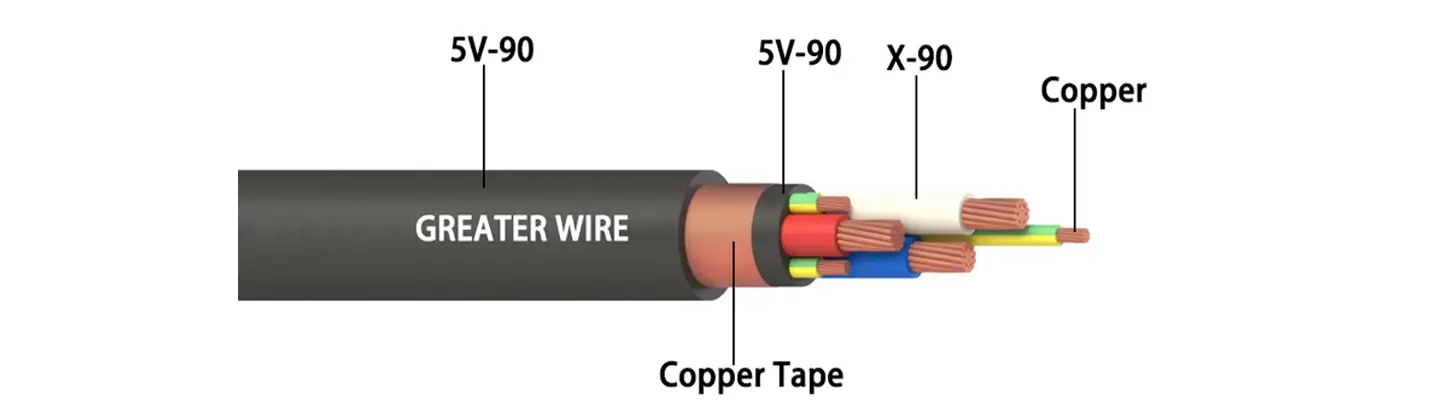
Elastomer Cable guarded the most demanding post: deep-well submersible pumps. Permanently immersed in slightly saline groundwater, subjected to mechanical stress from pump start-stop cycles, this was the exclusive territory of EPR (ethylene propylene rubber) insulation and CSP (chlorosulfonated polyethylene) sheathing. H07RN-F specifications from 3G 2.5mm² to 5G 4mm² offered bending radii as tight as 6×outer diameter, transforming deep-well installation from a battle against stiff conductors into manageable deployment.
Building Trust, Delivering Certainty
Technical solution acceptance was merely step one. The client needed certainty that our certification claims held substance, that our delivery promises weren't empty air.
Certification Transparency
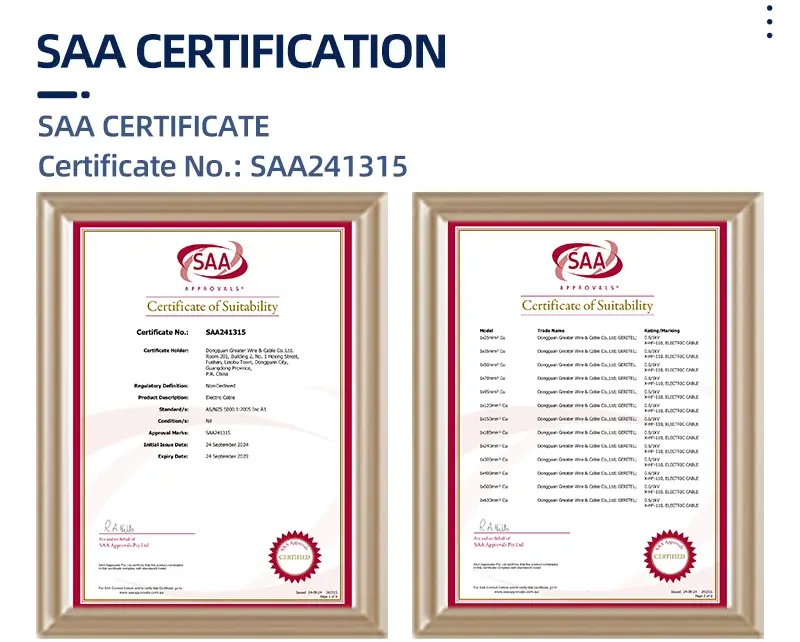
We didn't send scan-and-pray documents. The client received a complete SAA certification package mapping AS/NZS 5000 series, AS/NZS 3000, AS/NZS 3191, AS/NZS 1125—every applicable standard. More critically, we provided detailed scope mapping: which certificate covered which product family, which specification, which voltage class. This transparency eliminated the "certificate in hand, product out of scope" anxiety.
Environmental Proof
Addressing durability concerns for island environments, we voluntarily submitted third-party accelerated aging test reports: after 1,000 hours at 85°C/85%RH, critical performance indicators maintained above 90% retention. This exceeded standard requirements, but data soothes anxiety more effectively than promises.
Delivery Anatomy
Ten weeks door-to-door, we dissected every segment: raw material pre-positioning (we maintain strategic copper conductor inventory), precision manufacturing scheduling (priority green channel), quality inspection (parallel processing compression), ocean freight booking (South Pacific direct service). The client saw not vague "ASAP" commitments but weekly milestone nodes with named owners.
Execution reality: first batch arrived week nine. When the container crane released its load at Majuro Port, the project manager sent a sunset photograph without caption. We understood the unspoken relief.
In the Field, Underground, Under Sun
Cable value ultimately proves itself in dirt and seawater. Our technical engineer accompanied the first batch for two weeks—not to supervise unloading, but to ensure designed performance survived installation reality.
He trained local electricians on VSD Cable shield grounding essentials—the most commonly overlooked field detail, yet decisive for VFD stability. He demonstrated Elastomer Cable sealing protocols for deep-well joints: heat-shrink tubing plus epoxy resin double-protection, refusing any moisture penetration pathway. He verified TPS Cable armor grounding continuity—in salt fog, disconnected armor becomes corrosion accelerators.
These details never appeared in acceptance reports, but they constituted the foundation of "zero failure."
The Fields One Year Later
When the 2024 dry season arrived, all three project phases stood complete. Numbers speak more eloquently than adjectives:
Eight off-grid sites. 420kW photovoltaic capacity. 650MWh annual generation. 180,000 liters of diesel displaced. Thirty-two pumps covering 380 hectares—triple the pre-project irrigation area. Cable system operational record: zero insulation faults, zero joint failures, zero EMI-induced control malfunctions.
The technical lead said during a follow-up video call: "We've almost forgotten the cables exist—which is exactly their best state."
Energy data held a surprise dividend: VSD Cable's low-capacitance design reduced voltage reflection losses, cutting overall pump system consumption 8% below design values. This compressed payback period by roughly six months—significant breathing room for cash-constrained public projects.
Our Difference, Your Gain
The Marshall Islands project wasn't isolated. From Fiji's sugar mills to Samoa's hospitals, Tonga's fish processing to Vanuatu's tourism resorts, our cables energize the South Pacific. These projects taught us three lessons that constitute our unique client value:
First: Certification Completeness, Not Selectivity
SAA certification isn't a universal passport—it requires precise mapping to product models, specifications, and application scenarios. We maintain comprehensive, current certification matrices across all product families, eliminating the compliance jigsaw puzzle of multiple suppliers.
Second: Environmental Interpretation, Not Standard Application
Tropical islands, desert interiors, high-altitude regions—each environment kills cables differently. Our solution design begins with environmental understanding, not catalog copying. This regional expertise prevents clients from bearing "learning curve" costs.
Third: Agile Certainty, Not Rigid Scale
Island projects typically feature "small batches, multiple specs, urgent schedules." Our flexible production and strategic inventory unify these seemingly contradictory demands. Standard delivery runs 40% faster than industry averages; emergency requirements compress to four weeks.
Epilogue: Your Story Starts Here
Coconut crabs still roam Marshall Islands nights, but their claws find no exposed cable to attack. The sun rises daily. Photovoltaic panels transform light to electricity. Cables silently transmit this energy. Pumps push fresh water into thirsty soil. This is a story of technology serving survival—and we are honored to be the invisible bond.
Whether your project sits in the Pacific, Indian Ocean, or Caribbean, whether facing agricultural irrigation, seawater desalination, or off-grid community power, we provide cable systems that are certified, validated, and time-tested.
Don't let cables become your project's unknown variable.
Dongguan GERITEL Electrical Co., Ltd.
Tel/WhatsApp/WeChat: +86 135 1078 4550 / +86 136 6257 9592
Email: manager01@greaterwire.com
Send your project outline. Our technical team responds within 24 hours with preliminary selection recommendations and certification packages. From first email to final delivery, experience a different collaboration—professional, transparent, reliable.
The next "invisible cable" success story could be yours.
 Tourism Infrastructure Upgrade Project (Palau Resort & Eco-Tourism Development)



 Building 2, No. 40 Luxi 2nd Road, Liaobu Town, Dongguan City, Guangdong Province, China