


 Home
HomeMarshall Islands Majuro Port Modernization and Maritime Infrastructure Upgrade
 GERITEL
 Apr 10,2026

When the Marshall Islands Ports Authority launched the comprehensive modernization of Majuro Port—specifically the critical infrastructure upgrades at Delap Dock and Uliga Dock under the World Bank-supported Marshall Islands Maritime Investment Project—they faced a challenge that extends far beyond typical electrical installations. Situated in one of the world's most demanding marine environments, this project required cable systems that could withstand relentless salt spray, extreme UV exposure, tropical cyclones, and the constant mechanical stress of heavy maritime operations.
As the primary electrical infrastructure contractor for this landmark Pacific port upgrade, we delivered a complete cable solution that transformed how this strategic transshipment hub powers its operations.
Understanding the Challenge: Why Standard Cables Fail in Tropical Maritime Environments
The project engineering team approached us with a clear set of concerns born from previous infrastructure failures across Pacific island ports. Their initial assessment revealed three critical pain points that threatened the entire modernization timeline:
Environmental Aggression: Standard PVC-insulated cables, which might suffice in temperate climates, deteriorate rapidly in the Marshall Islands' equatorial marine environment. Salt mist penetrates conventional cable jackets within months, causing conductor corrosion and insulation breakdown. The previous port infrastructure had experienced complete electrical failures within 18 months of installation due to these factors.
Mechanical Durability Requirements: The port's shore power systems and mobile equipment demanded cables capable of withstanding constant flexing, crushing from heavy vehicle traffic, and abrasion from rough concrete surfaces. Standard rigid cables simply couldn't accommodate the dynamic nature of vessel connections and cargo handling operations.
Regulatory Compliance Complexity: As a former Australian and New Zealand administrative territory with ongoing technical cooperation agreements, the Marshall Islands requires electrical infrastructure to meet AS/NZS 5000.1 standards. Many international suppliers lack SAA certification, creating procurement delays and compliance risks that could derail the entire World Bank-funded project timeline.
The project specifications called for a complete electrical overhaul including medium voltage distribution systems, port-wide LED lighting infrastructure, ISPS-compliant security systems, and critically—the installation of modern shore power (cold ironing) capabilities to support international shipping lines' decarbonization initiatives.
Engineering the Solution: Tailored Cable Architecture for Maritime Excellence
Our engineering team conducted a comprehensive site assessment in collaboration with the project's international consulting engineers, analyzing everything from tidal patterns to cargo handling workflows. This analysis led us to develop a three-tier cable solution specifically architected for the Marshall Islands' unique operational demands.
Tier 1: High-Voltage Distribution Backbone
For the primary power distribution from the port's upgraded backup generators to the main distribution boards, we specified Medium Voltage Cable rated at 11kV with heavy-duty SWA Cable (Steel Wire Armoured) construction. The armored steel wire layer provides exceptional mechanical protection against accidental damage during the heavy equipment operations that characterize Delap Dock's container handling activities.
We supplied these in 3C × 95 mm² and 3C × 70 mm² configurations to handle the substantial power demands of the new port control tower, container scanner systems, and extensive LED lighting arrays being installed across the facility. The steel wire armor eliminates the need for additional conduit protection in exposed trench installations, reducing both material costs and installation complexity in the corrosive soil environment.
Tier 2: General Power & Lighting Distribution
For building services, port lighting circuits, and auxiliary power distribution throughout the Uliga Dock passenger terminal and administrative facilities, we deployed TPS Cable (Tough Plastic Sheathed) in 2C × 16 mm² and 3C × 10 mm² sizes. The flat construction of TPS cables allows for efficient installation in confined spaces within the port's existing concrete structures, while the heavy-duty PVC sheath provides excellent resistance to the mechanical abrasion inevitable in high-traffic port zones.
The Orange Circular Cable we supplied for critical safety circuits and emergency systems features high-visibility coloring that meets international maritime safety standards, ensuring rapid identification during maintenance operations or emergency responses.
Tier 3: Mission-Critical Shore Power Systems
The most technically demanding aspect of this project was the design and implementation of the shore power infrastructure—the system allowing international vessels to connect to land-based electrical supply while at berth, eliminating the need to run onboard diesel generators.
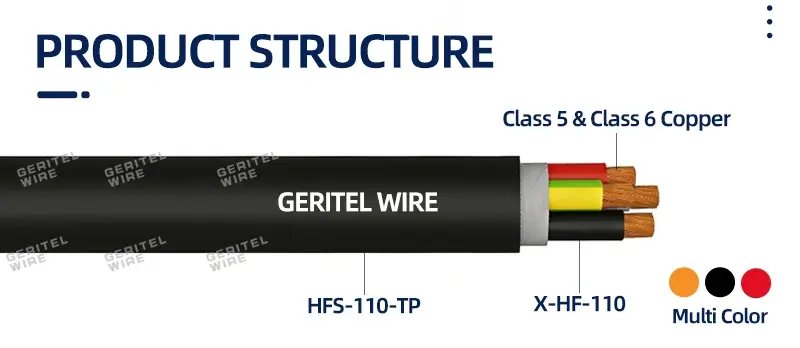
For this application, we specified our specialized Elastomer Cable in the critical configuration of Elastomer Cable 3C × 25 mm² for the primary vessel connection points. This wasn't an arbitrary choice—it was an engineering necessity based on the specific operational profile of Majuro Port.
Why Elastomer Cable 3C × 25 mm² Instead of Standard Alternatives?
The difference between standard rubber-flex cables and our specialized Elastomer Cable lies in molecular structure and compound engineering. Standard EPR (ethylene propylene rubber) cables offer basic flexibility but degrade rapidly under the combined assault of marine hydrocarbons, ozone exposure, and saltwater immersion.
Our Elastomer Cable employs a chlorinated polyethylene (CPE) or specialized polychloroprene (PCP) compound that creates a virtually impermeable barrier against:
- Hydraulic oils and marine fuels that inevitably leak during bunkering operations
- Saltwater spray with its ionic corrosive potential
- UV radiation at levels 40% higher than temperate zones due to equatorial proximity
- Ozone generated by high-voltage electrical equipment
The 3C × 25 mm² sizing was specifically calculated to handle the 400A current requirements of medium-sized container vessels and fishing fleet processors that frequent Majuro, while maintaining voltage drop within AS/NZS 3008.1.1 limits across the 150-meter cable runs from shore connection boxes to vessel receptacles.
For the high-flex mobile cable reels and shore power cable management systems, we provided Elastomer Cable in 4C × 35 mm² configurations with additional tinned copper braiding for enhanced electromagnetic compatibility—a critical consideration given the sophisticated navigation and communication equipment on modern vessels.
Certification & Quality Assurance: The SAA Advantage
What ultimately secured this contract wasn't merely technical specification compliance—it was our comprehensive certification portfolio that eliminated the client's procurement risk entirely.
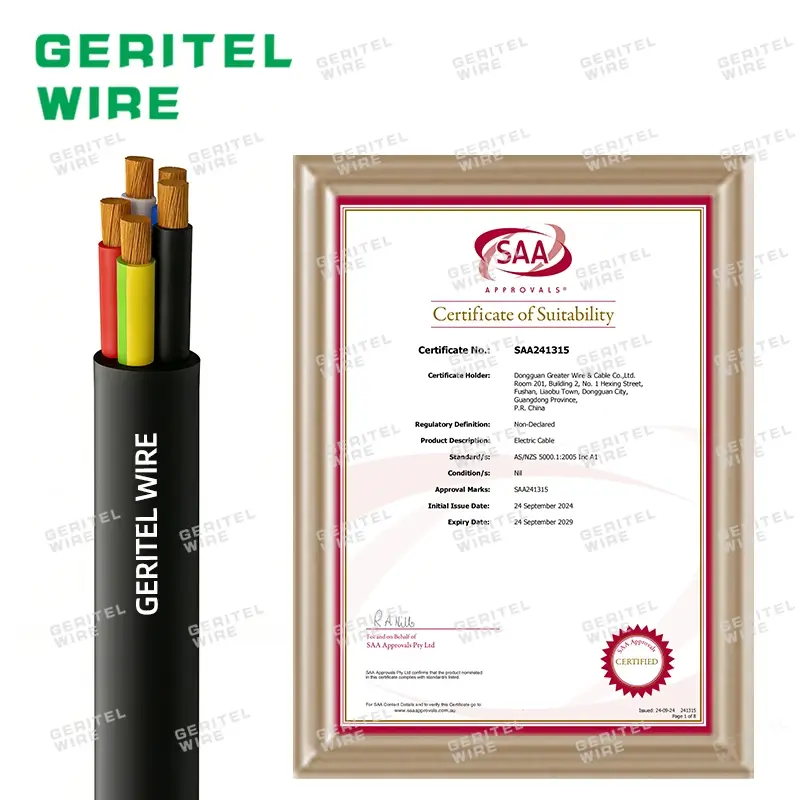
SAA Certification & AS/NZS Compliance: Our entire product range carries SAA (Standards Australia Approval) certification, demonstrating full compliance with AS/NZS 5000.1 for flexible cables and AS/NZS 3008.1.1 for current-carrying capacity calculations. This certification is recognized throughout the Pacific Islands region, including the Marshall Islands, ensuring seamless regulatory approval without costly third-party testing or documentation delays.
Proven Pacific Track Record: Our portfolio includes successful cable supply for similar maritime infrastructure projects across Fiji, Papua New Guinea, and Vanuatu—environments sharing the Marshall Islands' climatic challenges. This regional experience meant we understood the specific failure modes that concern Pacific port engineers: UV degradation at the cable-to-equipment interface, moisture ingress at termination points, and the thermal cycling issues unique to tropical installations.
Accelerated Delivery Capability: Perhaps most critically for this World Bank-funded project with strict milestone requirements, we maintained substantial pre-manufactured inventory of all specified cable types. While competitors quoted 12-16 week lead times for specialized marine-grade cables, we delivered the complete order—including the specialized Elastomer Cable 3C × 25 mm² shore power assemblies—within 4 weeks of contract execution. This rapid fulfillment prevented installation contractor downtime that would have cost the project thousands of dollars daily.
Implementation Excellence: From Warehouse to Wharf
The execution phase revealed why our pre-project engineering consultation proved invaluable. Our technical team provided on-site support during the critical cable pulling operations, ensuring that the SWA Cable armor grounding was properly implemented at every transition point and that the Elastomer Cable terminations used marine-grade heat-shrink systems with anti-corrosion gel filling.
For the shore power installation, we coordinated directly with the vessel connection system integrators to ensure our Elastomer Cable 3C × 25 mm² specifications matched the IEC 80005-1 standard connectors being installed. This coordination prevented the interface mismatches that commonly delay shore power commissioning.
The installation of TPS Cable for the port lighting infrastructure proceeded without incident, with our flat-profile design allowing efficient routing through existing conduit systems that round cables couldn't navigate—eliminating the need for costly concrete cutting and remediation.
Project Outcomes: A Port Transformed
Eighteen months after energization, the Marshall Islands Ports Authority reports zero cable-related failures across the entire installation—a stark contrast to the previous infrastructure's rapid deterioration. The shore power system is now actively reducing vessel emissions at berth, supporting the RMI's commitments under the International Maritime Organization's environmental protocols.
The port's new LED lighting system—powered by our Orange Circular Cable and TPS Cable distribution network—provides the illumination quality necessary for 24/7 operations and ISPS Code compliance, while the medium voltage backbone ensures reliable power even during the island's frequent tropical storm events.
Most significantly, the Elastomer Cable shore power connections have demonstrated exceptional durability through over 500 vessel connection cycles, with no insulation degradation or conductor fatigue—validating the material science advantages over standard flexible alternatives.
Partnership Value: Beyond Product Supply
What distinguishes this engagement isn't merely the cable specifications—it's the consultative approach that transformed a procurement transaction into a technical partnership. The Marshall Islands Ports Authority benefited from:
Pre-emptive Engineering Support: Our team identified potential voltage drop issues in the original shore power design and proposed the Elastomer Cable 3C × 25 mm² upgrade before installation, preventing costly retrofit requirements.
Logistics Coordination: We managed the complex international shipping requirements to Majuro, including customs documentation and transshipment coordination through Honolulu, ensuring the entire cable consignment arrived as a single coordinated delivery.
Technical Documentation: We provided comprehensive cable test certificates, installation guidelines specific to tropical marine environments, and ongoing technical support availability—resources that proved invaluable for the local electrical contractors executing the installation.
Your Maritime Infrastructure Deserves Proven Performance
The Marshall Islands Majuro Port Modernization demonstrates that in the world's most demanding environments, cable selection determines infrastructure longevity. Whether you're upgrading port facilities in the Pacific Islands, developing shore power capabilities for decarbonization compliance, or building resilient electrical systems for any marine application, the difference between standard products and engineered solutions manifests in years of reliable operation versus months of failure-induced downtime.
When your project demands:
- SAA-certified compliance with AS/NZS standards for Pacific region acceptance
- Specialized marine-grade materials that outlast standard cables in salt-spray and hydrocarbon exposure
- Rapid, reliable delivery that keeps your installation contractors productive
- Technical partnership that anticipates challenges before they become costly problems
- We're ready to engineer your solution.
Contact Dongguan GERITEL Electrical Co., Ltd.
Let's discuss your maritime infrastructure cable requirements:
Tel/WhatsApp/WeChat: +86 135 1078 4550 / +86 136 6257 9592
Email: manager01@greaterwire.com
 Marshall Islands Agricultural Irrigation and Solar-Powered Microgrid Development



 Building 2, No. 40 Luxi 2nd Road, Liaobu Town, Dongguan City, Guangdong Province, China