


 Home
HomePalau Smart Agricultural Irrigation System Upgrade Project
 GERITEL
 Apr 10,2026

I. Project Genesis: When Tropical Agriculture Meets Intelligent Transformation
In early 2023, the Palauan agricultural sector confronted an urgent reality: this import-dependent island nation desperately needed to boost domestic crop yields, while traditional flood irrigation methods were rapidly depleting limited freshwater resources. The government launched an ambitious smart agricultural irrigation system upgrade initiative, aiming to achieve precision irrigation through soil sensor networks and automated valve control.
However, the project team soon discovered that infrastructure electrification posed the most formidable challenge. Palau's unique environment—characterized by high temperatures, extreme humidity, salt spray corrosion, and frequent typhoons—imposed stringent demands on cable systems. Compounding the complexity, this system needed to simultaneously handle high-power pump supply and precision sensor signal transmission, two fundamentally different electrical requirements that had to coexist harmoniously within the same infrastructure.
The client initially approached several Southeast Asian suppliers, but sample testing revealed critical failures: standard PVC cables exhibited accelerated sheath aging in salt spray environments, while signal cables suffered persistent data packet loss. With the construction window narrowing to just six months before the dry season ended, the client needed a partner who understood both technical excellence and reliable delivery.
II. Requirements Decoding: Precision Mapping of Four-Layer Electrical Architecture
Upon assuming the project, our technical team resisted the urge to rush into quoting. Instead, we invested two weeks in deep consultation with the client, dissecting four distinct electrical application scenarios. This layered analytical approach ultimately became the cornerstone of project success.
The pump power layer needed to withstand the dual assault of heavy-load currents and mechanical stress. Palau's topography dictated that pump stations were predominantly located at mountain foothills or coastal lowlands, where cables might be directly buried or traverse rocky strata—any mechanical damage could paralyze the entire system.
The intelligent control layer served as the system's "nervous system." Communication among hundreds of soil moisture sensors, weather monitoring stations, and the central PLC demanded cables with exceptional anti-interference capabilities. In Palau, where lightning activity is frequent and the electromagnetic environment complex, signal integrity represented the paramount challenge.
The end distribution layer involved short-distance power supply from sub-control boxes to field valves. Here, cost-effectiveness and installation convenience took precedence—scattered routes and numerous nodes meant that premium cables for every meter would rapidly exhaust the budget.
The cross-regional connection layer needed to span wetlands and valleys where excavation was impractical. The client sought to avoid environmental disruption while controlling construction costs, implying a need for an overhead solution that required no burial.
III. Product Selection: Why These Cables Emerged as Winners
For each architectural layer, we proposed differentiated product portfolios, with every selection subjected to rigorous comparison against alternatives.
3.1 Pump Stations: The Irreplaceability of SWA Cable
For pump main power supply, the client initially considered PVC cables with steel conduit protection to reduce costs. We presented failure cases from local Palauan projects: conduit joints corroded in humid environments, and moisture ingress actually accelerated cable aging. The ultimately selected SWA Cable (Steel Wire Armoured Cable) employs steel wire armor as mechanical protection, enabling direct burial without additional conduit.
Our specifications ranged from 3C x 25mm² to 3C x 95mm², covering pumps of varying power ratings. Compared to aluminum-armored cables, steel wire armor commands a slightly higher unit cost, but delivers superior impact resistance in rocky excavation zones and lower long-term failure rates. The client endorsed our life-cycle cost (LCC) argument.
3.2 Automation Control: Precision Assurance via Instrumentation Cable
Signal transmission selection sparked intense technical debate. Some client team members advocated for standard shielded control cables to save budget, but we insisted on Instrumentation Cable.
The critical distinction lay in capacitance balance design. Standard control cables lacked sufficient twist pitch consistency and insulation uniformity to guarantee long-distance analog signal (4-20mA) precision, whereas instrumentation cables achieved extremely low pair-to-pair capacitance variance through rigorous twisting processes and PE insulation. In the Palau project, some sensors were located over 800 meters from sub-control boxes; testing demonstrated that instrumentation cables exhibited 60% lower signal attenuation than alternatives.
We configured specifications from 1Pair x 1.5mm² to 12Pair x 1.0mm², with overall plus individual shielding double-layer structures effectively isolating electromagnetic interference from variable-frequency pumps.
3.3 Field Distribution: The Economical Choice of 3C x 2.5mm² TPS Cable
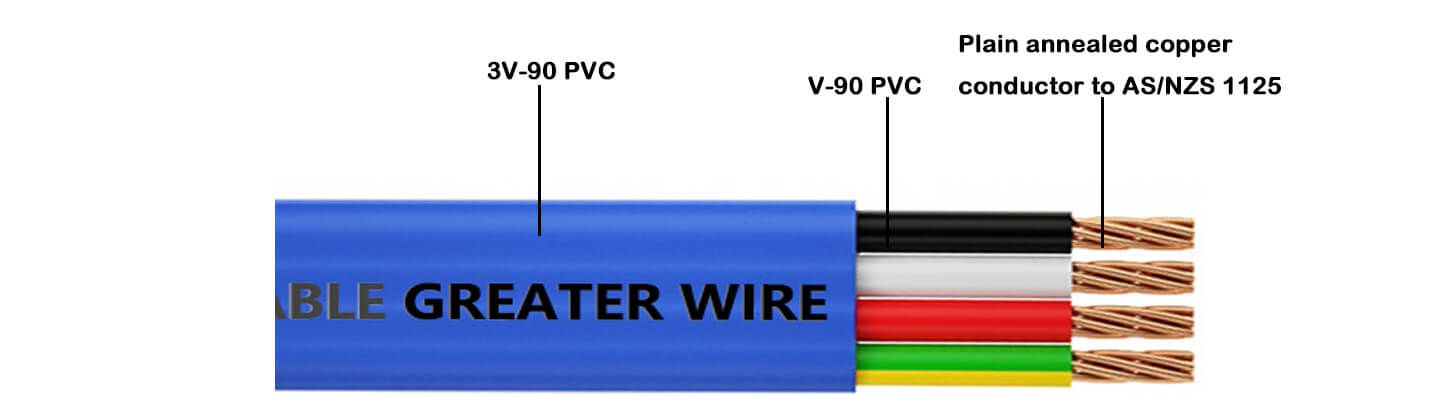
End distribution represented the most cost-sensitive segment. Our recommended 3C x 2.5mm² TPS Cable (Tough Plastic Sheathed Cable) played a pivotal role here.
3C x 2.5mm² TPS Cable serves as the mainstream choice for low-voltage distribution in Australia/New Zealand. Its flat sheath structure enables remarkably convenient fixing on field supports, allowing workers to complete installation without specialized tools. Compared to North American NM Cable commonly used, TPS features thicker PVC sheathing and higher mechanical strength, better resisting physical wear in farm environments.
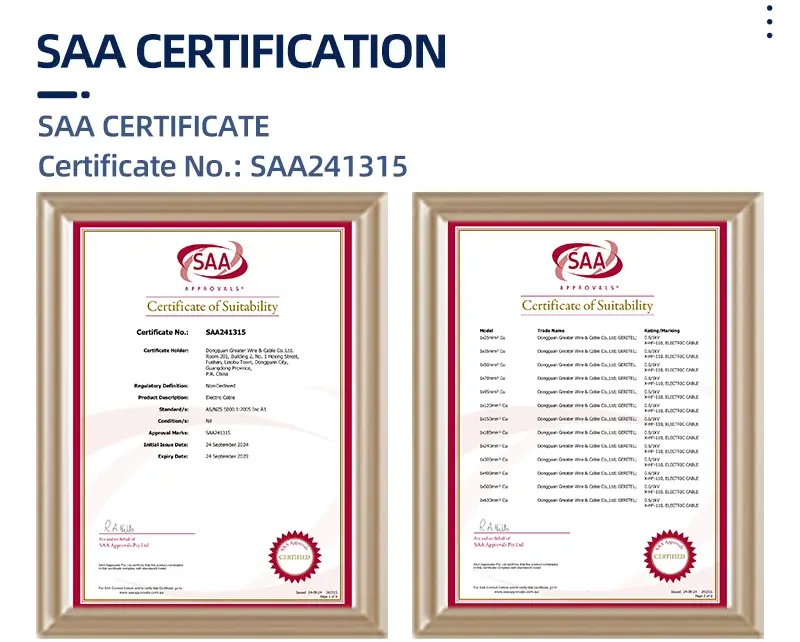
The client paid particular attention to certification. Our presented SAA Certification documentation confirmed full compliance with AS/NZS 5000.2 standards—mandatory requirements for Palauan electrical acceptance. Some competitors offered CE-certified cables at lower prices, but these could not pass local inspection, potentially facing rework risks.
3.4 Outdoor Spanning: Environmental Adaptability of Aerial Cable
For wetland and valley crossings, we rejected the client's initial elevated steel pipe bridge scheme—prohibitively expensive and visually intrusive. Aerial Cable employs self-supporting design with built-in tensile steel wire, enabling direct pole-to-pole installation without additional messenger wires.
Its sheath incorporates carbon black and other UV-resistant formulations, delivering over 25 years of service life under Palau's intense equatorial sun. Our 3C x 16mm² to 3C x 50mm² specifications featured XLPE insulation with 90°C temperature rating and 250°C short-circuit tolerance. Compared to underground installation, the overhead solution saved approximately 40% in installation costs while enabling more intuitive fault troubleshooting.
IV. Execution Excellence: Seamless Translation from Drawing to Reality
With solutions finalized, the true test lay in delivery. Palau's logistics conditions presented formidable challenges: no deep-water port, cargo transshipment through Guam or the Philippines, conventional sea freight cycles of 45-60 days, and the client's three-month total construction window requiring three-batch delivery to coordinate with site progress.
We activated a dedicated response mechanism. On the production front, our Dongguan factory reserved dedicated production lines with priority scheduling for Palau orders. Logistically, the first urgent batch employed a hybrid "air-to-sea" model—air freight to Guam followed by sea transfer—compressing initial delivery to 18 days. Documentation-wise, our export team prepared complete customs clearance packages including SAA certificates, certificates of origin, and packing lists, ensuring 24-hour port clearance upon arrival.
Throughout the project, we established weekly progress reporting, enabling clients to query production status and shipping positions at any time. The sole delay stemmed from typhoon season weather impacts, but we provided 72-hour advance warning and coordinated alternative shipping routes, ultimately containing the delay within three days without affecting overall construction schedules.
V. Project Outcomes: Transforming Pain Points into Highlights
In Q2 2024, the Palau Smart Agricultural Irrigation System officially commenced operation. Our cable solution withstood its first rainy season trial—amid sustained high humidity and multiple thunderstorms, the system maintained zero-fault operation.
Core value points from client feedback included:
System Stability: Signal transmission bit error rate below 0.001%, PLC control response latency under 50ms.
Installation Efficiency: Approximately 30% wiring labor time saved compared to conventional solutions, particularly through TPS cable's lay-and-fix characteristics.
Maintenance Costs: Armored and overhead solutions reduced underground fault points, projecting 40% five-year maintenance cost reduction.
Compliance Assurance: SAA certification enabled seamless project acceptance by the Palau Public Utilities Commission without secondary rectification.
VI. Value Proposition: Three Dimensions of Competitive Advantage
The Palau project's success validated our core capabilities distinguishing us from ordinary suppliers.
Certification Barrier. In Pacific Island markets, AS/NZS standards command far greater recognition than American or European standards. Our SAA certification is not marketing rhetoric but a passport for client project acceptance. Many competitors conceal certification discrepancies during quoting, exposing clients to rework or penalty risks later.
Experience Assets. Previous Pacific Island projects accumulated unique tacit knowledge: port crane capacity limitations, customs inspection priorities for SAA markings, local electricians' wiring habits. For instance, we pre-sized cable drums within 20-foot container load limits to avoid unloading impossibilities at Palau's port—details appearing in no technical manual.
Flexible Responsiveness. We deliver both standardized 3C x 2.5mm² TPS Cable for rapid turnaround and customized solutions for special scenarios. In the Palau project, certain swamp zones required rodent-resistant sheathing; we added nylon jacket layers to standard products, completing sample confirmation within one week without delaying overall progress.
VII. Call to Action: Initiate Your Project Dialogue
Today, the cable network of the Palau Smart Agricultural Irrigation System works quietly beneath tropical sunshine and sea breezes. From SWA Cable at pump stations to Instrumentation Cable in control rooms, from 3C x 2.5mm² TPS Cable in fields to Aerial Cable spanning valleys, every meter of line embodies our commitment to reliability.
Whether your project lies in Pacific Islands, Southeast Asia, or Africa, whether facing salt spray corrosion, extreme temperature differentials, or complex electromagnetic environments, we are prepared to translate Palau project experience into your competitive advantage.
Contact us today:
Dongguan GERITEL Electrical Co., Ltd.
Tel/WhatsApp/WeChat: +86 135 1078 4550 / +86 136 6257 9592
Email: manager01@greaterwire.com
Website: www.greaterwire.com
 Samoa Transport Decarbonisation & EV Infrastructure Project (2023–2025)



 Building 2, No. 40 Luxi 2nd Road, Liaobu Town, Dongguan City, Guangdong Province, China