


 Home
HomeSyria Damascus Rooftop Solar(2023)
 GERITEL
 Apr 18,2026

Damascus, Syria, 2023. Years of instability have left this ancient city struggling to rebuild—and more challenging than clearing rubble is the complete collapse of the electrical infrastructure.
Our client, a local commercial property developer, faced near-impossible operating conditions: the national grid limits power to 4-16 hours daily, voltage fluctuations are severe, and random blackouts are routine. Medical systems fail, IT equipment gets damaged, and commercial buildings cannot maintain basic operations. This is not about environmental goals; it is about survival.
Diesel generators were the only fallback, but soaring fuel prices, transportation difficulties, and and high maintenance costs make the per-unit electricity price unbearable. With limited capital, restricted bank financing, and and constrained foreign investment, the client needed a solution that could deploy quickly and scale in phases.
Rooftop solar became the lifeline in this power crisis.
Client Core Requirements: Building Reliable Power on Ruins
Through multiple technical consultations, we identified three critical constraints:
First, unpredictable supply. The client does not need "more power" but "predictable power." Any solution must ensure grid failure ≠ System shutdown.
Second, diesel cost escalation. Solar must substantively replace diesel generation, not merely serve as decoration.
Third, severely constrained budget. Unable to build an ideal station in one phase, the client must accept cost-driven design, prioritizing "functional" and "scalable."
Based on these constraints, the client specified clear technical needs: A 20kW-200kW distributed rooftop system using PV+Grid+Diesel three-source hybrid architecture (Hybrid Power System), requiring a cable solution that supports complex switching logic while controlling initial investment.
Solution Design: Tiered Cable Configuration Strategy
Faced with this dilemma of "reliability needed, costs controlled," we abandoned the "one-size-fits-all" premium approach in favor of a tiered cable strategy:
Core Tier: Uncompromising Standards on DC Side
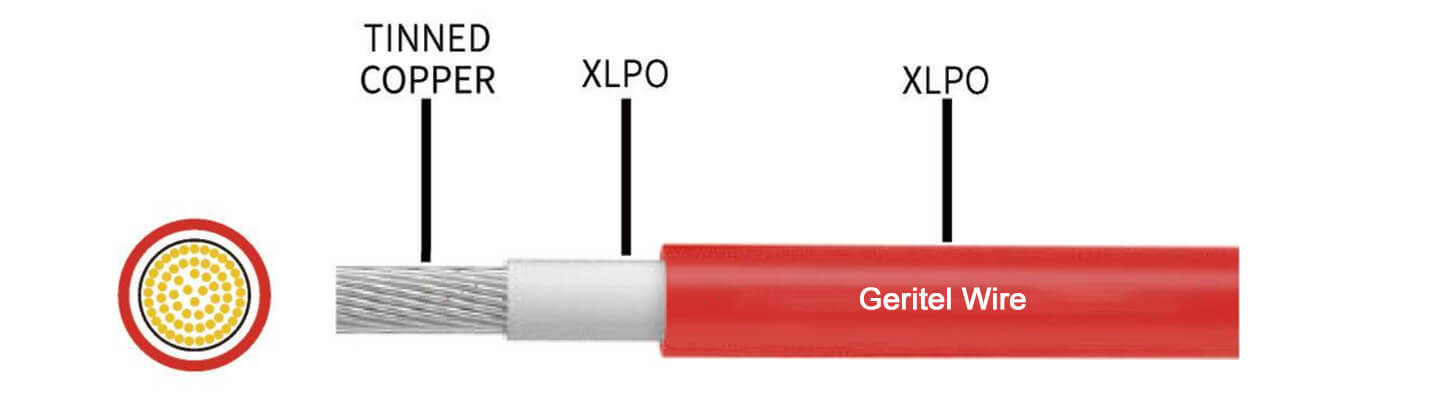
PV DC cables is the system's artery. We insist on H1Z2Z2-K 1×6mm² as the mainstream configuration (80% of project volume), with 1×4mm² for short string connections.
Why insist on H1Z2Z2-K rather than downgrade alternatives?
In Syria's environment—large temperature swings, intense UV radiation, occasional sandstorms—cable weathering resistance directly determines system lifespan. H1Z2Z2-K uses double-layer co-extruded sheath construction: inner insulation of irradiation cross-linked polyolefin, outer sheath of halogen-free flame-retardant material. Temperature range -40°C to +90°C, rated voltage DC 1.8kV, with excellent ozone, UV, and chemical corrosion resistance. By comparison, ordinary PVC cables show sheath chalking and cracking within two years—meaning frequent replacement, system downtime, and high maintenance costs locally that the client cannot afford.
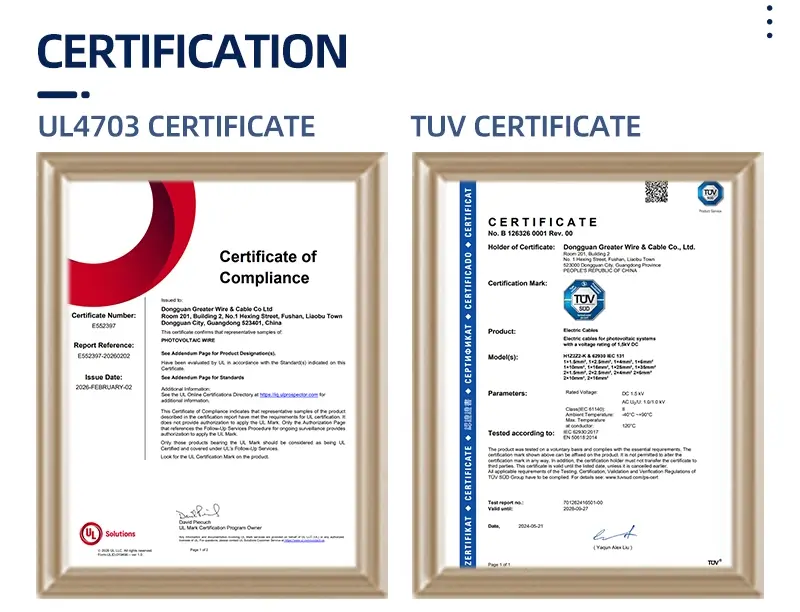
Our products carry TÜV certification (Certificate No. B 126326 0001 Rev.00) and UL 4703 certification (UL File No. E552397). This means conductor DC resistance, insulation withstand voltage, and finished cable flame retardancy have all undergone rigorous international authority testing. providing the only bridge for trust when the client cannot conduct on-site factory inspections.
Optimization Tier: Flexible Alternatives on AC Side
For AC side, we use YJV XLPE cable 3×35mm² and 3×50mm² as the backbone, but due to cost pressures, 20% of sections allow aluminum core cable to replace copper. This compromise is based on strict technical evaluation: although aluminum cables have lower conductivity and copper and require more sophisticated termination techniques, in large cross-section, short-distance transmission scenarios, the cost advantage can offset increased voltage drop losses. We optimized inverter positioning to shorten AC cable length, keeping voltage drop within 5%.
Efficiency Tier: Construction Speed Priority
Control lines originally followed standard practice H07V-K (1×1.5mm², 1×2.5mm²) single-core, conduit wiring.However, considering the scarcity of skilled electricians locally and tight schedules, we proactively recommended RVV 2×1.5mm² and RVV 3×1.5mm² multi-core flexible cable.
RVV is paired, bundled PVC sheathed flexible wire requiring no individual conduit installation—workers can wire directly, improving construction efficiency by over 40%. This "derating" suggestion actually saved the client 15% labor costs without compromising control signal transmission stability—in Syria, saving construction hours means saving risk.
Making the System "Blackout-Resistant" Rather Than "Grid-Dependent"
Addressing the client's core concern of "unpredictable power supply," our cable solution builds system resilience at three levels:
First, supporting seamless three-source switching. H1Z2Z2-K's low-resistance copper conductor (≤5.09Ω/km at 20°C for 6mm²) ensures minimal losses on PV side; YJV XLPE's 90°C long-term allowable operating temperature and 250°C short-circuit withstand temperature guarantee thermal stability during frequent switching between grid and diesel generator; RVV control lines' 300/500V rated voltage and 70°C temperature resistance ensure switching signals are not lost.
Second, reducing failure points. We optimized string wiring structure, reducing intermediate connection points. Fewer cable joints mean fewer contact resistance failure points—in maintenance-resource-scarce regions, "not breaking" matters more than "easy to repair."
Third, off-grid operational capability. DC side design ensures solar can operate independently, maintaining critical load power even during complete grid failure, with diesel generator as final backup rather than primary source. Grid fails, business continues—this is the value the client prioritizes most.
Modular vs. Localization Balance
Considering the client's cash flow constraints, we designed a phased delivery scheme:
Phase 1 (0-3 months): Basic solar system (50% capacity), core cable H1Z2Z2-K 6mm² approximately 15,000 meters, YJV 3×35mm² approximately 2,000 meters, RVV control lines approximately 3,000 meters, achieving daytime basic load coverage.
Phase 2 (3-6 months): Expansion to design capacity, supplementing H1Z2Z2-K 6mm² approximately 10,000 meters, adding energy storage interface reserved cables.
Phase 3 (6-12 months): Based on diesel replacement effectiveness evaluation, deciding whether to upgrade AC side aluminum cable to copper.
During delivery, we provided detailed cable installation guidelines and voltage drop calculations, helping local construction teams understand why H1Z2Z2-K's 1.8kV rated voltage is essential in Syria's intense UV environment, and how optimizing inverter positioning reduced H1Z2Z2-K usage from originally designed 18,000 meters to 15,000 meters, directly saving costs.
Why Partners Trust Us: More Than Suppliers, Risk-Sharers
In this race against time, cost, and environment, our value lies not just in providing cables but in understanding constraints, flexible adaptation, and risk-sharing:
• Certification Endorsement: TÜV B 126326 0001 Rev.00 and UL E552397 are not paper documents but trust anchors when clients cannot conduct on-site factory inspections.
• Engineering Experience: Similar post-conflict reconstruction market experience tells us when to hold standards (H1Z2Z2-K mandatory) and when to flexibly compromise (RVV replacing H07V-K)—this judgment comes from practice, not manuals.
• Delivery Assurance: In supply-chain-unstable regions, we pre-lock raw materials ensuring H1Z2Z2-K and YJV on-time delivery, avoiding construction site (work stoppages waiting for materials).
• Tiered Supply: Not forcing clients to overdraw budgets for "perfect solutions," but designing evolvable systems where every investment generates immediate value.
Client Voice: Technical Judgment as Business Certainty
Six months post-commissioning, key client feedback data:
• PV Replacement Rate: 75% of daytime load covered by solar, diesel generation time reduced from 12 hours daily to 3 hours, fuel costs down 60%.
• System Availability: Even during all-day grid failure, critical commercial loads remain operational, zero IT equipment damage.
• Expansion Flexibility: Reserved cable interfaces allow Phase 2 energy storage expansion without rewiring, protecting initial investment.
More importantly, the psychological shift: The client moved from "daily anxiety about when power will cut" to "planning how to further reduce diesel dependence." Solar is no longer an emergency patch but the starting point for energy autonomy.
The client project director summarized in subsequent communications: The most unexpected value was our "technical insurance"—during cable selection, we proactively identified risks in their original design of direct AC aluminum cable to copper terminal connections, recommending copper-aluminum transition terminals to avoid potential contact issues later. "You don't just sell wires; you sell the confidence to make decisions."
Next Step: Mapping Your Cable Blueprint
The Syrian project proves that in extreme environments, cable selection directly determines solar system survival. H1Z2Z2-K's weather resistance, YJV's stability, and RVV's construction convenience—every choice reflects deep understanding of local conditions, client constraints, and technical risks.
If you are planning similar high-challenge PV projects—whether post-conflict reconstruction, off-grid islands, or extremely unstable grid regions—our TÜV and UL dual-certified PV cable product line and modular cable configuration solutions can provide comprehensive support from standard adherence to flexible adaptation.
Don't let cables become your system's weak link. Let us help you design a cable solution that is both reliable and economical.
Contact Us
Dongguan GERITEL Electrical Co., Ltd.
Tel/WhatsApp/WeChat: +86 135 1078 4550 / +86 136 6257 9592
Email: manager01@greaterwire.com
 Bulacan 50MW Solar Farm(2020–2021)



 Building 2, No. 40 Luxi 2nd Road, Liaobu Town, Dongguan City, Guangdong Province, China