


 Home
HomeBulacan 50MW Solar Farm(2020–2021)
 GERITEL
 Apr 20,2026

In late 2020, our team partnered with an EPC contractor tasked with developing a 50MW solar farm in Bulacan, Philippines—a province known for its intense tropical climate, high humidity, and aggressive UV exposure. The client faced a familiar dilemma in large-scale Philippine solar projects: how to source cable systems that could withstand 20+ years of environmental stress while satisfying strict financing requirements from international banks.
The project combined both ground-mounted arrays and commercial rooftop installations, creating a complex wiring topology that demanded multiple cable tiers—from panel-level string wiring to medium-voltage grid interconnection. The EPC's procurement team had initially considered sourcing from local distributors, but encountered three critical pain points:
• Certification gaps: Many local suppliers lacked dual TÜV and UL4703 certification, which the project's European financing partner required for technical due diligence.
• Inconsistent sizing: Standard 4mm² string cables caused unacceptable voltage drop across longer rooftop runs, yet upgrading to 6mm² or 10mm² required validation against inverter input specifications.
• Thermal management concerns: With ambient temperatures regularly exceeding 35°C and rooftop surface temperatures reaching 60°C+, standard PVC-insulated cables presented long-term degradation risks.
The client needed a partner who could deliver a complete, pre-engineered cable package—not just individual spools of wire—with documented thermal performance, halogen-free safety credentials, and the flexibility to support both DC and AC side requirements under a single procurement order.
Product Overview: Engineered for the Philippine Climate
For this project, we supplied our H1Z2Z2-K photovoltaic cable series, a dual-certified solution designed specifically for high-humidity, high-UV environments like Southeast Asia.
Product Specifications:
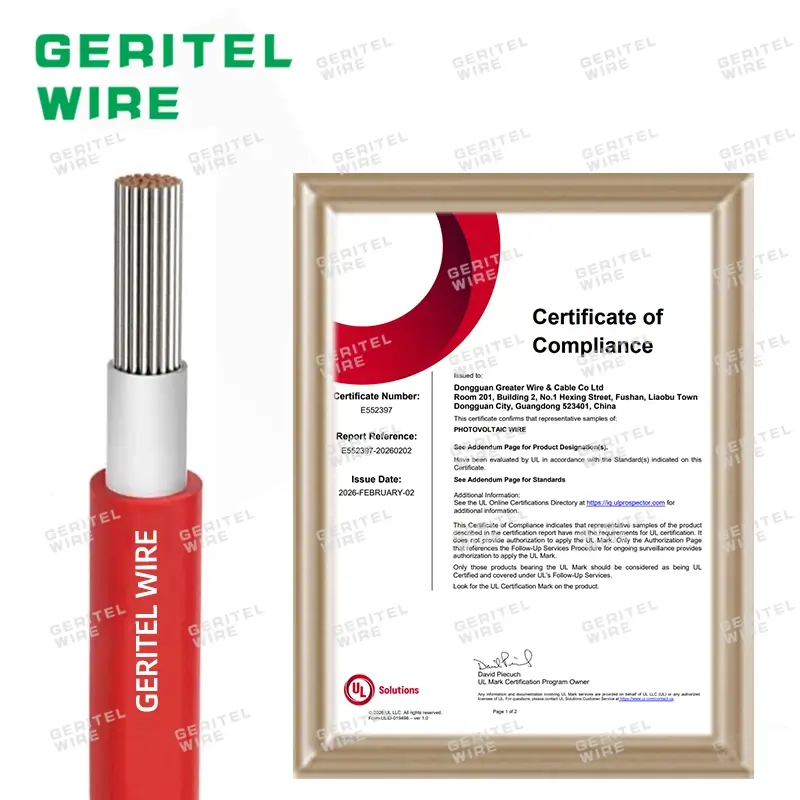
• Certifications: TÜV Rheinland (Certificate No. B 126326 0001 Rev.00) and UL4703 (UL File No. E552397)
• Voltage Rating: DC 1500V / AC 1000V
• Temperature Range: -40°C to +90°C (operating), with maximum conductor temperature of 120°C and short-circuit tolerance up to 200°C
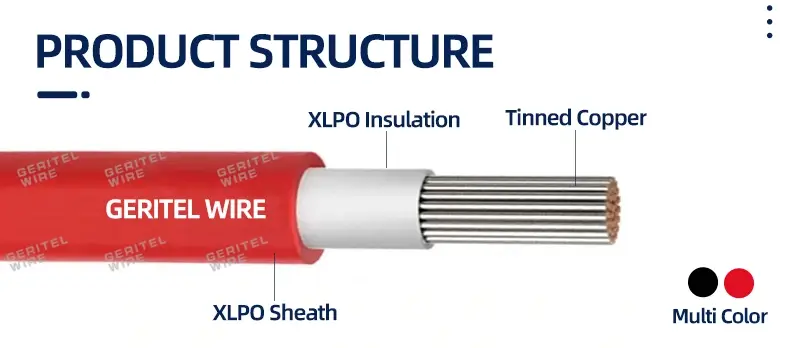
• Conductor: Class 5 flexible tinned copper (EN 60228 / IEC 60228), providing superior corrosion resistance in saline, high-humidity coastal environments
• Insulation & Sheath: Double-layer XLPO (cross-linked polyolefin), halogen-free, low smoke emission, flame-retardant per IEC 60332-1
• Available Sizes: 1.5mm² through 120mm², with project-specific supply of 4mm², 6mm², 10mm², 16mm², 25mm², 35mm², 185mm², and 240mm²
• Colors: Standard red (positive) and black (negative) for DC polarity identification; yellow/green available for grounding conductors
• Water Resistance: AD7 rated for direct burial and conduit applications
• Bend Radius: 5× cable diameter, facilitating installation in tight combiner box terminations
The tinned copper conductor was a decisive factor for this project. Unlike bare copper, which oxidizes rapidly in tropical humidity, the tin coating maintains low contact resistance at MC4 connectors and terminal blocks, directly reducing the risk of hot spots and connection failures that plague long-term operations in the Philippines.
The Solution: A Tiered Cable Architecture
Rather than forcing the EPC to adapt to off-the-shelf products, we reverse-engineered the cable schedule from their single-line diagrams, delivering a five-tier system matched to each voltage level and current load:
Tier 1: String Interconnection (DC Side)
• Cable: H1Z2Z2-K 4mm² and 6mm²
• Application: Panel string → Combiner box
• Rationale: 4mm² handled standard 20–22 module strings, while 6mm² was deployed on east-west oriented rows where longer string lengths increased current carrying demand. The XLPO double insulation eliminated the need for additional conduit in rooftop sections, reducing installation labor by approximately 15%.
Tier 2: Sub-Main DC Collection
• Cable: H1Z2Z2-K 10mm² and 16mm²
• Application: Combiner box → DC distribution cabinet → Inverter input
• Rationale: These larger cross-sections controlled voltage drop below 1.5% across the 80–120 meter runs typical in the ground-mounted portion. The 10mm² size proved particularly effective for the commercial rooftop segments, where space constraints limited cable tray capacity but current requirements demanded more than 6mm².
Tier 3: AC Output Collection
• Cable: YJV (XLPE insulated) 185mm² and 240mm²
• Application: Inverter → Step-up transformer → MV switchgear
• Configuration: 3-core + PE (protective earth)
• Rationale: The 240mm² became the absolute workhorse for 1MW inverter blocks, while 185mm² served as branch feeders for smaller 500kW units. XLPE insulation provided the thermal headroom needed for continuous operation at 80%+ load factors during peak irradiance hours.
Tier 4: Medium-Voltage Grid Connection
• Cable: MV Cable (UL1072 certified), single-core, 8.7/15kV and 12/20kV ratings
• Cross-Sections: 185mm² and 240mm²
• Application: Transformer secondary → Grid interconnection point
• Rationale: The single-core design simplified termination at the MV switchgear and reduced induced circulating currents in the three-phase arrangement. UL1072 certification ensured compliance with the project's international insurance requirements.
Tier 5: Grounding & Safety
• Cable: Bare copper and insulated yellow/green grounding conductors, 10mm² and 16mm²
• Application: Array frame grounding, equipment bonding, lightning protection down-conductors
• Rationale: Often overlooked in procurement planning, these conductors were pre-cut to site-specific lengths based on pile foundation layouts, eliminating field fabrication delays.
Why H1Z2Z2-K Won Over PV1-F and Local Alternatives
During technical evaluation, the EPC compared our H1Z2Z2-K against standard PV1-F cables and locally available PVC-insulated products. The decision matrix favored H1Z2Z2-K for four specific reasons:
1. Double-Layer Insulation vs. Single-Layer Construction
PV1-F typically carries a single insulation layer rated for 600V–1000V DC. Our H1Z2Z2-K employs
dual XLPO layers—a thicker inner insulation plus robust outer sheath—providing superior mechanical protection during pull-through conduit and enhanced resistance to abrasion from cable tray edges. This proved critical during the rainy season installation, when wet cables were more susceptible to nicks and cuts.
2. 1500V DC Rating Future-Proofing
While the project utilized 1000V inverters, the
1500V DC rating of H1Z2Z2-K allowed the EPC to standardize on one cable specification across the entire DC side. This simplified inventory management and provided headroom for future inverter upgrades—a significant consideration for an asset with a 25-year design life.
3. Halogen-Free Safety for Commercial Rooftops
The commercial rooftop portion of the project sat atop an active manufacturing facility. In fire scenarios, standard PVC cables release toxic halogen gases that endanger workers and corrode sensitive equipment. Our XLPO compound is
halogen-free with low smoke emission, meeting EN 50618 safety standards without the premium pricing of specialty fire-rated cables.
4. Tinned Copper in a High-Salinity Environment
Bulacan's proximity to Manila Bay means airborne salt particles accelerate corrosion. Tinned copper maintains stable contact resistance at terminations, whereas bare copper develops oxide films that increase joint resistance over time. For a project targeting 25-year operational life, this material choice directly impacts long-term O&M costs.
Execution: From Factory Floor to Philippine Soil
With the Philippine government's renewable energy incentives tied to construction completion deadlines, delivery speed was non-negotiable. Our execution plan addressed three time-sensitive challenges:
Pre-Engineered Cutting & Labeling
Rather than delivering bulk reels requiring field measurement, we supplied cables
pre-cut to design lengths with meter-marking and polarity identification. This eliminated the "measure-twice, cut-once" bottleneck that typically delays large-scale termination work.
Certification Package for Financial Close
The project's European lender required complete traceability documentation. We provided:
• TÜV test reports (Certificate B 126326 0001 Rev.00)
• UL4703 listing documentation (File E552397)
• Material compliance declarations (RoHS, REACH)
• Factory acceptance test (FAT) reports for MV cables
This documentation package enabled the EPC to satisfy bank engineers without delaying the financial close.
Phased Delivery to Site
Recognizing limited on-site storage capacity, we staged deliveries in four phases aligned with construction milestones: pile driving completion, module mounting, DC cabling, and AC/MV termination. This just-in-sequence approach reduced site clutter and theft risk while ensuring the right cables arrived when installation crews were ready.
Safety & Long-Term Reliability: The Hidden Value
Beyond the visible cable infrastructure, we integrated several low-fault-rate design principles that resonated with the client's operations team:
• Reduced Joint Count: By supplying exact lengths, we minimized the number of mid-run splices—historically the highest-failure-rate component in DC systems.
• Thermal Derating Calculations: We provided ampacity tables corrected for Philippine ambient conditions (35°C base, 40°C rooftop), ensuring the 6mm² and 10mm² selections had adequate margin against continuous load heating.
• UV & Ozone Resistance: The XLPO compound formulation includes stabilizers specifically tested for tropical UV exposure, addressing the polymer degradation that causes cracking and moisture ingress in standard cables after 8–10 years.
Results: A Project That Stayed on Schedule and Under Budget
The Bulacan 50MW project achieved energization in Q3 2021, meeting the feed-in tariff deadline that secured the client's revenue model. Post-commissioning thermographic scans showed uniform temperature profiles across all cable terminations—no hot spots, no loose connections, no surprises.
The EPC reported three concrete benefits from our integrated cable supply:
1. 15% reduction in DC-side installation labor due to pre-cut, polarity-marked cables
2. Zero cable-related commissioning delays, a first for their Philippine portfolio
3. Single-source accountability for DC, AC, and MV cable systems, simplifying warranty claims and technical support
For the operations team, the dual-certified product stack means future expansion or repowering can leverage the same cable specifications, reducing spare parts inventory complexity.
The Partnership Value: More Than a Supplier
This project reinforced a lesson we've applied across Southeast Asian markets: commercial solar clients don't buy cables—they buy certainty. Certainty that components won't fail in year seven. Certainty that documentation will satisfy international lenders. Certainty that delivery schedules won't derail policy-dependent revenue streams.
Our H1Z2Z2-K and YJV cable systems, backed by TÜV and UL dual certification, provide that certainty. The 25-year life design isn't a marketing claim—it's engineered into the XLPO molecular structure, the tinned copper metallurgy, and the double-insulation geometry that protects conductors from the day they leave our factory until the day the panels are retired.
Contact Us
Whether you're developing a ground-mounted utility plant, a commercial rooftop installation, or a hybrid configuration like Bulacan, we deliver cable systems engineered for your specific climate, electrical topology, and certification requirements.
Dongguan GERITEL Electrical Co., Ltd.
• Tel/WhatsApp/WeChat: +86 135 1078 4550 / +86 136 6257 9592
• Email: manager01@greaterwire.com
 Armenia Solar Project (AboitizPower)



 Building 2, No. 40 Luxi 2nd Road, Liaobu Town, Dongguan City, Guangdong Province, China