


 Home
HomeSuriname Rosebel Gold Mining Project
 GERITEL
 Apr 07,2026

Chapter One: The Letter from the Rainy Season
March 2022. The plum rains had just begun in Dongguan.
An email sat in my inbox. The sender's name read "Zijin Rosebel Project Procurement." The subject line was sparse, almost urgent: "Urgent: UL certified wire supply for mine modernization."
Attached was a 47-page technical specification document. I noticed the coffee stains along the margins—someone had clearly reviewed this file repeatedly through the early morning hours. On page three, handwritten annotations caught my attention: "Previous supplier delayed 11 weeks. Project at risk. Need reliable partner."
I later learned these notes came from Marcos (name changed), the project's electrical director. His team had previously worked with a European supplier who promised delivery in eight weeks. That promise stretched into nineteen. When the container finally arrived at the Port of Paramaribo carrying THHN/THWN-2 building wire, Suriname's rainy season had already unleashed its full fury. Roads were impassable. The installation crew had waited idle in camp for six weeks.
"We lost the golden construction window before the rains," Marcos told me during our first video call. "Standing costs were forty thousand dollars per day. Worse, the cables arrived without complete UL traceability documentation. Customs held the shipment for three additional weeks."
That call lasted seventy-three minutes. He detailed Rosebel Mine's predicament: following Zijin's acquisition in early 2023, the electrical system required immediate upgrades to meet new safety audit standards. The Pikin Saramacca open-pit expansion was imminent, yet the existing distribution network couldn't even support current capacity reliably. Most pressing of all, a 25-megawatt solar power station was in design phase, requiring underground cables that would perform reliably for two decades in tropical wetland conditions.
"Tell me honestly," he asked before we hung up. "Can you really deliver everything to our warehouse within fourteen weeks? Including customs clearance?"
Thinking of the neat rows of THHN/THWN-2 building wire PVC insulation reels in our warehouse. "Yes," I said. "But we need to coordinate with precision from week one."
Chapter Two: The Electrical Code of the Rainforest
Two weeks later, I landed in Paramaribo.
This wasn't my first time in South America, but the site survey at Rosebel Mine still impressed me deeply. The 120-kilometer journey from the capital began on paved asphalt, which gave way abruptly to red dirt roads at kilometer sixty, rutted and pounded by heavy mining trucks. The rainy season hadn't ended. Our four-wheel-drive pickup skidded repeatedly through water-filled craters.
The mine itself was a self-sufficient small city. The thunder of the 24-hour crushing plant, the distinctive chemical scent of the cyanide leaching facility, the ever-present red dust—this was the landscape of gold extraction. The electrical supervisor walked me past a cable tray being dismantled, pointing to a section where the insulation had crazed and cracked.
"Installed five years ago," he said, peeling back the PVC sheath to reveal oxidized copper cores. "Standard THHN, supposedly moisture-resistant. But Suriname's moisture is not ordinary moisture."
He explained the unique challenges: annual rainfall of 2,200 millimeters, relative humidity consistently between 85% and 95%, ultraviolet intensity amplified by equatorial proximity, and sulfide dust from mining operations that accelerated aging in standard insulation materials. More insidious was the day-night temperature differential—35°C afternoons dropping to 22°C at night, creating a perpetual condensation cycle that left conduits permanently filled with water.
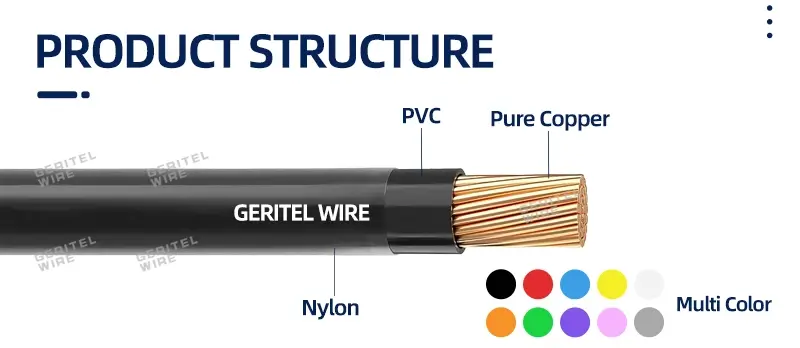
"We need THHN/THWN-2 building wire PVC insulation," he wrote the string of characters in my notebook, "not standard THHN. That 'W' stands for waterproof. The nylon jacket is critical. But the previous supplier shipped the wrong product—standard THHN—and we caught it during acceptance inspection."
This survey helped me understand why their specification document was so complex. Different operational zones demanded entirely different cable types:
In the mobile equipment areas of the open pit, SOOW cable had to survive daily crushing under heavy tires and repeated coiling and uncoiling. In the damp underground tunnels, USE-2 cross-linked polyethylene insulation needed to provide lifetime waterproofing. In the chemical processing plant, XHHW-2 solvent resistance was a matter of personnel safety. And for the main feeders connecting the new solar station, TC-ER tray cable efficiency would determine whether the project could be completed before the dry season ended.
"One more thing," Marcos mentioned over dinner, "our warehouse space is limited. Can you ship in batches according to installation sequence, rather than all at once?"
This meant completely restructuring our production schedule. But looking at his exhausted eyes, I nodded agreement.
Chapter Three: The Countdown at the Factory
Back in Dongguan, our production meetings stretched across two full days.
The fourteen-week delivery window was divided into seven batches, corresponding to seven construction phases at the mine. The first batch had to ship within eighteen days of contract signing—this was the limit Marcos could accept, as he needed materials on site before the new installation crew arrived.
THHN/THWN-2 building wire PVC insulation accounted for 40% of the total order. We had 12 AWG through 4/0 AWG in stock, but the 500 MCM large sizes required custom production. The technical team confirmed one critical detail: the nylon jacket thickness had to reach 0.25 millimeters to pass Rosebel's special acceptance standards, stricter than UL minimum requirements.
"Tell the client we can do it," the production director said at the meeting, "but we need to lock copper prices. LME copper has fluctuated 8% in the past two weeks."
I drafted price-locking terms that same night, while preparing a comprehensive certification package: UL 83 certificates, factory ISO 9001 audit reports, third-party laboratory insulation aging test data, and reference cases from our previous supplies to Chilean copper mines and Ghanaian gold operations. Marcos's team completed supplier qualification review within forty-eight hours of receiving the documents—far faster than their usual two-week process, the urgency palpable.
First batch production launched on day nine after contract signing. I insisted on two non-standard procedures: waterproof synthetic paper for each reel's barcode label, and tropical-grade anti-mold wooden pallets for outer packaging. These details weren't in the contract requirements, but I knew the warehouse humidity in the rainforest would destroy ordinary paper labels.
On day seventeen, the first 12,000 meters of THHN/THWN-2 building wire and 8,000 meters of MTW machine tool wire were containerized and dispatched. I chose the shipping route via Panama Canal to Paramaribo, estimated at twenty-two days total transit. Simultaneously, I sent electronic copies of the bill of lading, packing list, certificate of origin, and UL compliance declaration to Marcos's designated customs broker.
"The cargo is still at sea, but customs documentation is pre-cleared," I wrote in the email. "Forty-eight hours from port arrival to collection."
His reply contained only one sentence: "Previous supplier never did this."
Chapter Four: The Trial at the Port
Day thirty-nine. An urgent message from Marcos.
"Port delay. Customs has raised questions about the aluminum armor material on MC cable, requesting additional material certification."
This was typical Suriname customs procedure—extra scrutiny on metal-content-sensitive imports. I immediately contacted our laboratory, which issued an aluminum strip chemical composition analysis report and UL 1569 standard compliance statement within six hours. These were express-shipped via DHL to Paramaribo. Simultaneously, I had our local agent meet directly with customs technical department officials to explain the bonding design of the grounding conductor in MC cable.
The delay was contained to seventy-two hours. When Marcos's trucks finally delivered the first batch to the mine site, the installation crew was waiting on location. The photos he sent showed workers unloading wooden pallets marked with "GERITEL," the green rainforest skyline in the background.
"Labels perfect," he said in a WhatsApp voice message. "Scanner read all barcodes in one pass. How did you know our inventory system model?"
I didn't tell him I had specifically asked about it after our first call.
Chapter Five: The Dry Season Offensive
The following ten weeks moved with drumbeat intensity.
The second batch of XHHW-2 and USE-2 underwent the most rigorous inspection before shipment. Since these cables would be used for underground direct-burial sections of the solar power station, Marcos required capacitance test data for every individual reel. Our quality inspectors worked overtime for three consecutive days, completing individual testing of eighty-seven reels.
The fourth batch encountered a genuine crisis. The scheduled vessel was canceled due to Panama Canal drought restrictions, leaving cargo stranded at Shenzhen Port. I calculated the timeline: waiting for the next available vessel would delay delivery by eleven days, missing the closure of the dry season construction window.
"Switch to air freight," I decided during a midnight conference call. "The remaining SOOW cable and TC-ER go via Guangzhou-Amsterdam-Paramaribo route. Seventy-two hours to arrival."
This meant absorbing additional freight costs. But when I informed Marcos of this decision, his silence stretched for a long moment. "You know this saves our entire solar station grid-connection schedule?" he finally said.
That air freight arrived at the mine site sixty-eight hours after departure. I later learned the installation crew completed the main feeder connections to the solar inverters that same day, four days ahead of Zijin Group's internal assessment deadline.
Chapter Six: Acceptance Day
August 2023. My second visit to Rosebel.
The dry season sun had baked the red dirt roads to cement-like hardness. The mine had transformed: new solar panel arrays glittered on the eastern hillside, the crushing plant chimney no longer belched black diesel exhaust, and the cable trays displayed neatly arranged THHN/THWN-2 building wire PVC insulation lines like silver rivers.
Marcos walked me through the newest section of underground tunnel. Overhead, MC cable followed the rock walls, the aluminum armor reflecting cold light under our headlamps. "Zero failures," he shouted over the ventilation fan noise. "Since your first batch arrived, not a single cable-related electrical system shutdown."
In the surface control room, he displayed an internal report: compared to the old system, the new cable infrastructure had reduced maintenance labor hours by 60%, while the solar station's early grid connection had saved approximately $180,000 in diesel generation costs.
"One more thing," he mentioned while driving me back to the airport, "we're qualifying you for Phase Two expansion supply. But this time the specification will be more complex—we're introducing intelligent monitoring systems."
I watched the rainforest scenery flash past the window. Fourteen weeks ago, this had been a landscape of uncertainty and challenge. Now it had become the most solid reference case in our South American mining portfolio.
Epilogue: The Continuity of Current
December 2024. A copied email appeared in my inbox. The sender was Zijin Rosebel's sustainability department, the subject line reading: "Solar Plant Performance Report - 1 Year Anniversary."
Charts in the attachment showed the 25-megawatt solar station had achieved 97.3% availability in its first year of operation, far exceeding the industry average of 91%. The report specifically noted: "Electrical infrastructure supplied by certified vendors with proven tropical climate performance."
I didn't reply to that email. But I added a new entry to our project archive: Suriname, Rosebel Gold Mine, 2022-2023, 340,000 meters, zero defects, on time.
In our Dongguan warehouse, the next batch of THHN/THWN-2 building wire PVC insulation was being reeled, destined for a copper mining project in Peru. The label printer chattered rhythmically, the synthetic paper barcodes crisp and clear.
Some connections, once established, continue to flow.
About Us
Dongguan GERITEL Electrical Co., Ltd. specializes in UL-certified wire and cable solutions for demanding industrial environments. From tropical rainforest mining operations to Arctic energy developments, our products have proven their reliability in extreme conditions across six continents.
Contact us to begin your project story:
Tel/WhatsApp/WeChat: +86 135 1078 4550 / +86 136 6257 9592
Email: manager01@greaterwire.com
 Uruguay Dairy Farm Energy Efficiency Upgrade



 Building 2, No. 40 Luxi 2nd Road, Liaobu Town, Dongguan City, Guangdong Province, China