


 Home
HomeStubbo Solar Farm 500MW Utility-Scale Solar Power Project Australia
 GERITEL
 Apr 20,2026

Project Context
In late 2022, approximately ten kilometres north of Gulgong in New South Wales' Mid-Western Regional Council, ACEN Australia and PCL Construction broke ground on the Stubbo Solar Farm—a 500MW photovoltaic matrix with provision for 200MWh of battery energy storage, destined to supply clean electricity to 185,000 homes across the region. This was no ordinary construction site: summer surface temperatures regularly exceeded 60°C, UV radiation indexes remained at extreme levels year-round, and winter frosts were severe enough to embrittle standard metallic components, meaning every metre of cable we supplied would need to withstand thermal cycling stress, ozone attack, and salt mist corrosion across a thirty-year design life, all within a construction window of just three years from groundbreaking to grid connection in October 2025—a timeline so aggressive for a project of this magnitude that every supplier's delivery rhythm had to synchronise precisely with the construction metronome or risk cascading delays through the entire value chain.
The Client's Dilemma
When the EPC contractor approached us in early 2023, they had already exhausted their options across European, Indian, and domestic Chinese suppliers, yet remained trapped in an impossible triangle of standards complexity, cost pressure, and schedule intensity. AS/NZS 5033:2021 installation requirements layered atop IEC 62930 international standards, AS/NZS 5139 battery safety mandates, and AS/NZS 3000 earthing regulations created a compliance filter that many suppliers failed to navigate—European manufacturers often stumbled at the SAA local certification hurdle, while Indian vendors could not assemble complete TÜV+SAA documentation packages, and the project's financing structure drew a hard cost ceiling that made the thirty to fifty percent premium of established Western brands economically untenable. The construction schedule, rolling forward in weekly increments, meant that any cable delivery delay would trigger sequential slippage across panel installation, inverter commissioning, and grid connection testing, and with Gulgong's remote inland location making bulk storage prohibitively expensive and logistically impractical, the client needed not merely products but a supply partner capable of precise, phased, just-in-time delivery. Their engineering director distilled the requirement succinctly: they sought neither the cheapest nor the fastest option in isolation, but a supplier whose certification portfolio was complete, whose quality credentials were verifiable, and whose delivery cadence could match their construction tempo with technical responsiveness throughout the project lifecycle—a brief that crystallised for us the understanding that our competitive advantage lay not in any single product parameter but in weaving products, certifications, and services into a seamless fabric of reliability.
Product Selection: Why H1Z2Z2-K Became the Backbone
When we presented the technical dossier for our H1Z2Z2-K Solar Cable, bearing TÜV Certificate No. B 126326 0001 Rev.00, the client immediately recognised the depth of validation it represented—German Rheinland TÜV's most rigorous testing protocol for photovoltaic application cables, covering a rated voltage of 1.8kV DC to accommodate future high-power module trends, an operating temperature bandwidth from -40°C to +90°C in fixed installation with +120°C short-circuit tolerance, and a dual-layer insulation architecture comprising tinned copper conductors, electron-beam cross-linked halogen-free inner insulation, and a UV-resistant, ozone-resistant outer sheath that constituted a material-science defence system purpose-built for inland Australian climates, finished in a black sheath with red polarity marking that aligned with Australian electricians' visual identification habits to enhance both installation speed and accuracy.
The client's decision to specify H1Z2Z2-K as the primary DC cabling rather than PV1-F or alternative options hinged on the molecular stability differential of electron-beam cross-linking: where conventional chemically cross-linked XLPE suffers insulation regression under sustained high-UV exposure—cross-link bonds gradually breaking down and degrading dielectric withstand capability—the carbon-carbon bonds formed through electron-beam processing maintain their integrity through the more than 250 severe diurnal thermal cycles experienced annually in the Central-West Orana region, delivering measurably slower insulation ageing rates that provided the project operator with substantive technical confidence during twenty-five to thirty-year warranty negotiations. We supplied approximately 2.5 kilometres of 6mm² string cabling and 55 kilometres of 10mm² DC feeder runs, every metre subjected to 100% power-frequency withstand testing and insulation resistance verification to eliminate any micro-leakage pathways across the 930,000-panel array.
System-Wide Solutions
The 200MWh BESS was never merely battery containers but the grid's metronome, smoothing output through solar irradiance fluctuations and dispatching reserves during price peaks, and the connections between battery clusters and PCS power conversion systems, and between PCS units and switchgear assemblies, demanded conductors capable of withstanding daily charge-discharge flexing in confined container spaces while carrying hundreds of amperes of DC current—this was the domain of our Heavy Duty Flexible Copper Cable 35mm², whose Class 5 ultra-fine copper stranding with single-wire diameters controlled within 0.21mm endowed the cable with textile-like flexibility, while the special elastomer insulation, certified to AS/NZS 5000.1 and rated for 105°C continuous operation, provided critical safety margin for thermal runaway scenarios where standard power cables would suffer conductor fatigue from repeated bending and conventional rubber compounds would lose mechanical strength above 85°C.
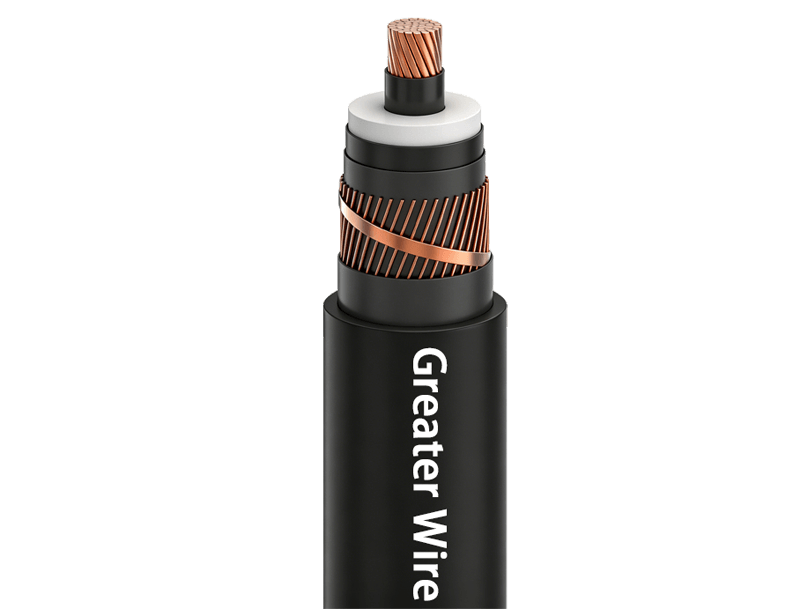
For AC power transmission from inverter stations to the 500kV step-up substation, we deployed Medium Voltage Cable in 11kV and 33kV ratings with 120mm² and 185mm² cross-sections, while underground traverses through agricultural land and road crossings received SWA Cable—steel wire armoured configurations delivering crush resistance and rodent protection across decades of buried service. Earthing Cable 25mm² and 50mm² wove through every tracker row, every inverter, and every substation earth grid node, our tin-plated copper conductors with soil-corrosion-resistant sheaths maintaining earth resistance below 1Ω even through seasonal soil resistivity variations—well beneath the 5Ω regulatory ceiling—in a country where lightning activity and step-potential hazards make earthing integrity non-negotiable.
The SCADA network, meteorological stations, inverter communication links, and grid connection control circuits formed the farm's nervous system, carried by Orange Circular Cable 2.5mm² and 5mm² in 3-core and 4-core variants—orange being the unspoken industry code in Australian industrial cabling that allows electricians to distinguish control circuits from high-voltage power feeders at a glance, eliminating misconnection risk and accelerating fault tracing, while SDI Cable on SCADA backbones and weather station links employed shielding coverage exceeding 85% to preserve signal integrity against the electromagnetic noise generated by inverter switching frequencies.
Certification Architecture
The client's deepest anxiety—cables arriving on site only to fail compliance audit at grid connection—was addressed through our integrated multi-certification supply capability: H1Z2Z2-K carried TÜV B 126326 0001 Rev.00 satisfying IEC 62930 and EN 50618 international baselines, while medium voltage, control, earthing, and BESS flexible cables all bore SAA approval and complied with AS/NZS 5000.1, AS/NZS 5033, AS/NZS 3000, and AS/NZS 5139. This meant no fragmented supplier base, no pieced-together certification files, no awkward explanations to network operators about missing local approvals—a single supplier, a complete compliance archive, and a single technical clarification cycle, an integration value in Australia's schedule-pressured, audit-intensive market that outweighed any marginal unit price differential.
Delivery Choreography
When the first batch of 6mm² H1Z2Z2-K departed Dongguan in March 2023, we rejected the conventional path of bulk sea freight to Sydney followed by road haulage to Gulgong, which would have created an expensive, weather-exposed material mountain on a remote site with limited laydown area, opting instead for phased beat-synchronised delivery aligned to construction sequencing—string cables during Q2 2023 to match pile and tracker installation, 10mm² DC feeders and medium voltage cables through Q3-Q4 to synchronise with inverter station construction, BESS flexible and control cables in early-to-mid 2024 to match battery container arrival, and earthing system top-up with contingency stock in Q3 2024 to absorb design micro-adjustments and field variations.
Weekly tripartite video conferences—our project manager, the client's logistics coordinator, and the Australian freight forwarder—formed the neural centre for dynamic schedule adjustment, and when a grid connection scheme revision in early 2024 required advancing one 10mm² batch by two weeks, our production system resequenced within seventy-two hours, deploying air freight for critical sections and sea freight for follow-on quantities, ultimately arriving three days ahead of the client's revised target—an responsiveness that dissolved a long-standing anxiety source and prompted their project manager to describe us not as a vendor but as a supply chain co-pilot.
Field Evidence
On site, three details resonated with the Australian electrical crew: the colour-coding discipline that compressed misconnection rates to zero when control circuits universally appeared in orange and DC polarity followed black-red convention, saving thousands of man-hours during commissioning; the custom-cut reel lengths that eliminated approximately one hundred and eighty intermediate joints across the 55-kilometre total by supplying cables pre-cut to actual loop lengths rather than standard 500-metre drums, releasing forty-five workdays for critical-path activities; and the thermal validation during January 2024's extreme heatwave when surface temperatures hit 67°C, where our H1Z2Z2-K heat deformation data—less than 15% sheath elongation change after 1,000 hours at 90°C, well below IEC's 30% threshold—assuaged immediate concerns and validated the electron-beam cross-linking investment for long-term operation.
Post-Grid Performance
Since achieving commercial operation in October 2025, the cables have entered their second life—not the logistical intensity of construction but three decades of silent service. H1Z2Z2-K insulation has endured approximately 250 thermal cycles in its first year with partial discharge values maintained above 90% of factory baseline; BESS flexible cables sustain daily mechanical flexing with conductor break values above 85% of original specification; and earthing networks hold firm below 1Ω through seasonal soil variation. These figures never make headlines, but they fill the operations log with a single word: zero-fault—the only brand endorsement that ultimately matters.
Market Trajectory
Stubbo is no outlier. The Central-West Orana REZ plans 8GW of renewable capacity, with Queensland, South Australia, and Western Australia queueing gigawatt-scale solar-plus-storage projects. Australia's market uniquely combines maturity with stringency—PPA-driven financing with clear closure, BESS evolving from optional to grid-connection-mandatory, AS/NZS complexity creating supplier barriers, and coal retirement acceleration making 2024-2026 an infrastructure golden window. For cable suppliers, photovoltaic DC cables are the entry ticket, BESS specialised flexibles are the differentiation chip, and full-spectrum AS/NZS compliance is the moat.
Our Proposition
Stubbo validated three principles: certification is capability not paperwork, with our TÜV+SAA matrix eliminating audit risk; product is systemic solution not parameter list, engineered for lifecycle performance not merely delivery acceptance; and delivery is choreographed collaboration not logistics transaction, where responsiveness outweighs unit price when schedules compress to weekly granularity.
Engage With Us
Whether tendering for the next gigawatt-scale project in the NSW REZ, planning distributed solar-plus-storage portfolios in Queensland, or replacing ageing cable inventories, our engineering team can engage from early design phases to optimise selection, navigate certification pathways, and coordinate delivery scheduling—because in Australia's standards-intensive, schedule-compressed, competitively heated market, supply certainty is itself a critical project success factor.
Dongguan GERITEL Electrical Co., Ltd.
Tel/WhatsApp/WeChat: +86 135 1078 4550 / +86 136 6257 9592
Email: manager01@greaterwire.com
From blueprint to grid connection, we deliver not merely copper conductors and insulation sheaths but the certainty that your project will operate on time, in compliance, and across its design lifetime—and when 930,000 photovoltaic panels silently harvest sunlight across Australia's inland plains, every ampere of current flowing smoothly through our cables is wordless validation of that commitment.
 New Zealand North Island Photovoltaic Power Station



 Building 2, No. 40 Luxi 2nd Road, Liaobu Town, Dongguan City, Guangdong Province, China