


 Home
HomePNG Napa Napa Refinery Solar–Diesel Hybrid Power System Cable Supply
 GERITEL
 Apr 20,2026

The dawn in Port Moresby arrives abruptly. By five o'clock, equatorial sunlight pours like molten gold across the steel rooftops of Napa Napa Refinery, yet the diesel generator that has kept the facility alive for twelve years is still growling its tired song.
"Every kilowatt-hour we generate, we're burning money." That was the last thing Mark, the project chief engineer, said during our first video call. When our team saw the fuel invoices PNG had sent across the screen in early 2024, everyone fell silent.
But this was never just about money.
A Refinery's Power Anxiety
PNG's national grid behaves as unpredictably as the tropical weather. For ordinary residents, a blackout means fans stopping. For Napa Napa, it means emergency shutdown of refining processes, pipeline pressure imbalances, and potential safety incidents. "We cannot afford to lose power, yet we cannot rely solely on diesel," Mark explained—a dilemma shared by countless off-grid industrial facilities worldwide.
The environment adds its own cruelty. Salt-laden coastal winds chew through equipment daily. Equatorial UV radiation can age standard plastics into brittle fragments within two years. During monsoon season, humidity condenses inside electrical cabinets like morning dew. The refinery had tried "cost-effective" cable solutions before. Three years later, oxidized joints and cracked insulation sent maintenance crews scrambling through mud, tracing faults in the tropical downpour.
"The system must be done right the first time. No rework." This wasn't demanding perfection—it was acknowledging PNG's reality. Skilled electrical technicians are scarce locally. Spare parts take weeks to arrive. "Small problems become big failures" isn't probability theory here; it's arithmetic.
A Cable's Tropical Survival Code
We received a long requirements list, but the core need was singular: build a power distribution network that wouldn't demand human attention for two decades in PNG's environment.
Our engineers didn't rush to quote. Instead, we asked one question first: "What damaged your last photovoltaic cables?"
The answer: oxidation and UV degradation. That single response determined our first critical decision—H1Z2Z2-K.
Within the photovoltaic array, this cable carries the entire DC load—from modules to combiner boxes, then onward to inverters. It appears as slightly thicker black cabling, but conceals survival mechanisms engineered for PNG's hostility. The tin-plated copper conductors resist salt-fog corrosion that destroys bare copper. In coastal industrial atmospheres, unprotected copper develops green corrosion layers within three years, resistance creeps upward, joints begin heating, and one afternoon the circuit silently fails. The tin coating acts as close-fitting armor, preserving copper integrity through humid salt spray.
Its jacket is dual-layer XLPO—not simple plastic, but cross-linked polyolefin where molecular chains form chemical bonds. Under equatorial sun, standard PVC hardens and cracks like dried rubber bands; XLPO maintains flexibility across -40°C to +90°C, and UV cannot tear its surface. Project feedback later confirmed that while a previous brand's cable sheaths showed chalking degradation under identical exposure, H1Z2Z2-K retained its factory finish.
In this system's DC wiring, 6mm² handles roughly 80% of trunk routes—the thirty-to-fifty-meter runs from combiners to inverters, where this cross-section balances current capacity against installation flexibility. 4mm² comprises about 15% for short inter-module strings, slimmer profile easing passage through narrow frame gaps. 10mm² accounts for 5% serving high-current aggregation branches, preventing thermal accumulation. The unified 1500V DC rating carries hidden future-proofing: when panel efficiencies improve and string voltages rise, this cabling requires no replacement.
Mark later noted in correspondence that the TÜV certification documents (Certificate No. B 126326 0001 Rev. 00) became critical boardroom evidence—international certification in PNG isn't merely quality proof; it's financing and insurance prerequisite.
From Inverter to Distribution: A Journey Through the Jungle
Once DC becomes AC inside the inverter, the real challenge begins. Current must leave the relatively "clean" inverter room, traverse outdoor refinery zones, underground trenches, and reach various distribution nodes.
What awaits cable along this journey? Occasional vehicle compaction, accidental tool impacts during maintenance, prolonged immersion in monsoon flooding, and chemical corrosion from refinery atmospheric emissions.
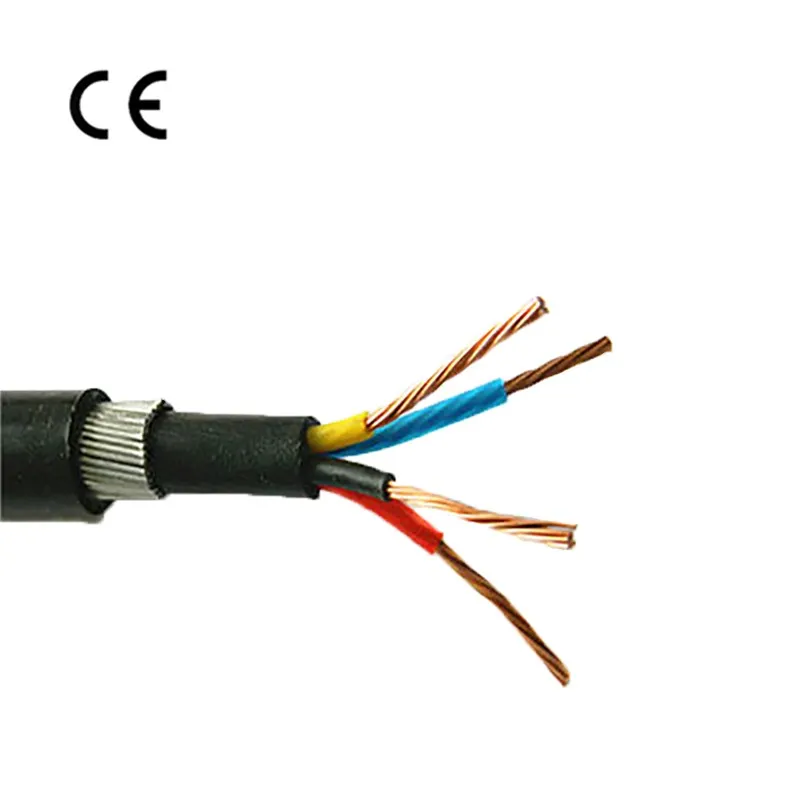
Standard XLPE cables manage indoor environments adequately. Here, we specified SWA (Steel Wire Armored) Cable. Its sandwich structure layers XLPE insulation between galvanized steel wire armor and heavy-duty PVC outer sheath. That steel ring isn't decorative—when cables run underground or cross vehicle pathways, it withstands substantial external pressure without damaging internal copper or insulation. During construction, one SWA section took an accidental scraper bucket strike during backfilling. The outer PVC scarred, but electrical testing confirmed internal integrity. With non-armored cable, the story would have different ending.
3C×50mm² and 70mm² specifications cover large-current transmission from inverter mains to zone distribution boards. Sizing wasn't "bigger is safer" but precise calculation of inverter full-load output current, line-length voltage drop, and PNG high-temperature derating factors.
Electromagnetic Silence in the Pump House
Hybrid system essence lies in seamless switching—solar dominance when skies clear, diesel backup when clouds sweep through or night falls. This means one grid hosting both photovoltaic inverter high-frequency harmonics and diesel generator mechanical fluctuations.
Refinery pump systems run on variable frequency drives, and VFDs are exquisitely sensitive to electromagnetic interference. We've witnessed cases where standard power cables connecting frequency converters caused electromagnetic coupling, inducing "ghost fluctuations" in adjacent instrument loops that took operators three days to trace.
At Napa Napa, all pump house and VFD control cabinet connections used VSD Cable. Its distinction lies in an internal EMC shielding braid—a Faraday cage imprisoning the cable's own electromagnetic field while blocking external interference. It establishes an "electromagnetically silent channel" between inverter output and motor input. Specifications range from 3C×16mm² to 35mm², matching different pump power classes—smaller pumps suit 16mm² flexibility, while high-flow main pumps need 35mm² to suppress voltage harmonic distortion across long transmission distances.
Nerve Endings in the Control Room
If power cables are the system's blood vessels, control cables are its nerves.
The EMS (Energy Management System) requires real-time acquisition of photovoltaic generation data, inverter status, diesel start/stop signals, and voltage-current information from distribution nodes. These signals are weak and sensitive; any electromagnetic noise can trigger system misjudgment—interpreting normal power fluctuations as faults, initiating unnecessary protective actions.
We deployed Instrumentation Cable in control loops—1.5mm² and 2.5mm² multi-core shielded twisted pairs. Twisted-pair structure causes interference to cancel between each signal line pair, while outer shielding further filters environmental noise. The 300/500V rating seems modest, but for milliamp-level signal transmission, ample insulation margin means long-term reliability.
Some scenarios demand cables that "bend without breaking"—mobile control panels, temporary test equipment, mechanical linkages requiring frequent flexing. Orange Circular Cable with flexible PVC/rubber sheath serves here. Its orange jacket isn't aesthetic choice but safety code: in dense cable trays, orange means "control circuit, non-specialists do not touch." 1.0mm² to 2.5mm² covers loads from signal indicators to small solenoid valves, while oil-resistant properties survive occasional refinery splashes.
Earthing: The Neglected Safety Baseline
Many projects treat earthing cable as "attach something cheap at the end." In PNG, earthing is the lifeline.
Photovoltaic arrays on rooftops and ground mounts are natural lightning targets. Inverters contain high-voltage DC-to-AC conversion; fault conditions can energize enclosures. Refinery metal piping and equipment require equipotential bonding to prevent sparking from static accumulation. 16mm², 25mm², and 35mm² Earthing Cable forms this safety net—yellow-green PVC sheathing lets maintenance crews identify it instantly, while bare copper variants suit welded underground grounding electrode connections. Low-impedance design isn't paper specification; it ensures fault current diverts to earth within milliseconds, allowing protection devices to cut power before harm occurs.
Delivery: Installability Matters More Than Product
Once cables leave the factory, the real test shifts to logistics and site conditions.
We staged three shipment waves aligned with construction sequence: photovoltaic and earthing materials first, matching frame installation; SWA and power cables second, following inverter positioning; control cables last, coordinating system commissioning. Every drum carried bilingual labels noting origin-destination, specification, even suggested conduit routing—because PNG site engineers may lack experience extracting such details rapidly from drawings.
The installation guide included a section titled "Cable Laying Taboos in PNG Environment": avoid midday cable dragging during hot season to prevent sheath softening; SWA armor must ground reliably at both ends, not single-side; VSD cable shield grounding differs from instrumentation cable—mixing methods creates "ground loop" interference. These details aren't textbook content; they're lessons purchased through previous overseas project setbacks.
One Year After Commissioning: The Things That Didn't Happen
During our early 2025 revisit, the most valuable feedback was a litany of absences:
• No photovoltaic joint oxidation causing power degradation;
• No cable insulation breakdown triggering monsoon-season trips;
• No electromagnetic interference causing pump control failures;
• Most importantly—no emergency overseas technical support calls due to cable faults.
Diesel consumption curves declined steadily. Solar fraction climbed month by month. Local operations teams now conduct routine cable route inspections independently, because the system was standardized from inception, and because no "only-the-factory-engineer-understands" traps were buried in the design.
Mark wrote something in his year-end summary that stuck with us: "You didn't sell us cables. You sold us the ability to sleep through the night."
Final Notes: The Logic of Choice
Napa Napa wasn't GERITEL's largest project, but it epitomizes "high environmental stress, low fault tolerance." Reviewing the selection logic, several decision patterns deserve sharing:
Why H1Z2Z2-K instead of standard photovoltaic cable? Because under salt-fog plus intense UV assault, the incremental cost of tin-plated copper and XLPO is negligible compared to replacement expense and production losses three years later.
Why SWA instead of standard armoring or conduit? Because in PNG construction environments, steel pipe embedding precision and corrosion protection are difficult to guarantee, while factory-integrated wire armor provides predictable, verifiable mechanical protection.
Why insist on full-category supply? Because multi-brand mixing means incompatible insulation materials, different bending radius standards, divergent shield grounding methods—in remote projects, interface risk is the largest hidden cost.
Behind these choices stand certification systems providing technical confidence: TÜV B 126326 0001 Rev. 00 and SAA/AS/NZS 5000.1, plus GERITEL's accumulated delivery experience in similar overseas engineering projects.
Contact Us
If your next project also grows in demanding environments—whether Pacific island salt spray, Middle Eastern sandstorms, or high-altitude intense radiation—we're ready to treat it as a survival system from the first phone call.
Dongguan GERITEL Electrical Co., Ltd.
Tel/WhatsApp/WeChat: +86 135 1078 4550 / +86 136 6257 9592
Email: manager01@greaterwire.com
Let's discuss your site conditions, and how cables can work quietly there for twenty years.
 Stubbo Solar Farm 500MW Utility-Scale Solar Power Project Australia



 Building 2, No. 40 Luxi 2nd Road, Liaobu Town, Dongguan City, Guangdong Province, China