


 Home
HomeSolomon Islands Renewable Energy & Microgrid Electrification
 GERITEL
 Apr 20,2026

Scattered across the sapphire waters of the South Pacific, where coral reefs fringe more than 900 islands that collectively form the Solomon Islands, this rainforest-shrouded nation had long grappled with an electricity coverage rate of merely 19% when, during the humid and oppressive rainy season of 2023, we received an urgent inquiry from a local engineering contractor who was bidding on an off-grid microgrid project funded by international aid agencies and needed to build independent solar power systems for schools and hospitals across three remote islands, yet found themselves struggling to locate a cable supplier capable of simultaneously addressing tropical high-humidity salt-spray corrosion, meeting stringent budget audit requirements, and ensuring on-time delivery through complex international logistics.
Five Anxieties
Through several rounds of trans-oceanic video conferences and email exchanges, we gradually pieced together the five intertwined anxieties weighing on our client's mind: first, the instability of South Pacific shipping routes, where cargo often required transshipment through Australia with transit times stretching 45 to 60 days, meaning any delay in material delivery would trigger direct construction timeline penalties; second, the Solomon Islands' average annual humidity exceeding 85% combined with high-concentration salt spray in the air, which had caused the ordinary bare copper cables they previously used to oxidize and blacken within 6 to 12 months, with joint failures occurring frequently and the cost of dispatching a maintenance vessel far exceeding the cables' own value; third, the World Bank aid project's strict cost audit mechanism, where every expenditure needed to withstand third-party scrutiny, prohibiting both quality sacrifice for lower prices and wasteful over-configuration; fourth, the microgrid's dependence on battery energy storage systems (BESS) for day-night switching, requiring cables that could endure frequent charge-discharge cycles and dynamic current surges; and fifth, perhaps the most intractable reality of all—that these remote islands housed virtually no professional electricians, meaning any cable system demanding complex maintenance would become a future operational nightmare.
The Material Dialogue
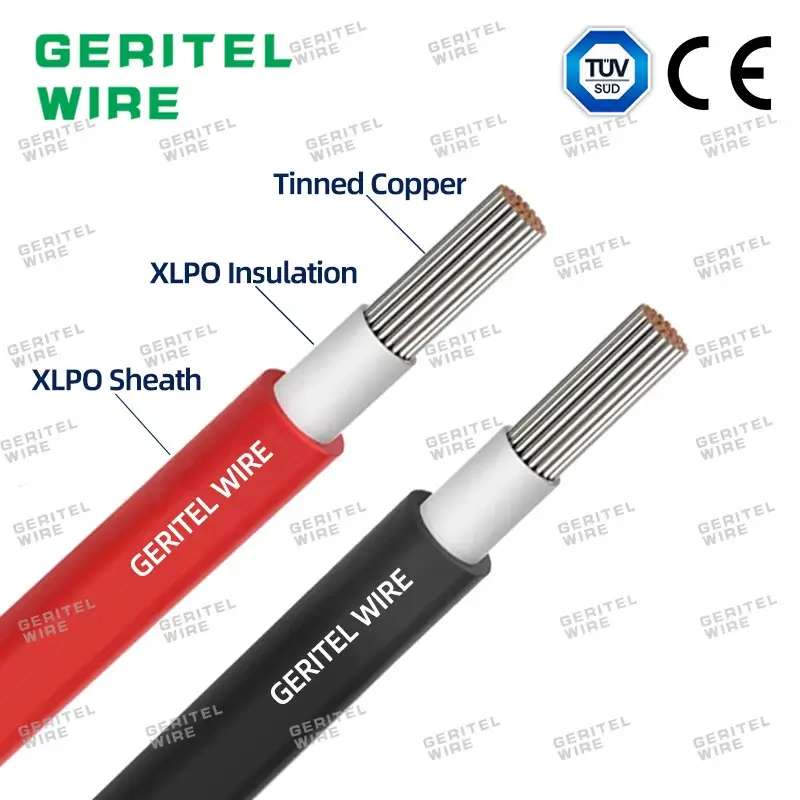
Rather than rushing to quote, we spent two full weeks conducting in-depth needs analysis with the client's technical team before designing a comprehensive cable solution spanning photovoltaic DC, energy storage connection, low-voltage distribution, and grounding systems, with the centerpiece being our flagship H1Z2Z2-K Solar Cable—a PV-specific cable employing tinned copper conductors and dual-layer XLPO sheathing, certified under TÜV B 126326 0001 Rev.00, rated for DC 1500V, with an operating temperature range extending from -40°C to +90°C and capable of withstanding +120°C under short-circuit conditions, featuring standard red positive and black negative color coding with pre-printed identification that enabled even minimally experienced installation crews to recognize phases quickly, while the critical tin plating layer delivered a full 300% improvement in anti-oxidation performance compared to ordinary bare copper in salt-spray environments, with a designed lifespan exceeding 25 years that perfectly matched the photovoltaic module lifecycle.
For energy storage system connections, we recommended Elastomer Cable—a high-flexibility cable carrying SAA certification and meeting AS/NZS 5000.1 standards, deployed in 16mm² for standard battery cabinet connections, 25mm² for main storage cabinet high-current transmission, and 35mm² for high-current inter-cabinet links, whose ultra-fine copper strand construction paired with EPR rubber insulation could endure over 100,000 bending cycles, meaning that even with two complete charge-discharge cycles daily, the cable maintained stable electrical and mechanical integrity, fundamentally resolving the chronic fracture problem at dynamic connection points that plagued traditional rigid cables.
For low-voltage distribution, we specified Ordinary Duty Cable (in 3×10mm² plus earth and 3×16mm² plus earth configurations), a 0.6/1kV-rated cable employing XLPE insulation with UV-resistant PVC sheathing specifically designed for tropical outdoor environments, while the grounding system utilized Earthing Cable (1×6mm² for framework grounding and 1×16mm² for main grounding trunk lines), ensuring reliable fault current discharge paths throughout the entire microgrid system.
The Art of Logistics
Recognizing that international logistics would make or break the project, we collaborated with the client to develop a phased precision delivery strategy that split what would have been a single bulk shipment into three tightly sequenced batches: the first batch, dispatched 45 days before project kickoff, contained all H1Z2Z2-K photovoltaic cables pre-cut to 50-meter and 100-meter lengths according to site array layouts, each reel carrying clear phase identification and length labeling that allowed construction crews to begin photovoltaic array wiring before energy storage equipment even arrived; the second batch, shipped 30 days before battery cabinet installation, included Elastomer Cable, Ordinary Duty Cable, and detailed installation guides with phase sequence identification systems to ensure workers of varying skill levels could follow standardized procedures; the third batch, sent 15 days before system commissioning, supplemented grounding cables and reserved joint materials alongside complete TÜV and SAA certification documentation packages satisfying international aid project audit compliance requirements.
This phased delivery model not only reduced on-site waiting times by 40%, but more importantly dramatically decreased waste from field cutting through pre-cut lengths, saving the client approximately 15% on cable procurement costs within their budget-sensitive project, while the records of 100% electrical testing and quality inspection performed on each batch before departure became powerful evidence for the client to demonstrate supply chain reliability to aid agencies.
Time's Verdict
When the final energy storage system passed commissioning and acceptance in early 2024, the client sent field photographs showing that the tinned copper conductors of those H1Z2Z2-K cables maintained their factory-fresh metallic luster after three months of operation, presenting a striking contrast against adjacent ordinary bare copper cables installed earlier, while the elegant arcs of Elastomer Cable between battery cabinets had withstood continuous daily charge-discharge cycling without showing any signs of insulation cracking or conductor fatigue.
More gratifying to the client was the dramatic reduction in operational maintenance costs, as the annual sea vessel inspections and joint replacement trips previously required could now be extended to once every five years, meaning substantial savings in labor and vessel charter expenses on those remote islands where transportation costs were exorbitant and weather windows limited, while the standardized identification system and reduced-joint long-life design also enabled local non-professional electricians to perform simple troubleshooting when necessary, reducing dependence on expensive expatriate technical personnel.
Building Trust
Looking back across the project's full lifecycle, we realized that what truly resonated with the client extended far beyond the numbers on product specification sheets, rather manifesting in the professional depth we demonstrated at every turn: the patience invested in two weeks of needs analysis rather than rushing to quote, the technical integrity of recommending tinned copper over standard bare copper for salt-spray environments, the proactive risk anticipation and management embedded in our phased delivery strategy, and the third-party quality endorsement represented by TÜV B 126326 0001 Rev.00 and SAA certification, all of which collectively constructed a complete chain of trust that convinced the client choosing GERITEL meant not merely selecting a batch of cables, but partnering with a long-term companion capable of standing with them through 25 years or more of South Pacific heat, humidity, and salt spray.
The Invitation
If you are planning off-grid microgrid projects in the Solomon Islands or other Pacific Island nations, or if your solar installations similarly face the harsh test of high-humidity salt-spray environments, or if you seek a cable supplier who understands the complex compliance requirements of international aid projects and ensures on-time delivery, our technical team stands ready to listen to your needs and craft a comprehensive solution spanning from selection design through logistics delivery.
Dongguan GERITEL Electrical Co., Ltd.
Tel/WhatsApp/WeChat: +86 135 1078 4550 / +86 136 6257 9592
Email: manager01@greaterwire.com
 PNG Napa Napa Refinery Solar–Diesel Hybrid Power System Cable Supply



 Building 2, No. 40 Luxi 2nd Road, Liaobu Town, Dongguan City, Guangdong Province, China