


 Home
HomeFiji Lau Islands Off-Grid Solar Microgrid Project (Rarama Vou Kei Lau)
 GERITEL
 Apr 20,2026

The diesel generator on Vanuabalavu Island had been coughing for weeks. Nurse Mereoni watched the temperature gauge on the vaccine refrigerator climb past safe levels while she waited for the supply boat from Suva. It would not arrive for another ten days. The fuel had run out three days ago, and the backup canisters were empty.
This was 2023 in the Lau Group, a scattering of sixty islands stretched across the eastern edge of Fiji. Some communities here had never seen grid electricity. Others had grown tired of the diesel cycle: the expensive shipments, the storage tanks rusting in the humidity, the generators breaking down just when the medical clinic needed them most. The archipelago sat more than three hundred kilometers from Fiji's main island of Viti Levu, and the ocean between them made every repair a logistical nightmare.
That same year, Mana Pacific signed a partnership with the Lau Provincial Council to change this reality. The project was called Rarama Vou Kei Lau—"A New Dawn for Lau"—and it promised to replace diesel dependence with solar-powered mini-grids across the outer islands. The vision was straightforward: clean, reliable electricity for clinics, schools, and communities that had spent decades in energy insecurity.
But vision and execution live in different worlds. When the technical team began surveying existing installations across the Pacific, they found a pattern that disturbed them. Solar panels were mounted and functioning. Inverters were installed. Yet the cables—the silent arteries carrying energy from panels to batteries to buildings—were failing at alarming rates.
The Hidden Crisis: Why Cables Die Young in Paradise
A technician from Dongguan GERITEL Electrical arrived in the Lau Group in early 2024. He had been asked to inspect a six-year-old installation on one of the islands, a system that should have been in its prime. What he found looked like it had aged twenty years.
The cable sheaths had turned powdery and brittle. Copper conductors, exposed at junction points, had bloomed with green corrosion. In some places, maintenance crews had wrapped connections in layer after layer of waterproof tape, a desperate attempt to keep moisture out. It was not working.
The environment here is not merely challenging. It is aggressively hostile to anything electrical. Salt mist drifts continuously from the ocean, settling on every exposed surface. Humidity rarely drops below eighty-five percent. The tropical sun delivers ultraviolet radiation intense enough to degrade standard plastics within months. Combined, these forces create what engineers call a "compound stress environment"—where materials do not face one challenge at a time, but three or four simultaneously.
For cable systems, the consequences are severe. Salt accelerates corrosion of metal conductors. UV radiation breaks down polymer chains in insulation. Heat and humidity accelerate every chemical degradation process. Standard cables rated for temperate climates simply exhaust themselves here.
The project team identified six specific pain points that any cable supplier would need to address:
Environmental destruction. Salt mist corrodes bare copper within months. Standard PVC sheaths crack and disintegrate under UV exposure. The combination means cable replacement every five to eight years instead of the twenty-five-year design life of the solar modules themselves.
Reliability demands. These mini-grids power medical refrigerators, communication equipment, and water pumps. A cable failure does not just mean lost energy—it means spoiled vaccines, interrupted medical care, and communities returning to diesel dependency.
Maintenance impossibility. The islands are scattered across vast ocean distances. A technician visit requires boat charters, weather windows, and coordination with local schedules. The cost of sending someone to replace a single failed cable can exceed the cable's purchase price by five times.
Fragmented procurement. The project involved fifteen islands with capacities ranging from fifty kilowatts to two megawatts. Traditional cable suppliers demanded minimum order quantities in the thousands of meters, forcing project managers to over-purchase some specifications while under-purchasing others.
Standard confusion. Different construction phases had used different cable brands with varying certifications. Mixing cables of different grades in the same system created compatibility risks and complicated troubleshooting.
Logistical pressure. Sea freight to Fiji takes three to four weeks. Missing a delivery window means delaying construction until the next shipping cycle, potentially pushing the project into the rainy season when outdoor electrical work becomes impossible.
What We Did Differently: Designing for the Real World
GERITEL's approach did not begin with a product catalog. It began with a question: if a cable must survive burial in coral sand, exposure to salt spray, and daily thermal cycling between tropical noon and evening storms, what should it actually be made of?
The answer reshaped how we thought about every component.
For the solar array connections—the path from panels to combiner boxes to inverters—we specified H1Z2Z2-K Solar Cable. The conductor is tinned copper, not bare copper. The tin layer serves a specific purpose in this environment: it forms a protective oxide barrier that prevents salt ions from reaching the copper beneath. A technician who had worked on Pacific installations for five years later told us that when he cut open a tinned copper connection after six months of operation, the metal inside still looked bright. Bare copper connections from earlier projects had already turned green and powdery.
The insulation and sheath use cross-linked polyolefin, a material that behaves fundamentally differently from PVC in tropical conditions. Where PVC softens in heat and becomes brittle under UV exposure, XLPO maintains mechanical integrity across temperature extremes. It does not melt against hot metal surfaces. It does not crack when flexed after years of sun exposure. This is why the cable carries TUV certification (Certificate No. B 126326 0001 Rev. 00) that includes specific testing for salt mist resistance, UV aging, and damp heat cycling—not just standard electrical performance.
We also made PV1-F available as an alternative specification, certified to UL4703 (E552397), for projects requiring North American compliance standards alongside European certification.
For the battery connections, where cables must flex repeatedly in tight spaces, we selected pure copper conductor Elastomer Cable. The conductor uses fine-stranded copper that bends easily around battery terminals without work-hardening. Its insulation resists the electrolyte vapors present in battery compartments and remains flexible across temperature ranges where standard rubber would stiffen. An installation crew working in a cramped battery container described it as "wiring with a memory for shape"—it could be bent into position and would hold that shape without springing back.
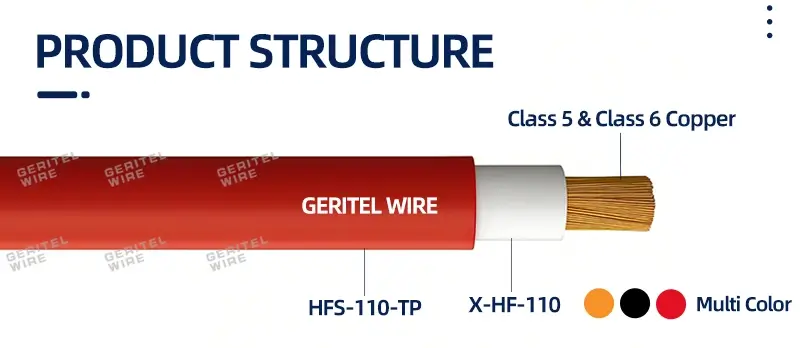
For power distribution from inverters to buildings, we used two complementary designs. Underground runs through coral sand and rocky soil received SWA Cable—steel wire armored cable. The galvanized steel braid provides mechanical protection against rodent damage, sharp rock edges, and the abrasion that occurs when cables shift slightly in settling soil. Above-ground and indoor distribution used Building Cable with XLPE insulation rated to 0.6/1kV, providing higher temperature tolerance than PVC alternatives at transformer connection points where heat concentrates.
For the monitoring and control systems—arguably the most overlooked cables in any microgrid—we supplied Instrumentation Cable and SDI Cable. The instrumentation cable uses individually shielded twisted pairs within an overall screen, preventing the high-frequency switching noise from inverters from corrupting sensor signals. The SDI cable, with its low-capacitance design, ensures that digital communication between battery management systems and energy management controllers arrives intact even over hundred-meter runs. In a mini-grid, these thin conductors carry the intelligence that keeps the system balanced. A single compromised shield can cause erratic charging behavior that damages expensive battery banks.
For grounding, we specified Earthing Cable with tinned copper conductors. Grounding systems in marine environments face a unique challenge: the soil itself is conductive due to salt content, accelerating galvanic corrosion at connection points. Tinned copper slows this process, maintaining low earth resistance through years of exposure. Given that tropical thunderstorms regularly strike these islands, grounding integrity is not merely a safety requirement—it is survival infrastructure.
Why Certificates Matter in the Real World
During technical evaluation, the project engineer asked a direct question: "Your certificates look impressive on paper. But how do I know they mean anything on my island?"
We showed him the test protocols behind the certifications.
The TUV certification (B 126326 0001 Rev. 00) includes 168 hours of salt mist exposure per IEC 60068-2-11. This simulates approximately five years of marine atmospheric exposure in a compressed timeframe. It includes 1000 hours of UV aging per ISO 4892-2, equivalent to a decade of equatorial sun. It includes damp heat cycling at 85 degrees Celsius and 85 percent relative humidity—conditions that replicate the worst days of a tropical wet season.
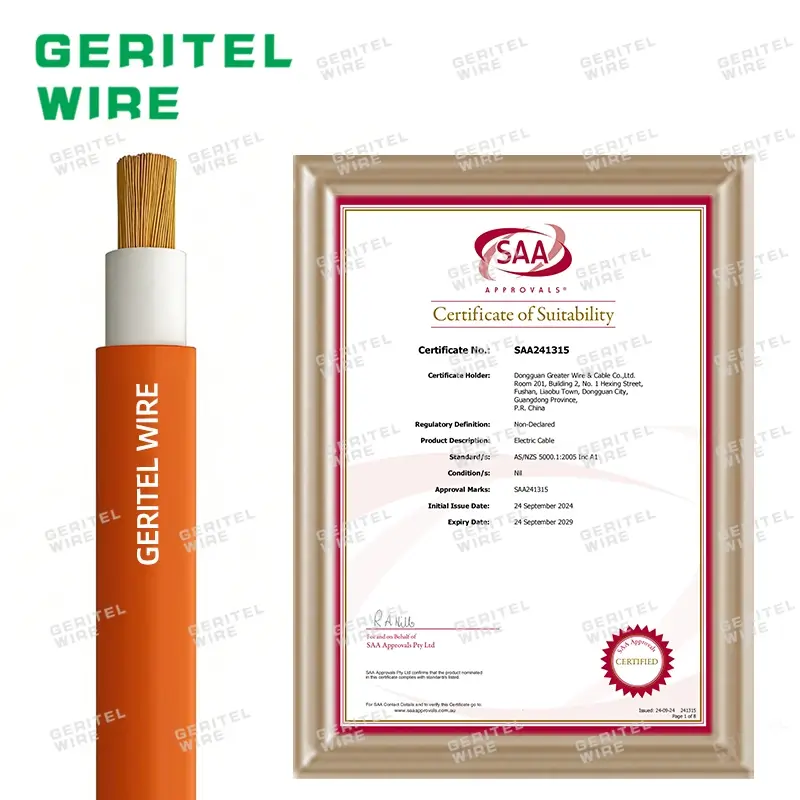
The SAA certification to AS/NZS 5000.1 adds another dimension. This standard, developed for Australian and Pacific Island conditions, mandates low-smoke zero-halogen properties. In a battery room or underground cable vault, if a fault causes overheating, halogen-free materials do not release toxic acidic gases. This gives maintenance personnel time to identify and address problems without facing immediate respiratory hazards.
These are not theoretical benefits. They translate directly to operational reality: cables that do not require replacement, connections that maintain low resistance, systems that keep functioning when the weather turns severe.
Moving Material Across an Ocean
The logistical challenge was as complex as the technical one. Fifteen islands. Multiple cable types per island. Quantities ranging from a few hundred meters to several kilometers. And everything needed to arrive within a specific construction window.
We structured the supply chain in three tiers.
Stock availability. Our warehouse in Dongguan maintains ready inventory of the most common solar cable sizes—4mm², 6mm², and 10mm² in H1Z2Z2-K Solar Cable. For the Lau project, this meant that emergency replenishments could be packed and shipped within 72 hours of order confirmation.
Production flexibility. For larger conductor sizes needed at the 2MW sites, we ran dedicated production lots. From conductor stranding through insulation extrusion to final testing, we completed manufacturing in fifteen days—roughly forty percent faster than industry standard lead times.
Consolidated shipping. Rather than shipping cables separately from other project materials, we worked with the project's logistics coordinator to consolidate cable drums with inverter pallets, mounting hardware, and battery racks into single container loads. Each cable drum received island-specific labeling, so when the container arrived at the Port of Suva, local teams could immediately distribute materials to the correct vessels without unpacking and resorting.
The entire delivery cycle, from order confirmation to arrival in Fiji, fit within the three-week ocean freight window. For a project racing to complete outdoor construction before the November rains, this timing margin meant the difference between a completed installation and a six-month delay.
Six Months Later: The Numbers That Matter
The first three sites entered service in August 2024. By February 2025, the operations team had accumulated enough data to assess performance.
Cable joint temperatures measured by infrared thermography showed a twelve-degree temperature rise above ambient at connection points using H1Z2Z2-K Solar Cable. Comparable measurements at a nearby site using standard PVC cables showed twenty-two degrees. Lower temperature rise means less thermal stress on connections, slower oxidation rates, and longer service life.
Insulation resistance testing of the photovoltaic array showed values consistently above 500 megohms—indicating no moisture ingress, no insulation degradation, no developing faults.
Most tellingly, the cable-related failure count was zero. System availability reached 99.7 percent, with the remaining 0.3 percent attributable to inverter communication issues unrelated to cabling.
But the number that mattered most to the local maintenance supervisor was not in the technical report. It was the boat fuel budget. Previously, his team had made monthly inspection trips to multiple islands, opening junction boxes to check for corrosion and taping damaged sheaths. Now they conducted quarterly visual inspections from outside the enclosures, using thermal cameras to spot anomalies without disassembling anything. "We are not saving cable costs," he noted. "We are saving the cost of reaching the cable."
Why This Partnership Worked
The project team had evaluated cable suppliers from Australia, New Zealand, and Asia before selecting GERITEL. Three factors distinguished our proposal.
Context-specific design. Other suppliers offered catalogs. We offered solutions shaped by the specific stresses of Pacific island environments. The tinned copper, the XLPO sheathing, the armor configurations—each choice traced back to a specific environmental challenge rather than a generic specification sheet.
Integrated coverage. From the solar array to the battery bank, from power distribution to control signals, from equipment grounding to lightning protection, the entire cable system carried consistent certification levels and compatible insulation systems. The project manager dealt with one technical contact, one quality standard, one accountability chain.
Operational flexibility. We accepted orders for single reels of 500 meters. We accommodated specification changes after initial orders were placed. We shipped partial air freight when a critical delivery faced delays. This responsiveness matters in island projects where conditions change faster than paperwork can adapt.
The Work That Happens in Silence
On a February evening in 2025, the community center on Vanuabalavu Island filled with light. Children gathered around a projector showing educational videos. The medical clinic's refrigerator maintained its steady hum. Outside, the salt mist drifted in from the lagoon as it had for centuries, settling on rooftops and cable sheaths and the leaves of breadfruit trees.
No one in that room thought about cables. They thought about the lesson on the screen, about the vaccines that would remain effective, about the water pump that would still run tomorrow. The cables carrying these currents were buried in coral sand, strung along weathered eaves, coiled in battery cabinets—working, aging slowly, requiring nothing.
This is the measure of infrastructure done well. It disappears into the background of daily life. It does not demand attention through failures or maintenance crises. It simply functions, year after year, while communities get on with the business of living.
The Rarama Vou Kei Lau project represents something larger than a single installation. It demonstrates that renewable energy in the Pacific is not merely about placing panels in the sun. It is about building systems that respect the environment they serve—systems tough enough for salt and storms, reliable enough for medical clinics and schools, and designed for lifetimes measured in decades rather than years.
For island communities considering similar transitions, the lesson is clear: the cable choice you make today determines whether your system thrives or merely survives. Choose accordingly.
Contact Us
Dongguan GERITEL Electrical Co., Ltd.
Tel/WhatsApp/WeChat: +86 135 1078 4550 / +86 136 6257 9592
Email: manager01@greaterwire.com
 Solomon Islands Renewable Energy & Microgrid Electrification



 Building 2, No. 40 Luxi 2nd Road, Liaobu Town, Dongguan City, Guangdong Province, China