


 Home
HomeNew Zealand North Island Photovoltaic Power Station
 GERITEL
 Apr 20,2026

The Market Context: A Misunderstood "Small" Market
In early 2024, we received an inquiry from the Bay of Plenty region on New Zealand's North Island. The project was modest—2.5MW—but the backstory was telling.
New Zealand's solar market is often dismissed as "niche." True, there are no GW-scale explosions here like in the Middle East. Distributed PV capacity stood at just 85MW in 2022, with nearly half added in the preceding two years. Yet Transpower's latest monitoring reports paint a different picture: as of late 2025, 1,415MW of generation projects were under construction nationwide, with solar accounting for 787MW of that total. Another 6GW of solar-plus-storage projects sat in the connection queue, up from 2.3GW in early 2023. The government has committed to tripling renewable capacity by 2030, and grid operators are investing NZD 393 million to upgrade networks for distributed generation.
The real character of this market is fragmented but high-standard steady penetration. The Bay of Plenty typifies this—it is dairy farming country, and agrivoltaics is gaining traction. Lodestone Energy's Te Herenga o Te Rā project in the Ōpōtiki District converted 62 hectares of dairy farm into a 42MWp solar array, the first utility-scale PV project to connect directly to the grid. Our customer followed this pattern: a local energy company building a 2.5MW distributed plant on retired dairy land to supply a nearby industrial park.
What made this project distinct was its hybrid nature. It was not a standard ground-mount installation. Existing agricultural infrastructure remained operational. Cables had to cross drainage channels, avoid underground biogas lines, and the landowner stipulated zero cable-related disruption to farming activities across the 25-year operational life. The cables needed to perform electrically while surviving complex field conditions with minimal tolerance for failure.
The Customer's Real Constraints
By the time the customer contacted us, they had already filtered through two rounds of suppliers. The first round was European brands. Technically respected, but the 14-week lead time clashed with New Zealand's summer construction window (November to March). More critically, the products were designed for Central European climates. The suppliers did not account for Bay of Plenty's average annual relative humidity of 75-85% or summer UV indexes exceeding 11.
The second round was low-cost Southeast Asian suppliers. Prices were 40% lower, but TUV or SAA certifications were absent. Salt spray testing on samples showed bare copper conductors oxidizing and blackening within 48 hours. The customer's technical lead had been burned before on an Australian project—cheap cables led to corroded MC4 connectors after three years, dropping array output by 12%.
Their core requirement, distilled: "Control cost without sacrificing 25-year life. Deliver fast while meeting local standards. Ensure technical reliability while reducing installation complexity." These demands appear contradictory but reflect universal pain points in the New Zealand market. Projects are small by global standards (2.5MW counts as mid-sized here), yet standards match European or Australian rigor. EPC teams often have international backgrounds, but local subcontractors lack experience. Grid connection approvals are stringent, with connection queue waits averaging three and a half years. A cable parameter mismatch causing commissioning test failure would delay the project far beyond any cable procurement cost differential.
A hidden constraint was skilled labor shortage. The solar industry faces acute shortages of technicians, from rooftop installers to grid connection specialists. The customer was direct: local electrical contractors are licensed but inexperienced with PV. "We need a cable system that makes it harder for them to get it wrong."
Translating Site Conditions into Technical Specs
We requested a detailed site survey and commissioned supplementary environmental data from a local partner. Several findings directly influenced cable selection:
Salt spray corrosion was underestimated. The site sits roughly 12 kilometers from the Bay of Plenty coastline, classified as IEC 60721-3-4 corrosion class 4C2 (moderate salt mist). The customer initially considered this distance "safe," overlooking two factors. First, the coastal plain geography means prevailing southeasterly winter winds transport salt particles directly to the site. Second, decades of fertilizer use left the soil mildly acidic (pH 5.8-6.2), accelerating metallic corrosion. Standard bare copper cables in this environment develop oxide films at termination points within three to five years, raising contact resistance and generating heat.
UV radiation accumulates differently. North Island summer day lengths fall short of Australian levels, but atmospheric clarity is higher and the ozone layer thinner, meaning a higher proportion of UV-B and UV-C. Standard PVC-sheathed cables exposed outdoors begin surface cracking within two to three years, with significant insulation degradation by year five to eight. The customer's Australian experience confirmed UV aging as the leading cause of premature cable failure.
Humidity and thermal cycling compound the stress. Temperate maritime climate creates daily temperature swings that drive "breathing" in cable sheaths, accelerating moisture ingress. Parts of the site were converted from wetlands, pushing soil thermal resistivity to 1.5 K·m/W—a figure that directly derates current-carrying capacity.
Grid codes contain hidden thresholds. Local distribution network operators like Powerco enforce strict voltage fluctuation controls for 11kV connections under AS/NZS 4777. Cable impedance parameters must match precisely; deviations cause commissioning rejection. A neighboring 3MW project failed grid connection testing three times due to medium-voltage cable impedance deviation, incurring a four-month delay.
Cable Selection Mapped to Application
Module to Combiner Box: H1Z2Z2-K 4mm² and 6mm²
The project used 550W monocrystalline modules, 4,545 total. Standard strings comprised 26 series-connected modules, yielding open-circuit voltage of 1,237V and operating current of 13.3A.
4mm² application: Standard strings under 50 meters in length. Conductor resistance of 4.61 mΩ/m gives loop resistance of 0.461Ω and voltage drop of 6.1V—0.5% of system voltage, well below the 3% allowance. Current-carrying capacity at 60°C ambient is approximately 55A, providing 4x margin.
6mm² application: The site's east-west span placed some strings over 80 meters from combiner boxes. At 4mm², voltage drop would reach 9.8V, approaching the threshold. At 6mm², resistance drops to 3.08 mΩ/m, bringing 80-meter loop drop to 7.4V. The larger cross-section also provides 35% higher tensile strength for long-span aerial installation.
Why not PV1-F: PV1-F carries a 1.0kV DC rating. String open-circuit voltage of 1,237V exceeds this insulation withstand level. H1Z2Z2-K is rated 1.8kV DC, providing necessary headroom. Structurally, H1Z2Z2-K's dual-layer XLPO construction (inner insulation ~1.2mm plus outer sheath ~1.2mm) delivers roughly 40% better UV endurance than PV1-F's single-layer design. The tinned copper conductor, with 1.5-2μm tin layer, reduces salt spray corrosion rates by an order of magnitude—a decisive factor in Bay of Plenty's coastal environment.
Color selection: Black sheathing for standard strings, red for string-end grounding identification. This detail targeted the local crew's limited familiarity with DC polarity identification.
Inverter to Transformer: YJV 25mm², 35mm², 50mm²
Fourteen 110kW string inverters arranged in two zones, each feeding a 1,250kVA pad-mounted transformer.
25mm²: Single inverter output current of approximately 159A at 400V three-phase, for runs under 30 meters. 25mm² copper XLPE carries roughly 143A in soil, 170A in free air, satisfying requirements with voltage drop under 1.5%.
35mm² and 50mm²: Two inverters paralleled into a transformer create 318A at the combiner section. 35mm² carries approximately 175A in soil, satisfied by dual parallel runs. The main feeder from switchgear to transformer low-voltage side spans 85 meters; 50mm² constrains drop to 2.1% with conductor losses of 4.8kW—0.19% of system power.
XLPE versus PVC logic: YJV's XLPE insulation withstands 90°C continuously, 250°C for 5 seconds during short-circuit. All-PVC construction (VV cable) limits insulation to 70°C, forcing a size upgrade for equivalent ampacity. At 50mm², XLPE delivers 181A in soil versus 140A for PVC—the difference of exactly one size class. For cost-sensitive projects, the 15% cable cost savings from using a smaller XLPE size offset the insulation material premium.
Installation adaptation: Local subcontractors were accustomed to SDI Cable (single-core double-insulated) per AS/NZS 5000.1, but SDI is limited to 0.6/1kV and lacks three-core assembly. We matched YJV outer diameters to SDI equivalents and supplied phase-color marking sleeves (red/white/blue/black for three phases plus neutral).
Transformer to Switchyard: MV XLPE 70mm² 11kV
Two 1,250kVA transformers paralleled at 11kV, yielding rated current of approximately 131A. 70mm² copper XLPE in direct-buried soil carries roughly 285A per AS/NZS 1429.1 (soil thermal resistivity 1.2 K·m/W, burial depth 1.0m), providing 2.2x margin. AC resistance of 0.342 Ω/km and reactance of 0.121 Ω/km produce active losses of 5.4kW over 1.2km—0.22% of transmitted power.
Short-circuit verification: 11kV system fault level of 200MVA yields 10.5kA. 70mm² copper XLPE withstands 10.0kA for 1 second, near the threshold. With protection relay operating time set at 0.3 seconds, cable capability rises to 18.3kA, providing adequate margin. For projects scaling above 5MW, 95mm² (13.6kA/1s) would be prudent.
Shielding design: Copper tape screen (minimum 10mm² cross-section) meets capacitive current discharge and earth-fault return path requirements. Outer sheath is black HDPE with 2.5% carbon black content for UV resistance, extending outdoor buried life by roughly 8 years over PVC.
Armor selection: Single-core cables use aluminum wire armor (AWA) rather than steel to avoid AC magnetic induction heating. This matters significantly when three phases are run in separate single-core configurations.
Grounding: Bare Copper 16mm² and 35mm²
Module frame earthing: 28 string arrays with 56 earthing points, each using 16mm² bare copper to the main earth ring. AS/NZS 5033:2021 mandates exposed metallic array frames be earthed with minimum 4mm² conductor, but aluminum frame-to-copper galvanic corrosion necessitated upsizing to 16mm² with stainless steel transition clamps. Measured earth resistance was 0.8Ω, within AS/NZS 3000's ≤1Ω requirement.
Transformer and switchyard main earth: 35mm² bare copper buried at 0.6m depth encircling equipment foundations. Thermal stability checked against 11kV single-phase earth fault of 5kA for 1 second; 35mm² copper satisfies this. Where soil resistivity runs high (volcanic soils in parts of the North Island exceed 100 Ω·m), vertical earth electrodes or 50mm² upgrade is needed.
Equipotential bonding: Inverter enclosures, cable trays, and combiner boxes tied with 16mm² green/yellow Building Wire per AS/NZS 5000.1.
Field Adjustments During Implementation
Two changes emerged during delivery. First, survey findings revealed some strings crossed low-lying wetland with year-round soil moisture above 90%. Originally direct-buried AC cables were rerouted to PVC conduit aerial installation, raising the current capacity correction factor from 0.85 to 1.0. The existing 50mm² specification remained valid.
Second, Powerco requested 10kA/1s short-circuit test reports for the medium-voltage cables. We supplemented third-party test data and increased copper tape screen cross-section from the designed 10mm² to 15mm² to meet internal utility specifications. This added roughly 8% to cable costs but avoided potential commissioning delays. Given average connection queue waits of three and a half years, any rework is unacceptable.
Operating Data
Commissioned October 2024. Through April 2025, the site experienced peak UV index of 11, typhoon passage with 45 m/s winds, and salt spray deposition season. Infrared inspection showed maximum MC4 connector temperature rise of 4.2K (39.2°C at 35°C ambient). Medium-voltage terminations showed no tracking marks. Earth resistance held steady at 0.8Ω. Zero cable system faults.
Observations on This Market
This case clarified several characteristics of New Zealand's PV cable market:
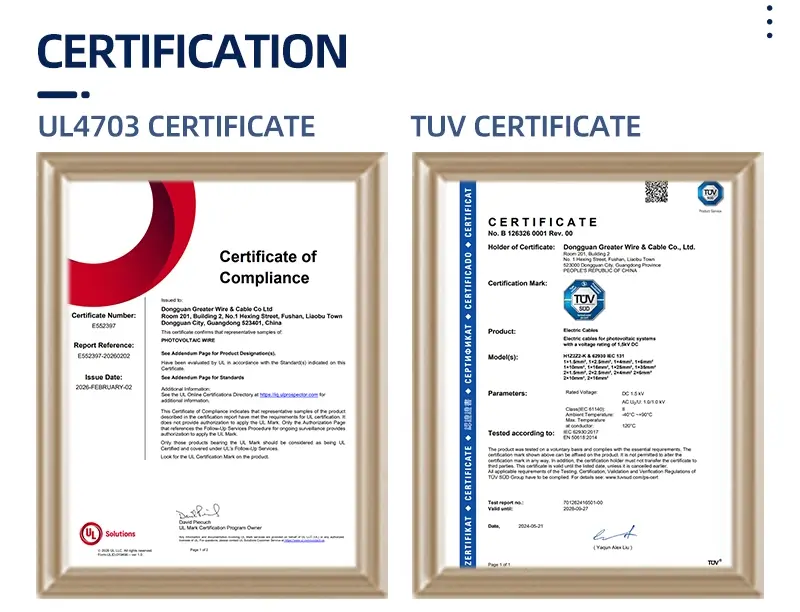
Certification is a hard gate, not a differentiator. TUV for PV cable, SAA for power cable, UL for medium-voltage—these are entry requirements, not value-adds. This fundamentally differs from Southeast Asian or African markets where certification may be negotiable.
Environmental adaptation determines lifespan. North Island cable selection must simultaneously address UV, salt spray, and humidity. European brands often carry full certification but optimize for continental climates; island-specific adaptation from specialized Asian suppliers can prove superior.
Supply chain resilience outweighs price. As an island nation, New Zealand faces 6-8 week replenishment cycles. For a 2.5MW "small" project, one stockout causing construction stoppage can cost 20% of the cable purchase price. Responsive lead times and sensible inventory matter more than lowest unit price.
Installation friendliness is an underestimated cost. Skilled technician shortages mean pre-labeling, standard color coding, and detailed laying drawings reduce error rates. These hidden costs are often ignored in lump-sum bids but surface significantly during construction.
Grid connection is the dominant uncertainty. Transpower's connection review is rigorous and lengthy. Cable parameters must match grid code precisely at the design stage; any later revision triggers re-approval.
Dongguan GERITEL Electrical Co., Ltd.
Tel/WhatsApp/WeChat: +86 135 1078 4550 / +86 136 6257 9592
Email: manager01@greaterwire.com
 Stubbo Solar Farm 500MW Utility-Scale Solar Power Project Australia



 Building 2, No. 40 Luxi 2nd Road, Liaobu Town, Dongguan City, Guangdong Province, China