


 Home
HomeSolomon National Broadband Infrastructure Project
 GERITEL
 Apr 07,2026

A Morning in Honiara Port, the Global Journey of a Cable Drum
Some Tuesday in August 2023, a container ship labeled "Pacific Direct Line" slowly entered Honiara Port. On deck, 42 heavy cable drums sat silent in the salt-laden breeze—they had traveled from a factory in the Pearl River Delta, beginning a journey longer than the Titanic's, only this time, the destination wasn't a sinking iceberg but floating jungles.
On the material list for the Solomon Islands National Broadband Infrastructure Project (SINBIP), these cables were classified as "Electrical Materials—Low Voltage." But project manager Joshua (pseudonym) knew that when construction crews tried to unload generators on the coral reef beachhead of Ranongga Island, the flexibility of 10 mm² 3-core elastomer cable would determine whether they powered up before sunset or spent the night in mosquito-infested darkness.
This was no ordinary power project. Behind the World Bank-funded $120 million budget lay a brutal geographical fact: the Solomon Islands' land area comprises only 3% of its territory, the remaining 97% is ocean. When you need to erect a communication tower on an uninhabited island in Malaita Province, "next-day delivery" is myth, "maybe next week" is reality.
Five Wars Behind Cable Selection
War One: Ultraviolet Radiation vs. Molecular Chains
Pacific island sunlight isn't warmth, it's weaponry. Standard PVC cables harden, powder, and crack within 12 months—this isn't theory, it's what field photos from a Papua New Guinea mine taught us in 2019. Our recommended Elastomer Cable employs LSZH insulation, whose saturated carbon chain molecular structure provides natural immunity to ozone and UV.
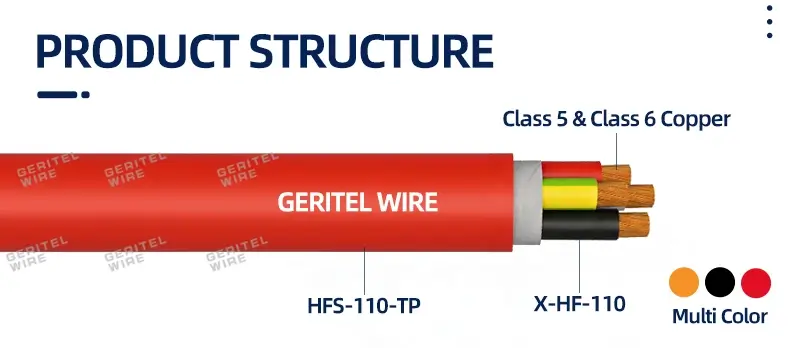
In the SINBIP project, 10 mm² 3-core elastomer cable was designated as the lifeline for all mobile generators. Why this specification? The 10 mm² copper cross-section handles 32A current with ease, while the 3-core configuration (L1/L2/L3, no neutral) perfectly matches the three-phase diesel generators commonly used on the islands. More critically, when local workers drag cables 200 meters from beach to tower base through jungle paths, the elastomer sheath's -25°C low-temperature bending performance (though it never freezes here) means "toughness redundancy" in physical properties—it won't develop micro-cracks from repeated flexing.
The alternative? SWA Cable (Steel Wire Armoured) is certainly tougher, but its bending radius is 6 times the cable outer diameter—turning on jungle trails is like trying to drive a truck through a bicycle lane. SWA's true battlefield is underground—the 25mm² 4-core SWA cable we supplied runs from solar arrays to equipment rooms, its steel tape armor resisting not bending but hidden basalt fragments in coral sand and rough handling during installation.
War Two: Salt Spray and the Slow Farewell of Galvanized Layers
The Solomon Islands' annual humidity exceeds 80%, and airborne salinity makes carbon steel rust at visible speed. Our SWA cable uses galvanized steel wire rather than ordinary low-carbon steel, with zinc coating thickness ≥80g/m². This isn't for aesthetics—it's so that after cable burial, the galvanized layer acts as a sacrificial anode, corroding preferentially to protect the internal steel structure—designed for 20 years, likely longer, because no one will dig it up to verify.
War Three: Signal Survival in Electromagnetic Noise
Communication towers are electromagnetic battlefields. 50kW diesel generators, variable-frequency air conditioners, UPS inverters, and high-frequency RF equipment at the tower top collectively create a spectrum pollution zone. The client's initial drawings showed sensor lines using ordinary multicore cable—we vetoed this.
The decision to substitute Instrumentation / Shielded Cable hinged on one detail: the project's remote monitoring system needed to transmit 4-20mA analog signals, while VFD-generated common-mode voltage spikes could reach hundreds of volts. Our specified 1.5mm² 2-pair shielded cable uses aluminum foil + braided mesh double shielding, with transfer impedance below 10mΩ/m at 1MHz. Translated to field language: even with generators at full speed, wind sensor data won't jump, antenna azimuth feedback won't drift.
War Four: The Symmetry Philosophy of VSD Cable
Solar system MPPT controllers and room air conditioning use extensive variable speed drives (VSD). Here's a counter-intuitive fact: the most common cause of VFD motor damage isn't overcurrent, it's bearing current—PWM pulses inducing high-frequency circulating currents in the rotor-bearing-housing loop, etching bearing raceways within a year.
Our solution is the symmetrical three-earth design of VSD / Control Cable. Three power cores of 4mm² are symmetrically surrounded by three protective earth conductors of equal cross-section, this geometric symmetry eliminating magnetic field imbalance, reducing bearing voltage to safe thresholds. Clients won't test this parameter during acceptance, but motor overhaul records five years later will prove the value.
War Five: The "Indoor Discrimination" of TPS Cable
TPS Cable (Tough Plastic Sheathed) was "demoted" in this project—restricted to prefabricated equipment room interiors. The 2.5mm² and 4mm² specifications, white flat profile, offer unbeatable cost-performance in dry environments. But we explicitly banned outdoor use, even under eaves. This isn't excessive caution—it's scar tissue from a 2017 Fiji project: TPS's white PVC yellowed after 6 months of UV exposure, powdered after 12 months, and after 18 months, a rainstorm caused a short circuit at a supposedly "semi-sheltered" corridor.
SAA Certification—The Power Game Behind a Pass
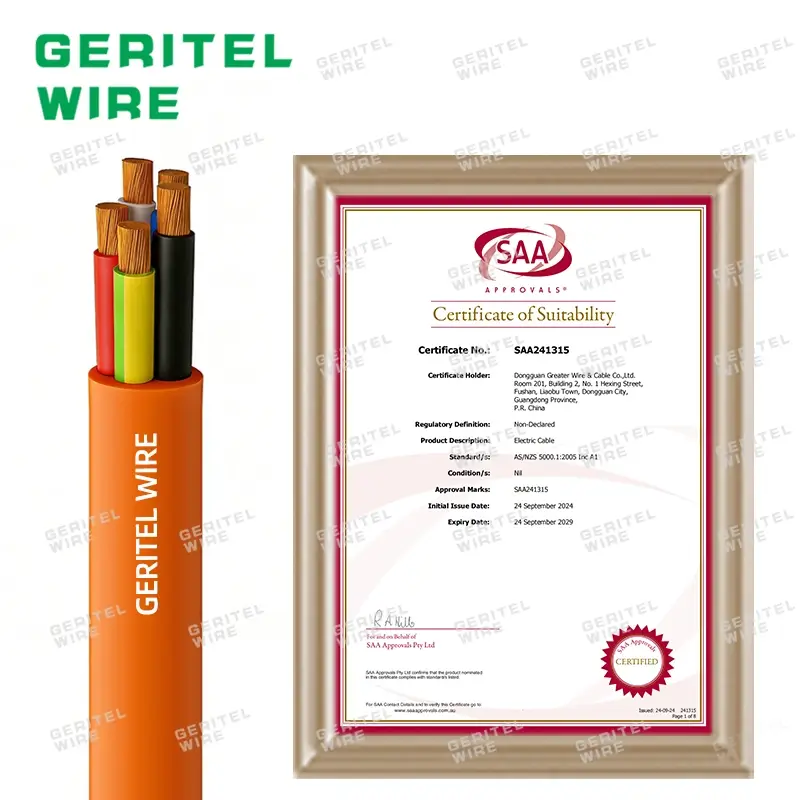
A former British colony, the Solomon Islands inherited electrical regulations from Australia's AS/NZS system. In the client's tender documents, "SAA Certification" wasn't a bonus item—it was a bidding qualification threshold.
Our certificate numbers can be verified on the SAA Approvals website, covering AS/NZS 5000.1 (power cables), AS/NZS 3191 (flexible cords), AS/NZS 3808 (insulation and sheathing materials). But certificates are just entry tickets; the real game is in documentation details:
• Batch Test Reports: Conductor resistance, voltage withstand tests, insulation thickness data for every drum, traveling as PDFs with the goods
• Certificate of Origin: Form E, for China-ASEAN Free Trade Agreement tariff benefits
• Wood Packaging Fumigation Certificate: IPPC mark, preventing biosecurity interception at Honiara Port
March 2024, when the second shipment arrived, customs inspectors randomly selected a drum of 6 mm² 4-core elastomer cable for conductor resistance testing. Measured value: 0.272 Ω/km, standard limit: 0.272 Ω/km—passing, but near the boundary. We provided the original resistivity report for that batch's copper rod the same night, proving the difference came from measurement ambient temperature (32°C vs. standard 20°C) rather than material defects. Goods cleared the next day, construction crews didn't miss that weekend's weather window.
This is what "fast delivery" truly means: not ships sailing faster than others, but documents prepared before problems arise.
Three Hidden Pain Points Solved (Never Explicitly Stated by the Client)
Pain Point One: The "Curse" of Inventory
Pacific island projects have a bizarre phenomenon: spare parts are harder to obtain than main materials. Our contractual promise of "30-day buffer stock" isn't marketing speak, it's specialized arrangement for the Solomon Islands. When Tropical Low "Anggrek" passed in January 2024, diverting three cargo vessels to Australia, our pre-positioned 12-core Multicore Flexible Cable and 18-core control cable in Dongguan warehouse allowed Phase 2 equipment room internal wiring to start on schedule, rather than waiting for the next shipping schedule.
Pain Point Two: The "Tower of Babel" in Technical Translation
The client's field engineers are Solomon Islands locals, familiar with NEC (US standards); the supervision team is Australian, insisting on AS/NZS; our technical documents are Chinese originals. In three-way communication, "earth conductor" and "grounding conductor" caused two weeks of confusion—in some contexts interchangeable, strictly distinguished in AS/NZS 3000.
Our technical support engineer (a Guangdong native who studied in Sydney for five years) stationed in Honiara for two weeks, not to sell but to translate—translating our cable specifications into "Chinese that supervisors can sign off on," then translating supervisory comments into "process adjustments that factories can execute." This "technical localization" service never appeared on the quotation, but it appeared in the client's subsequent recommendation letter.
Pain Point Three: The "Moral Weight" of Waste
Pacific island nations have no cable recycling industry. Post-project, cut cable ends, damaged drums, packaging materials become permanent residents. We deliberately reduced plastic wrap in packaging design, substituting biodegradable sisal cloth binding; cable drums use detachable steel-wood structures, encouraging clients to recycle steel rings and repurpose wooden drums as fuel or construction material post-project. This isn't green marketing, it's a supplier' sense of responsibility for "what happens here after we leave."
September 2024, An Afternoon in Nukufero Village
Project milestone records show that by September 2024, 14 towers were energized, 57 towers installed. But numbers won't tell you that in Nukufero village on the Russell Islands, a middle school teacher named Maria (pseudonym) saw her hospitalized mother in Honiara for the first time via mobile video call—previously, she needed to walk half an hour over mountains, then boat an hour to the nearest signal point.
Our cables didn't directly create this moment, but they ensured the base station's power system wouldn't fail at critical moments. The 10 mm² 3-core elastomer cable connecting diesel generators underwent 17 emergency starts during the first monsoon season, sheath intact without crazing; SWA cable buried solar trunk lines survived minor landslides triggered by heavy rain; shielded instrumentation cable transmitted wind speed data allowing remote monitoring systems to warn of typhoon paths 48 hours ahead, letting construction crews reinforce temporary facilities.
These "stories that didn't happen" are infrastructure projects' most honest success metrics.
Epilogue: When Projects End, Relationships Continue
SINBIP's Phase 3 will continue through late 2026. On our inventory list, cables of specific specifications are already reserved for 51 towers in Malaita and Temotu provinces—not because contracts mandate it, but because three years of collaboration built predictive capability. We know Temotu Province's port can only accommodate 5,000-ton vessels, so cable drum maximum diameter is limited to 1.8 meters; we know local electricians prefer crimp terminals over bolted connections, so Multicore Flexible Cable conductor stranding pitch is optimized for crimp die compatibility.
This isn't knowledge a product catalog can carry. This is "field wisdom"沉淀 after three years living with a specific project, specific people, and a specific ocean.
Your Project Deserves This Treatment
If you're planning infrastructure involving any of these elements:
• Tropical or coastal corrosive environments
• Australian/New Zealand standards compliance requirements
• Complex logistics chains and unpredictable field conditions
• Need not just cables, but "cables + technical translation + risk anticipation"
Dongguan GERITEL Electrical Co., Ltd. doesn't participate as a "quote-produce-ship" three-act play, but as a complete narrative of "diagnose-design-deliver-stay." Our SAA certification opens compliance doors, our Pacific project experience shortens learning curves, our manufacturing flexibility adapts to field changes—these three form a closed loop ensuring you won't discover the gap between "ideal cable specifications" and "tropical port reality" mid-project.
Contact us to begin your project diagnosis:
Dongguan GERITEL Electrical Co., Ltd.
Tel/WhatsApp/WeChat: +86 135 1078 4550 / +86 136 6257 9592
Email: manager01@greaterwire.com
 Vanuatu Waterfall Pico‑Hydro Power Station



 Building 2, No. 40 Luxi 2nd Road, Liaobu Town, Dongguan City, Guangdong Province, China