


 Home
HomeSde Nitzan Solar + Energy Storage Project (Israel, 2023)
 GERITEL
 Apr 18,2026

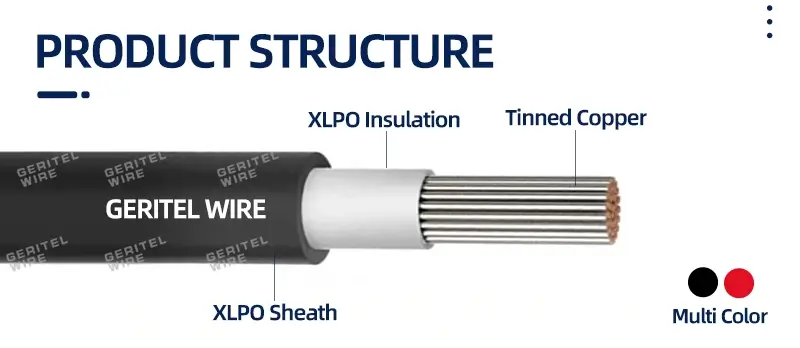
42,000 meters of 1×6mm² H1Z2Z2-K cable form the project's capillary network, connecting each module's positive and negative terminals. We rejected twin-core consolidation: while parallel conductors save installation labor, heat superposition reduces dissipation efficiency, elevating operating temperatures by 15°C or more in desert conditions. Single-core independent routing with proper spacing ensures each cable's thermal channel remains unobstructed, keeping conductor temperatures below 90°C with ample margin beneath the 120°C ceiling.
Long-Distance Feeders Spanning the Array
15,000 meters of 1×10mm² specification carry power from strings to combiner boxes. Sde Nitzan's array layout includes 80 to 100-meter long-distance loops; had we retained 6mm² cross-section, voltage drop would approach 2.5%, narrowing inverter MPPT windows and compromising low-irradiance startup. The 10mm² solution constrains voltage drop within 1.5%, ensuring efficient generation during morning and evening edge hours—whose cumulative energy contribution significantly impacts project IRR.
Power Aggregation from Combiner to Inverter
8,500 meters of 1×10mm² cable complete multi-string electrical consolidation within DC cabinets. Current density runs high here, making XLPO's thermal resilience critical—during summer noon, enclosed metal cabinets reach 70°C, where conventional PVC insulation risks softening and deformation, while XLPO's cross-linked molecular network maintains mechanical integrity, preventing contact degradation from insulation displacement at terminations.
Dynamic Connections for the Storage System
6,200 meters of XLPO energy storage DC cable (35mm² and 50mm² specifications) shuttle between battery containers and the PCS. Storage duty imposes distinctive demands: current direction reverses every few hours, subjecting terminations to repetitive micro-vibration. We optimized conductor stranding pitch for enhanced flexibility, while IEC 62930/EN 50618 certification ensures electrical parameter matching with mainstream storage inverters, avoiding charge/discharge efficiency losses from impedance mismatch.
Medium-Voltage Leap to Grid Connection
1,200 meters of 180mm² XLPE insulated cable complete the final stretch from inverter AC output to 35kV step-up transformer. UL 1072-certified medium-voltage cable meets Israel grid company interconnection standards, with copper shielding design suppressing harmonic interference to ensure power quality compliance.
Nervous System for Monitoring Networks
5,800 meters of 1.5mm² KVV control cable weave the information network for SCADA systems, environmental monitoring sensors, and fire protection linkage. Multi-core construction consolidates multiple signal paths, reducing wiring complexity within control cabinets, with 0.75 to 2.5mm² specification gradients covering full scenarios from weak-current communications to solenoid valve actuation.
Material Narrative: XLPO and PVC Are Not Generational Upgrade, But Epochal Divide
Explaining XLPO's premium value to clients, we avoid vague "better" claims. Instead, we demonstrate physical limit divergences. PVC's linear molecular chains begin softening near 70°C, decomposing to release hydrogen chloride at 160°C; XLPO's three-dimensional cross-linked structure resembles a tensioned net—shape-stable at 120°C, non-puncturing and non-dripping at 250°C short-circuit instants. In Sde Nitzan's desert environment, this translates concretely: at summer noon, PVC cable insulation may form permanent deformation from softening against supports, while XLPO maintains original cross-section with conductor centered and electric field uniformly distributed.
UV resistance dimensions prove more intuitively temporal. ASTM G154 accelerated weathering simulates Arizona sunlight intensity; XLPO samples retain over 90% tensile strength after 2,000 hours exposure, while PVC shows obvious chalking after 500 hours. Translated to Sde Nitzan's actual duty, this implies zero cable replacement for insulation aging across the 25-year lifecycle, whereas PVC schemes might trigger batch replacement at years 8-10, with outage losses plus material costs far exceeding initial price differentials.
Low-temperature performance, often neglected for desert projects, governs construction windows and maintenance convenience. Sde Nitzan's winter nights plunge below -10°C; PVC cables crack when bent at such temperatures, while XLPO's -40°C flexibility certification permits year-round installation and reserves operational space for fault maintenance across 25 years—storage system maintenance often occurs during predawn low-temperature periods, when cable flexibility directly impacts termination re-crimping quality.
Certification as Commercial Language: Rendering Technical Trust Transferable
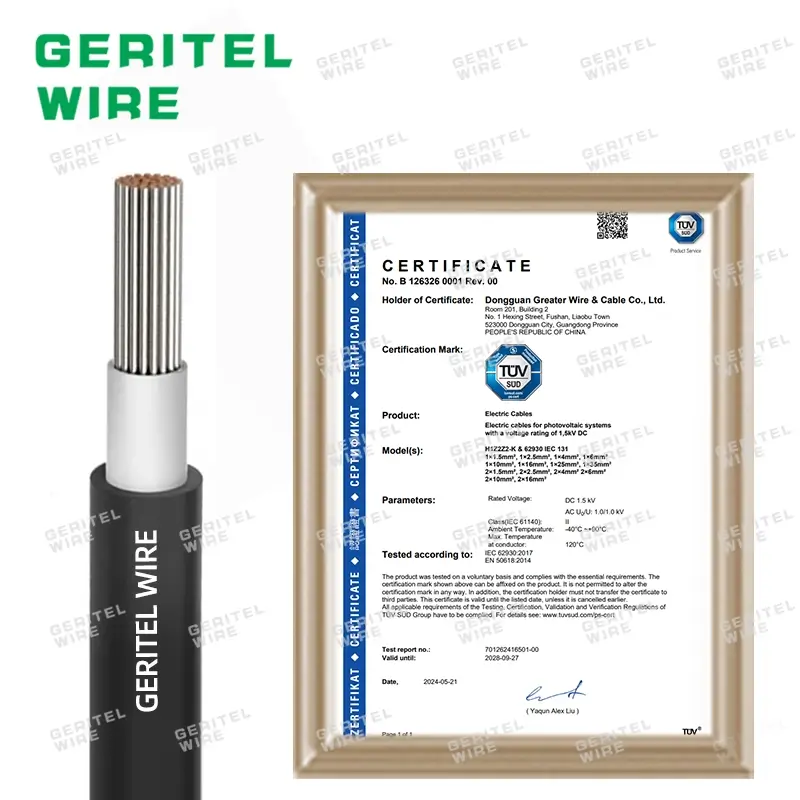
In Middle Eastern solar markets, self-declarations of "IEC compliance" proliferate, leaving clients unable to discern substantive differences. For Sde Nitzan, we provided TÜV Rheinland certification B 126326 0001 Rev.00 and UL 4703 file number E552397, transforming technical performance into verifiable, auditable commercial credentials.
TÜV certification's core value lies in testing protocol completeness: measuring not merely finished cable electrical parameters, but tracing raw material aging genetics. The 2,000-hour thermal life test at 135°C simulates post-25-year insulation performance; UV endurance testing quantifies material degradation curves under desert sunlight; flame propagation testing ensures fire non-spread and toxic gas non-release. These test data enter directly into project technical due diligence packages, becoming necessary conditions for international lender disbursement.
UL certification opens dialogue channels with North American technical systems. Though Sde Nitzan sits in Israel, project investors include US-background funds; the UL mark eliminates cross-standard comprehension costs. Our UL 1072 medium-voltage cable certification serves similarly diverse compliance scenarios—when engineers of different nationalities review identical drawing sets, certification numbers become quality consensus requiring no translation.
Execution Slices: From Copper Ingot to Desert Mount
Pre-production technical clarification spanned six weeks. Our engineers conducted three video conferences with Enlight's team, deliverables including voltage drop calculations based on actual array CAD drawings, insulation coordination analysis reports for 1500V systems, and batch traceability documentation from copper smelting to wire drawing. These documents weren't afterthought compilations, but data acquisition embedded in production workflows—every cable drum's conductor resistance, insulation thickness, and withstand voltage test curves could be associated with specific heat number copper chemistry.
Production executed IEC 62930 quality management systems, with 100% finished goods passing 4kV DC withstand voltage testing (5 minutes without puncture), conductor DC resistance measurement (deviation ≤2% of nominal), and insulation eccentricity inspection. Bureau Veritas resident inspectors independently sampled, issuing factory acceptance test reports cross-verified against our quality data.
Logistics planning accounted for seasonal congestion at Israel's southern ports, adopting six-week door-to-door delivery cycles. Cable drums were wrapped in UV protective film then sleeved in moisture barriers, adapting to desert site open-air storage conditions. All cable ends were heat-shrink sealed to prevent sand ingress during transit. Upon arrival acceptance, Enlight's warehousing team confirmed packaging integrity; upon unboxing, conductor surfaces showed no oxidative discoloration, proceeding directly to installation workflows.
Operational Echoes: When Data Begins Speaking
Following commercial operation date on August 2, 2023, Sde Nitzan entered its two-year performance guarantee period. Monitoring data to date indicate: DC side insulation resistance stable above 500MΩ/km without decay trend; infrared thermography inspections show cable termination temperatures within 3°C of conductor body temperature, indicating excellent crimping quality; the storage system has completed over 800 charge-discharge cycles, with PCS DC side cable temperature rise curves stable and no contact resistance increase from flexural fatigue.
Behind these numbers lies broader validation: the 15-year PPA with Amdocs executes smoothly, SodaStream's production lines operate on 100% Sde Nitzan-supplied green power, and Enlight's "Solar + Storage 1" cluster subsequent sites have incorporated our cables into standard material lists. Technical reliability compounds into commercial reputation.
Market Ripples: Israel's Solar-Plus Landscape After Sde Nitzan
Sde Nitzan's commissioning coincided with Israel's electricity market reform inflection point. 2024 regulations permitting renewable projects to sell directly to corporate offtakers spawned direct PPA models like Enlight's with Amdocs and SodaStream. Such models demonstrate far higher asset quality sensitivity than traditional subsidy projects—corporate buyers possess technical audit capabilities, and any generation loss across 25-year contract terms may trigger indemnification clauses.
Solar-plus-storage has become the new standard configuration. Israel's grid has limited absorption capacity for intermittent sources; new PV projects without storage face drastically harder interconnection permit approval. Sde Nitzan's 40MWh configuration provides four hours storage duration, enabling grid peak-shaving services—a model expanded to six or even eight hours in subsequent projects, imposing higher demands on DC side cable continuous current-carrying capacity and termination reliability.
1500V system architecture has achieved comprehensive penetration. From Sde Nitzan's 23MW to subsequent Arad Valley 1's 17MW, then multiple 2024 grid-connected sites, 1500V DC has become the standard option for LCOE reduction. Our cables were developed from inception for this voltage grade, with insulation thickness and tracking resistance performance maintaining margins, rather than simple uprating from 1000V systems—this forward consideration established trust differentiation during client technical clarification stages.
Invitation to Dialogue: What Cable Narrative Does Your Next Project Need
Whether you're planning distributed rooftop solar-plus systems in Israel or ground-mount facilities elsewhere in the Middle East, cable selection should transcend mere "conducts electricity" functionality. The Sde Nitzan case demonstrates that under dual constraints of 25-year lifecycle and desert environment, materials science, certification systems, and execution details constitute a project's invisible infrastructure.
Dongguan GERITEL Electrical Co., Ltd. provides full-series certified cables from module-level to grid-connection, holding complete certification portfolios including TÜV B 126326 0001 Rev.00, UL 4703 E552397, IEC 62930/EN 50618, and UL 1072. Our technical support encompasses cable cross-section optimization based on actual layouts, 1500V system insulation coordination analysis, and materials selection guidance for desert/high-temperature/high-UV environments.
Contact:
• Tel/WhatsApp/WeChat: +86 135 1078 4550 / +86 136 6257 9592
• Email: manager01@greaterwire.com
• Company: Dongguan GERITEL Electrical Co., Ltd.
 Al Ula PV BIPV Project



 Building 2, No. 40 Luxi 2nd Road, Liaobu Town, Dongguan City, Guangdong Province, China