


 Home
HomeSanta Maria Port Logistics Center, Cape Verde
 GERITEL
 Apr 11,2026

Background
The Republic of Cape Verde, an archipelagic nation situated in the central Atlantic Ocean off the western coast of Africa, is leveraging its unique geographical advantages to drive unprecedented infrastructure modernization through the "Blue Economy Sustainable Port Facilities" program, a comprehensive initiative backed by the European Union and the European Investment Bank, and within this transformative context, the Santa Maria Port Logistics Center—strategically located on Sal Island at the nexus connecting the city of Santa Maria, the deep-water Port of Palmera, and the Espargos International Airport—represents the country's first purpose-built industrial park specifically designed for modern logistics services and manufacturing activities, featuring flexible warehouse spaces ranging from 650 to 3,300 square meters that can be customized to accommodate diverse tenant requirements and operational modalities.
However, this large-scale port infrastructure project, situated in a typical tropical maritime climate characterized by high salt spray concentrations, intense ultraviolet radiation, and seasonal Saharan dust deposition, faces a complex array of interrelated technical challenges in the design and implementation of its electrical power transmission and distribution systems: first and foremost, the highly corrosive salt-laden atmosphere presents severe material degradation risks for all metallic conductors and polymeric sheath materials, creating an operating environment where conventional cable products are prone to electrochemical corrosion of conductors, embrittlement and cracking of insulation and jacket materials, and ultimately catastrophic failure modes that can result in unplanned outages and safety hazards; second, the dynamic operational requirements of port cargo handling equipment—including gantry cranes, automated stacking systems, and continuous conveyor networks—demand power cables with exceptional flexibility, abrasion resistance, and tensile strength to withstand the mechanical stresses induced by frequent starting and stopping, reciprocating motion, vibration, and shock loading that far exceed the specifications of standard building wire applications; third, the complete electrical transmission chain from external grid interconnection points through zone substations to end-use equipment requires large-conductor cross-section cables capable of carrying currents in the hundreds to thousands of amperes while maintaining precise balance among voltage drop limitations, short-circuit thermal withstand capabilities, and reactive power loss optimization; fourth, the rigid milestone requirements imposed by project financiers necessitate completion of the entire electrical system—from design specification and equipment procurement through installation and commissioning—within a compressed 12-month timeframe to meet contractual obligations for fund disbursement and avoid penalty clauses; and fifth, as a flagship infrastructure investment under the EU Global Gateway framework, all material suppliers must demonstrate full compliance with IEC/EN international standards through comprehensive certification documentation, third-party testing reports, and traceable quality management system audits, requirements that automatically disqualify numerous potential suppliers lacking international accreditation credentials.
The client's project team initially conducted thorough feasibility assessments for direct procurement of cable products from European domestic markets, only to discover that this seemingly conservative approach faced insurmountable obstacles including lead times extending to six months with no possibility of acceleration, procurement costs significantly exceeding budgetary constraints, and product specifications that exhibited poor alignment with actual project requirements resulting in either technical over-engineering or dangerous under-capacity, and it was within this challenging context that, following comprehensive technical evaluations, sample testing protocols, manufacturing facility audits, and commercial negotiations with multiple potential suppliers across global markets, the client ultimately awarded the critical cable system supply contract to Dongguan GERITEL Electrical Co., Ltd.—a decision grounded not merely in recognition of our product quality and technical capabilities, but equally in our demonstrated experience with analogous overseas port projects, responsive supply chain infrastructure, and capacity to deliver full-lifecycle services spanning from preliminary technical consultation through post-installation site support.
Challenges
During the pre-project needs assessment and technical exchange phase, our engineering team engaged in multiple rounds of in-depth consultations with the client's technical personnel, project management staff, and third-party engineering consultants, systematically identifying three interconnected dimensions that collectively constituted the primary risk sources for project execution:
Certification barriers proved insurmountable for many suppliers. Given that this project qualified for preferential loan financing from the European Investment Bank under the EU Global Gateway framework, the financing agreement stipulated mandatory compliance with IEC/EN international standards for all permanent materials and equipment suppliers, requiring comprehensive certification documentation including validated CE Declarations of Conformity from authorized Notified Bodies, type test reports covering complete product ranges, and factory quality management system audit reports demonstrating continuous standard compliance—yet preliminary market research revealed that while numerous suppliers claimed standard compliance in promotional materials, most failed to provide satisfactory responses when requested to furnish specific test report numbers, certification validity periods, or clause-by-clause conformity evidence against standard requirements, with some exhibiting serious compliance deficiencies including mismatches between certification scopes and proposed products, expired test reports, or quality management certifications failing to cover actual manufacturing locations, any of which—if discovered during the financier's technical audit—could trigger product rejection, project payment suspension, or even invocation of contractual default clauses with potentially catastrophic consequences for project funding continuity.
Environmental adaptability presented significant technical hurdles. Although Cape Verde enjoys a mild and pleasant climate year-round, the Santa Maria Port Logistics Center's coastal location experiences exceptionally high salt spray concentrations combined with intense solar ultraviolet radiation and seasonal Saharan dust deposition, creating a composite aging environment that aggressively degrades cable jacket materials, and the client's technical team had personally witnessed premature failures of standard PVC-jacketed cables in similar coastal port environments across Africa—manifesting as surface chalking, cracking, and disintegration within 3–5 years of installation, followed by moisture ingress into insulation layers, conductor oxidation and corrosion, and eventual ground faults or phase-to-phase short circuits—experiences that led to demanding requirements for optimized material formulations and structural designs capable of extending cable system service life beyond 25 years to achieve optimal life-cycle cost (LCC) economics.
Supply chain reliability conflicted with compressed delivery schedules. Detailed bill-of-quantity calculations indicated total cable requirements exceeding 350,000 meters requiring consolidation into four 40-foot standard shipping containers, with staged delivery across three shipments necessary to align with construction sequencing for civil foundation works, principal installation activities, and equipment commissioning phases, all within a compressed four-month delivery window—yet inquiries to major European cable manufacturers revealed minimum lead times of six months with no flexibility for partial shipments, implying that adherence to a European procurement strategy would expose the project to severe schedule delays, potential missing of the dry season construction window, and forced execution of outdoor electrical installation during the rainy season with attendant productivity losses and weather damage risks, while alternative Asian suppliers promising shorter lead times raised concerns regarding quality stability, inexperience with large-scale port projects, and immature operational systems for international logistics, export customs clearance, and destination port handling that introduced unacceptable supply chain uncertainties.
Solutions
Engaging in multiple technical clarification sessions with the client's electrical designers to analyze load characteristics, installation environments, operational modes, and future expansion requirements for each power consumption zone, our engineering team developed a hierarchical, zoned, and mechanically differentiated cable system configuration that optimized the balance between technical performance and economic efficiency:
Main Power Distribution
Serving as the arterial power transmission network for the entire logistics park, the main distribution infrastructure—which carries bulk electrical energy from the central substation to zonal distribution centers—demands reliability levels that directly determine overall facility safety, prompting our recommendation for a coordinated configuration of YJV cross-linked polyethylene insulated non-armored cables and SWA steel wire armored cables:
• YJV 4×240mm² XLPE Insulated PVC Sheathed Power Cable: A total of 18,500 meters supplied for main distribution circuits installed via overhead cable tray or conduit systems, connecting 10kV outgoing switchgear at the 35kV/10kV step-down substation to incoming line cabinets at warehouse zone substations, featuring high-quality oxygen-free copper conductors in four equal cross-sections accommodating three-phase power loads plus neutral current imbalance, with silane-crosslinked polyethylene (XLPE) insulation rated for 90°C continuous operation and 250°C short-circuit withstand temperatures—substantially superior to conventional PVC insulation in thermal aging resistance and current-carrying capacity, particularly suited to Cape Verde's high-temperature operating environment, while the low dielectric loss factor of XLPE significantly reduces reactive power losses over long transmission distances.
• YJV 4×300mm² Large-Section Main Supply Cable: 12,000 meters supplied for high-load concentration areas including cold storage warehouses, heavy container handling equipment zones, and reserved manufacturing spaces, with the larger conductor cross-section ensuring voltage drop from substation to end distribution panels remains within GB/T 12706 standard limits under peak loading conditions, preventing equipment starting difficulties, operational efficiency reductions, or protective device malfunctions while providing adequate capacity margins for 5–10 years of natural load growth.
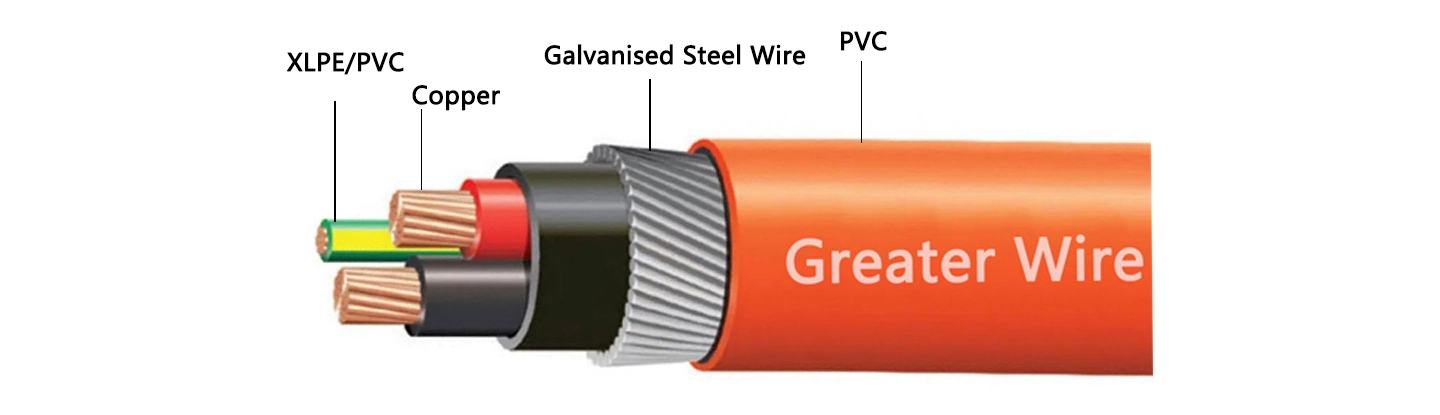
• SWA cable 4×240mm² Steel Wire Armored Power Cable: A core specification for this project, with 8,600 meters of SWA cable 4×240mm² supplied specifically for outdoor underground installation sections traversing roadways, parking areas, cargo stacking yards, and other zones subject to mechanical stress, as well as direct-buried feeder routes from the park boundary interconnection point to the central substation, featuring high-strength galvanized steel wire armor—1.6mm diameter in double-layer reverse-lay gap-type braiding—between inner and outer sheaths to provide exceptional radial compression strength and longitudinal tensile resistance against soil overburden, vehicle loading, construction excavation, and ground settlement while offering electromagnetic shielding benefits reducing interference with adjacent communication circuits.
• SWA cable 4×300mm² Wharf Front Zone Application: 6,200 meters deployed in cable trenches and protective conduits along the quay front, connecting shore power transformer outputs to vessel shore connection boxes, where steel wire armor provides supplementary mechanical protection against the complex operational conditions of vessel mooring forces, cargo handling equipment movement trajectories, and high salt spray corrosion.
• SWA cable 4×500mm² Extra-Large Section Incoming Feeder: 4,800 meters of SWA cable 4×500mm² serving as the main electrical entry point for the entire logistics park, sized based on comprehensive calculations of total anticipated load including all warehouse lighting, power, refrigeration systems, office facilities, shore power infrastructure, and reserved development land, with the extra-large conductor cross-section reducing resistive losses and voltage drop during normal operation while providing adequate thermal stability under short-circuit fault conditions.
The extensive application of SWA steel wire armored cables in this project reflects our deep understanding of port-specific environmental conditions and targeted technical countermeasures: compared to conventional steel tape armored cables, steel wire armor offers superior flexibility and resistance to bending fatigue, facilitating installation around complex terrain features and underground obstacles with larger curvature radii; the open braid structure of wire armor promotes heat dissipation during cable operation, avoiding eddy current losses and localized overheating associated with closed magnetic circuits in tape armor; and the special passivation treatment of galvanized steel wires provides corrosion resistance significantly superior to standard steel tape in Cape Verde's high-salt underground environment, ensuring long-term mechanical protection functionality.
Low-Voltage Distribution
For the low-voltage distribution level extending from zonal substations to end-use equipment—characterized by relatively lower load densities but numerous circuits and complex routing paths—we recommended the H07V-U series single-core solid conductor PVC insulated cables, whose simple construction, installation convenience, reliable terminal connections, and superior cost-effectiveness ratio make them the mainstream choice for building electrical installations:
• H07V-U 1.5mm² Single-Core Copper Conductor Cable: 42,000 meters supplied for lighting circuits, emergency lighting systems, and small switch control lines throughout warehouses and office buildings, with the 1.5mm² conductor cross-section meeting routine LED lighting load ampacity requirements while the solid conductor structure facilitates smooth pulling through metallic conduits and cable trays and ensures more secure crimp connections with standard terminals, reducing localized overheating risks from poor contact.
• H07V-U 2.5mm² Standard Socket Circuit Cable: 38,000 meters for general socket outlets in office areas, maintenance workshops, and staff facilities, complying with IEC 60364 requirements for minimum conductor cross-sections in socket circuits while providing appropriate margins for possible short-term overloads.
• H07V-U 4mm² Power Branch Cable: 15,000 meters for air conditioning system connections, ventilation equipment, and small water pumps, ensuring voltage drop remains acceptable during high inrush currents at motor starting.
• H07V-U 6mm² to 25mm² Large-Section Power Cables: 26,000 meters in aggregate across multiple sizes for main feeders from distribution panels to sub-panels and dedicated power circuits for high-capacity equipment, enabling refined power allocation from distribution centers to end devices.
The H07V-U series, rated at 450/750V with premium PVC insulation meeting all IEC 60227-3 requirements including insulation resistance, dielectric strength, thermal aging, and low-temperature winding performance, features the "U" designation indicating rigid conductor construction (solid or compacted strands) offering higher mechanical strength and terminal connection reliability compared to flexible conductors, particularly suited to fixed installations without frequent movement requirements; for Cape Verde's high-temperature environment, we specified 70°C temperature-rated insulation formulations with UV stabilizer additives for exposed tray installations.
Control and Flexible Wiring
For automated control systems, sensor networks, and equipment connections requiring installation flexibility, rigid conductor cables prove inadequate, prompting configuration of flexible cable alternatives:
• H05V-K / H07V-K (1.5mm²–4mm²): 35,000 meters for secondary control wiring within zonal distribution cabinets, fire alarm sensor loops, security monitoring device power and signal transmission, and automated inspection equipment connections, with the "K" designation indicating fine-stranded conductor construction (souple) comprising multiple 0.2mm-diameter copper wires providing exceptional flexibility and small bending radius characteristics for complex routing in confined control cabinet spaces, while ensuring tighter contact with cage spring terminals or pin connectors to reduce contact resistance and false connection risks; the distinction between H05V-K and H07V-K lies primarily in voltage ratings (300/500V versus 450/750V) and insulation thickness, with selection matched to specific circuit voltage levels and mechanical protection conditions.
• H07V-R (1.5mm²–25mm²): 28,000 meters for dynamic applications requiring frequent movement, vibration, or bending—including power supply to gantry cranes, rubber-tired gantries, conveyor systems, mobile maintenance tools, and temporary lighting—where the "R" designation indicates extra-flexible multi-stranded construction (extra-souple) with optimized lay lengths and finer wire diameters providing superior flexibility and bending fatigue life compared to H07V-K, capable of withstanding tens of thousands of reciprocating cycles at specified bending radii without damage, a critical characteristic for ensuring continuous operation of port cargo handling equipment.
End-Device Connectivity
For terminal equipment connections in packaging operation areas, maintenance workshops, laboratories, and office zones requiring both power supply and control signal transmission with convenient field installation and replacement characteristics, the H03VV-F / H05VV-F series multi-core sheathed flexible cables provide optimal solutions:
• H03VV-F 2×1.5mm² Light-Duty Multi-Core Cable: 12,000 meters for desktop computers, printers, and copiers in office areas, as well as laboratory test instruments and bench power tools, with two-core design (phase plus neutral) meeting single-phase equipment requirements and flat or circular sheath profiles facilitating concealed installation in confined spaces beneath desks and behind equipment.
• H03VV-F 3×1.5mm² Protective Earth Included: 8,500 meters for Class I hand-held power tools, kitchen equipment, and outdoor temporary power applications requiring safety grounding connections, with the third core (green/yellow) dedicated to equipment enclosure grounding to provide fault current pathways upon insulation failure.
• H05VV-F 4×2.5mm² Multi-Circuit Control Cable: 6,800 meters for automated control boxes, distribution panels, and small PLC cabinets throughout warehouses, with four-core design accommodating three-phase power or two-phase power plus control signals, the 2.5mm² cross-section satisfying small motors, solenoid valves, and indicator light power requirements, and circular sheath construction providing mechanical protection and moisture resistance.
• H05VV-F 5×4mm² Complex Control Circuit Cable: 4,200 meters for multi-channel signal transmission applications such as crane control console connections to electrical rooms and fire linkage control system wiring, with five-core design providing abundant circuit resources flexibly allocable as power, signal, or spare lines.
The H03VV-F / H05VV-F series "F" designation indicates specialized sheath structures—typically thermoplastic elastomer or high-flexibility PVC materials—with soft non-hygroscopic fillers between cores and outer sheaths exhibiting superior oil resistance, abrasion resistance, and tear strength for industrial environments where oil contact and mechanical friction are probable, while voltage ratings (300/300V or 300/500V) lower than power cables permit thinner insulation for enhanced flexibility and reduced weight.
Quality Assurance
The client's ultimate selection of Dongguan GERITEL Electrical Co., Ltd. as cable system supplier rested fundamentally on our capacity to provide comprehensive IEC/EN standard compliance documentation covering complete product ranges throughout the supply chain—documentation that not only satisfied project financier mandatory requirements but eliminated client exposure to schedule delays, funding freezes, or legal disputes arising from material compliance deficiencies:
All supplied cable products underwent type testing and factory quality control auditing against the following international standards:
• IEC 60227 "Polyvinyl chloride insulated cables of rated voltages up to and including 450/750V": Applicable to the complete range of H07V-U, H05V-K, H07V-K, and H07V-R PVC insulated cables, specifying conductor resistance, insulation thickness, electrical strength, insulation resistance, mechanical properties before and after aging, low-temperature winding performance, high-temperature pressure testing, and flame retardance—with our products demonstrating performance metrics exceeding standard requirements in third-party laboratory testing.
• IEC 60245 "Rubber insulated cables of rated voltages up to and including 450/750V": Applicable to H03VV-F and H05VV-F flexible cables, with specific requirements for ozone resistance, oil resistance, and weathering performance of elastomeric insulation and sheath materials, our formulations maintaining excellent mechanical strength and elasticity following standard accelerated aging protocols.
• IEC 60502 "Power cables with extruded insulation and their accessories for rated voltages from 1kV (Um=1.2kV) up to 30kV (Um=36kV)": Applicable to YJV series XLPE insulated power cables, specifying crosslinking degree, thermal elongation performance, shrinkage, and critical finished cable tests including partial discharge, voltage withstand, and thermal shock—with our production lines equipped with online X-ray thickness gauges and eccentricity monitoring systems ensuring insulation uniformity at industry-leading levels.
• IEC 60502-2 and IEC 60719: Providing design and test bases for SWA steel wire armored cables regarding armor structure and wire performance, our armoring process employing CNC braiding machines with automatic tension control and precise pitch adjustment ensuring armor coverage exceeds standard minimums, with salt spray testing validating corrosion resistance of galvanizing.
• EN 50525 "Electric cables—Low voltage energy cables of rated voltages up to and including 450/750V": The European harmonized standard parallel to IEC 60227 with additional CE marking, DoC, and application-specific requirements (such as flame retardance for building cables), our complete product range carrying CE marks with corresponding DoC documentation.
• RoHS 2.0 Directive (2011/65/EU) and Amendment (EU) 2015/863: Restricting hazardous substances in electrical equipment, our raw material procurement maintaining strict supplier admission and incoming inspection protocols with all insulation and sheath materials tested by SGS for RoHS compliance.
Our quality control extends throughout the manufacturing process: conductor manufacturing with resistivity testing, chemical composition spectrographic analysis, and grain size inspection for copper purity ≥99.95%; insulation extrusion with online laser thickness measurement and capacitive eccentricity monitoring for real-time closed-loop control; multi-core cable laying-up with optimized lay length calculations minimizing inter-core relative displacement; SWA steel wire armoring with double-layer reverse braiding enhancing torsional resistance and stress distribution; and finished product testing with 3.5kV/5-minute AC voltage withstand (no breakdown) and insulation resistance measurement (exceeding specified values at 20°C), plus sampling for thermal elongation, low-temperature winding, and combustion performance testing.
For Cape Verde's specific marine environment, we implemented targeted enhancements: UV stabilizer systems (absorbers and hindered amine light stabilizers) in all PVC sheaths with tensile strength and elongation retention >80% after 1000-hour QUV accelerated aging; double hot-dip galvanizing for SWA wires with zinc coating thickness ≥60g/m² and passivation treatment forming dense oxide films withstanding 500-hour ASTM B117 salt spray without red rust, ensuring 25+ year service life in C3-M (medium corrosive) marine atmospheric and C4 (high corrosive) occasional splash zones; and Bitrex bittering agents and hard fillers in SWA cable outer sheaths reducing rodent attraction and increasing surface hardness against gnawing damage prevalent in African coastal regions.
Delivery
This project involved approximately 350,000 meters of cable products consolidated into four 40-foot standard shipping containers from our Dongguan, Guangdong production base, transiting via ocean freight across the Indian Ocean around the Cape of Good Hope or through the Suez Canal (depending on vessel scheduling) to Mindelo Port, Cape Verde, with final domestic transport to the Santa Maria construction site—a complex supply chain spanning two continents and multiple transportation modes that tested our production planning, inventory management, export customs clearance, ocean freight booking, destination port clearance, and last-mile delivery capabilities, which we successfully executed through refined project management and close collaboration with clients and logistics service providers:
Flexible Three-Batch Production Scheduling Strategy: Aligning with port construction sequencing and limited on-site storage capacity, we developed a rolling three-batch production and delivery plan with the client: first batch (August 2024) focusing on large-section YJV and SWA series main distribution cables totaling 50,100 meters—including all YJV 4×240mm² (18,500m), YJV 4×300mm² (12,000m), SWA cable 4×240mm² (8,600m), SWA cable 4×300mm² (6,200m), and SWA cable 4×500mm² (4,800m)—arriving mid-September to meet critical path requirements for central substation and main cable trench construction; second batch (October 2024) comprising 121,000 meters of H07V-U low-voltage distribution cables across full size ranges, arriving early November to match warehouse structural completion and electrical installation ramp-up; third batch (December 2024) including 178,600 meters of control and flexible cables (H05V-K, H07V-K, H07V-R, H03VV-F, H05VV-F), arriving early January during equipment commissioning peak demand while avoiding Christmas and New Year logistics congestion.
Customized Packaging, Labeling, and Documentation: For the extensive specification range, we implemented specialized designs: ISPM 15-compliant fumigated wooden or steel-wood cable drums with weather-resistant painted flanges clearly marked with project number "CV-SMP-2024", complete cable specifications (e.g., "SWA cable 4×240mm²"), manufacturing standards (IEC 60502), rated voltage (0.6/1kV), drum numbers, gross/net weights, lengths, manufacturing dates, and GERITEL branding; Portuguese-English bilingual tags with technical parameters and safety warnings for local construction personnel; and comprehensive shipping documentation including commercial invoices, packing lists, Form A certificates of origin, IEC/EN test report copies, CE DoCs, material test certificates (MTC), and Cape Verde Pre-Shipment Inspection (PSI) certificates—all embassy and chamber of commerce certified to prevent customs clearance delays.
Full-Visibility Logistics Tracking and Customs Support: Through strategic partnerships with international freight forwarders providing factory pickup, export customs, ocean booking, destination clearance, and inland transport door-to-door services with online tracking systems sharing real-time cargo position and status; and through early selection (six months pre-project) of a Mindelo Port-experienced local customs broker with excellent relations with customs and port authorities, we achieved average clearance times of just three working days per container—well below the local 7–10 day average—with zero demurrage charges from documentation discrepancies, declaration errors, or inspection failures.
Results
By Q1 2025, the Santa Maria Port Logistics Center cable system was fully installed, passing joint completion acceptance by the client, supervising engineers, Electra (Cape Verde's national power utility), and EU funder representatives, and entering trial operation with outcomes exceeding expectations across multiple dimensions:
Quality Verification Excellence: Throughout 350,000 meters of cable installation, zero product quality defects requiring return or replacement occurred; SGS third-party testing of 12 randomly selected samples showed conductor DC resistance (at 20°C) 8–15% below IEC standard maximums, insulation thickness uniformity deviation <5%, and tensile strength/elongation aging change rates well below standard allowances—all significantly superior to basic IEC/EN requirements reflecting manufacturing excellence and material stringency.
Cost Control and Schedule Optimization: Compared to the initially investigated European domestic procurement option, our solution saved approximately 32% in direct material procurement costs—stemming from Chinese manufacturing scale effects, supply chain completeness, and raw material price fluctuation hedging—while compressing delivery from six-plus months to under four months with precise batch delivery avoiding on-site storage costs and capital tie-up, enabling overall electrical installation completion six weeks ahead of schedule and successfully avoiding Cape Verde's rainy season (July–October) with its productivity reductions, equipment protection requirements, and rework risks, generating economic value far exceeding material savings.
Operational Reliability Assurance: Since trial operation commencement, zero cable fault-induced power interruptions or equipment shutdowns have occurred, with voltage quality and supply continuity meeting design expectations; this reliable electrical infrastructure provided critical support for the client's successful passage of EU funder final acceptance audits in early 2025 and full project retention payment receipt, establishing the logistics center as Cape Verde's first fully operational, internationally standardized modern port logistics facility under the "Blue Economy" national strategy, laying foundations for attracting international shipping companies and multinational logistics operators.
Partnership Value
In internal project summary meetings, the client's project management team identified three core value propositions in selecting Dongguan GERITEL Electrical Co., Ltd.:
Certification completeness eliminated compliance risks. In EU Global Gateway framework projects, material international standard compliance is not competitive advantage but fundamental requirement determining financing access, audit passage, and legal exposure avoidance—we provided not merely compliant products but a verified, traceable, audit-ready compliance documentation system including TÜV, SGS, and Intertek type test reports, ISO 9001/14001/45001 certifications, and batch-specific inspection reports and DoCs, eliminating client material compliance concerns throughout the project cycle.
Tropical port experience enabled targeted optimization. Our core technical team members possess 10+ years overseas project cable supply experience with deep involvement in West African port expansions (Tema, Ghana; Lekki Deep Sea Port, Nigeria; Tanger Med, Morocco), Middle East oil terminals, and Southeast Asian export processing zones—environments highly similar to Cape Verde's conditions, enabling early identification of standard product adaptability deficiencies and proposing targeted improvements: double galvanizing for SWA corrosion protection, UV stabilizer-enhanced PVC formulations, and rodent-resistant sheath hardness optimization—increasing our production costs but significantly enhancing long-term reliability in specific environments and creating substantial life-cycle cost value.
Vertical integration delivered supply chain agility. Unlike manufacturers relying on subcontracting or partial outsourcing, GERITEL maintains full-chain in-house capabilities from copper rod drawing through finished product testing, enabling complete production schedule autonomy unaffected by upstream supplier delays or subcontractor capacity fluctuations; from contract signing to first shipment in just 45 days, with 350,000 meters completed in four months across three batches—industry-leading responsiveness translating for schedule-sensitive port projects into lower financial costs, higher schedule certainty, and enhanced risk resilience, with our dedicated logistics team and long-term freight forwarder partnerships ensuring factory-to-site controllability and efficiency.

Client Feedback
While direct quotation is precluded by confidentiality agreements, technical evaluation reports and subsequent business communications indicate high client satisfaction, particularly regarding SWA cable 4×240mm² installation performance in wharf front zones—where steel wire armor flexibility exceeded expectations for cable trench routing around bollard foundations and ground settlement adaptation, with jointing and termination proving more convenient than previously used tape-armored alternatives, and YJV series lightweight design (40% weight reduction versus equivalent oil-impregnated paper cables) reducing structural load and steel support costs.
With the Santa Maria Port Logistics Center's commercial operation commencement in H1 2025, handling container transshipment and cold chain logistics from Europe, Africa, and South America, and establishing itself as Cape Verde's key infrastructure node for global trade participation, Phase II expansion discussions are underway for 2026 launch including approximately 50,000m² additional cold storage, 500,000 TEU annual capacity container yard automation, and dedicated freight rail electrification connecting to Port of Palmera—bringing requirements for 220kV high-voltage XLPE cables, large-section submarine cables for inter-island transmission, and advanced intelligent cable monitoring systems, which we anticipate supporting with our technical expertise, quality commitment, and service dedication.

Contact Us
Whether planning port expansion and modernization, large logistics parks and free trade zones, industrial manufacturing bases and export processing zones, or urban grid renovation and new energy integration projects, cable system specification decisions will influence project reliability, safety, and economics over 20–30 year operational lifecycles, where incorrect specification selection, quality batch issues, or delivery delays can cause millions in direct losses and immeasurable missed commercial opportunities.
Dongguan GERITEL Electrical Co., Ltd., with complete IEC/EN standard certification coverage, deep engineering experience in tropical maritime climate port projects, and vertically integrated manufacturing enabling rapid delivery, has provided complete cable solutions from high-voltage transmission to end-device connectivity for major infrastructure projects across 30+ countries—including international EPC contractors, national utilities, major industrial groups, and emerging market local developers—with each success story demonstrating our professional capabilities.
Contact us now for customized cable configuration proposals, detailed technical specifications, and competitive commercial quotations tailored to your specific project requirements:
Dongguan GERITEL Electrical Co., Ltd.
Tel/WhatsApp/WeChat: +86 135 1078 4550 / +86 136 6257 9592
Email: manager01@greaterwire.com
Address: Dongguan City, Guangdong Province, China
 Cameroon Government Complex Renovation Project



 Building 2, No. 40 Luxi 2nd Road, Liaobu Town, Dongguan City, Guangdong Province, China