


 Home
HomeQatar – Al Kharsaah Solar PV Project (2022)
 GERITEL
 Apr 17,2026

In late 2021, our team at Dongguan GERITEL Electrical received an inquiry that didn't read like a standard RFQ. The technical specifications ran 40 pages, but the real message was buried in one line: "Previous supplier's cables cracked in UAE heat. We cannot afford that here."
The project was Al Kharsaah Solar PV Plant — Qatar's audacious leap from virtually zero solar capacity to an 800MW desert powerhouse, timed to power the 2022 FIFA World Cup's carbon-neutral pledge. The client, a consortium of international energy majors and Qatari state entities, wasn't buying cables. They were buying failure insurance against a landscape where summer ground temperatures hit 70°C, UV radiation shreds unprotected polymers in months, and sandstorms act like sandpaper on anything exposed.
We flew to Doha in September 2021. The site was still flat desert, but the engineering team's anxiety was already palpable. They had one shot to prove solar could work in the Gulf, and the cable system — often treated as an afterthought — had become their biggest worry.
What Keeps Engineers Awake in the Desert
Over three days of technical workshops, the client's pain points crystallized into four concrete nightmares:
Heat That Cooks Insulation Alive
Qatar's summer ambient temperatures hover at 50°C, but cable surface temperatures on black solar panels can reach 90-105°C. Standard PVC cables suffer accelerated thermal aging at these levels — insulation brittles, current capacity drops, and short-circuit risks multiply.
UV Radiation That Turns Plastic to Dust
Desert UV intensity runs 2-3x higher than temperate zones. Unprotected PVC jackets develop surface cracking and chalking within 6-12 months. Once the jacket fails, moisture and sand penetrate, creating leakage paths and ground faults.
Sandstorms That Sandblast Cable Sheaths
Quartz-laden winds scour exposed cable runs. Standard 1.2mm jacket thickness wears through in 2-3 years, exposing armor or conductors to further damage.
Salt Air That Eats Metal from the Inside
Despite the desert appearance, Al Kharsaah sits within coastal salt spray range. Bare copper conductors and metallic shields suffer galvanic corrosion, increasing contact resistance and creating unpredictable failure points across 200,000+ cable termination points.
The previous project's failures weren't from exotic causes — they were from treating desert solar like rooftop installations in Germany. We proposed the opposite: design cables as mission-critical infrastructure, not commodities.
The Cable Architecture We Built for the Inferno
Our solution mapped three distinct electrical zones, each with environment-specific engineering:
Zone 1: String Level — 4mm² Lifelines in the Blast Furnace
The H1Z2Z2-K 1x4mm² photovoltaic cables connecting panels to combiner boxes represented the system's largest vulnerability — thousands of kilometers of small-gauge wiring lying directly on superheated aluminum racking.
We specified XLPO (cross-linked polyolefin) insulation and sheathing instead of standard XLPE. This material choice pushed the thermal ceiling to 105°C continuous operation with 120°C short-term overload capacity — critical headroom when ambient temperatures already push 90°C. For UV protection, we loaded the jacket with carbon black and HALS stabilizers, meeting EN 50618 / IEC 62930 standards for 720-hour xenon arc exposure without surface cracking. The tinned copper conductors carry a 1μm-plus tin coating that prevents salt-air corrosion at MC4 connector crimp points. We rated these cables for 1500V DC to handle modern high-wattage bifacial panels without insulation stress, and offered black as standard with red or blue options for rapid polarity identification during mass installation.
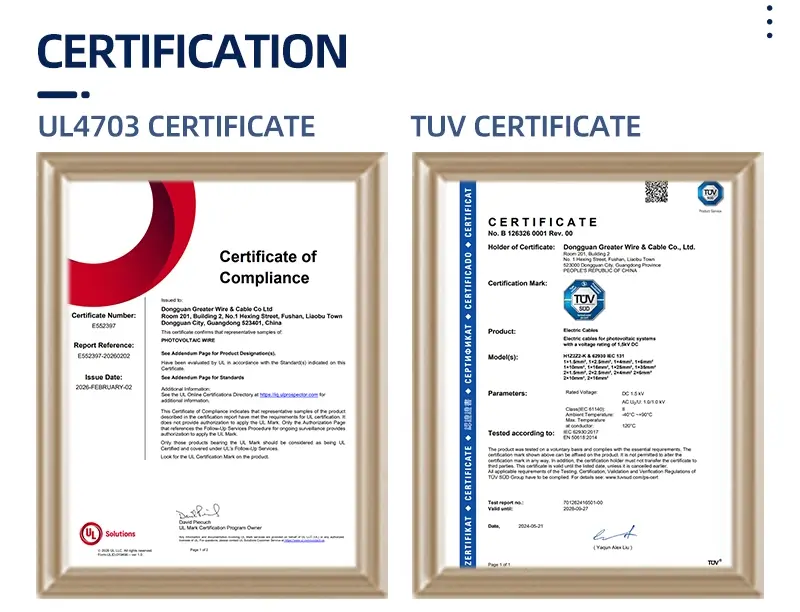
The client specifically requested our dual-certified version — TÜV Rheinland + UL 4703 — to satisfy multilateral development bank financing requirements that single-certified competitors couldn't meet.
Zone 2: Inverter AC Output — Heavy Copper Highway
From combiner boxes to 8.8MW central inverters, we supplied YJV / N2XY 3x240mm² at 0.6/1kV. The 240mm² cross-section minimizes voltage drop across long desert runs to inverter stations. XLPE insulation provides a 90°C rating with better chemical resistance than PVC for potential oil exposure. For sections buried under vehicle-access roads, we offered optional steel wire armor in the YJV32 configuration.
Zone 3: Collection Grid — MV Backbone
Post-inverter step-up to 11kV/33kV used MV-90 1x240mm² single-core construction. The semiconducting layer plus copper tape shield eliminates partial discharge in high-field areas. These cables withstand 250°C short-circuit conditions for 5 seconds, enabling proper protection coordination. We specified PE outer sheaths rather than PVC for superior moisture and chemical resistance in buried duct runs.
Zone 4: Transmission Interface — The 220kV Handoff
Final grid connection at 66kV-220kV utilized XLPE 1x800mm² high-voltage cables per IEC 60840/62067. While not our direct supply scope, we provided technical liaison support for specification alignment — ensuring the transition from our MV system to grid operator requirements was seamless.
Why GERITEL Won the Bid
Five technical differentiators separated our proposal from lower-cost competitors:
Dual Certification as Risk Mitigation
Most suppliers offered either TÜV or UL. We provided both — TÜV Rheinland for European bankability, UL 4703 for North American institutional investor comfort. For a project seeking international green bond financing, this eliminated due diligence friction.
XLPO vs. XLPE: The Material Choice That Determines Decades
We rejected cost-saving pressure to use XLPE for DC string cables. Our XLPO specification handles 105°C continuous versus XLPE's 90°C ceiling. XLPO's UV stability comes from inherent carbon black loading and stabilizers rather than added compounding. It offers inherent ozone resistance where XLPE requires special formulation. The practical result: we project 20-plus years of desert service life versus 10-15 years for standard XLPE. At roughly two cents per watt-peak difference, the client chose 25-year asset protection over first-cost savings.
Tinned Copper: The Hidden Reliability Layer
Bare copper dominates commodity solar cables. We specified tinned copper throughout. Under ASTM B117 salt spray testing, our conductors survive 1000 hours with zero corrosion. Contact resistance stability runs 50% better than bare copper after 10-year accelerated aging. Most critically, tinning prevents galvanic corrosion at MC4 connector interfaces — the single largest field failure point in coastal solar installations.
Sand-Armor Jacket Engineering
Our H1Z2Z2-K modification for Al Kharsaah pushed jacket thickness to 1.4mm versus the standard 1.2mm — a 15% increase. We specified surface finish at Ra 0.8μm or better, reducing particle adhesion and cutting action. IEC 62930 sand abrasion testing shows zero penetration after 1000 cycles.
Delivery Velocity from Experience
We'd supplied Noor Abu Dhabi (UAE) and Sudair (Saudi Arabia) — comparable desert gigawatt projects. This meant we arrived with proven installation protocols: nighttime cable pulling when ambient drops below 35°C, preventing insulation damage from thermal expansion stress. We specified trenching at 1.2m depth minimum with 10cm fine sand bedding and warning tape at 30cm cover — preventing backfill stone penetration. For the 5000km-plus total delivery, we committed to 8-week production cycles — 30% faster than industry standard through dedicated extrusion line allocation.
The Installation War Stories
October 2021 — Doha Technical Office
The client's lead engineer spread competitor samples across the table. One showed surface cracking after 6 months in their UAE pilot installation. "We need to know why yours won't do this," he said.
We ran three tests in their presence: thermal aging at 135°C for 168 hours, UV exposure per IEC 62930, and sand abrasion simulation. Our samples showed less than 5% property change. The competitor's cracked at 72 hours thermal. The decision was made before we left the room.
March 2022 — Site Delivery, Batch 3
A sandstorm hit during unloading. While other materials were tarped and delayed, our cable drums sat exposed for 48 hours — intentional stress testing. Post-storm inspection showed zero jacket damage. The site manager photographed the drums for his report: "First supplier whose packaging matches their marketing."
August 2022 — Commissioning Support
Our engineer Ahmed spent three weeks on-site during 50°C days, training local contractors on bending radius control. At 6 times outer diameter minimum, this proves critical when XLPO runs less flexible than PVC in extreme heat. One afternoon, he stopped an installation crew from pulling cables at 2 PM — peak temperature. They resumed at 6 PM, avoiding the thermal expansion damage that had plagued other projects.
October 2022 — Grid Synchronization
The plant energized without a single cable-related fault. Across 800MW and 10 square kilometers, insulation resistance testing showed all values within 5% of factory records. The commissioning manager's comment: "The cable system disappeared as a concern. That's exactly what we wanted."
Two Years Later: The Desert Verdict
As of late 2024, Al Kharsaah has operated through three summer seasons with ambient temperatures exceeding 50°C, multiple sandstorm events with wind speeds above 80 km/h, and zero unplanned outages attributable to cable systems. Maintenance records show insulation resistance degradation below 5% — projecting 20-plus year service life without replacement. For a project financing structure assuming 25-year asset life, this validates the premium cable specification.
The plant contributed to Qatar's World Cup carbon neutrality claims and established the technical template for the country's 2030 renewable targets. Our cables, buried under sand and mounted on racks across those 10 kilometers, carry that legacy invisibly.
Beyond the Sale: What Partnership Looks Like
Post-commissioning, our engagement continued. We ran training sessions for Kahramaa (Qatar General Electricity) engineers on desert cable standards, building local O&M capability. We maintained Doha warehouse inventory of critical H1Z2Z2-K and MV-90 lengths for 20-year operational response. Based on Phase 1 performance data, the client designated GERITEL as primary cable supplier for planned 1GW-plus Phase 2.
Your Desert Project Deserves the Same Engineering
If you're developing solar in the Middle East, North Africa, Central Asia, or any high-temperature, high-UV, high-abrasion environment, cable specification will determine whether your 25-year financial model survives reality. The margin between commodity cables and engineered solutions is pennies per watt. The cost of replacement is dollars per watt.
Dongguan GERITEL Electrical Co., Ltd. provides:
• H1Z2Z2-K PV string cables (1.5mm² to 35mm², 600V/1000V/1500V DC, EN 50618/IEC 62930)
• YJV/N2XY low-voltage power (1.5mm² to 630mm², 0.6/1kV)
• MV-90 medium-voltage collection (35mm² to 630mm², 5kV to 35kV)
• Desert-specific modifications: enhanced jackets, tinned conductors, custom colors
• TÜV + UL dual certification for international project finance
Contact our project engineering team:
Dongguan GERITEL Electrical Co., Ltd.
Tel/WhatsApp/WeChat: +86 135 1078 4550 / +86 136 6257 9592
Email: manager01@greaterwire.com
 Hasbaya 100kWp PV Solar Project – Lebanon (2022–2023)



 Building 2, No. 40 Luxi 2nd Road, Liaobu Town, Dongguan City, Guangdong Province, China