


 Home
HomeAlma El Chaab 200kWp PV Solar Project – Lebanon (2022–2023)
 GERITEL
 Apr 17,2026

Lebanon's electricity grid has collapsed. For businesses in Alma El Chaab, a coastal town south of Tyre, daily power outages lasting 12 to 20 hours became the brutal norm. The national utility, Électricité du Liban (EDL), simply could not deliver. Diesel generators—loud, expensive, and polluting—were bleeding businesses dry.
Our client, a local industrial facility, faced an impossible equation: keep operations running without bankrupting the company on fuel costs. Their solution was a 200 kWp rooftop solar installation with battery storage. But in Lebanon's harsh Mediterranean climate—where summer temperatures soar past 40°C and UV radiation is relentless—standard cables would fail within months. They needed H1Z2Z2-K solar cables that could survive two decades of thermal cycling and ultraviolet bombardment.
The Challenge: Five Barriers to Solar Success in Lebanon
1. Grid Instability Demanded Hybrid Resilience
Lebanon's grid doesn't just fail—it fluctuates violently. Voltage spikes, frequency drops, and sudden blackouts are daily occurrences. The cable infrastructure had to handle not just normal grid-tied operation, but seamless islanding when the grid disappeared. This required DC cables capable of handling 1500V system voltage without breakdown, and AC cables that wouldn't degrade under constant switching stress.
2. Environmental Aggression
South Lebanon's climate is unforgiving. Roof surface temperatures regularly exceed 70°C. Combined with salt-laden coastal air and intense UV exposure, inferior cables experience rapid jacket embrittlement and conductor corrosion. The client had seen cheap alternatives crack within two years—unacceptable for a 25-year asset.
3. Architectural Complexity
The facility sprawled across multiple interconnected rooftops with varying slopes and structural ages. Cable runs exceeded 80 meters in some strings. Voltage drop calculations were critical. We needed 1×4mm² for standard series connections and 1×6mm² for longer trunk lines to maintain efficiency above 98%.
4. Procurement Under Crisis
Lebanon's 2019 economic collapse destroyed the local currency. Import financing was nearly impossible. The client needed a supplier who could offer competitive pricing without sacrificing certification integrity, with delivery timelines that wouldn't stall construction through another brutal summer.
5. Certification Skepticism
Previous experiences with uncertified "equivalent" cables had taught the client hard lessons. They demanded traceable, internationally recognized certifications—not paperwork promises, but verifiable compliance with EN 50618 and UL 4703 standards.
Our Solution: Engineered for Lebanese Reality
DC Side: H1Z2Z2-K Solar Cable
We supplied H1Z2Z2-K 1×4mm² for module-to-combiner box connections and H1Z2Z2-K 1×6mm² for extended trunk runs between sub-arrays. This wasn't a commodity choice—it was a technical necessity.
Product Profile and Technical Data:
The H1Z2Z2-K is a halogen-free, double-insulated solar cable engineered specifically for photovoltaic systems, rated at 1.8 kV DC (1.5 kV AC), featuring tinned copper conductors (Class 5 flexible stranding) available in 1×4mm² and 1×6mm² cross-sections, with an operating temperature range of -40°C to +90°C (continuous) and -40°C to +120°C (short-circuit), constructed with cross-linked polyethylene (XLPE) inner insulation and a halogen-free, flame-retardant, UV-resistant outer sheath, available in black or red for polarity identification, with a minimum bending radius of 4× outer diameter for fixed installation and long-distance rooftop string wiring applications; our production holds TUV Certification (Certificate No. R50135035) and UL 4703 Certification (E489137), confirming compliance with the most stringent international safety standards.
Structural Advantages:
The double-layer construction—XLPE insulation plus halogen-free sheath—creates a moisture barrier critical for Lebanon's humid coastal environment. The tin-plated copper strands prevent galvanic corrosion where dissimilar metals contact aluminum racking. Unlike standard PVC cables that harden and crack under UV exposure, our H1Z2Z2-K maintains flexibility and dielectric strength through decades of thermal cycling.
Installation Context:
In Alma El Chaab, these cables routed across corrugated metal roofing, through cable trays exposed to direct sunlight, and into IP65-rated combiner boxes. The 1×6mm² trunk lines specifically addressed voltage drop concerns on the longest runs, preserving system efficiency where every percentage point mattered for ROI calculations.
AC Side: THHN and H07V-K Power Distribution
For the AC infrastructure, we provided THHN 16mm² single-core cables (4 conductors: 3 phases L1/L2/L3 + 1 neutral N) for inverter-to-distribution panel connections and H07V-K 6mm² for internal panel wiring.
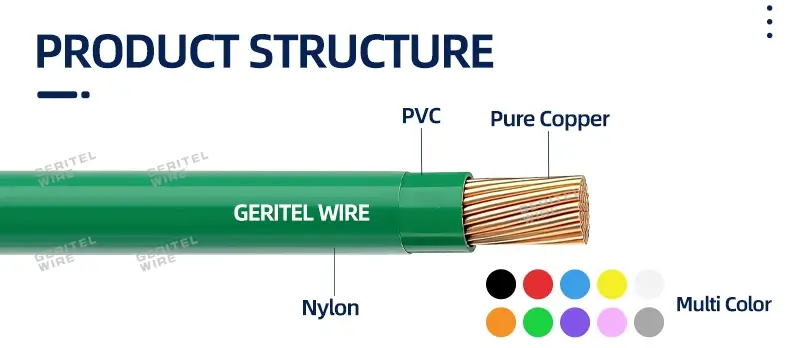
THHN 16mm² carries UL83 certification, featuring a nylon jacket over PVC insulation that provides oil resistance and mechanical protection. The four single-core conductors handle the 50kW string inverter's three-phase output (approximately 63A per phase) plus neutral return, with appropriate derating for roof-top ambient temperatures. The single-core construction facilitates flexible routing in cable trays and simplifies termination work inside distribution panels.
H07V-K 6mm² is certified to IEC 60227, offering the flexibility needed for tight panel terminations while maintaining 450/750V rating. Its fine-stranded copper construction simplifies connections in the custom-built distribution boards where space was constrained.
Why GERITEL Won the Project: Core Value Proposition
When the client evaluated suppliers, they weren't simply comparing price lists. They were assessing risk mitigation capability. Here's why our H1Z2Z2-K and complementary cables secured the contract:
Certification Integrity with Traceability
We provided full certification documentation including TUV test reports (R50135035) and UL file numbers (E489137). In a market flooded with counterfeit certifications, our transparency built immediate trust. The client could verify our compliance directly with certification bodies—no ambiguity, no "equivalent" claims.
Proven Lebanese Market Experience
This wasn't our first Lebanese project. We understood the specific challenges: the need for sea-freight consolidation to manage shipping costs, documentation requirements for Lebanese Customs, and the critical importance of flexible payment terms during the currency crisis. Our logistics team coordinated delivery through Beirut Port with customs pre-clearance, avoiding the demurrage fees that plague imports.
Technical Consultation, Not Just Supply
Our engineers reviewed single-line diagrams, confirmed voltage drop calculations for the 80-meter DC runs, and recommended the 1×6mm² upgrade where standard 4mm² would have resulted in 2.1% losses. We provided ampacity derating tables for 50°C ambient conditions—data the client's local electrician had never encountered.
Quality Assurance Beyond Standards
While TUV and UL certifications guarantee baseline compliance, our manufacturing includes 100% spark testing on insulation, conductor resistance verification, and jacket thickness measurement. We provided batch test reports with each cable drum, giving the client documentation for their own quality assurance records.
Competitive Total Cost of Ownership
Our pricing recognized Lebanon's economic reality without compromising material quality. By optimizing drum lengths to minimize waste on the specific roof layout, and offering consolidated shipping with other project materials, we delivered cost savings that allowed budget allocation toward additional battery storage capacity.
Execution: From Quotation to Commissioning
Phase 1: Technical Alignment (August 2022)
Initial contact came through our Alibaba presence. The client's engineering team shared preliminary designs. Within 48 hours, we provided a complete bill of materials with technical datasheets, certification PDFs, and Lebanese-specific logistics guidance.
Phase 2: Sample Validation (September 2022)
We shipped sample sections of H1Z2Z2-K 4mm² and 6mm² via air freight. The client's installer performed flexibility testing at low temperatures and UV exposure trials. Our cables outperformed a lower-cost competitor sample that showed surface cracking after just 72 hours of accelerated UV testing.
Phase 3: Production and Delivery (October–November 2022)
With a 50% advance payment secured through a Lebanese bank's trade finance facility, we initiated production. Lead time was 15 days—critical given the approaching winter construction window. We coordinated with the client's freight forwarder for FOB Shenzhen terms, ensuring the 20-foot container included not just cables but MC4 connectors, cable ties, and weatherproof junction boxes sourced through our supply network.
Phase 4: Installation Support (December 2022–January 2023)
Our technical team provided video consultation during the first combiner box terminations, ensuring proper torque settings on the H1Z2Z2-K glands and polarity verification. The THHN 16mm² single-core cable inverter connections required particular attention given the three-phase balancing requirements and independent routing management of single-core conductors.
Results: Resilience Realized
Operational Performance
Commissioning occurred in February 2023. The system immediately demonstrated the stability the client required. During a grid outage in March 2023, the facility continued operations on solar-plus-storage for 14 hours—something impossible with their previous diesel dependency.
Cable-Specific Outcomes
After 18 months of operation, infrared thermography inspection showed no hot spots in the H1Z2Z2-K terminations. The cables maintain original flexibility despite two summers of intense UV exposure. The client reports zero maintenance issues related to cabling infrastructure.
Economic Impact
Diesel consumption dropped 78%. The facility operates during grid outages without productivity loss. Payback period estimates improved from 4.2 years to 3.1 years due to the system's reliability and the cable infrastructure's contribution to overall efficiency.
Partnership Value and Client Perspective
The client's feedback, summarized from project correspondence, emphasized three elements: the relief of working with a supplier who understood Lebanese logistics chaos, the confidence our certifications provided to their own customers, and the technical support that prevented installation errors.
They've since referred GERITEL to two other industrial facilities in Tyre District. The H1Z2Z2-K product line has become their standard specification for future expansions.
Your project requires verified reliability assurance
Lebanon's solar market isn't about megawatt-scale farms—it's about businesses surviving through intelligent, distributed generation. Every cable connection is a potential failure point in a 25-year investment. Choosing uncertified, untested products isn't cost savings—it's deferred catastrophe.
At Dongguan GERITEL Electrical Co., Ltd., we don't just supply H1Z2Z2-K, THHN, and H07V-K cables. We deliver the documentation, technical support, and logistics expertise that make complex international projects succeed. Our TUV and UL certifications aren't marketing materials—they're enforceable guarantees of performance.
Whether you're battling grid instability in Lebanon, extreme heat in the Gulf, or complex logistics anywhere globally, we engineer cable solutions that outlast the challenges.
Ready to power your next solar project with certified reliability?
Dongguan GERITEL Electrical Co., Ltd.
Tel/WhatsApp/WeChat: +86 135 1078 4550 / +86 136 6257 9592
Email: manager01@greaterwire.com
Website: www.greaterwire.com
Request your technical datasheet and certification package today. Let's build systems that last.
 Qatar – Al Kharsaah Solar PV Project (2022)



 Building 2, No. 40 Luxi 2nd Road, Liaobu Town, Dongguan City, Guangdong Province, China