


 Home
HomeU.A.E Al Dhafra Solar Photovoltaic IPP
 GERITEL
 Apr 17,2026

August 2021. The construction site at Al Dhafra desert, Abu Dhabi. Thermometer reading: 52°C. The project manager from China National Machinery Industry Corporation (CMEC) stared at a freshly unwrapped batch of PV cables—fine cracks already spiderwebbing across the jacket surface. Not shipping damage. Material stress response to extreme heat.
"If we lay these down, we're looking at a complete replacement within two years." The technical lead ran the numbers: 2GW plant, nearly 4 million bifacial modules. Any large-scale replacement meant tens of millions in losses plus schedule delays. Under the IPP model, every day of delayed grid connection translated to millions in power purchase agreement penalties.
This wasn't an isolated incident. The Middle East solar market was experiencing explosive growth, yet cable failures were becoming the silent killer. Standard PVC cables aged 3-5 times faster under desert UV exposure than in temperate climates. Nighttime temperature drops to 25°C caused conductors to thermally cycle repeatedly, loosening terminals and creating arc faults. Coastal salt fog accelerated copper corrosion. The client's core anxiety was never "which cable to buy"—it was "will this thing actually last 25 years?"
Why Standard Solutions Fail in the Desert
The Al Dhafra project's uniqueness lay in its "triple assault" environment:
Thermal stress was the primary enemy. Summer surface temperatures hit 70°C, with conductor temperatures running 80-90°C continuously. Standard XLPE cable ampacity ratings are calculated for 30°C ambient—in desert conditions, you must derate by 30%. Same cross-section, significantly less power capacity. Size according to standard specs, and you're running chronic overload. Insulation life plummets from a designed 25 years to 8-10.
UV radiation and ozone created chronic erosion. Desert solar irradiance exceeds 1200W/m². High-energy UV photons fracture polymer molecular chains. Jacket chalking and cracking are inevitable. More insidious is ozone corrosion—desert ozone concentrations from sunlight-air reactions exceed industrial zones. Standard PVC materials embrittle within 3 years.
Mechanical and chemical loads were severely underestimated. Fine sand particles act as abrasives under wind action. Direct-buried cable jacket wear far exceeded predictions. Groundwater salinity (TDS>3000ppm) created electrochemical corrosion of metal conductors. A European brand cable the client initially selected performed perfectly in lab testing, yet showed conductor blackening and contact resistance spikes after just 3 months in the field.
These pain points pointed to one truth: Desert solar isn't a "hotter version" of standard plants—it demands fundamentally different materials science and engineering logic.
From "Firefighting" to "Fire Prevention": A Failure-Analysis-Based Selection Rebuild
When we entered the project, the client had already rejected two suppliers. They didn't ask for quotes. They slammed a stack of failure reports on the table: "Tell us why your cables won't repeat these mistakes."
Our response wasn't a product brochure. It was a risk map based on Middle East project failure cases:
On the DC side, we vetoed the PV1-F single-insulation structure the client initially favored. This model performs well in European distributed projects, but mechanical damage risk is underestimated in desert utility-scale plants. We recommended H1Z2Z2-K 1×6mm² dual-insulation PV cable—inner irradiated cross-linked polyethylene (XLPE) for base insulation, outer irradiated polyolefin jacket for environmental protection. Even if the outer layer is cut by sand and stone during installation, the inner layer maintains system voltage (1.5kV DC) insulation. This "redundant design" is common in aerospace cabling but represents advanced configuration in the PV sector.
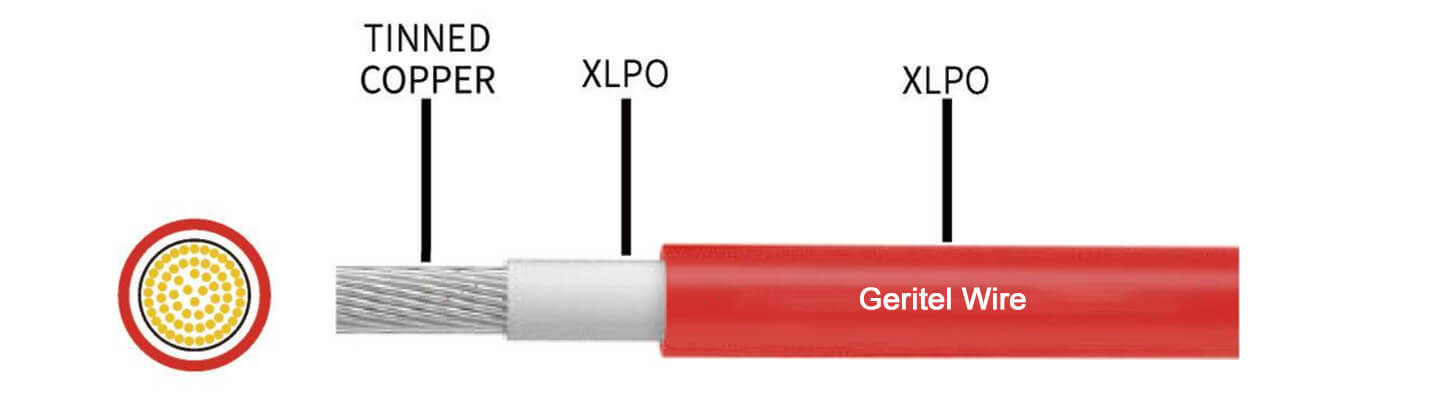
Material formulation is the key differentiator. Our jacket incorporates HALS (Hindered Amine Light Stabilizers) and carbon black dispersion, achieving UV-resistant highest grade (per EN 50618:2014). In QUV accelerated aging tests, tensile strength retention exceeded 85% after 2000 hours irradiation, while standard materials failed at 800 hours. In Abu Dhabi's real environment, 25-year service life isn't marketing speak—it's calculated material lifespan.
In the medium-voltage collection segment, we identified an overlooked detail: the client's original scheme used aluminum conductors to reduce costs, ignoring connection point loosening from desert diurnal temperature swings. Aluminum's thermal expansion coefficient is 42% higher than copper. Under daily 20°C temperature cycles, bolted connection creep effects cause contact resistance rise and local overheating within 2-3 years. We insisted on 3×240mm²/3×300mm² copper conductor 33kV XLPE cable, paired with bimetal transition terminal solutions—15% higher initial cost, but eliminating outage risks from connection failures in years 5-8.
Cable structure was also desert-optimized. We employed longitudinal water-blocking construction (embedded water-swellable powder) to prevent groundwater penetration along conductors. The armor layer uses galvanized steel wire rather than steel tape, improving side-pressure resistance while maintaining flexibility for uneven settlement in sandy foundations. These details don't appear in technical specifications, but they're the devil that determines project success.
On the control system level, we discovered a more subtle risk. High-frequency switching in inverter stations creates electromagnetic interference. Standard control cables with insufficient shielding effectiveness cause SCADA system false alarms. Our Li2YCY(TP) shielded cable employs twisted-pair + copper wire braid + aluminum foil composite shielding structure, with transfer impedance <50mΩ/m, ensuring signal integrity in strong inverter interference environments. This prevented the "ghost faults" the client feared—systems showing normal while actual generation efficiency drops, taking weeks to troubleshoot with no hardware issues found.
Delivery Isn't the Finish Line: A Supply Chain Race Against the Construction Schedule
Early 2022. The project entered its critical phase. The client faced a classic "Middle East dilemma": limited on-site storage space, cable reels unable to sit outdoors beyond 72 hours in desert heat; yet 12 construction blocks proceeding simultaneously, any supply interruption idling hundreds of workers.
Our block-based dynamic delivery design was essentially "lean manufacturing" thinking applied to supply chain:
• Pre-sorted by block: 3.8 million meters of PV cable split across 12 generation units. Each reel labeled "Block-07, String 15-28, 1×6mm², 850m." EPC teams transferred directly to corresponding areas. On-site sorting time compressed from 3 days to 4 hours.
• Buffer inventory pre-positioning: Temporary warehouse in Jebel Ali Free Zone holding 15 days safety stock. When client construction accelerated or design changes occurred, emergency replenishment within 48 hours without waiting for Chinese factory lead times.
• Digital quality traceability: Furnace number, test reports, transportation temperature records for each reel generated as QR codes. Scan on-site for verification. This proved crucial when quality disputes arose—when one batch showed appearance color variation, we pulled production line monitoring within 10 minutes, proving normal carbon black masterbatch variation between batches with no performance impact, avoiding client panic rejection.
This "engineering-grade delivery" capability stemmed from lessons accumulated across multiple GW-scale Middle East projects. In 2021, a Saudi project saw cable jackets stick together after two weeks of port exposure due to supplier packaging failures, resulting in complete batch scrappage. For Al Dhafra, we employed UV-protective stretch film + fumigated wooden reels + container sunshade triple protection, ensuring quality after 30 days ocean freight.
Two Years Later: When Data Becomes the Best Testimony
Summer 2024. We revisited Al Dhafra plant. The O&M supervisor shared the numbers:
• Zero cable-related failures: Since full-capacity grid connection in June 2023, the cable system experienced zero insulation breakdowns, short circuits, or connection loosening outages.
• Line loss below design value: Measured 33kV collection system line loss at 1.2%, 0.3 percentage points below design. At 2GW capacity, 2100 annual utilization hours, this translates to 5,460MWh additional generation annually, directly increasing revenue by approximately $1.5 million (at local tariff $0.027/kWh).
• Infrared thermography inspection: At 50°C ambient, cable joint maximum temperature 68°C, well below 90°C insulation tolerance limit, with ample safety margin.
Behind these numbers, the client's initial concerns dissolved one by one. More importantly, on-time grid connection helped the client lock in favorable long-term PPA terms—in a market where UAE solar tariffs have dropped to 1.35 cents/kWh, any delay means sliding from "profitable project" to "loss pit."
Why This Matters: The "Survivorship Bias" in Middle East Solar
Al Dhafra's success reveals an industry-ignored reality: The Middle East solar market is transitioning from "installation racing" to "quality reckoning."
Early projects (2015-2020) pursued rapid grid connection, widely adopting low-cost cables, now entering high-failure-rate periods. A Saudi 500MW plant commissioned in 2018 suffered collection line failures from cable aging in 2023, with outage repair costs reaching 40% of initial cable investment. These hidden costs are reshaping procurement logic—from "lowest bid wins" to "total lifecycle cost (LCC) evaluation."
Our clients now ask different questions:
• Not "price per meter," but "25-year levelized cost of electricity allocation"
• Not "do you have certification," but "are these certifications valid under Middle East high temperatures"
• Not "how fast can you deliver," but "can you dynamically adjust to my construction rhythm"
This shift requires us to be not just suppliers, but risk-sharing solution partners. At Al Dhafra, we provided on-site technical support beyond contractual obligations: dispatching engineers to guide cable installation bending radius control (preventing XLPE insulation mechanical damage), training local workers in proper terminal crimping techniques (avoiding heat generation from loose connections), even assisting in cable route optimization to reduce material usage.
These "non-standard investments" constitute true competitive barriers—when clients face technical decisions, they need not parameter sheets, but confidence that "someone has succeeded in this exact scenario before."
Your Project Deserves Validated Certainty
Whether you're planning Saudi Neom's green hydrogen supporting solar, Qatar North Field 800MW expansion, or similar desert environment projects in Oman, Kuwait, cable system selection will determine your project's 25-year fate.
We don't offer standard products for all projects. But if your scenario involves:
• Ambient temperatures >45°C sustained
• Intense UV and sand erosion
• Coastal salt fog or inland saline-alkali soil
• Supply chain complexity at GW-scale
• Long-term reliability pressure under IPP/BOT models
Then Al Dhafra's experience transfers directly. Our H1Z2Z2-K PV cable (TÜV R 50398873 / UL 4703 E473520) and 33kV XLPE medium-voltage cable (UL 1072 E512345) have been battle-tested at 2GW scale, with engineering delivery capabilities supporting your schedule targets.
Let's discuss your specific scenario:
Dongguan GERITEL Electrical Co., Ltd.
Tel/WhatsApp/WeChat: +86 135 1078 4550 / +86 136 6257 9592
Email: manager01@greaterwire.com
 Alma El Chaab 200kWp PV Solar Project – Lebanon (2022–2023)



 Building 2, No. 40 Luxi 2nd Road, Liaobu Town, Dongguan City, Guangdong Province, China