


 Home
HomeLiberia Monrovia Urban Electrification
 GERITEL
 Apr 14,2026

Liberia, a West African nation that endured fourteen years of devastating civil conflict, saw its electrical infrastructure almost completely destroyed. As of 2024, merely 33% of the national population had access to electricity, making the grid reconstruction in capital city Monrovia a cornerstone of national economic recovery. The Liberia Electricity Corporation (LEC), as the state-owned utility, bears the critical mission of rebuilding the national power system in the fastest, most prudent, and sustainable manner possible.
Between 2022 and 2024, LEC launched an ambitious urban distribution network expansion covering the Greater Monrovia metropolitan area and surrounding low-income communities. This initiative formed a key component of the World Bank-funded Liberia Electricity Sector Strengthening and Access Project (LESSAP), targeting stable electricity supply for over 120,000 households and businesses. However, the project faced severe challenges from inception: high humidity and salt-fog corrosion in the tropical climate, frequent failures stemming from aging infrastructure, and excessively long lead times for imported equipment—all significantly constraining construction progress.
The client's core pain points concentrated on three dimensions: First, the low-voltage distribution network required weather-resistant cables capable of withstanding Monrovia's coastal salt-fog environment. Second, medium-voltage backbone lines needed to balance mechanical strength with electrical performance to accommodate load growth from urban expansion. Third, the entire project demanded extremely tight delivery schedules, as each day of delay meant thousands of families continuing to live without electricity. LEC's procurement team explicitly stated they needed not merely products, but a proven, rapidly deployable cable solution meeting international standards.
Needs Analysis: Why Choosing a Professional Cable Supplier Matters
Before engaging with us, the project had attempted using locally available generic cables, which quickly revealed serious deficiencies. Standard PVC-insulated cables showed insulation aging and cracking within months under Monrovia's high UV radiation and rainy season humidity. Buried sections lacking mechanical protection were accidentally damaged during construction, causing large-scale outages and emergency repairs. These lessons convinced LEC that urban electrification projects cannot compromise on material quality—they needed an international supplier with IEC certification and familiarity with African power infrastructure challenges.
Our technical team conducted in-depth consultations with LEC to understand specific technical parameters: low-voltage side covering 0.6/1kV rating, medium-voltage side involving 10kV distribution networks, plus reserved control and communication pathways for future smart grid upgrades. Based on these requirements, we designed a tiered cable configuration ensuring targeted product matching for every segment—from overhead wiring to underground laying, from power transmission to signal control.
Solution: Tiered Cable Configuration and Product Differentiation
Low-Voltage Overhead Distribution: Weather Resistance Breakthrough with AB Cables
For Monrovia's low-voltage distribution overhead wiring needs, we recommended AB Aerial Bundled Cables. Compared to traditional bare conductors, AB cables employ insulated core bundling with multiple core advantages: The cross-linked polyethylene (XLPE) insulation resists UV radiation and ozone erosion, delivering over 25 years of service life in coastal salt-fog environments. The bundled structure effectively reduces short-circuit risks from wind-induced conductor contact and tree branches—particularly crucial for vegetation-dense Monrovia with its frequent rainy season storms. The compact wiring arrangement reduces pole loading, enabling easier installation in narrow streets.
LEC chose AB Aerial Bundled Cables over traditional bare conductors specifically for their safety and maintenance convenience in dense urban environments. Bare conductors require larger safety clearances and more frequent tree-trimming operations, while AB cables' insulated bundling design significantly reduces operational maintenance costs—a critical factor in long-term economics for budget-constrained utilities.
Medium-Low Voltage Backbone Lines: Load Adaptation with YJV Cables
For high-load nodes in central urban areas, we deployed YJV Cables (XLPE insulated PVC sheathed power cables) in 4×95mm² and 4×185mm² cross-sections. This selection derived from precise load calculations: 95mm² cross-section suits medium-small commercial districts and dense residential areas, carrying approximately 200-250A continuous current. The 185mm² cross-section deploys at critical load nodes including hospitals, schools, and industrial zones, ensuring voltage stability during peak demand periods.
YJV cables' XLPE insulation offers higher temperature rating (90°C continuous operating temperature) compared to traditional PVC insulation. This means either greater current transmission capacity for identical conductor cross-sections, or thinner cables for equivalent loads—reducing both material costs and installation difficulty. For LEC, this technical advantage directly translates to more efficient grid expansion capacity, completing more line installations within limited road excavation permit windows.
External Power Supply and Road Crossing Sections: Mechanical Protection with SWA Cables
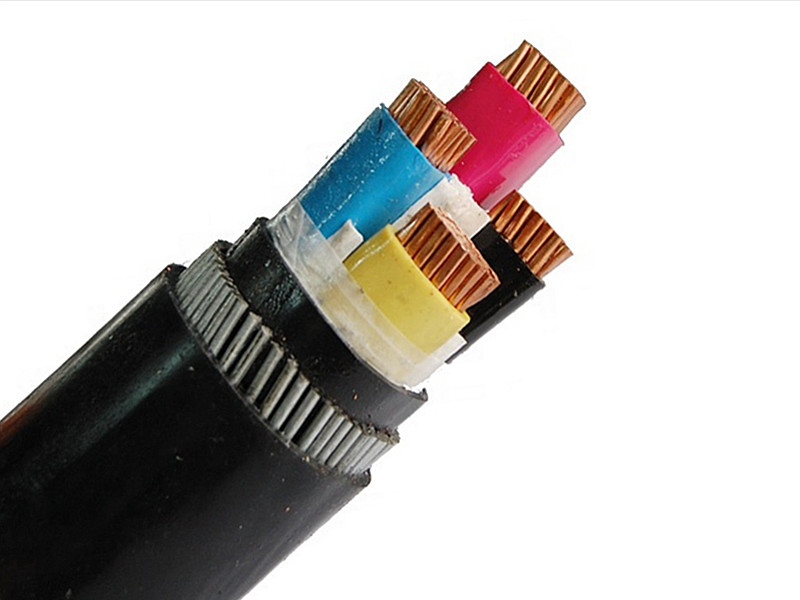
The project's most challenging segments involved cable laying across Monrovia's major traffic arteries and coastal low-lying areas. These sections faced dual threats: accidental excavation risks from surface traffic, and immersion corrosion from rainy season flooding. We provided SWA Steel Wire Armored Cables in 4×120mm² and 4×240mm² specifications to address these challenges.
The core advantage of SWA Steel Wire Armored Cables lies in their dual-layer protection structure: Inner XLPE insulation ensures electrical performance, intermediate galvanized steel wire armoring provides tensile strength and mechanical impact protection, while outer PVC sheathing delivers waterproofing and corrosion resistance. During SWA armored cable installation, we specifically guided construction teams to employ sand bedding protection, ensuring steel armoring remains undamaged by sharp stones. This detail handling proves crucial for extending cable service life under complex geological conditions in African cities.
LEC selected the SWA armoring solution over standard underground cables based on clear-eyed assessment of Monrovia's infrastructure realities: incomplete underground utility mapping, high third-party construction damage risks, and drainage systems frequently overwhelmed during rainy season causing road flooding. While steel armoring increases unit costs, it reduces failure rates and maintenance costs by over 60%—demonstrating clear advantages in project lifecycle cost analysis.
Control and Communication Systems: Automation Support with KVV Cables
With smart grid concepts gaining traction, LEC required simultaneous deployment of control and signal transmission channels in newly laid power lines, reserving infrastructure for future distribution automation and remote monitoring. We configured KVV Cables (PVC insulated PVC sheathed control cables) for connecting distribution transformers, switching equipment, and monitoring centers.
KVV cables' multi-core structural design (commonly 4-core to 37-core configurations) allows power, control, and signal transmission within a single sheath, reducing parallel pipeline quantities. While PVC insulation offers lower temperature rating than XLPE, it fully suffices for low-voltage, low-current control signal transmission scenarios at more competitive costs. For budget-constrained LEC seeking to preserve technical upgrade capacity, this represents an ideal balance between current investment and future expansion.
SafeIEC Certification and EN/IEC Standards Compliance
In African power infrastructure projects, international standard certifications often serve as the primary threshold for client supplier screening. All cable products we provided for this project hold IEC 60502 (power cable standards), IEC 60228 (conductor standards), and IEC 60332 (flame retardant testing standards) certifications, meeting EN 50525 (European low-voltage cable standards) technical requirements.
These certifications represent not merely entry tickets to international bidding projects, but substantive quality guarantees. For instance, IEC 60502 standards strictly regulate XLPE insulation cross-linking degree, thermal elongation performance, and aging resistance—ensuring cables won't prematurely degrade in tropical high-temperature environments. IEC 60332 flame retardant testing verifies fire safety under fault conditions, particularly important for densely populated urban areas.
LEC engineers noted in acceptance testing that our cables demonstrated performance margins exceeding standard requirements in conductor DC resistance, insulation resistance, and withstand voltage tests—meaning higher safety margins and longer service life in actual operation.
Rapid Response and Localized Support
Urban electrification project windows are often constrained by rainy seasons and municipal planning; delivery delays can collapse entire annual construction schedules. We established a rapid delivery channel for the LEC project: from contract confirmation to first batch arrival at Monrovia Freeport, the entire process was controlled within 45 days—half the industry average of 90 days.
This efficiency stems from three core capabilities: First, we maintain scaled inventory with ample stock of regular specifications including 4×95mm² YJV and 4×120mm² SWA, eliminating production scheduling waits. Second, we established West Africa dedicated line cooperation with major shipping companies, ensuring priority cabin class and customs clearance facilitation. Third, we stationed technical advisors in Monrovia during project execution, providing on-site guidance for SWA armored cable installation including bending radius control, armoring grounding treatment, and joint sealing—critical technical elements.
This integrated "product + technology + logistics" delivery model resolved coordination headaches LEC experienced with fragmented suppliers—cables arriving but accessories missing, or installation teams unfamiliar with new cable handling procedures. Our on-site technical support ensured construction quality met design expectations, avoiding rework delays.
Project Outcomes: From Numbers to Social Impact
By end-2024, the project successfully completed over 80 kilometers of distribution network laying in the Greater Monrovia metropolitan area, covering the Paynesville to Roberts International Airport corridor and multiple previously unelectrified low-income communities. Specific cable usage included: approximately 35 kilometers of AB Aerial Bundled Cables for low-voltage overhead lines, approximately 28 kilometers of YJV Cables (including 4×95mm² and 4×185mm² specifications) for underground distribution backbones, approximately 12 kilometers of SWA Steel Wire Armored Cables (4×120mm² and 4×240mm² specifications) for road crossing and coastal protection sections, and approximately 5 kilometers of KVV Cables for control and signal transmission.
The project directly benefited over 150,000 people, including 50 medical institutions, 65 schools, and 250 small businesses connecting to reliable grid power for the first time. Deeper impacts manifested in grid operational efficiency improvements: after deploying weather-resistant AB cables and armor-protected SWA cables, line failure rates dropped 70% compared to the old network, significantly reducing emergency repair workloads for maintenance teams—allowing LEC to redirect more resources toward network expansion rather than fault repair.
Client Feedback: How Partnership Value Translates to Long-Term Trust
Reviewing our collaboration with LEC, three core value pillars established mutual trust: certification-compliant quality assurance eliminated client concerns about product quality, rapid delivery responsiveness ensured controllable project schedules, and professional on-site technical support compensated for local construction teams' unfamiliarity with new materials.
LEC project management acknowledged in internal evaluations that choosing an Asian supplier with African project experience achieved optimal balance between cost control and quality assurance. Compared to European suppliers' lengthy delivery cycles or local suppliers' limited technical capabilities, our solution delivered technical standard upgrades within budget constraints. The client specifically noted that SWA armored cable installation technical guidance helped them establish standard operating procedures for armored cable construction—knowledge assets that will continue benefiting future network expansion.
Next Steps: Let Us Deliver Customized Solutions for Your Power Project
Whether facing salt-fog challenges on West African coasts or UV exposure on East African plateaus, urban distribution network construction demands customized solutions beyond standard products. We understand utilities' unique pressures: limited budgets, tight schedules, and communities' urgent expectations for electrification.
Dongguan GERITEL Electrical Co., Ltd. has specialized in power cable exports for years. Our advantages extend beyond comprehensive IEC and EN standard certifications to three differentiated capabilities: First, African project experience—we understand local logistics, customs clearance, and construction environments, delivering feasible deployment solutions. Second, technical response speed—standing inventory and flexible production ensure your project never stalls from material shortages. Third, on-site support networks—our engineers can reach project sites ensuring cable installation follows best practices.
If you're planning urban grid expansion, industrial zone power upgrades, or rural electrification projects, contact our technical team for customized cable configuration proposals and quotations.
Dongguan GERITEL Electrical Co., Ltd.
Tel/WhatsApp/WeChat: +86 135 1078 4550 / +86 136 6257 9592
Email: manager01@greaterwire.com
 Libya Tripoli International Airport Reconstruction



 Building 2, No. 40 Luxi 2nd Road, Liaobu Town, Dongguan City, Guangdong Province, China