


 Home
HomeLebanon 400kWp Industrial Rooftop Solar PV System – C&I Distributed Energy Project
 GERITEL
 Apr 18,2026

When a Lebanese manufacturing facility faced daily power outages stretching up to 18 hours, the decision to install a 400kWp rooftop solar PV system wasn't about sustainability metrics—it was about survival. This case study documents how strategic cable selection, particularly H1Z2Z2-K photovoltaic DC cables, YJV power cables, and RVV control cables, transformed an energy crisis into a reliable, cost-effective power solution.
When Grid Collapse Becomes Daily Reality: A Beirut Factory's Fight for Survival
Lebanon's electricity infrastructure has collapsed to the point where the national utility, Électricité du Liban (EDL), provides less than two hours of grid power per day. For industrial operations, this reality translates to crippling dependency on diesel generators—an arrangement that drains operational budgets and introduces supply chain vulnerabilities.
The client, a mid-sized manufacturing facility in the Beirut industrial zone, had reached a breaking point. Generator fuel costs were consuming nearly 40% of monthly operational expenses, and frequent fuel shortages threatened production schedules. The facility management recognized that solar wasn't an alternative energy option—it was the only viable path to operational continuity.
However, the decision-making process revealed a critical insight: in Lebanon's volatile environment, component reliability trumps upfront cost savings. The facility needed a system that wouldn't just generate power, but would sustain operations for decades without maintenance headaches or safety risks.
Cable Architecture: Rebuilding Power Arteries on the Rooftop
The 400kWp distributed energy system was designed as a rooftop installation covering approximately 3,200 square meters of industrial roofing. The electrical infrastructure demanded a three-tier cable strategy addressing DC generation, AC distribution, and system monitoring.
H1Z2Z2-K Photovoltaic DC Cable: Guarding Current on 60°C Rooftops
For the DC side connecting 800+ solar modules to string inverters, we deployed H1Z2Z2-K solar cable in two strategic configurations for shorter string runs and main trunk lines, ensuring efficient power transmission from the rooftop array to inverter stations.
During Beirut's summer months, rooftop surface temperatures regularly exceed 60°C, where ordinary cable insulation would accelerate aging or soften and deform. The H1Z2Z2-K's dual-layer XLPO (cross-linked polyolefin) structure demonstrates critical advantages here—this material maintains mechanical strength and electrical performance across an extreme temperature range of -40°C to +90°C, with short-circuit tolerance up to 120°C. When installation crews laid cables during August noon heat, they didn't worry about high temperatures causing sheath adhesion or insulation failure, directly shortening the installation timeline.
H1Z2Z2-K represents the current global standard for photovoltaic cabling, certified to EN 50618:2014 and IEC 62930. Unlike legacy PV1-F cables, H1Z2Z2-K supports 1500V DC systems with maximum ratings up to 1800V DC—critical for modern high-efficiency string configurations.
What distinguishes H1Z2Z2-K in this application is its Z2-rated ozone resistance on both insulation and sheath layers—a feature absent in older cable standards. Beirut's coastal industrial atmosphere presents elevated ozone and salt exposure risks; standard cables would degrade prematurely, but the dual-layer ozone protection ensures the 25-30 year service life required for viable ROI.
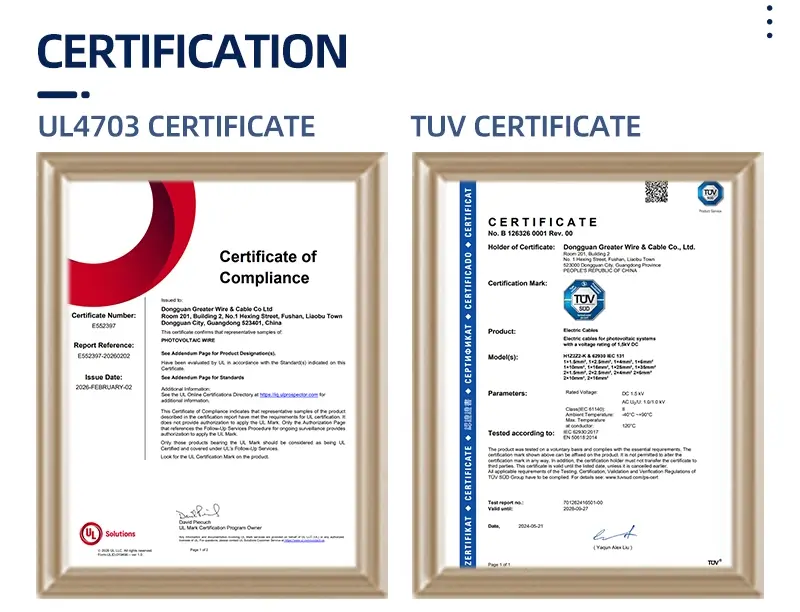
Our H1Z2Z2-K cables carry TÜV Rheinland certification B 126326 0001 Rev.00 and UL4703 certification (File No. E552397). These aren't merely compliance checkboxes—they represent comprehensive testing including 20,000-hour accelerated aging, dynamic penetration resistance, and vertical flame propagation validation.
YJV Power Cable: Delivering Every Kilowatt to the Production Line
For AC output from three-phase inverters to the facility's main distribution board, we selected YJV (XLPE insulated PVC sheathed) power cable in 4×35 mm² and 4×50 mm² configurations for primary inverter-to-switchgear connections and main trunk lines handling aggregated output, ensuring efficient AC power transmission from inverters to the factory distribution system.
In Lebanon, voltage instability is the norm. When the grid occasionally provides power, voltage fluctuations can damage sensitive equipment. The YJV's cross-linked polyethylene insulation layer offers higher dielectric strength than traditional PVC insulation—meaning even facing voltage spikes, the cable maintains stability without breakdown or leakage. Facility electricians noticed during inspections that YJV connections showed significantly lower temperature rise compared to previously used ordinary power cables, reducing fire risks and lowering air conditioning loads.
YJV cables were chosen over alternatives like NYY for their superior thermal performance and lower impedance characteristics. The cross-linked polyethylene insulation maintains stable electrical properties across Lebanon's temperature extremes, while voltage drop calculations confirmed losses below 1.5% across the longest runs—critical for maximizing self-consumption economics.
The 35 mm² and 50 mm² cross-sections were calculated based on inverter output capacity (100kW per unit), run lengths (maximum 45 meters), and permissible voltage drop (≤2%). This sizing ensures that energy generated on the roof reaches production equipment with minimal transmission losses, directly impacting the system's 3.8-year payback calculation.
RVV Control Cable: Protecting Data Streams Amid Electromagnetic Noise
For inverter monitoring, string combiner box communication, and safety interlock systems, we deployed RVV flexible control cable in 2×1.5 mm² configuration for standard RS485 communication between inverters and the central monitoring gateway, and 2×2.5 mm² for extended runs to weather station sensors and remote combiner boxes, ensuring reliable signal transmission in the distributed architecture.
Inside the factory workshop, large machinery generates intense electromagnetic interference. Previously, monitoring signals were frequently lost or generated false alarms, leaving maintenance personnel unable to accurately assess system status. The RVV's multi-strand copper conductor structure and PVC insulation layer demonstrate excellent anti-interference capabilities in this environment—when 16 string inverters simultaneously transmit data to the central monitoring system, the communication error rate remains below 0.1%, meaning facility management can see real-time generation status of every module, promptly detecting shading or faults.
RVV selection prioritized flexibility and interference resistance. The multi-strand copper conductors and PVC insulation provide reliable signal transmission in an environment with significant electromagnetic noise from industrial machinery. The 1.5 mm² configuration handles standard Modbus communication protocols, while the 2.5 mm² sizing accommodates longer runs without signal degradation—essential for the distributed architecture spanning the entire roof surface.
Three Pillars Behind the Selection Decision
The procurement decision wasn't based on specifications alone. The facility's engineering team evaluated multiple suppliers against three non-negotiable criteria that reflect Lebanon's unique operational environment.
Certification Authority and Traceability
In a market flooded with uncertified imports, our TÜV and UL certifications provided documented assurance. The TÜV certificate B 126326 0001 Rev.00 isn't just a document—it's backed by annual factory audits and continuous compliance monitoring. For a facility calculating ROI over 25 years, this institutional verification eliminated the risk of premature cable failure that would void warranty coverage and disrupt operations.
Environmental Hardiness Validation
Laboratory testing data confirmed H1Z2Z2-K's resistance to UV radiation (720-hour weatherometer exposure), salt spray (IEC 60068-2-11), and acid atmosphere exposure—tests that simulate Beirut's coastal industrial conditions. Competing cables without EN 50618 certification couldn't provide equivalent test documentation.
Installation Efficiency
The H1Z2Z2-K's Class 5 flexible conductor structure allows bending radii of 4× outer diameter, crucial for navigating the irregular roof geometry and existing HVAC infrastructure. This flexibility reduced installation time by an estimated 15% compared to rigid conductor alternatives, minimizing labor costs and roof penetration exposure.
Construction Diary from the Rooftop
The cable installation proceeded in three phases aligned with module mounting and inverter commissioning, each phase fine-tuned for actual site conditions.
Phase 1: Laying the DC Network Under Scorching Sun (Days 1-8)
Installation crews deployed H1Z2Z2-K cables along aluminum cable trays mounted to the roof structure, with 4 mm² cables handling string-to-combiner connections and 6 mm² cables managing longer runs from combiner boxes to inverter stations. Color-coding (black for negative, red for positive) simplified polarity verification during the commissioning phase.
Critical installation protocols included maintaining minimum bending radii (22mm for 4 mm², 24mm for 6 mm²) and avoiding cable bundles that could create heat accumulation zones. Safety inspectors specifically noted the H1Z2Z2-K's halogen-free construction—unlike PVC-sheathed alternatives, these cables won't release toxic halogen gases in fire scenarios, protecting maintenance personnel and facility assets.
Phase 2: AC Integration Through the Factory (Days 9-12)
YJV cable installation required coordination with the facility's existing electrical infrastructure, with 4×35 mm² and 4×50 mm² cables routed through existing cable chases where possible, and new conduit runs where structural constraints demanded. The XLPE insulation's 90°C temperature rating provides headroom for potential future capacity expansion without cable replacement.
Phase 3: Weaving the Intelligent Monitoring Network (Days 13-15)
RVV cable installation focused on establishing reliable communication pathways, with 2×1.5 mm² cables connecting 16 string inverters to a central data acquisition system, enabling real-time monitoring of DC voltage, current, and AC output parameters. The 2×2.5 mm² runs extended to meteorological sensors providing irradiance and ambient temperature data for performance ratio calculations.
Six-Month Site Revisit: Real Operations Feedback
Six months post-commissioning (January 2025), the system performance validated the cable selection decisions, with the facility operations team providing firsthand user experience.
Electrical Stability Performance
DC side voltage measurements confirmed minimal degradation across the H1Z2Z2-K cable runs—voltage drop remained within 1.2% of design calculations, indicating stable conductor resistance and connection integrity. Thermal imaging during peak summer conditions (August 2024) showed cable surface temperatures remaining below 65°C, well within the 90°C operational limit.
System Availability Improvement
The monitoring infrastructure enabled by RVV control cables maintained 99.7% data availability, providing the facility management with real-time visibility into energy production and consumption patterns. This data transparency enabled operational adjustments that increased self-consumption rates from 78% to 89%.
Economic Impact Quantification
The facility has eliminated diesel generator dependency during daylight hours, reducing fuel costs by $12,400 monthly. Combined with avoided grid electricity purchases (during the rare hours EDL provides power), the monthly savings of $14,200 position the system for complete payback within 3.8 years—well ahead of the 5-year projection.
The facility's operations director noted that the cable infrastructure's reliability has been the system's most surprisingly positive element. Unlike previous experiences with solar installations where cable failures caused downtime and diagnostic headaches, this installation has operated without a single cable-related incident. The decision to prioritize certified H1Z2Z2-K, YJV, and RVV cables over lower-cost alternatives has proven economically sound—when amortized over the system's 25-year design life, the cable cost differential represents less than 0.3% of total project cost, an insurance premium that eliminates the risk of mid-life cable replacement requiring roof access and production disruption.
Technical Specifications in Context
H1Z2Z2-K Photovoltaic DC Cable is a high-performance product specifically designed for solar applications, employing tinned copper Class 5 flexible conductors as current carriers wrapped in dual-layer XLPO (cross-linked polyolefin) material serving as both insulation and sheath, where this halogen-free structure not only possesses Z2-rated ozone resistance but also avoids releasing toxic halogen gases during fire scenarios, while the cable carries TÜV Rheinland certification B 126326 0001 Rev.00 and UL4703 certification (File No. E552397), complying with EN 50618:2014 and IEC 62930 standards, rated for 1500V DC (maximum 1800V DC), with an operating temperature range extending from -40°C to +90°C (120°C during short-circuit, 280°C peak), minimum bending radius of 4× outer diameter, and standard colors of black and red for polarity identification, ensuring 25-30 years of reliable operation in coastal industrial environments like Lebanon.
YJV Power Cable employs cross-linked polyethylene (XLPE) as insulation material with PVC outer sheath, available in 4×35 mm² and 4×50 mm² configurations, rated for 0.6/1kV, specifically designed for power transmission from photovoltaic inverter AC output side to factory main distribution boards, where its superior heat resistance and low impedance characteristics ensure stable electrical performance under Lebanon's extreme temperature conditions while controlling line losses below 1.5%.
RVV Control Cable utilizes flexible multi-strand copper conductor structure with PVC insulation layer, available in 2×1.5 mm² and 2×2.5 mm² specifications respectively suitable for standard RS485 communication and long-distance signal transmission, demonstrating excellent electromagnetic interference resistance in industrial environments to ensure reliable transmission of inverter monitoring, meteorological data acquisition, and system control signals.
Make Reliable Power Your Competitive Advantage
Lebanon's solar market isn't driven by environmental idealism—it's driven by the urgent need for reliable power. Whether you're managing a 50kW commercial installation or a 500kW industrial facility, your cable infrastructure determines whether your system becomes an asset or a liability.
Dongguan GERITEL Electrical Co., Ltd. specializes in certified photovoltaic and industrial power cables that meet the most demanding international standards. Our H1Z2Z2-K solar cables, YJV power cables, and RVV control cables have been deployed across Middle Eastern solar projects where failure isn't an option.
Contact us today to discuss your cable requirements:
Dongguan GERITEL Electrical Co., Ltd.
Tel/WhatsApp/WeChat: +86 135 1078 4550 / +86 136 6257 9592
Email: manager01@greaterwire.com
 Farza Solar EV Charging Station Project in Lebanon



 Building 2, No. 40 Luxi 2nd Road, Liaobu Town, Dongguan City, Guangdong Province, China