


 Home
HomeGuinea-Bissau Power Distribution Upgrade
 GERITEL
 Apr 14,2026

January 15, 2024. In the production workshop in Dongguan, the first batch of copper rods was being drawn on wire machines. Outside the window lay the damp cold of a Lingnan winter, while our production schedule marked an urgent date: all cables must arrive at the Port of Bissau before April 30. At that moment, only three months remained until the official commissioning of the OMVG regional interconnection project.
This timeline meant compressing the standard 8-10 week production cycle into 6 weeks, reserving 10 weeks for transcontinental shipping and customs clearance. The production supervisor presented the Gantt chart at the morning meeting: three parallel production batches, with the first batch of YJV 0.6/1kV 4×240mm² main feeder cables taking priority, ensuring arrival at the construction site before the March dry season window.
Bissau's Dilemma: When Clean Hydropower Meets Aging Infrastructure
Rewind to November 2023. Engineers at Guinea-Bissau's national power utility EAGB had just celebrated the completion of the OMVG transmission line—the 225kV high-voltage line connecting Guinea's Kaleta hydropower plant marked the country's first access to the regional grid. However, as they examined Bissau's distribution network, their mood quickly sobered.
Bissau's distribution system remained stuck in the 15MW diesel generation era. Energy losses reached 47%, the 30kV distribution ring network was fragmentary, and numerous low-voltage lines showed cracked insulation, causing frequent ground faults during the rainy season. More critically, the technical testing and official commissioning scheduled for March 2024 required the distribution network to handle loads allocated from 80MW of regional power.
During a video conference, EAGB's technical director showed us site photos: the cable trenches at Saltinho substation were severely waterlogged, with existing PVC-insulated cables showing sheath chalking; in the Mansoa suburbs, repeatedly excavated road construction had damaged the armor layers of directly buried lines, causing multiple short circuits. His core requirements were concise and urgent: a complete cable system that could complete installation before the 2024 rainy season, withstand the high-corrosion environment of the West African coast, and meet World Bank-financed project certification standards.
Spatial Reconfiguration: Differentiated Configuration Across Four Substations
Our technical team arrived in Bissau in early December 2023, spending two weeks conducting site surveys at four critical substations. Each location's environmental conditions and usage scenarios varied significantly, directly determining the spatial distribution strategy for cable selection.
Saltinho Substation: Gateway to Regional Power
As the hub connecting to the OMVG backbone network, Saltinho substation bears the core function of stepping down 225kV to 30kV for city-wide distribution. The outgoing lines here face two major challenges: high load currents and frequent maintenance operations. We configured YJV 0.6/1kV 4×240mm² as the main feeder, with its cross-linked polyethylene insulation rated for 90°C—30% higher than conventional PVC—maintaining stable electrical performance under high-load operation.
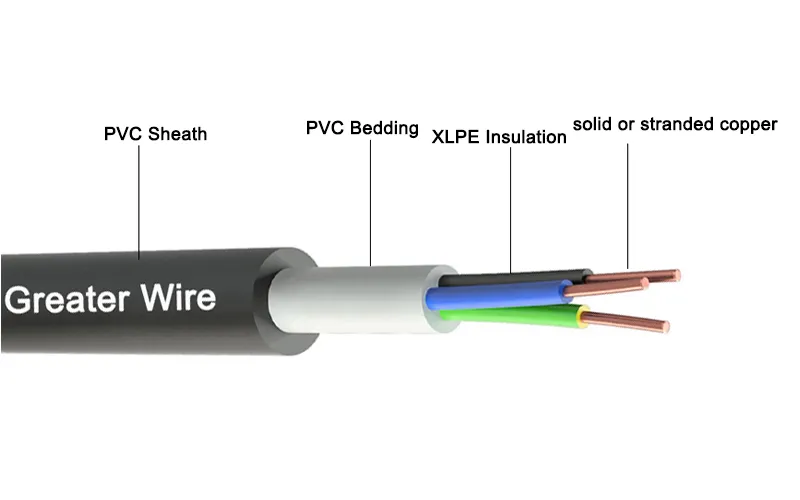
For the transformer-to-switchgear connections, we selected H07V-K 1×10mm² flexible single-core cables. EAGB's maintenance team particularly valued this cable's Class 5 extra-fine stranded conductor structure—in Saltinho's cramped switchgear room, flexible cables allow engineers to rapidly adjust busbar connections without power outages, saving hours of outage time during emergency repairs compared to rigid busbars.
Mansoa and Bambadinca: Urban Backbone and Rural Extension
Mansoa sits along the highway from Bissau to the Guinea border, a critical node for urban distribution extending to rural areas. Cable installation conditions here are complex: crossing unpaved roads requires withstanding construction machinery compaction, while entering residential areas demands adaptation to dense underground utility crossings. We adopted a layered configuration strategy: road sections use SWA steel wire armored cable 4×240mm², whose galvanized steel wire armor provides over 3000N/cm radial compression strength, resisting damage from conventional excavator contact; entering residential areas, we transition to YJV 0.6/1kV 4×120mm² in conduit, leveraging its lightweight characteristics to reduce construction difficulty.
Bambadinca substation presents a special case. Serving Bissau's emerging light industrial zone, the load profile shows significant day-night fluctuations—current surges during daytime factory operations, dropping sharply at night. Here we piloted YJV 0.6/1kV 4×500mm² extra-large section cable as a backup main feeder, reserving ample margin for load growth over the next 5-10 years. This forward-looking configuration earned recognition from EAGB's planning department, who are evaluating its rollout to other heavy-load areas.
Antula: The Severe Test of Coastal Salt Spray
Antula substation sits adjacent to the Port of Bissau, less than 2 kilometers from the coastline. Salt spray corrosion here reaches C4-M levels, where ordinary PVC sheathed cables typically become brittle and crack within 3-5 years. We configured enhanced SWA steel wire armored cable 4×150mm² for all external buried sections, with sheath materials incorporating UV stabilizers and anti-microbial additives, validated through 96-hour neutral salt spray testing. Inside the substation, the multi-core shielded structure of KVV 10×1.5mm² control cables ensures complete signal transmission for automated monitoring in high-electromagnetic environments.
Racing Against Time: From Wire Drawing to Loading in 42 Days
February 2024 saw Dongguan's factory operating on three shifts. The first week saw H07V-K 1×10mm² and KVV 10×1.5mm² small-section control cables coming off the line first—they would ship with the final batch to avoid mechanical damage during on-site storage. From the second week, large-section power cables entered concentrated production.
YJV 0.6/1kV 4×240mm² production involves the most complex processes: copper conductor stranding, XLPE insulation triple extrusion, copper tape screening, PVC sheath extrusion—each step requiring online diameter measurement and high-voltage spark testing. Our quality engineers particularly strengthened insulation eccentricity testing—in West Africa's high-temperature environment, uneven insulation thickness causes localized electric field concentration, potentially initiating treeing aging over long-term operation.
February 15: the first 12 drums of cable completed production and loaded into open-top containers. We selected the Nansha Port direct sailing route to West Africa, bypassing congestion risks at traditional transshipment ports. Shipping documents were prepared in advance: SGS pre-shipment inspection certificates, IEC 60502 type test reports, EN 50525 compliance declarations, and all Portuguese translations required by EAGB. These documents would save at least 5 working days during customs clearance at the Port of Bissau.
February 28: the vessel departed Nansha. At this point, the second batch of SWA steel wire armored cables was undergoing steel wire armoring in Dongguan, while the third batch of YJV 0.6/1kV 4×120mm² had entered insulation extrusion. Three batches shipped at 10-day intervals ensured EAGB's construction teams could work continuously without material shortages causing work stoppages.
On-Site Narrative: The Final Sprint Before Rainy Season
March 15: the first batch of cables arrived at the Port of Bissau. Only 6 weeks remained until the 2024 rainy season began. EAGB's construction teams immediately launched the outgoing line renovation at Saltinho substation.
The installation process for YJV 0.6/1kV 4×240mm² validated our predictions about construction efficiency: its unit weight is 30% lighter than equivalent ampacity armored cables, allowing three local workers to handle transportation and bending in narrow cable trenches without heavy machinery. This proved particularly crucial in space-constrained urban substations—the Mansoa station renovation completed in 60% of the planned man-hours for main cable replacement.
On the directly buried section from Bambadinca to the industrial zone, SWA steel wire armored cable 4×240mm² faced its real test. During construction, local road maintenance departments were conducting drainage pipeline work, with excavators operating multiple times above the cable route. Post-construction inspection showed only minor scratches on the armor layer, with insulation integrity unaffected. EAGB's project manager specifically noted this detail in progress reports, believing it avoided at least two unplanned repair outages.
Control system commissioning demonstrated the shielding effectiveness of KVV 10×1.5mm². Antula substation's distribution automation system needed to transmit telemetry, tele-indication, and tele-control signals, sharing trenches with high-voltage cables. During pre-commissioning interference testing, the copper wire braided screen of the control cables suppressed electromagnetic interference below 0.5mV, well under the IEC 60801-4 standard limits.
Commissioning Moment: April 2024 Lights Up
April 2024. The OMVG interconnection project completed final technical testing, and Guinea-Bissau officially joined the regional grid. For the first time, Bissau's night sky was illuminated by stable, bright lights that stayed on. EAGB's dispatch center data showed the newly laid cable system operating with zero faults, line losses 35% lower than the old network.
In the control room at Saltinho substation, our technical support engineers witnessed this moment alongside the EAGB team. From the first site survey in December 2023 to successful commissioning in April 2024, this 16-week project spanning four spatial nodes ultimately translated into stable power supply for 33,000 additional households.
Why Choose Us
Comprehensive Certification System: Full range products hold complete type test reports for IEC 60502, IEC 60228, IEC 60332, plus SGS-issued EN 50525 compliance declarations. For multilateral development bank-funded projects, documentation completeness directly determines customs clearance speed and fund disbursement efficiency.
Deep Understanding of African Markets: Cumulative exports of power cables to 15 African countries including Nigeria, Ghana, Kenya, and Tanzania, with familiarity with West African port logistics, customs procedures, and local construction environments. We anticipated the Port of Bissau's documentation requirements, preparing Portuguese translations in advance to avoid potential delays.
Agile Supply Chain Response: Standing raw material inventory supports urgent orders, with 4-6 week delivery for standard products and 6-8 weeks for customized products. This project's three-batch parallel production and direct sailing logistics solution compressed total delivery time to 60% of industry norms.
Full-Cycle Technical Support: From preliminary technical consultation, mid-production supervision, to on-site installation guidance, equipped with English/French technical support teams. This project embedded two engineers for three weeks, assisting EAGB with cable installation training and commissioning debugging.
Begin Your Power Infrastructure Upgrade Journey
Whether you are planning urban distribution network renovation, industrial park power supply construction, or new energy grid-connection projects, we can provide cable solutions meeting international standards and adapting to local environments.
Dongguan GERITEL Electrical Co., Ltd.
• Tel/WhatsApp/WeChat: +86 135 1078 4550 / +86 136 6257 9592
• Email: manager01@greaterwire.com
• Website: www.greaterwire.com
 Kisumu Solar Power Station, Kenya



 Building 2, No. 40 Luxi 2nd Road, Liaobu Town, Dongguan City, Guangdong Province, China