


 Home
HomeEthiopia Oromia 400MW Photovoltaic Park
 GERITEL
 Apr 24,2026

Driven by the global "dual carbon" goals, Africa has become a new blue ocean for renewable energy investment. As one of the countries with the largest power gaps in East Africa, Ethiopia is fully promoting the transformation of its new energy strategy. According to the "Renewable Energy Development Plan" released by the Ethiopian Ministry of Energy in 2023, the country plans to increase its photovoltaic installed capacity to 10GW by 2030 to address the predicament of only 30% national electricity penetration and alleviate the urgent demand for electricity in industrial production and people's livelihood. The Ethiopia Oromia 400MW Photovoltaic Park project is a core implementation project of this plan, co-funded by the Ethiopian government and international renewable energy financing institutions with a total investment of approximately 680 million US dollars. It is located in the Shashamane area in the central part of Oromia Region — this area has an average annual sunshine duration of 3,200 hours and stable light intensity, making it one of the most suitable areas in Ethiopia for building large-scale photovoltaic power plants. However, it also faces extreme natural conditions such as high temperature, strong ultraviolet radiation, and heavy dust, coupled with weak local infrastructure and a shortage of technical talents, posing multiple challenges to project implementation. In early 2024, Dongguan GERITEL Electrical Co., Ltd. successfully stood out and became the core cable supplier for the project by virtue of its complete international certifications, rich experience in large-scale international projects, and full-process project implementation solutions, achieving a win-win situation for wire export and project landing, and providing a replicable practical model for cable supply in Africa's high-threshold photovoltaic market.
I. Multiple Challenges Behind the High Threshold
As a key new energy project in Ethiopia, the Oromia 400MW Photovoltaic Park is not only a crucial project for the country's energy structure transformation but also one of the leading large-scale ground-mounted photovoltaic power plants in East Africa. It is scheduled to be fully connected to the grid for power generation by the end of 2025. Once completed, it can generate approximately 650 million kWh of electricity annually, meeting the electricity needs of nearly 2 million people in Oromia Region, providing stable power support for local industrial parks, and driving regional economic development. However, such a high-profile key project faces typical high-threshold market characteristics, putting the EPC general contractor in charge of project construction in many predicaments.
In terms of project attributes, the project is a large-scale government-led project supported by international financing. The decision-making chain involves multiple institutions including the Ethiopian Ministry of Energy, Ministry of Environment, and international development banks, with cumbersome and strict approval processes. In particular, the requirements for international certifications of core equipment are extremely high; any non-compliant indicator may lead to project suspension. The project scale is huge — a 400MW installed capacity means the cable demand reaches tens of millions of levels. As a large-scale ground-mounted photovoltaic power plant, it requires long cable laying distances and high environmental adaptability, and ordinary cables cannot meet the requirements of long-term stable operation at all.
In terms of on-site actual conditions, the Shashamane area has a tropical savanna climate, with the highest summer temperature reaching 42℃, and the ultraviolet radiation intensity is 1.8 times that of temperate regions. The local area also has frequent sandstorms, resulting in high dust concentration at the construction site, which puts extremely high requirements on the temperature resistance, UV resistance, and dust resistance of cables. At the same time, Ethiopia's local power industry is underdeveloped, lacking professional cable selection, installation, and maintenance technicians. The EPC general contractor often faces problems such as confusion in cable selection and non-standard installation during project advancement. In addition, due to the great political and policy uncertainty in Africa, construction plan adjustments and construction period changes may occur during project advancement, further increasing the difficulty of project implementation.
Based on the above challenges, the core demand of the customer (EPC general contractor) is not simply "purchasing cables", but finding a partner that can fully escort project implementation — one that can not only provide high-quality cables that meet international standards and adapt to extreme environments but also solve a series of supporting problems such as financing approval, technical support, and delivery guarantee. This is the core reason why we stood out among many competitors and the core starting point for us to practice the "high-threshold market project implementation solution".
Combined with the project's 400MW installed capacity, module arrangement, and laying distance, we determined through precise calculation that the total dosage of photovoltaic cables (H1Z2Z2-K) for this project is approximately 1,860 kilometers. Among them, the 1×4mm² and 1×6mm² specifications of photovoltaic cables from modules to combiner boxes total about 1,280 kilometers, mainly used for short-distance connection between each photovoltaic module and combiner box, covering the entire module array area of the power plant. The 1×10mm², 1×16mm², and 1×25mm² specifications of photovoltaic cables from combiner boxes to inverters total about 580 kilometers, used for DC main line transmission, connecting combiner boxes in various areas with the inverter room to ensure the stable transmission of DC power generated by photovoltaic modules to the inverter for conversion. This dosage calculation is based on the actual layout of the power plant, laying loss control, and redundancy design, which not only meets the current transmission needs of the project but also reserves space for subsequent power plant expansion.
II. Scenario-Based Adaptation: How Do Cable Products Support Project Implementation?
Abandoning the traditional model of stacking product parameters, we tailored a full-link cable solution for the project based on the actual application scenarios of each link of the power plant. Among them, the H1Z2Z2-K photovoltaic cable, as the core product, runs through the entire DC side of the photovoltaic system, matched with supporting cables to comprehensively solve the actual problems on the project site, ensuring that each section of cable can adapt to scenario needs and play a core role.
(1) The "Outdoor Persistence" of H1Z2Z2-K Photovoltaic Cables
The photovoltaic module array area is the core power generation area of the power plant, and also the area with the densest cable laying and the harshest environment — the modules are widely distributed, and the cables need to be exposed to outdoor environments with high temperature, strong UV, and heavy dust for a long time. During the laying process, they need to adapt to complex installation scenarios such as bracket binding and ground dragging, which puts high requirements on the flexibility and weather resistance of the cables.
For this scenario, we selected H1Z2Z2-K photovoltaic cables. Among them, the 1×4mm² and 1×6mm² specifications are used for short-distance connection between each photovoltaic module and combiner box (total 1,280 kilometers). This specification of cable has a small diameter and good flexibility, which can be easily bound to the photovoltaic brackets, adapting to the dense layout of the module array, and avoiding installation inconvenience caused by hard cables. The 1×10mm², 1×16mm², and 1×25mm² specifications are used for DC main line transmission from combiner boxes to inverters (total 580 kilometers). Due to the long laying distance of the main line (the longest single section can reach 800 meters), loss control is the key. This specification of cable adopts high-purity oxygen-free copper core with low DC resistance, which can control the transmission loss within 3%, ensuring the efficient transmission of DC power generated by photovoltaic modules to the inverter.
More importantly, this H1Z2Z2-K photovoltaic cable adopts XLPO insulation + sheath material, with a temperature resistance of up to 120℃. Even in the high-temperature environment of 42℃ in summer in the Shashamane area, it can maintain stable insulation performance without softening or cracking of the insulation layer. At the same time, its UV resistance meets the EN 50289-4-17/ENISO4892 standard, and its service life can still reach more than 25 years when exposed to strong ultraviolet radiation for a long time, completely solving the pain point that ordinary cables age and scrap in 2-3 years in this scenario. In addition, the cable adopts a black sheath design, which not only can further improve UV resistance but also facilitate on-site construction personnel to distinguish line uses, reduce installation errors, and adapt to the current situation of insufficient professional capabilities of local technicians.
This photovoltaic cable has obtained the authoritative TÜV EN 50618 certification (Certificate No.: B 126326 0001 Rev.00) and also meets the IEC 62930 certification standard. This is the core support for us to help the customer successfully pass the international financing approval — international financing institutions clearly require that core equipment must have authoritative international certifications. Our photovoltaic cables not only have complete certifications but also can provide complete test reports and technical documents to ensure project compliance.
(2) The "Underground Protection" of Armored Power Cables
After the inverter converts DC power into AC power, it needs to be transmitted to the step-up transformer through cables. This section of the line is mainly laid underground, crossing roads, green belts, and other areas inside the power plant, which is prone to mechanical damage such as soil pressure, construction excavation, and rodent damage. At the same time, it needs to adapt to the underground humid and dusty environment, which puts high requirements on the mechanical protection capability and insulation performance of the cables.
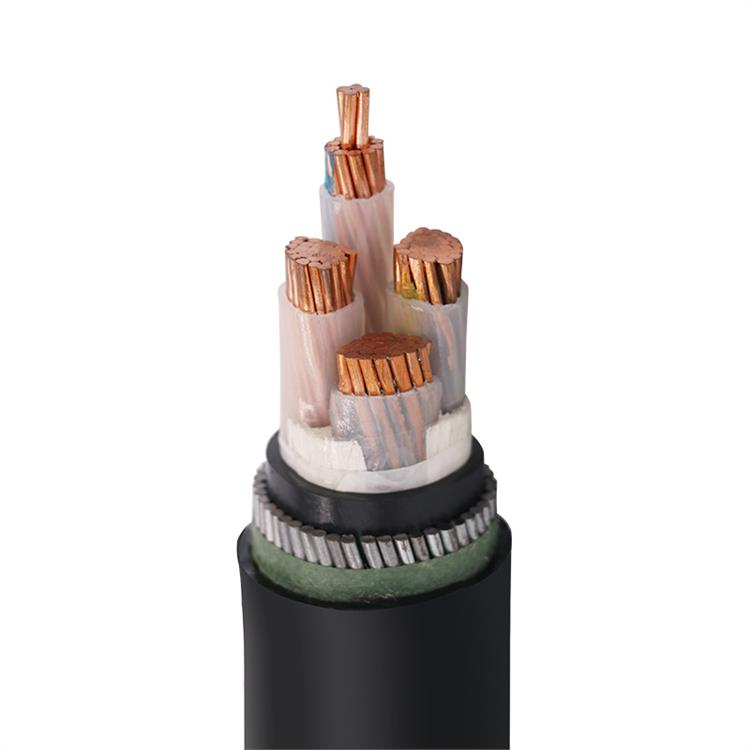
For this scenario, we selected armored power cables: NA2XY, with specifications of 4×240mm² and 4×300mm², and a voltage level of 0.6/1kV, which is exactly suitable for the AC transmission needs from the inverter to the step-up transformer. The cable adopts a steel tape armoring design, which has extremely strong mechanical protection capability. When laid underground, it can effectively resist soil pressure and excavation damage, and at the same time prevent rodent gnawing, avoiding power leakage caused by cable damage. Its insulation layer adopts high-quality XLPE material, which is moisture-resistant and dust-resistant, and can adapt to the complex underground environment, ensuring stable power transmission and laying the foundation for the normal operation of the subsequent step-up station.
(3) The "Power Grid Connection" of Medium-Voltage Cables
The step-up station is the "power hub" of the power plant, responsible for boosting the low-voltage AC power output by the transformer to high voltage, and then connecting it to the Ethiopian national power grid through the outgoing line. The stability of this section of the line directly determines the transmission efficiency and grid connection safety of the power plant's electricity, and has strict requirements on the high-voltage resistance and low-loss performance of the cables.
We equipped XLPE insulated medium-voltage cables for this scenario, with voltage levels of 33kV and 66kV, suitable for the connection of internal equipment in the step-up station and the needs of outgoing lines. The cable has excellent insulation performance and strong high-voltage resistance, which can withstand the electric field intensity during high-voltage transmission. At the same time, it has low transmission loss, which can effectively reduce energy waste during power transmission. It meets international power grid connection standards and can be directly connected to the Ethiopian national power grid, ensuring that the electricity generated by the power plant can be smoothly integrated into the national power grid to achieve efficient power allocation.
(4) The "Signal Guarantee" of Shielded Control Cables
The power plant control center is the "brain" of the entire photovoltaic power plant, responsible for monitoring and controlling the operation of all equipment in the power plant, including the operating status of photovoltaic modules, inverters, transformers, and other core equipment. Once the transmission of control signals is interfered or interrupted, it will lead to equipment failure and power plant shutdown. Therefore, the anti-interference capability of control and communication cables is crucial.
For this scenario, we selected KVVP shielded control cables, with a core number range of 2-61 cores, a cross-sectional area of 0.75~10mm², and a rated voltage of 450/750V. The cable adopts a copper wire braided shielding layer, with a shielding effectiveness of ≥69dB/km, which can effectively resist electromagnetic interference generated by internal equipment of the power plant, ensure the stable transmission of control signals and monitoring data, avoid equipment misoperation or failure caused by signal interference, and ensure the normal operation of the power plant. At the same time, it has good flexibility, which can adapt to the complex wiring needs inside the control center and facilitate later maintenance.
III. Breaking Through the High Threshold with Solutions to Escort Project Implementation
Focusing on the high-threshold characteristics of the project and the core pain points of the customer, we have always taken "project implementation" as the core, deeply integrated cable products with supporting services, and launched a full set of targeted solutions. Each service accurately meets the actual on-site needs, escorting the project advancement from financing approval to delivery and installation, which is also the core embodiment of our "high-threshold market project implementation solution".
(1) Certification + Document Support to Assist in Financing Approval
The customer's biggest capital pain point is that the project relies on international financing, with a long payment collection cycle of 3-5 years, and the approval process of international financing institutions is complex, with extremely high requirements for cable product certifications and technical documents. Ordinary suppliers can only provide products and cannot provide supporting financing support. Once the documents are non-compliant, it will directly lead to financing failure and project suspension.
With the advantage of complete international certifications, we not only provided the customer with cable products that meet TÜV and IEC standards but also specially set up a professional team to package and sort out a full set of financing support documents, including the TÜV EN 50618 test report of H1Z2Z2-K photovoltaic cables (Certificate No.: B 126326 0001 Rev.00), IEC certification reports of all cables, product technical parameters, project adaptation plans, quality commitments, and other complete materials. At the same time, we arranged special personnel to assist the customer in docking with international financing institutions, answer technical questions during the approval process, and help the customer improve the approval materials. Finally, we helped the customer successfully pass the financing approval, effectively alleviating the customer's capital pressure and ensuring the smooth start of the project.
(2) Adaptive Products to Resist Extreme Environments
The extreme environment in the Shashamane area is a major difficulty in project advancement. Ordinary cables are prone to aging and damage in high-temperature, strong UV, and dusty environments, which not only require frequent replacement, increasing maintenance costs but also affect project progress. The customer once tried to use ordinary photovoltaic cables for pilot laying, but the insulation layer cracked and the surface aged only after 3 months, which had to be completely replaced.
Combined with the on-site environment, we tailored H1Z2Z2-K photovoltaic cables and supporting cables for the customer. Among them, the photovoltaic cables adopt XLPO insulation + sheath material, with a temperature resistance of 120℃, UV resistance, and a service life of more than 25 years, without the need for frequent replacement. The armored power cables and medium-voltage cables also adopt materials with strong weather resistance, adapting to the environmental needs of different scenarios such as underground laying and outdoor use, completely solving the pain point of easy aging of ordinary cables, reducing the customer's later maintenance costs, and avoiding project shutdown caused by cable failures.
(3) Efficient Delivery to Avoid Penalty Risks
As a key project of the Ethiopian government, the project has a clear time limit for grid connection and power generation, with a tight construction period. Once the cable delivery is delayed, it will lead to delayed construction progress, and the customer will have to bear a fine of hundreds of thousands of US dollars per day. However, ordinary suppliers generally have problems such as long production cycles and slow logistics response, which are difficult to meet the urgent needs of the project.
We predicted the project needs in advance, optimized the production plan combined with the dosage of 1,860 kilometers of photovoltaic cables and supporting cables, opened an exclusive production line, and gave priority to ensuring the cable production for this project. At the same time, we provided a "full reel delivery + pre-cutting plan". According to the construction progress of each area of the power plant, the photovoltaic cables and supporting cables were pre-cut into corresponding lengths according to on-site needs and delivered in full reels, reducing on-site cutting time — the pre-cutting of photovoltaic cables alone saved the customer nearly 15 days of construction time. In addition, we selected experienced international logistics partners, planned logistics routes in advance, avoided logistics risks in Africa, and ensured that all cables were delivered to the construction site on time and safely, helping the customer avoid penalty risks and ensuring the project advanced on schedule.
(4) Full-Process Technical Support
Ethiopia lacks professional cable selection and installation technicians locally. In the early stage of the project, the customer's team faced confusion in cable selection and even over-design, which not only increased costs but also affected transmission efficiency. Ordinary suppliers do not provide technical support and only take responsibility for product delivery, unable to solve the customer's technical problems.
We set up a professional technical team to go deep into the power plant site. Combined with the actual situation of the project's installed capacity, laying distance, and environmental conditions, we provided the customer with a full set of cable selection plans, including the specification allocation of 1,860 kilometers of photovoltaic cables and the model selection of supporting cables, accurately matching the needs of each scenario and avoiding cost waste caused by over-design. At the same time, we arranged technical personnel to provide remote guidance on on-site installation, answer technical questions during the installation process, including the binding method of photovoltaic cables and the buried depth of armored cables, helping local construction personnel standardize installation, and upgrading from a "simple supplier" to the customer's "technical partner", completely solving the customer's pain point of lacking local technical capabilities.
(5) Flexible Supply to Reduce Inventory Risks
Due to the great political and policy uncertainty in Africa, during the project advancement, the construction plan was delayed due to adjustments in Ethiopia's energy policies, leading to temporary changes in cable demand. If the supply is made according to fixed orders, it is easy to have problems of inventory backlog or insufficient supply, increasing the customer's inventory risk.
We adopted a flexible supply model. According to the actual progress of the project, the 1,860 kilometers of photovoltaic cables and supporting cables were delivered in 3 batches, avoiding inventory backlog caused by one-time large-scale stock-up. At the same time, we reserved a certain production capacity. If the project demand changes, the order can be adjusted quickly to ensure that the cable supply is synchronized with the project progress, effectively reducing the customer's inventory risk and ensuring the smooth advancement of the project.
IV. Breaking Through the High Threshold with Strength to Achieve Project Completion
After more than a year of close cooperation, we successfully completed the supply of all cables and supporting services for the Oromia 400MW Photovoltaic Park. The 1,860 kilometers of H1Z2Z2-K photovoltaic cables and supporting cables all passed the acceptance at one time, perfectly adapting to the transmission needs of each scenario of the power plant. At present, the project has entered the commissioning stage and is expected to be smoothly connected to the grid for power generation by the end of 2025.
In this cooperation, we not only achieved a major breakthrough in wire export but also won high recognition from the customer. The customer stated that our solution accurately solved all the pain points in the project implementation process, such as capital, environment, technology, and delivery. In particular, the scenario-based adaptation and full-process technical support of the 1,860 kilometers of photovoltaic cables made the project advancement "worry-free, labor-saving, and cost-saving", completely solving their problems in project implementation in the high-threshold market. They also expressed their willingness to cooperate for a long time in the future and planned to list us as their core cable supplier for photovoltaic projects in the African region.
For us, the success of this project not only demonstrates our strength in the field of cable supply for large-scale photovoltaic power plants but also verifies the feasibility of our "high-threshold market project implementation solution". With complete international certifications, scenario-based product adaptation, perfect technical support, and a flexible delivery model, we successfully broke through the access barriers of Africa's high-threshold market, proving that we have the ability to provide professional and efficient cable solutions for large-scale photovoltaic projects around the world, and also laying a solid foundation for us to further explore the African new energy market.
V. Cooperation Appeal
The African new energy market has great potential, especially the rapid rise of large-scale photovoltaic power plant projects. However, the high-threshold market characteristics make many suppliers hesitate. If you are an EPC general contractor, a state-owned enterprise, a central enterprise, or a partner with international project experience, and you are participating in African photovoltaic projects and facing multiple problems such as capital, technology, delivery, and environment, do not hesitate to choose Dongguan GERITEL Electrical Co., Ltd.
Based on the successful experience of the Oromia 400MW project, we will provide you with products with complete certifications, scenario-based adaptation plans, full-process technical support, and efficient and flexible delivery services, fully escorting your project implementation, helping you overcome all difficulties in the high-threshold market, and achieving win-win cooperation with you to jointly explore the broad future of the African new energy market.
No matter what needs you have related to cable selection, supply, or project implementation, you can contact us at any time, and we will provide you with professional consultation and solutions as soon as possible.
Contact Information:
Dongguan GERITEL Electrical Co., Ltd.
Tel/WhatsApp/WeChat: +86 135 1078 4550 / +86 136 6257 9592
Email: manager01@greaterwire.com
 Ghana Agona Solar PV Project



 Building 2, No. 40 Luxi 2nd Road, Liaobu Town, Dongguan City, Guangdong Province, China