


 Home
HomeEquatorial Guinea Annobón Solar Hybrid Microgrid Project
 GERITEL
 Apr 13,2026

YJV 3×70mm² sat on our warehouse shelf, unremarkable, unassuming. No one imagined it would travel halfway across the world to be buried in the red earth of Annobón Island, Equatorial Guinea.
It was the beginning of the 2023 dry season when the email arrived from Madrid. The sender was a European engineering firm specializing in off-grid energy solutions. They had just secured the EPC contract for a solar hybrid microgrid on Annobón, yet found themselves paralyzed at the cable procurement stage. European suppliers demanded fourteen weeks lead time. The next maritime window to the island closed in six. To compound the pressure, the island's existing diesel grid had been wheezing for forty years—so degraded that spare parts had become archaeological artifacts.
"We don't just need cables," the email read. "We need someone who understands what this island does to infrastructure."
Salt Spray, Ultraviolet Radiation, and the Race Against Time
Annobón Island is an anomaly. It sits six hundred kilometers southwest of mainland Equatorial Guinea, too small to appear on most maps, yet possessing ultraviolet intensity fierce enough to blister unprotected skin and salt-laden marine air that devours metal. For four decades, the island's electricity came from diesel generators. Fuel arrived by ferry when weather permitted. Residents grew accustomed to daily blackouts. The hospital relied on backup units for basic operations. Schools dismissed at four in the afternoon—not because lessons concluded, but because darkness approached.
The new microgrid design called for 4.2MW of photovoltaic capacity paired with 2.8MWh of battery storage, aiming to deliver 24-hour power to the island for the first time in its history. Yet the elegant drawings collided with reality during cable selection: standard PVC-sheathed cables would last perhaps two years in this environment. Armoring wires would rust from the inside out. Insulation would powder under relentless UV exposure. And the project budget forbade over-engineering—every meter of cable demanded precise calibration between service life and cost.
The client's initial instinct mirrored their European island projects: specify marine-grade cables throughout. Technically sound, but the quotation kept the project manager awake at night. The marine-grade premium hovered near forty percent, and their EPC contract was fixed-price.
We needed to prove something different: industrial-grade cables meeting IEC standards, with correct material selection, could achieve design life in demanding environments without the marine-grade surcharge.
Six Cable Categories, Six Distinct Survival Strategies
Our first technical video conference lasted three hours. We didn't rush to quotation. Instead, we requested Annobón's environmental monitoring data: annual average relative humidity of eighty-seven percent, salt spray deposition rate classified as C5-M high corrosivity under ISO 9223, UV radiation levels approaching Saharan thresholds. These numbers dictated material formulations for every cable category.
H1Z2Z2-K 1×4mm² and H1Z2Z2-K 1×6mm² were specified for the photovoltaic array DC side. The selection of this model over cheaper PV1-F alternatives hinged on sheath composition. H1Z2Z2-K employs low-smoke zero-halogen polyolefin, enhanced with specific UV stabilizer and antioxidant ratios that demonstrated superior aging resistance in QUV accelerated testing compared to standard photovoltaic cables. We ultimately supplied 18,500 meters—sufficient to interconnect over six thousand modules.
The battery energy storage system (BESS) interior presented a different battlefield. Inter-cluster connections demanded frequent bending to accommodate compact container layouts while carrying hundreds of amperes of charge-discharge current. The H07V-K flexible cable series, ranging from 1×25mm² to 1×50mm², addressed this requirement. Class 5 stranded conductor construction reduced bending radius to four times outer diameter, while oil-resistant sheath formulation withstood cooling fluid leakage risks. The total 12,800-meter length represented reliable connections for over two hundred battery clusters.
The genuine test arrived on the AC side. YJV cable 3×35mm², YJV cable 3×50mm², and the main distribution backbone YJV cable 3×70mm² formed the arterial network from inverters to distribution transformers. The client initially questioned XLPE insulation's temperature performance—they were more familiar with European-preferred EPR rubber insulation. We provided type test reports under IEC 60502-2, particularly the 90°C continuous operating temperature and 250°C short-circuit withstand data. At Annobón's 35°C ambient temperature, XLPE's current-carrying advantage enabled smaller cross-sections to achieve equivalent transmission capacity, directly reducing copper costs and installation complexity. The final 6,200-meter order of YJV 3×70mm² became the backbone of the entire low-voltage distribution system.
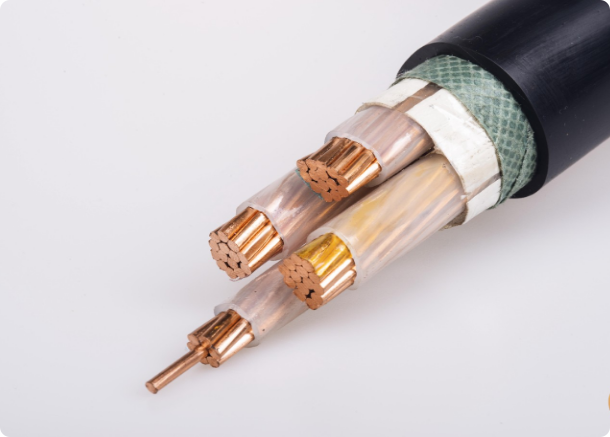
The medium-voltage segment employed 6.35kV-rated XLPE insulated steel wire armored cables, with copper tape shielding suppressing harmonic interference common in microgrids. For coastal direct-buried sections, we specifically enhanced longitudinal water-blocking structures—non-standard but essential given Annobón's concentrated rainy season rainfall and saturated soil conditions. Any minor sheath damage could become a water ingress channel.
Control systems utilized KVV and KVVP control cables, with 9,600 total meters covering BMS communications, inverter monitoring, and distribution automation. Shielding employed aluminum-plastic composite tape plus tinned copper wire braiding dual-layer construction, crucial in frequency-converter-dense environments—the client had experienced signal interference causing false alarms in a previous Caribbean project.
The Trust Reconstruction Behind Certification Documents
Selecting an Asian supplier represented adventure for this European engineering firm. Their board questioned: IEC certificates can be purchased. Factory audits can be staged. How to ensure delivered cables match samples?
Our response was transparency in quality control. From copper rod incoming spectrographic analysis, to conductor stranding online resistance monitoring, to XLPE insulation layer X-ray eccentricity detection, through finished cable partial discharge testing—every stage left traceable records. The client's appointed SGS pre-shipment inspection (PSI) passed without discrepancy, the inspector noting in his report: "Factory testing equipment calibration status superior to European equivalent supplier averages."
Deeper trust emerged from experiential resonance. We shared archives from two previous Caribbean island projects: similar salt spray environments, similar microgrid architectures, similar delivery pressure. Post-installation sampling after three years' operation showed sheath mechanical property retention above ninety-five percent. These weren't marketing claims. They were data points from maintenance reports.
The Morning of Day Forty-Three
Forty-three days after contract signature, cargo arrived at Equatorial Guinea's Bata port. Two days ahead of schedule.
This velocity concealed invisible orchestration: H1Z2Z2-K series continuous production from dedicated irradiation cross-linking lines, YJV series double-shift dry cross-linking operations, and standby equipment coordination for medium-voltage cable steel wire armoring to prevent main equipment failure disruptions. The logistics scheme underwent three iterations—air freight initially considered, rejected on cost grounds; final selection of Dongguan Port direct sailing to Bata, then lighterage transfer to Annobón, with steel-wood reel reinforced packaging throughout.
The client later told us that when cable drums unloaded on the island, the local diesel generators had just suffered a major failure. Two weeks' further delay would have missed the dry season construction window, pushing microgrid commissioning into the following year.
The Echo After Silence
Second quarter, 2024. Annobón's diesel generators fell silent for extended periods. The microgrid covered eighty-five percent of resident electricity demand. The hospital achieved continuous refrigeration. Schools extended evening study until nine o'clock. The project manager didn't use "satisfied" in his email—he wrote "relieved."
Technical feedback proved more specific: YJV 3×70mm² backbone cable actual temperature rise under full load measured three degrees Celsius below our calculated values. This meant line losses below design expectations, granting additional safety margins for system efficiency. H1Z2Z2-K series on the photovoltaic DC side recorded zero faults during six months' monitoring. H07V-K flexible cables in the energy storage system withstood daily twice-daily charge-discharge cycling mechanical stress.
These numbers transformed into second collaboration intention. Late 2024, the same client specified GERITEL for cable supply on another Central African island project. This time, the technical conference lasted forty minutes—most discussing logistics details rather than product specifications.
Postscript: The Logic of Selection
Reviewing the Annobón project, the client's core demand was never simply "cheap" or "fast." In off-grid energy engineering, cables constitute infrastructure within infrastructure—buried underground, hidden behind walls, yet whose failure could nullify entire system investments. They sought partners who comprehended this risk and responded with technical substance rather than sales rhetoric.
Our advantage was never merely IEC certificates or TÜV reports. It was the patience to spend an additional week on material selection论证 after receiving environmental monitoring data. The stubbornness to maintain partial discharge testing for every cable drum despite delivery pressure. The transparency of sharing Caribbean island project maintenance reports proactively with new clients.
If you're planning similar engineering—whether African island microgrids, Southeast Asian solar-storage integration, or any power infrastructure facing harsh environments, tight timelines, and zero fault tolerance—we should talk. Not about our production capacity or market share, but about your project's specific challenges and how we've addressed analogous situations before.
Dongguan GERITEL Electrical Co., Ltd.
Tel/WhatsApp/WeChat: +86 135 1078 4550 / +86 136 6257 9592
Email: manager01@greaterwire.com
Annobón's diesel generators have remained silent for a long while. What sound should your project make?
 Lubombo Solar PV Plant – Eswatini



 Building 2, No. 40 Luxi 2nd Road, Liaobu Town, Dongguan City, Guangdong Province, China