


 Home
HomeEritrea Ekemhare Solar PV + Battery Energy Storage Project
 GERITEL
 Apr 13,2026

From Diesel Scarcity to Green Energy Freedom: A Nation's Energy Breakthrough
In early 2023, we received a strategic inquiry from East Africa that would test our capabilities in one of the world's most challenging environments. Eritrea, a nation on the Horn of Africa, had long grappled with severe electricity shortages—national electrification rate at merely 54%, with rural areas plunging below 15%. The country relied heavily on expensive diesel generation, with electricity costs soaring to 27 cents per kWh, stifling economic growth and industrial development.
Under the African Development Bank's (AfDB) $49.9 million financing package, the Eritrean government launched its first utility-scale ground-mounted solar project—a 30MW PV plant paired with 15MW/30MWh battery storage in the Dekemhare region. This flagship initiative aimed to catapult renewable energy share from 3% to 23%, targeting 365GWh annual generation and 42,910 tons of CO₂ emission reduction annually.
The EPC consortium faced a cable procurement dilemma emblematic of frontier market projects: how to secure IEC/EN-compliant cable systems capable of withstanding extreme heat (annual average 30°C+), intense UV radiation, and sand abrasion, while ensuring one-stop supply and rapid delivery? The battery-to-PCS connections in the storage system posed particularly stringent demands on cable flexibility and thermal endurance.
Technical Chess in the Desert: The Client's Three Core Anxieties
Through intensive technical consultations, we identified three pivotal concerns driving the client's decision-making:
First, certification complexity. The project mandated full compliance with IEC 62930, EN 50618, and TÜV certification—standards rigorously scrutinized in African markets where counterfeit documentation remains prevalent.
Second, environmental resilience. Dekemhare's tropical desert climate featured brutal temperature swings (nights dropping to 10°C, days peaking at 45°C) and high-altitude UV intensity that degraded conventional cables within months. Inside battery containers, continuous charge-discharge cycles maintained ambient temperatures above 60°C.
Third, delivery coordination urgency. Spanning four subsystems—PV arrays, energy storage, step-up stations, and control networks—the project demanded 35-day delivery windows. Previous experiences with delayed shipments causing construction standstills made the client exceptionally time-sensitive.
Four-Subsystem Deployment: The Complete Cable Battle Plan
Based on site surveys and technical validation, we engineered a hierarchical cable solution covering the entire value chain from PV modules to grid interconnection:
PV DC Side: Anti-Aging Defense at 1500V
For photovoltaic array DC connections, we supplied H1Z2Z2-K solar-rated cables in configurations spanning 1×4mm², 1×6mm², plus 2×4mm² and 2×6mm² twin-core parallel structures—totaling 18,500 meters.
The H1Z2Z2-K selection leveraged irreplaceable technical advantages: unlike legacy PV1-F cables, H1Z2Z2-K adheres to EN 50618 with 1500V DC ratings (withstanding 1800V peak), perfectly matching modern high-efficiency string architectures. Its dual-layer cross-linked polyolefin (XLPO) insulation delivers Z2-class ozone resistance, ensuring 25+ year lifespans in Dekemhare's high-altitude UV environment. Critical for African deployment, AD8 water resistance certification protects against seasonal flash floods.
The client's technical lead specifically validated our tinned annealed copper conductors (Class 5 flexible stranding)—oxidation-resistant yet maintaining exceptional flexibility across -40°C to +90°C, solving metal fatigue from desert temperature cycling.
Storage Arteries: The Flexible Conductor Current Revolution
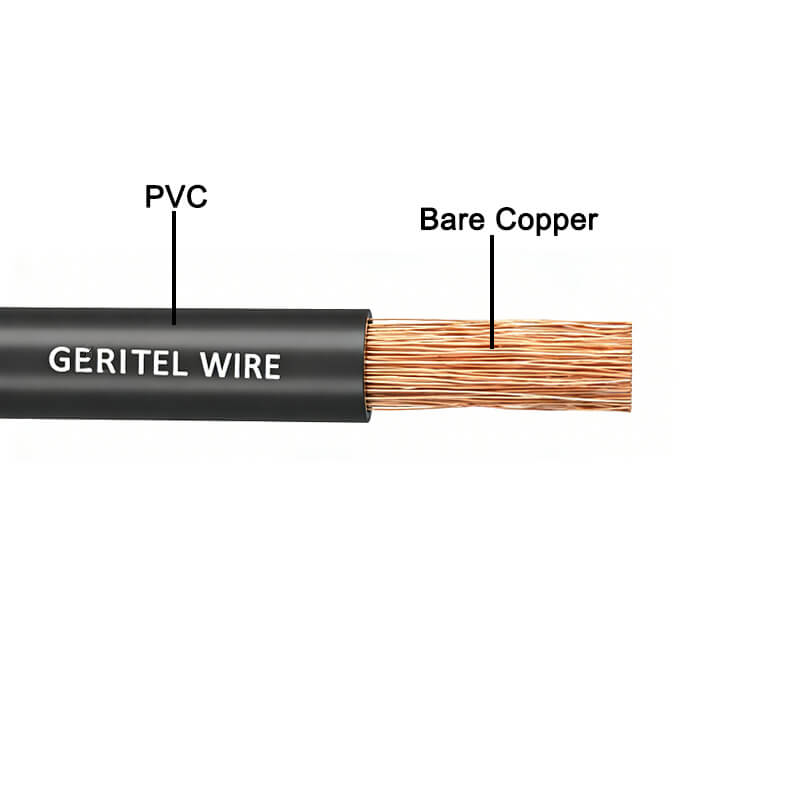
This represented the project's technical centerpiece. Battery cluster-to-PCS DC connections demanded our utmost attention. We configured H07V-K single-core flexible cables spanning 1×25mm² through 1×120mm², with 1×70mm² and 1×95mm² dominating the 12,800-meter shipment.
H07V-K advantages proved decisive here: as HD 21.3 S3-compliant flexible cables, modified PVC insulation achieves 90°C continuous rating with 120°C short-term overload capacity—precisely matching storage charge-discharge thermal profiles. Compared to standard power cables, H07V-K's Class 5 ultra-flexible conductor structure achieves 4× outer-diameter bending radii in cramped container spaces, dramatically easing installation.
The client initially considered XLPE-insulated power cables, but H07V-K won on installation efficiency and cost equilibrium: 15-20% lower pricing than XLPE equivalents in the 25-120mm² range, plus tool-free bendability that boosted local workforce productivity significantly. We provided black/red dual-color identification to prevent polarity errors during field termination.
LV AC Side: YJV's Steady Energy Transmission
For inverter output collection at 0.6/1kV, we supplied YJV 0.6/1kV XLPE-insulated power cables, primarily 3×70mm² and 3×120mm² configurations totaling 8,200 meters.
YJV cables functioned as the "energy arteries"—XLPE insulation rated 90°C (30% higher than legacy PVC VV types) maintaining full ampacity in Dekemhare's heat. Compact-stranded copper conductors at 93% fill factor minimized line losses. Against desert rodent threats, we recommended steel-tape armored YJV22 variants—8% cost premium for exponentially enhanced mechanical protection.
MV Grid Connection: XLPE's Long-Distance Power Haul
From step-up station to national grid tie-in, 33kV/66kV transmission required our triple-extrusion XLPE insulated cables, conductor cross-sections 185mm² to 400mm², totaling 6,500 meters. IEC 60502-2 certified with superior electrical treeing resistance, these withstand African grid harmonics for 30+ year insulation lifespans.
Control Nervous System: KVV/KVVP Precision Signal Guardianship
For SCADA monitoring, temperature sensing, and fire alarm systems, we deployed KVV (PVC-insulated control cables) and KVVP (shielded variants), 4-core to 24-core configurations, 1.0-2.5mm² cross-sections, totaling 15,600 meters. KVVP's 80% density copper braid shielding effectively suppresses high-frequency inverter EMI, ensuring signal integrity.
Certification Moat: TÜV Endorsement and Quality Discipline
The client's selection fundamentally rested on our comprehensive international certification framework:
• TÜV Rheinland Certification: Dual IEC 62930 and EN 50618 for solar cables
• CE-CPR Certification: EU Construction Products Regulation, fire class Dca-s2,d2,a1
• IEC 60502/60227/60228 Foundation Certifications: Covering power and control cable portfolios
Our production protocols exceed national standards: conductor DC resistance 3% below IEC 60228 limits, insulation eccentricity controlled within 5% (versus 8% national tolerance), and mandatory 6.5kV/5min AC withstand testing per batch. All wooden drums undergo fumigation treatment meeting African phytosanitary requirements.
Cable Delivery Campaign: 35-Day Sprint Within 8-Month Marathon
Upon contract execution, we activated "Project Green Channel": H1Z2Z2-K solar cables leveraged standing inventory with 7-day production scheduling; H07V-K series compressed to 12 days through optimized stranding processes; MV XLPE cables utilized dry-cure extrusion lines, 40% faster than conventional steam curing.
Logistics strategy deployed "Dongguan Port-Djibouti Port-Land Transport" multimodal routing, approximately 28 days transit. anticipating Eritrea's complex customs clearance, we pre-positioned SABER certification (East African market) and Certificates of Origin, ensuring 3-day port clearance upon arrival.
Critical to success was field technical support: two senior engineers deployed to Dekemhare for 10-day installation guidance. For H07V-K container routing, they demonstrated "Z-pattern" cable management preventing insulation damage from sharp bends; for H1Z2Z2-K MC4 connector crimping, specialized dies ensured contact resistance below 0.1mΩ.
One-Year Post-Commissioning Report: Data-Driven Validation
Grid-connected in Q2 2024, the installation completed 12 months of operational validation with outstanding cable system performance:
• H1Z2Z2-K solar cables maintained 35K temperature rise at 50°C ambient—well below standard limits
• H07V-K storage connection cables endured daily dual charge-discharge current cycles without thermal anomalies
• Full system insulation resistance sustained above 1000MΩ/km with zero aging indicators
Client feedback indicated 8% generation surplus over design projections, partly attributable to cable losses below design assumptions (1.2% measured versus 1.8% specified). AfDB project supervision specifically noted in acceptance documentation: "Cable system installation quality and material compliance represent benchmark standards rarely seen in such projects."
Retrospective: Three Value Anchors from the Client's Perspective
Post-project review distilled three universal partnership values:
Integrated Supply Synergy. Eliminating five-vendor coordination complexity with unified technical interfaces and clear accountability boundaries. When H07V-K cable-to-PCS terminal matching issues emerged, our technical team delivered adapter lug solutions within 24 hours, preventing schedule slippage.
Certification-Backed Risk Mitigation. In African markets where certificate fraud persists, our TÜV certification's real-time Rheinland database verification plus third-party SGS factory inspection reports provided decisive confidence during owner acceptance.
Hidden Cost Optimization. Surface pricing 5-8% above local traders translated to 12% lower total cost of ownership (TCO) when factoring delivery assurance (avoiding idle labor), technical support (reducing installation errors), and warranty commitments (5-year free replacement).
GERITEL's Defensive Moat: Three Unreplicable Advantages
Dekemhare crystallized why clients choose us:
Advantage One: Full-Spectrum IEC Certification Matrix. Unlike solar-only or power-only specialists, we span weak-current control to high-voltage transmission with complete IEC/EN/CE coverage per category. This eliminates multi-vendor procurement complexity and compliance risk fragmentation.
Advantage Two: Tropical Environment R&D Specialization. Drawing from African, Middle Eastern, and Southeast Asian project experience, we've built environmental adaptation databases. For H1Z2Z2-K, optimized 2.8% carbon black content in outer sheaths boosts UV absorption 15%; for H07V-K, 105°C-rated heat-resistant PVC formulations provide enhanced safety margins in storage thermal environments. These "invisible" technical details often determine decade-long operational outcomes.
Advantage Three: EPC Project Delivery DNA. We understand large-scale energy project rhythm pressures—design changes as routine, emergency reorders as necessities. Consequently, we maintain semi-finished inventory of H1Z2Z2-K 4mm²/6mm² and H07V-K 35mm²/70mm² for "7-day emergency delivery," plus pre-cut cable and pre-crimped terminal services boosting field installation efficiency 40%.
Closing: Let Expertise Insure Your Project
Dekemhare's success validates a fundamental truth: in harsh environments with stringent standards, cables transcend mere "conductors" to become system reliability foundations. From H1Z2Z2-K's UV aging resistance, to H07V-K's flexible thermal endurance, to YJV's steady transmission—every meter embodies our technical obsession.
If your PV, storage, or grid project faces cable selection dilemmas—certification compliance anxiety, extreme environment challenges, or delivery pressure—we stand ready to replicate Dekemhare's success.
Contact GERITEL today for your customized cable solution:
Dongguan GERITEL Electrical Co., Ltd.
Tel/WhatsApp/WeChat: +86 135 1078 4550 / +86 136 6257 9592
Email: manager01@greaterwire.com
 Equatorial Guinea Annobón Solar Hybrid Microgrid Project



 Building 2, No. 40 Luxi 2nd Road, Liaobu Town, Dongguan City, Guangdong Province, China