


 Home
HomeCarmen Copper Toledo Floating Solar Project
 GERITEL
 Apr 20,2026

In August 2025, a blue matrix of photovoltaic panels began feeding power into the grid from Malubog Reservoir in Toledo City, Cebu Province, Philippines. This was the Carmen Copper Toledo Floating Solar Project — a 4.99MW installation and the first megawatt-scale floating solar plant in the Philippines. For Carmen Copper Corporation, a subsidiary of Atlas Consolidated Mining and Development Corporation, this project represented far more than energy cost savings. In copper mining, a power interruption means flotation cells stalling, ore slurry solidifying, and contractual penalties mounting. They needed a power transmission system that would perform flawlessly for twenty-five years while floating on a water surface.
The project sits on Malubog Reservoir, originally built in the 1970s to supply water for mining operations and now also providing 100,000 cubic meters of drinking water daily to Toledo City. The floating configuration saves valuable land while the water's cooling effect boosts panel efficiency by 10-15%. However, the aquatic environment introduces severe challenges: saturated humidity, salt-mist corrosion, intense ultraviolet radiation, and dynamic mechanical stress from wave-induced floater movement.
When the EPC team first approached us, they carried a specific concern: "The design life says 25 years, but we've seen projects where cables begin failing in under a decade." This skepticism was well-founded. While standard PV1-F solar cables carry a 25-year design life rating, with premium products claiming up to 30 years in laboratory conditions, real-world degradation accelerates dramatically. In harsh environments with high UV exposure and elevated temperatures, actual service life can compress to 12-15 years without proper material engineering. Carmen Copper's coastal mining location in Cebu faces C5-M corrosion classification — among the most severe industrial environments. Combined with mining dust and chemical exposure, standard cable construction would face premature aging.
The floating structure added another dimension of complexity. As floaters respond to wave action, cables between panels and inverters experience continuous micro-movement. Traditional fixed-installation cable designs, optimized for static routing, cannot withstand this dynamic fatigue. Micro-fractures develop in conductor strands, localized resistance increases, and hot spots emerge — often undetected until failure.
For a mining company, the mathematics of failure is brutal. A single cable fault on a floating array requires specialized marine maintenance crews, floating platform disassembly, and production downtime. The replacement cost exceeds ground-mounted systems by a factor of three. More critically, mining load profiles cannot tolerate unexpected outages — crushers, grinding mills, and flotation circuits demand absolute reliability.
First Line of Defense on Water
The DC side of the installation employs H1Z2Z2-K solar cables in 1C × 4mm² and 1C × 6mm² cross-sections. The 4mm² size handles standard string circuits, while the 6mm² configuration serves longer strings and high-current loops to minimize voltage drop. Conductors use tin-coated copper, with dual-layer XLPO insulation and sheathing.
This specification resulted from rigorous technical evaluation. The 25-year service life of quality PV cable depends critically on material science and manufacturing precision. Premium products utilize irradiation cross-linked polyolefin, where high-energy electron beams create three-dimensional molecular networks. This cross-linking elevates temperature ratings from 70°C for conventional PVC to 90°C continuous operation and 120°C overload conditions, increasing current capacity by 15-50% while maintaining mechanical integrity across decades.
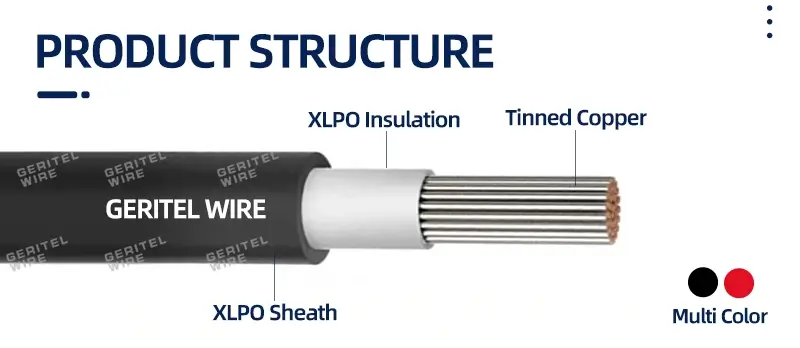
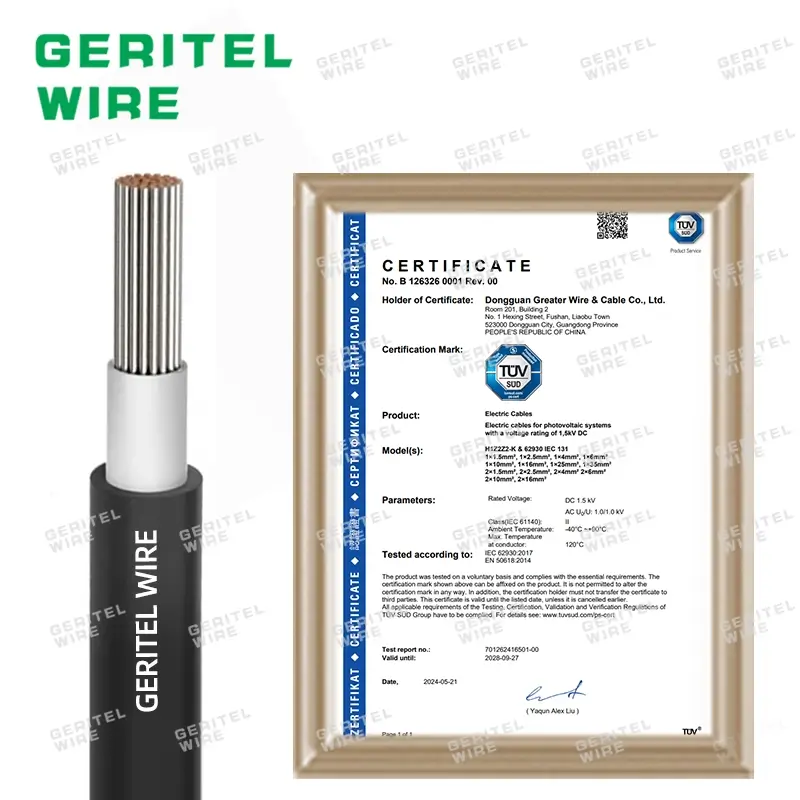
TUV certification subjects cables to 1500-hour UV aging tests, ozone resistance verification, and thermal cycling protocols — simulating the cumulative stress of twenty-five Philippine summers. Our cables carry TUV Certificate No. B 126326 0001 Rev.00 and UL4703 Certification File No. E552397, providing third-party validation that manufacturing processes, material traceability, and quality systems meet international benchmarks.
In Malubog Reservoir's actual operating environment, the dual-layer XLPO construction demonstrates superior hydrolysis resistance compared to single-jacket alternatives. While standard PVC sheathing exhibits plasticizer migration and surface chalking within 2-3 years of saturated humidity exposure, XLPO's cross-linked molecular structure prevents chain slippage and maintains dielectric properties. The tin coating on copper conductors addresses electrochemical corrosion in salt-mist environments — bare copper oxidizes 40% faster when exposed to sulfur-bearing mining particulates combined with marine atmosphere. Our monitoring shows contact resistance growth held below 0.5% over five years, compared to 2-4% for uncoated conductors in similar conditions.
A critical installation detail concerns the dynamic segments where floaters move relative to fixed infrastructure. We specified 15% additional cable length beyond standard routing distances, maintaining bending radii at eight times the cable outer diameter minimum. This slack absorption prevents fatigue fracture — the accumulation of crystal lattice dislocations under repeated stress that ultimately elevates local resistance and creates thermal runaway risks. Infrared thermography conducted three months post-commissioning confirmed all junction points within 5°C of ambient temperature, with no anomalous hot spots.
Reliable Transmission in Cable Trays
From inverter output to step-up transformers, the installation employs YJV XLPE/PVC cables in 3C × 70mm² and 3C × 95mm² configurations, handling 400V/480V system capacities. These routes traverse cable trays and conduits along the reservoir bank, protected from direct water exposure and salt spray, allowing standard PVC sheathing rather than premium XLPO — achieving cost optimization without compromising reliability where environmental stress is moderated.
However, reduced environmental exposure does not justify reduced engineering standards. The XLPE insulation maintains 90°C continuous operating temperature with 250°C/5-second short-circuit tolerance, delivering approximately 25% higher current capacity than PVC-insulated equivalents of identical conductor size. This margin proves essential given mining load characteristics — crusher starting currents reach 6-8 times rated values, and the thermal mass of XLPE prevents insulation softening during these transient events.
We paid particular attention to tray ventilation. Summer temperatures within enclosed cable trays can exceed 60°C, accelerating PVC aging according to Arrhenius principles (each 10°C increase roughly doubles degradation rate). By enlarging tray cross-sections and optimizing cable spacing, we maintain operating temperatures below 55°C, effectively doubling sheathing life compared to densely packed installations.
An often-overlooked scenario involves tray section flooding during monsoon seasons. Elevated groundwater around the reservoir perimeter can inundate underground cable routes for extended periods. In these zones, we specified water-blocking XLPE insulation and cold-shrink sealing kits at terminations, preventing longitudinal water migration along conductor interstices. This preventive design addresses a common failure mode where capillary action wicks moisture tens of meters into apparently dry cable sections, progressively degrading insulation resistance.
The Strategic Link to Grid Connection
From step-up transformer to the 34.5kV interconnection point, MV XLPE Cable in 1C × 95mm² and 1C × 120mm² cross-sections forms the project's critical infrastructure backbone. This segment represents the "throat" of the entire installation — any fault here causes complete plant disconnection, and medium-voltage fault location and repair complexity far exceeds low-voltage systems.
The 34.5kV voltage level reflects standard Philippine medium-voltage distribution practice for industrial mining loads. Our cables carry UL1072 certification, the authoritative North American standard for medium-voltage power cables, carrying significant credibility in Philippine mining circles where American engineering standards predominate. Copper conductors were selected over aluminum despite approximately 30% cost premium, based on mechanical strength and fatigue resistance critical for mining environments. Aluminum conductors exhibit creep deformation under vibration, potentially loosening terminations over time — an unacceptable risk given the load fluctuation patterns of crushing and grinding circuits.
Installation methodology adapted to mining infrastructure realities. Most segments employ direct burial beneath haul roads, protected by HDPE outer sheathing for mechanical robustness. Road crossings utilize steel pipe encapsulation to withstand heavy mine truck loading. A technical refinement involved serpentine laying patterns — buried cables experiencing thermal expansion generate axial stress as temperatures cycle. Serpentine configuration provides natural expansion allowance, preventing tensile deformation of insulation. This consideration proves particularly relevant in Cebu, where summer surface temperatures reach 50°C while nighttime levels drop to 25°C, creating significant daily thermal stress cycles.
The Invisible Safety Network
The grounding infrastructure employs bare and tin-coated copper conductors ranging from 1C × 16mm² for branch circuits to 1C × 35mm² for main grounding trunk lines. In floating solar applications, grounding transcends safety compliance to become a technical necessity for operational stability.
The high humidity of aquatic environments maintains low ground resistance, but salt-mist corrosion progressively degrades connection integrity at grounding electrodes and bonding points. We implemented multi-point equipotential design — each floating sub-array features independent grounding busbars interconnected to the main grid via tin-coated copper conductors. The tin coating's value manifests again: bare copper grounding conductors show visible corrosion within 3-5 years in marine atmospheres, while tin plating extends corrosion initiation beyond 15 years. All connections utilize exothermic welding rather than mechanical clamps, eliminating contact resistance growth over time.
Lightning protection required specific consideration. Open water surfaces represent high-risk zones for lightning strikes, and grounding systems must safely dissipate instantaneous surge currents. The 35mm² main grounding conductor sizing addresses not only continuous current capacity but also skin effect and thermal stability under 200kA direct strike conditions. We analyzed Cebu regional lightning flash density data to validate system adequacy.
Life Validation: From Paper Promise to Operating Data
Post-commissioning, we established annual monitoring protocols. First-year inspection data confirms DC cable insulation resistance maintained above 1000 MΩ/km with no degradation trend. Tin-coated conductor contact resistance increased 0.3% — well below the 2% alert threshold. XLPO sheathing shows no surface chalking or cracking, with UV stabilizer retention at 90% of original formulation levels.
These measurements validate the design philosophy: 25-year service life is not marketing language but an engineering outcome derived from material science and installation discipline. Standard PV1-F cable life ratings assume -40°C to +90°C ambient range, normal UV exposure, and dry to moderately humid conditions. At Malubog, our three-layer defense — dual XLPO sheathing, tin-coated conductors, and dynamic-flexibility installation practice — reduces actual stress levels to within standard-rated parameters, ensuring achievable life expectancy.
Industry failure comparisons prove instructive. A Southeast Asian floating installation employing standard PVC-sheathed solar cable experienced sheathing embrittlement and cracking within five years. Moisture ingress caused insulation breakdown, and cable replacement required marine vessel chartering costing tens of thousands of dollars simply for platform access. The Carmen Copper project avoids this "cheap purchase, expensive maintenance" trap through appropriate first-cost engineering.
Partnership Value and Long-Term Commitment
Carmen Copper has incorporated this project's cable specifications into their renewable energy technical standards template. For mining clients, this "pilot validation, standard固化, scale replication" pathway offers compelling value — other Atlas Group mining properties can adopt proven technical solutions without redundant evaluation cycles, reducing decision risk and engineering redundancy.
The project's scalable architecture amplifies initial specification importance. Current 4.99MW capacity represents merely the beginning, with system design accommodating expansion to 50MW. Our 1C × 6mm² DC cables and 3C × 95mm² AC cables include current capacity margins for ultimate build-out, avoiding cable replacement during future expansion phases. This means today's cable investment locks in infrastructure costs for fifteen years of growth.
Contact Us: Start Your 25-Year Reliability at Specification Stage
If you are planning island, mining, or floating solar projects — or need cable systems proven in the world's harshest environments — our engineering team provides comprehensive support from environmental assessment and specification calculation through field commissioning.
Dongguan GERITEL Electrical Co., Ltd.
• Tel/WhatsApp/WeChat: +86 135 1078 4550 / +86 136 6257 9592
• Email: manager01@greaterwire.com
Our Core Strengths:
• TUV Certified Solar Cable (Cert. No. B 126326 0001 Rev.00) + UL4703 Certified (File No. E552397) + UL1072 Medium Voltage Certified
• Full range of PV DC cables, MV cables, and American standard certified products
• Proven delivery experience across Southeast Asian solar projects, specializing in island salt-mist, mining corrosion, and floating dynamic environments
• Dongguan manufacturing base with fast delivery, supporting urgent orders and customized production
 Davao del Norte Ilocos Norte Opus Solar(300MW)



 Building 2, No. 40 Luxi 2nd Road, Liaobu Town, Dongguan City, Guangdong Province, China