


 Home
HomeDavao del Norte Ilocos Norte Opus Solar(300MW)
 GERITEL
 Apr 20,2026

The Coastal Challenge
Davao del Norte sits on the southeastern quadrant of Mindanao Island, receiving over 2,100 annual sunshine hours with irradiance levels reaching 5.5 kWh/m²/day. In early 2024, a Philippine conglomerate with deep roots in mining and agribusiness initiated a 300MW ground-mounted photovoltaic installation across 400 hectares of coastal lowland. The project adopted a phased grid-connection strategy, stepping up to 33kV medium voltage before feeding into the national transmission network.
As the EPC contractor's electrical consultant evaluated the initial bill of materials, a fundamental tension emerged. The project site lies less than three kilometers from the Philippine Sea, placing it within the C5-M corrosion category under ISO 9227. Ambient temperatures hover at 28°C year-round, relative humidity rarely drops below 75%, and ultraviolet radiation indexes regularly exceed extreme levels. Standard construction-grade cables, while electrically functional on paper, would face a hostile environment that attacks insulation from multiple vectors simultaneously.
A ninety-day field exposure test conducted during the pre-construction phase settled the debate. Unmodified PVC sheathing exhibited surface chalking within six weeks of UV exposure. Conventional XLPE insulation samples developed micro-cracking after repeated thermal cycling in the humid coastal air. The evidence was unambiguous: cable selection for this project required treating the conductor not merely as a current path, but as a multi-layer defense system against thermal, hygroscopic, photochemical, and saline stress.
Material Science in the Tropics
The DC side—from module string to inverter—demanded the most rigorous material specifications. We specified H1Z2Z2-K photovoltaic cable throughout this segment. The compound formulation uses irradiation-crosslinked polyolefin for both insulation and sheath, achieving a continuous operating temperature range of -40°C to +90°C in fixed installation. The 1500V DC rating accommodates the elevated open-circuit voltages of contemporary high-wattage modules without insulation margin concerns.
Field application followed a graduated sizing logic. 1×4mm² handled inter-module string wiring within rows. 1×6mm² served as the homerun from string to combiner box. For longer combiner feeder runs where voltage drop calculations demanded lower resistance, 1×10mm² maintained DC losses below the 1.5% threshold specified in the plant performance model.
The DC trunk lines—carrying aggregated current from combiner boxes to central inverters—required a different scaling approach. XLPE-insulated DC-rated cables in sizes from 1×16mm² up to 1×50mm² managed the collective amperage of multiple strings. Here, the 90°C thermal limit of crosslinked polyethylene provided meaningful headroom compared to PVC's 70°C ceiling, particularly relevant where cables run in densely populated trench or tray configurations with reduced heat dissipation.
Navigating Standard Complexity
The Philippine solar market operates within a pluralistic standards environment. IEC, TÜV, and UL frameworks coexist, often creating uncertainty among local engineering teams. During technical workshops, the client's project finance team repeatedly raised a specific concern: would the cable selection satisfy both ERC grid-code requirements and the lender's technical due diligence checklist?
Rather than presenting isolated product specifications, we mapped cable types to functional zones and their corresponding standard requirements.
For the AC low-voltage segment—inverter output to step-up transformer—the 0.6/1kV operating environment permitted XLPE-insulated power cable structurally equivalent to YJV under IEC 60502. Deployed sizes included 3×120+70mm², and 3×185+95mm². The copper conductors utilize Class 2 stranding, striking a calculated balance between current capacity and installation pliability. Inside transformer enclosures where bending radii are constrained, this flexibility advantage becomes operationally significant compared to solid-conductor alternatives.
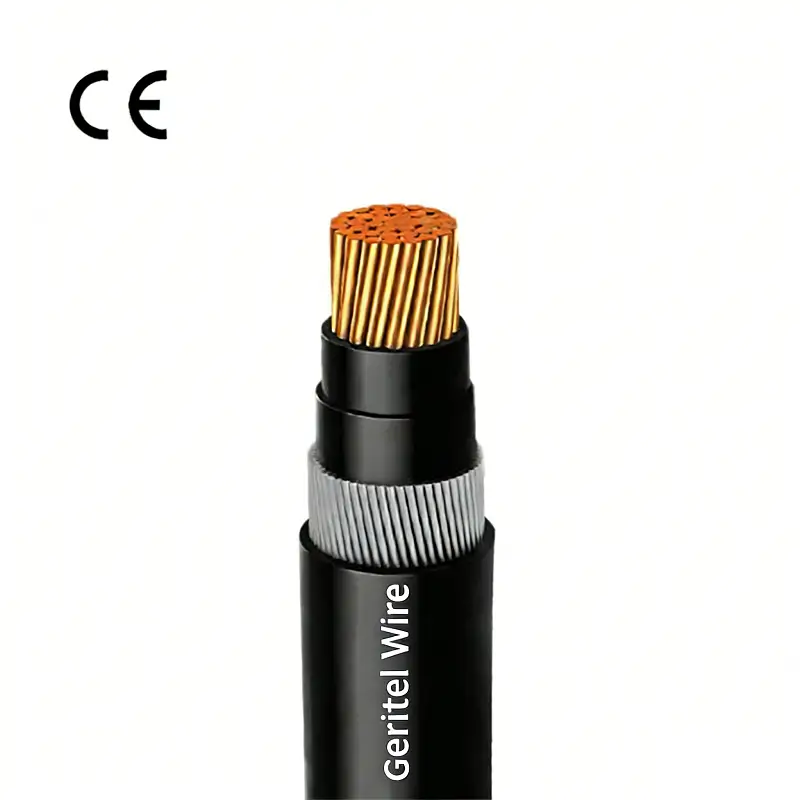
The medium-voltage collection system—step-up station to grid interconnection point—represented the highest electrical stress environment. 33kV XLPE cable with copper wire screen and steel wire armor was specified across 1×95mm² through 1×240mm² sizes. The metallic screen serves a protective function beyond electrostatic shielding: in a region experiencing frequent atmospheric electrical activity, it provides a low-impedance fault current path that coordinates with substation protection relays. The armor layer addresses mechanical hazards during direct-burial installation across existing haul roads within the former agricultural estate. Insulation wall thickness of 10.5mm—substantially exceeding low-voltage norms—reflects design margin against electrical treeing degradation over the operational lifespan.
Auxiliary systems completed the architecture. Earth conductors in 16mm², 25mm², and 50mm² with green-yellow identification established equipotential bonding networks. Control and monitoring circuits used 1.5mm² and 2.5mm² multicore screened cables to preserve signal integrity across the distributed inverter communication network.
Certification as Risk Mitigation
The Energy Regulatory Commission's interconnection review process requires comprehensive equipment documentation. The photovoltaic cables supplied for this project carry TÜV certification (Certificate No.: B 126326 0001 Rev.00) and UL listing (File No.: E552397). Medium-voltage products conform to UL 1072 standards. These credentials represent more than manufacturer declarations—they indicate sustained third-party surveillance of production processes and batch testing protocols.
A frequently overlooked correlation exists between certification test parameters and actual service conditions. The TÜV humidity-heat cycling protocol (85°C/85% relative humidity, 1,000 hours) and UV aging sequence (720-hour xenon-arc exposure) effectively simulate the stress profile that Davao cables encounter in continuous outdoor exposure. When the client's technical director reviewed the certification package, the recognition that laboratory prequalification directly anticipated field conditions provided the confidence foundation for accepting the 25-year performance warranty.
Logistics as Engineering Discipline
The cable scope for 300MW capacity exceeded 800 kilometers total length, requiring six phased deliveries aligned with construction sequencing. The first tranche of DC products needed to arrive two weeks ahead of module delivery to support pre-assembly activities. Medium-voltage reels were scheduled for just-in-time placement following substation civil completion, minimizing outdoor storage exposure that could compromise sheath integrity before installation.
During the second delivery window, monsoon-related port congestion at Davao International Container Terminal threatened schedule slippage. Activation of a contingency routing through Manila Port, with subsequent domestic transshipment, maintained material availability ahead of concrete curing milestones. This responsiveness stemmed from preemptive logistics planning that recognized a structural vulnerability of Philippine project execution: archipelagic geography concentrates port risk at single nodes unless alternative channels are pre-qualified.
Operational Validation
The initial 50MW phase achieved commercial operation in Q3 2024. Infrared thermographic inspection during the commissioning period recorded cable joint temperatures within 15K of ambient across all termination points, comfortably below IEC 60502 limits. A particularly instructive observation involved surface temperature differentials on coastal exposure runs: the UV-stabilized sheathing registered 3-5°C lower surface temperatures than comparative samples during peak irradiance hours. Over compound annual thermal cycling, this differential translates into measurably reduced polymer oxidation rates.
Post-rainy season insulation resistance testing, conducted by the client's operations team, demonstrated superior stability in DC field circuits compared to a previous Luzon-based project where non-photovoltaic-grade cables had been deployed. The performance aligned with the low moisture absorption characteristics of XLPO compounds, whose water permeation coefficients are an order of magnitude below conventional PVC formulations.
Technical Decisions, Commercial Consequences
Retrospective analysis of cable selection decisions reveals several patterns relevant to comparable developments:
Specialization over Generalization: The 15% first-cost premium for H1Z2Z2-K versus general-purpose alternatives in the DC segment eliminated the risk of mid-life insulation replacement. For an asset with 25-year financing tenor, any operational interruption triggers revenue loss and potential covenant breach.
Shielding and Armoring as Economic Rationality: The metallic screen and steel tape armor added approximately 8% to medium-voltage cable unit pricing, yet eliminated the need for supplementary concrete encasement when crossing existing estate roads. The net installed cost decreased while fault-current coordination improved, protecting higher-value transformer assets downstream.
Certification Documentation in Financial Structuring: During syndicated loan technical assessment, the TÜV and UL certification files were classified as critical security items. For developers seeking non-recourse project financing, equipment credentials function as risk-mitigation instruments rather than purely technical specifications.
Guidance for Comparable Developments
Based on implementation experience in Davao del Norte, developers planning solar installations in tropical coastal zones across Southeast Asia should incorporate the following considerations into cable procurement strategy:
• UV Stability Verification: Require suppliers to present ASTM G154 or ISO 4892 UV aging test reports confirming adequate carbon black loading or UV stabilizer incorporation in sheath compounds.
• Hygrothermal Qualification: Prioritize products tested to IEC 60068-2-78 (damp heat steady state) or equivalent protocols, with particular attention to insulation water absorption coefficients.
• Ampacity Derating Discipline: The Philippine Electrical Code mandates soil thermal resistivity correction factors for buried cables. Coastal sandy soils typically exhibit resistivity values exceeding standard reference conditions; design calculations should incorporate site-specific geotechnical data rather than generic assumptions.
• Standards Harmonization: Maintain consistency by specifying DC cables to IEC 62930 or UL 4703, AC cables to IEC 60502 or UL 1072, and medium-voltage products to IEC 60502-2. Mixed standard environments create acceptance ambiguity that delays commissioning.
Contact Us
Dongguan GERITEL Electrical Co., Ltd.
Tel/WhatsApp/WeChat: +86 135 1078 4550 / +86 136 6257 9592
Email: manager01@greaterwire.com
 Carmen Copper Toledo Floating Solar Project



 Building 2, No. 40 Luxi 2nd Road, Liaobu Town, Dongguan City, Guangdong Province, China