


 Home
HomeCalatrava Solar Power Plant (173 MWp) – Negros Occidental, Philippines
 GERITEL
 Apr 20,2026

The Calatrava Solar Power Plant sits in Barangay San Isidro, Negros Occidental, Philippines—a 173 MWp facility spanning 139 hectares of former sugarcane land. It stands as the largest operating solar and variable renewable energy installation in the Visayas grid. Construction began in late 2023, with initial energization achieved by the end of 2024 and full commercial operation certification from the National Grid Corporation of the Philippines (NGCP) secured in July 2025.
The site presents a textbook tropical marine environment: year-round high humidity, six-month typhoon seasons, intense ultraviolet exposure, and salt-laden air from the coastline roughly 15 kilometers away. The soil profile adds another variable—acidic, sulfur-rich earth left behind by decades of sugarcane cultivation. These factors do not merely complicate cable selection; they redefine the baseline requirements entirely.
The Selection Starting Point: From "Standard Configuration" to "Environmental Adaptation"
The initial electrical design followed conventional utility-scale logic: 1500V DC arrays, 33kV/34.5kV medium-voltage collection, central inverters with pad-mounted transformers. The cable bill of materials reflected standard practice—PV string cables for DC collection, YJV copper power cables for AC side, medium-voltage trunk lines, and grounding infrastructure.
The turning point arrived during geotechnical surveys. The 139-hectare parcel was not flat farmland but undulating cane fields, crisscrossed with irrigation ditches and scattered with gravelly subsoil. Two immediate consequences emerged: first, DC string lengths could not be standardized, with standard 50-meter runs coexisting alongside extended 75-meter strings; second, medium-voltage direct-burial routes faced genuine mechanical damage risks from rocky soil conditions.
The design team recognized that adhering to "standard configurations" meant accepting environmental mismatch risks. In the Philippine market, cable failure remediation costs—including production losses during downtime—typically exceed initial procurement differentials by an order of magnitude. Underground medium-voltage cable replacement involves extensive excavation, creating operational disruptions that asset owners cannot easily absorb.
DC Side Solution: Scenario-Based PV Cable Matching
PV Solar Cable represented the highest-volume cable category in this project, covering all DC connections from module to combiner box. Selection decisions rested on three field-specific constraints:
Current and Voltage Drop Calculations in Context
Standard strings (approximately 50–60 meters) operating at 1500V DC carried working currents of 13–15A. A
4mm² cross-section provided sufficient conductivity to hold voltage drop below 1.5%. However, extended 75-meter strings pushed voltage drop toward 2.8% with the same gauge—beyond design tolerance. The resolution adopted a mixed 4mm² and 6mm² deployment: standard strings retained 4mm², while extended runs upgraded to 6mm². This approach avoided custom non-standard manufacturing while balancing cost and electrical performance.
Conductor Protection in Saturated Environments
With average annual humidity exceeding 80% and acidic soil chemistry, bare copper faces accelerated galvanic corrosion. GERITEL's specification employed
tin-plated copper conductors, where the tin layer forms a dense oxide barrier that interrupts electrochemical degradation chains. Comparative testing demonstrated that after 90 days in simulated local soil conditions, tin-plated samples showed contact resistance variation roughly one-third that of bare copper equivalents.
Long-Term Jacket Weatherability
The site receives substantial cumulative UV radiation annually, compounded by salt-mist penetration. GERITEL's PV cable utilized an
XLPO double-layer insulation and jacket system, with the outer layer incorporating advanced UV stabilizers and salt-mist resistant formulations. This material combination achieved 5,000 hours in QUV accelerated aging without jacket cracking, whereas conventional single-layer XLPE constructions typically showed embrittlement around the 2,000-hour mark.
The product carries dual certification: TÜV (Certificate No. B 126326 0001 Rev.00) and UL 4703 (UL File No. E552397). This certification matrix satisfied dual financing requirements—European lenders recognizing TÜV credentials, while Philippine grid authorities referenced UL standards for equipment acceptance.
AC and Medium-Voltage Sides: YJV Cables and Armoring Decisions
Connections from inverter AC outputs to the medium-voltage step-up station employed YJV cable 3C × 185mm² + PE and 3C × 240mm² + PE configurations. The 185mm² gauge covered standard transmission distances, while 240mm² addressed longer high-current branches to minimize line losses.
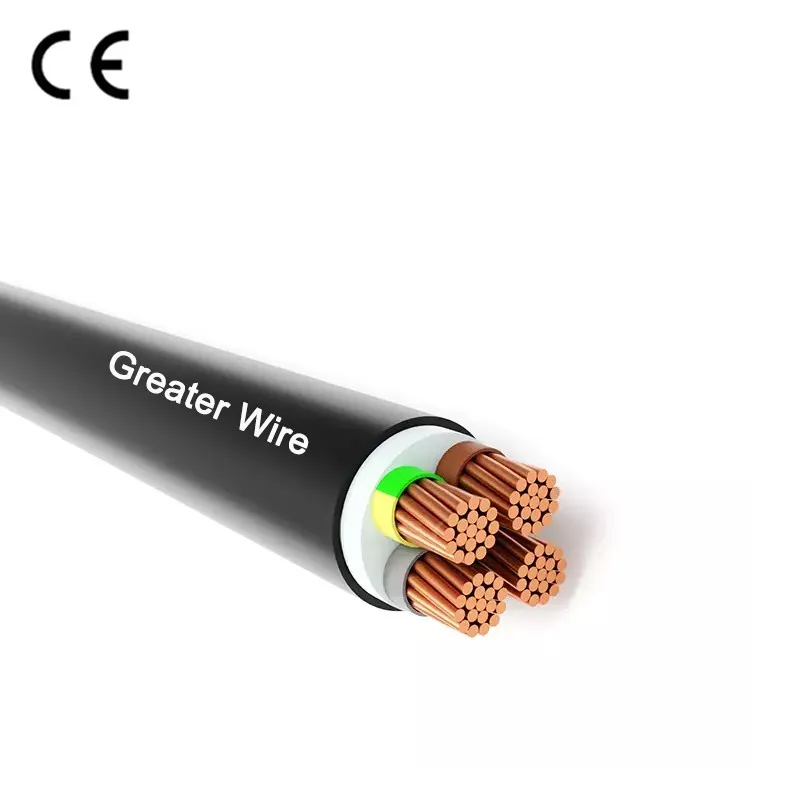
The medium-voltage collection system (33kV/34.5kV) presented a critical design choice: armoring strategy. The project team evaluated two pathways:
• Armored Pathway (SWA): Applied to all direct-burial sections. Steel wire armoring provides mechanical protection against stone compression during backfilling and potential agricultural equipment impacts during future land use. In Negros Occidental's converted farmland, ground settlement and soil shifting represent common phenomena; the armor layer creates redundant protection for the cable jacket.
• Non-Armored Pathway: Reserved exclusively for conduit runs and aerial transitions, optimizing unit costs where mechanical protection already exists.
The final solution adopted segmented logic: mandatory SWA armoring for direct burial, cost-optimized non-armored variants for controlled environments. Medium-voltage specifications included 1C × 240mm² and 1C × 300mm² (for extended distances), carrying UL 1072 certification aligned with the project's North American technical reference framework.
Grounding System: Engineering the Lightning Protection Network
The Philippines ranks among the world's most lightning-active regions, with over 100 thunderstorm days annually. The grounding design employed a layered architecture:
• Main Grounding Trunk: Bare copper conductors at 25mm² and 35mm², forming a closed ring network around the site perimeter to minimize grounding impedance
• Equipment Bonding: Yellow-green insulated grounding conductors connecting module frames, inverter enclosures, and transformer tanks to establish equipotential bonding
• Lightning Down-Conductors: Integrated with the substation lightning protection system to ensure rapid surge current dissipation
GERITEL delivered grounding conductors concurrent with power cables, with clear color identification reducing field wiring errors. Grounding system construction completed before the 2024 rainy season, allowing resistance testing to finish ahead of typhoon season.
Supply Chain Synchronized to Construction Rhythm
Solar project construction surfaces advance in rolling waves—land clearing, pile driving, module installation, electrical termination, and commissioning overlap rather than proceed linearly. GERITEL's delivery schedule matched this rhythm:
First Shipment: PV Solar Cable (mixed 4mm² and 6mm² ratios), arriving before DC field work commenced to satisfy string wiring needs for the initial 50MW phase.
Second Shipment: YJV AC cables (3C×185mm² and 3C×240mm²), timed to inverter foundation completion to avoid prolonged on-site storage.
Third Shipment: Medium-voltage cables (1C×240mm² and 1C×300mm²) including SWA armored variants, entering the site after substation civil work concluded for direct transition into trenching operations.
This phased arrival model reduced site storage pressure and minimized weather exposure risks during the rainy season. When field surveys revealed shifted string-length distributions, GERITEL dynamically adjusted the 4mm²-to-6mm² ratio before the second shipment without requiring production rescheduling.
Operational Validation: Post-Commissioning Performance Tracking
By the second half of 2025, the project entered commercial operation. Operations teams conducted two focused inspections:
DC Side Inspection: Infrared thermography scanning showed normal temperature rise across all string connection points, with no abnormal hotspots. IV curve testing confirmed that voltage drop control in extended strings met design expectations—the 6mm² upgrade strategy effectively offset additional losses from increased length.
Medium-Voltage Side Inspection: Partial discharge measurements registered well below IEC 60502 thresholds. SWA armored sections showed no insulation degradation signs attributable to mechanical damage during installation.
Grounding System Inspection: Station-wide grounding resistance remained stable below 0.5 ohms, meeting design targets. Lightning protection records through typhoon season showed zero incidents.
These data points validated the foresight embedded in selection decisions—the cable system did not emerge as a shortcoming variable during the operational phase.
Project Insights: Systems Thinking in Cable Selection
The Calatrava project offers a replicable decision framework for tropical solar developments:
Environmental Constraints as Design Inputs
Tropical solar cable selection should not transplant temperate-zone standard templates. UV intensity, humidity, salt-mist exposure, and soil chemistry must enter material screening criteria during initial design rather than later adjustment.
Certification Portfolios as Project Assets
The TÜV+UL dual certification on PV cables, combined with UL 1072 on medium-voltage products, satisfied compliance requirements while compressing international financing technical due diligence timelines. For IPPs employing diverse funding sources, certification completeness directly impacts financial close schedules.
Gauge Gradients Replacing Custom Manufacturing
Addressing irregular site string-length variations through 4mm²/6mm² cross-section gradients proves more economical and faster than custom non-standard lengths. This "flexibility within standardization" represents an effective supply-chain risk management tool.
Delivery Cadence Coupled to Construction Surfaces
Bulk single-shipment cable arrivals often create storage pressure or weather exposure risks. Phased delivery requires supplier inventory management and logistics coordination capabilities, but significantly benefits field construction organization.
Conclusion
The Calatrava 173 MWp project demonstrates an engineering principle fundamental to infrastructure development: the least visible components often determine the longest-term reliability. Cables buried underground, threaded through conduit, or secured to mounting structures remain unseen in daily operations, yet their material selection, structural design, certification completeness, and delivery coordination collectively form the foundational guarantee for a power plant's 25-year economic life.
For engineering teams currently planning similar projects, cable selection merits technical attention equivalent to design review. Environmental adaptation, regulatory compliance, and supply-chain responsiveness—evaluated across these three dimensions—reflect true costs more accurately than price comparison alone.
To discuss cable specification matching or delivery planning for specific projects, contact GERITEL's technical team.
Dongguan GERITEL Electrical Co., Ltd.
Tel/WhatsApp/WeChat: +86 135 1078 4550 / +86 136 6257 9592
Email: manager01@greaterwire.com
 Carmen Copper Toledo Floating Solar Project



 Building 2, No. 40 Luxi 2nd Road, Liaobu Town, Dongguan City, Guangdong Province, China