


 Home
Home2021 Iraq Kurdish Region 3×100MW Photovoltaic Project
 GERITEL
 Apr 17,2026

Autumn 2021. A construction site on the outskirts of Erbil in Iraq's Kurdistan Region. Three 100MW ground-mounted solar plants. The mounting structures were up. Inverter foundations poured. PV modules arriving within the week. And then the cable supplier dropped the bomb: ocean freight delayed, delivery pushed back 40 days.
The EPC project manager's voice was hoarse on the call. "Every day of delay costs us 0.5% of the contract value in penalties."
When we stepped in, the client had 32 days left to meet the owner's hard deadline. From contract signature to goods arriving on site in Iraq: 28 days total. 330,000 meters of H1Z2Z2-K solar cable. 35,000 meters of YJV 1×240mm² power cable. 50,000 meters of H07V-K control cable. All accepted on first inspection.
This wasn't luck. It was about anticipating problems, technical depth, and execution density.
The Reality of the Iraqi Market: Opportunity Lives in Chaos
The Iraqi PV market in 2021 was wild.
Government power shortages led to nationwide blackouts during summer peaks. Solar policies were just taking shape. Developers were mostly European or Middle Eastern capital. EPC contractors were predominantly Chinese and Turkish firms. Project documents mixed European standards, American standards, and outdated local codes. Design changes on site came faster than email updates.
The client's real situation:
• Price mattered, but delivery disasters from low-bid suppliers mattered more. Their previous supplier delayed three months and nearly killed the project.
• Certification requirements were brutal. The Iraqi Ministry of Electricity only recognized top-tier TÜV and UL certificates, verified batch by batch.
• Logistics was a black hole. Kurdistan Region customs procedures were complex. One wrong word in the documentation meant two weeks stuck at port.
• Site conditions were hostile. Summer surface temperatures exceeded 50°C. UV radiation was extreme. Standard cables aged three times faster than in Europe.
They didn't need a price list. They needed a partner who could take responsibility, knew the terrain, and had backup plans.
Product Choice: Why H1Z2Z2-K Was Non-Negotiable
The client's initial technical specification still referenced the outdated PV1-F standard. Our engineering team flagged it immediately: PV1-F cannot handle the Iraqi environment in terms of heat resistance and flame retardancy.
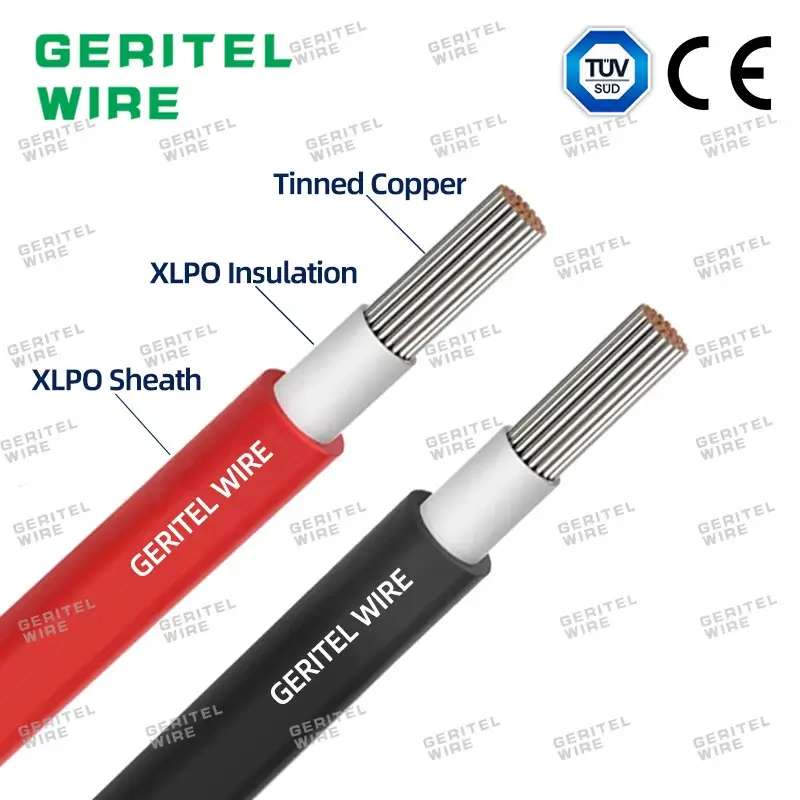
H1Z2Z2-K represented a comprehensive upgrade over PV1-F. While PV1-F was limited to DC 1000V rated voltage, H1Z2Z2-K handles DC 1500V with maximum capacity up to 1800V. The conductor temperature rating jumped from 90°C to 120°C, and short-circuit tolerance increased from 200°C to 280°C. The flame retardancy improved from basic levels to halogen-free low-smoke IEC 60332-1 classification. Ozone resistance went from general to enhanced grade. Most critically, the service life extended from 15-20 years to over 25 years.
The fundamental difference lies in materials and manufacturing process. H1Z2Z2-K uses electron-beam irradiation cross-linked XLPO (cross-linked polyolefin) double-layer insulation. This creates a three-dimensional molecular network structure that prevents softening or dripping under extreme heat. The tin-plated copper conductors resist sulfide corrosion from desert air. The black outer sheath incorporates UV stabilizers to maintain mechanical strength under the brutal Iraqi sun.
The client hesitated initially. Upgrading the specification meant roughly 8% higher material costs. We provided a Life Cycle Cost (LCC) analysis showing that the labor and downtime costs of replacing cables in Iraq far exceeded the initial material premium. They accepted the full proposal.
Project Configuration:
• 1×4mm²: 220,000 meters for standard string connections
• 1×6mm²: 110,000 meters for long-distance strings with superior current margins
• Total DC side: 330,000 meters
For the AC grid connection side, we simultaneously supplied 25,000 meters of YJV 1×240mm², 10,000 meters of YJV 1×185mm², and approximately 8,000 meters of 33kV XLPE 1×300mm² medium voltage cable. Control circuits used 30,000 meters of H07V-K 1.5mm² and 20,000 meters of 2.5mm² to meet secondary wiring needs for combiner boxes and inverters.
Certification: Not Just Having Certificates, But Full-Series Coverage
The Iraqi Ministry of Electricity's verification process was painstaking. They didn't just want to see certificates. They checked the certificate annexes to confirm that your supplied specifications actually appeared on the certified model list.
Many suppliers held TÜV certificates covering only up to 4mm², leaving 6mm² and above technically uncertified. Some presented certificates that were photoshopped, with no record on the official website.
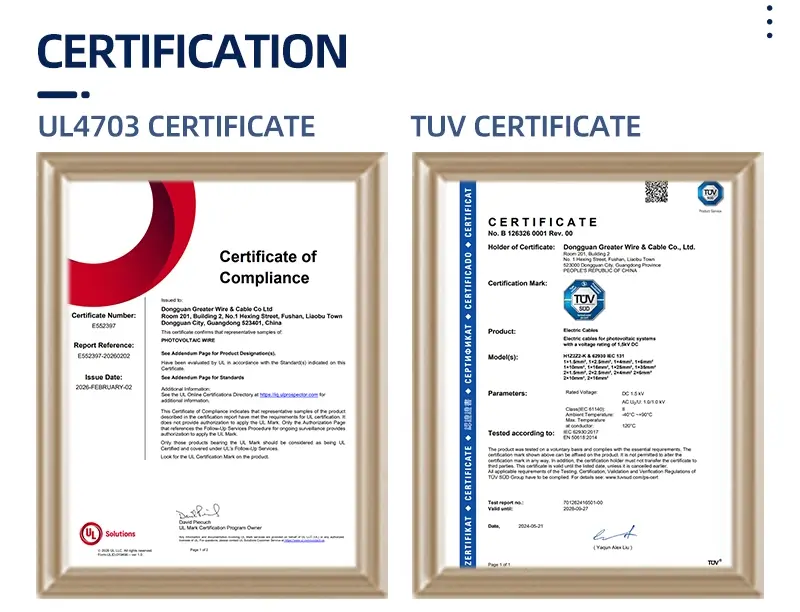
Our H1Z2Z2-K series carries TÜV Rheinland certificate number R 50435095, covering the full range from 1.5mm² to 240mm², all verifiable online. We also hold UL 4703 American standard certification to accommodate different EPC technical preferences. Every batch ships with complete documentation including SGS composition reports for raw material copper rods (99.99% oxygen-free copper), proof of dose uniformity for irradiation cross-linking processes, and 100% factory withstand voltage test records (AC 6.5kV/5min with no breakdown).
The client told us: "Your documentation package is the most complete we've seen. Customs clearance passed on the first attempt."
Delivery: How 28 Days Happened
Days 1-3: Contract signature and technical confirmation. We discovered that 15% of circuit current calculations in the client's drawings were conservative, leaving insufficient margin for 4mm² cable under high temperatures. Within 48 hours, we completed ampacity recalculations and recommended upgrading to 1×6mm², simultaneously adjusting production schedules.
Days 4-10: Full production line operation. We activated priority "solar dedicated line" status. Quality inspection employed online eddy current testing combined with high-voltage testing in parallel, compressing inspection time by 40%.
Days 11-15: Pre-customs documentation preparation. Iraq COC certification launched in advance. Packing lists, invoices, certificates of origin, and quality inspection reports all pre-reviewed. Port agent on standby 72 hours before cargo arrival.
Days 16-22: Ocean freight. Primary route: Shenzhen through Suez Canal to Jordan's Aqaba Port, then overland to Erbil. Backup plan: via Turkey's Mersin Port. If primary route encountered problems, we could switch within 24 hours.
Days 23-28: Port arrival, customs clearance, cargo pickup. The pre-clearance strategy worked. Cargo released on the day of port arrival. Overland delivery reached the site within 48 hours.
During acceptance inspection, the EPC project manager checked three cable drums for meter markings, sheath surface condition, and reel deformation. All passed. He wrote on the acceptance form: "Packaging intact, markings clear, deadline savior."
On-Site Support: Service Begins When Cables Arrive
After cable unloading, our engineers guided the site construction team via video conference on critical installation parameters. For bending radius in fixed installation, maintain minimum 4 times the outer diameter to prevent mechanical damage to insulation layers. For MC4 connector assembly, use dedicated crimping tools to ensure contact resistance below 0.5mΩ. For routing paths, avoid heavy equipment corridors and use sand bedding protection in Gobi gravel areas.
During construction, the client added an urgent requirement: the inverter room needed H07RN-F flexible cable for mobile equipment connections. We coordinated factory expedited production and air freight supplementation, delivering within 5 days.
This responsiveness is more valuable than price discounts in the Iraqi market.
Post-Project Review: What the Client Actually Paid For
After grid connection, the client sent an email summarizing the partnership value. Three points stood out.
First, risk anticipation. We identified version conflicts in their technical specifications during the quotation phase, avoiding later compliance risks. Many suppliers just sell products without caring about compliance.
Second, delivery resilience. With a 32-day window, we not only avoided delay but delivered 4 days early. Backup shipping routes, pre-customs clearance, production capacity reserves. These "hidden costs" are invisible to clients but save projects when it counts.
Third, technical backing. From ampacity recalculation to on-site installation guidance, we provided a system solution, not a one-time transaction.
Regarding price? The client said: "5% higher than the lowest bidder, but the saved delay penalties and change costs exceeded 20%."
For Buyers Evaluating Suppliers: Five Essential Questions
If you're participating in Middle East, North Africa, or Central Asian solar projects and evaluating cable suppliers, verify these points.
Does certification cover the full specification range? Demand certificate numbers and verify on TÜV/UL official websites. Beware of "certificate borrowing" traps.
Do they have comparable project experience? Iraq, Saudi Arabia, Egypt, and Jordan have vastly different environments. Theoretical knowledge and battlefield experience are completely different.
What is their delivery flexibility? Monthly production capacity, emergency scheduling mechanisms, logistics backup plans must be confirmed in writing.
How deep is their technical support? Can they assist with technical clarifications, ampacity calculations, and on-site problem response?
What is their quality traceability system? Does every cable drum have an independent serial number? Can raw material batches be traced?
GERITEL's answers:
• TÜV Rheinland (R 50435095) + UL 4703, full series coverage 1.5mm² to 240mm²
• Over 800MW solar project supply across Iraq, Saudi Arabia, Egypt, and Jordan
• 5 million meters monthly capacity, 48-hour emergency scheduling, dual-route logistics guarantee
• Engineering team with 10+ years EPC experience, 7×24 hour response
• Full-chain serial number management, 30-year warranty (industry standard 25 years)
Final Words: Ready for the Next Project
The 3×100MW station in Iraq's Kurdistan Region now generates 450 million kWh annually. Blue PV panels and black H1Z2Z2-K cables weave together into a stable energy network across the Gobi desert.
This is just the beginning. Iraq's 2030 renewable energy targets are advancing. More hundred-megawatt projects are coming to tender. If your team is evaluating cable suppliers, facing delivery pressure, technical confusion, or certification challenges, we want to be one of your options.
28 days delivery record. Not our limit. Our standard.
Contact us now for project-specific solutions:
Dongguan GERITEL Electrical Co., Ltd.
Tel/WhatsApp/WeChat: +86 135 1078 4550 / +86 136 6257 9592
Email: manager01@greaterwire.com
Website: www.greaterwire.com
 Ashalim Solar Complex Ongoing expansion (Negev Desert, Israel, 2021–2023)



 Building 2, No. 40 Luxi 2nd Road, Liaobu Town, Dongguan City, Guangdong Province, China