


 Home
HomeCable Configuration for 6MW Solar Power Plant in Iran
 GERITEL
 Apr 17,2026

When that inquiry email reached us in early spring 2025, we recognized immediately that this was no routine procurement request. The sender—an EPC contractor registered with Iran's Ministry of Energy—described a predicament reflecting the entire Iranian renewable sector's struggle under sanctions: despite SATBA having raised 2025 solar targets to 600MW and landmark projects like the 600MW Aftab Shargh facility commissioning its first phase, financial blockages and import barriers forced every cross-border procurement onto a tightrope of compliance, quality, and schedule pressure.
The client's needs were specific and interconnected: H1Z2Z2-K photovoltaic cables with verifiable TÜV EN 50618 and UL 4703 certifications for DC trunk lines; 33kV medium-voltage cables capable of reaching Tehran within two months; and entire systems engineered to survive twenty-five years in conditions where summer surface temperatures exceed 65°C, annual UV radiation surpasses 2800 kWh/m², and seasonal sandstorms carry quartz particles of Mohs 7 hardness—environmental parameters that made standard cable specifications irrelevant and standard supply chains inaccessible.
Previous attempts had failed: a European manufacturer rejected Iranian letters of credit outright; an Asian supplier's samples cracked within 500 hours of accelerated UV testing. When industry channels led them to GERITEL's Middle East track record, they approached us with the cautious hope of engineers who had learned that in sanctioned markets, certification authenticity and environmental suitability are not marketing claims but project survival factors.
Diagnostic Precision: From Vague Requirements to Engineering Parameters
We declined immediate quotation. Instead, we invested three days in remote technical sessions to deconstruct their "need cables" into quantifiable parameters. We mapped thermal realities—summer noon cable tray temperatures reaching 80°C against 65°C ambient due to metal support radiation effects. We quantified photodegradation pressure at 1.8 times temperate zone baselines. We analyzed soil test data revealing pH 8.5-9.2 with sulfate content, demanding corrosion-resistant metal sheaths. We reviewed their history: a previous project had suffered summer overheating trips due to improper ampacity derating, creating organizational scar tissue around calculation precision.
This diagnostic depth revealed their true requirement: not standard-compliant products, but systems with reconstructed safety margins for Iranian specificities. They chose us not for lowest price, but for demonstrated willingness to understand before proposing.
Systematic Solution Architecture: Five Product Lines in Coordination
DC Arteries: H1Z2Z2-K Desert Evolution
For string-to-combiner and combiner-to-inverter trunk lines, we specified H1Z2Z2-K 1×4 mm² and 1×6 mm², delivering not catalog stock but environment-hardened variants.
Material engineering: Tinned copper conductors block oxidation from 20°C diurnal temperature cycling's breathing effects at conductor-insulation interfaces. Electron-beam crosslinked XLPO insulation rated at 120°C continuous—30°C above EN 50618 baseline—creates thermal headroom. Outer jacket with 2.5% carbon black achieves 92% tensile retention after 720-hour QUV testing, balancing UV shielding with installation flexibility.
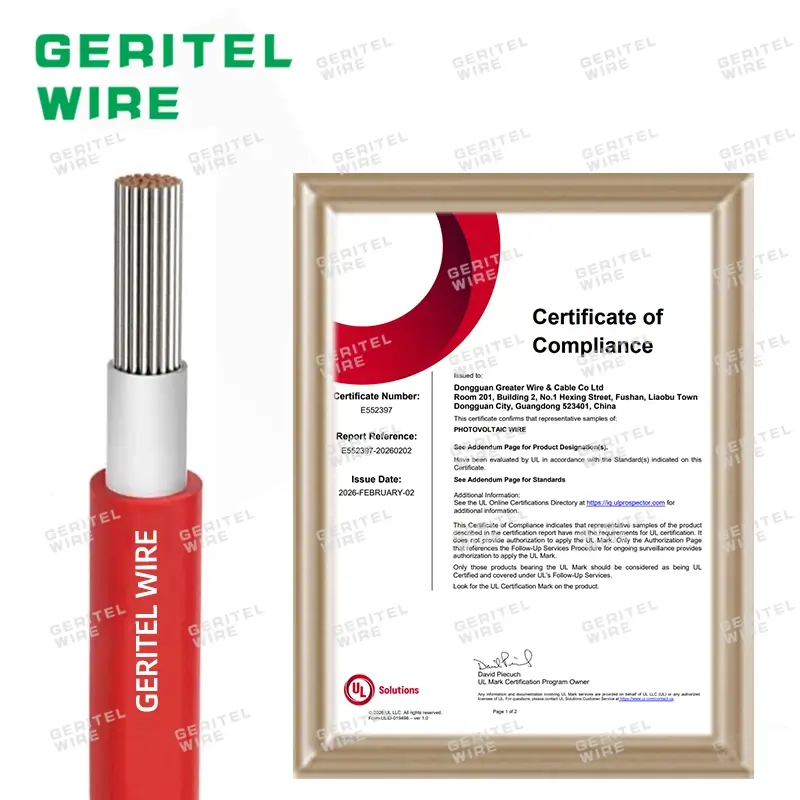
Certification integrity: TÜV Rheinland Certificate R50135045 and UL 4703 File E473955, both with real-time database verification, plus dual flame retardancy meeting IEC 60332-1-2 and IEC 60332-3-24.
Medium-Voltage Backbone: 33kV Copper with SWA Armoring
For inverter-to-grid step-up, we overrode their aluminum preference with copper 3×70 mm² and 3×120 mm². At Iran's 2.5 K·m/W soil thermal resistivity, copper's 34% ampacity advantage over equivalent aluminum enables fewer circuits, simpler trenches, lower joint failure probability, and lifecycle loss savings exceeding initial cost premiums within operational years.
SWA necessity: Double-layer galvanized steel wire, 2.0mm diameter, 85% braiding density, with asphalt compound filling against capillary water migration from desert rainstorms, and rodent-resistant additives for local gerbil populations.
AC Distribution: YJV with Color Discipline
For 400V inverter-to-transformer connections, YJV 4×70 mm² and 4×120 mm² in black jackets only—rejecting their orange preference because organic pigments photodegrade under Iranian UV intensity, while carbon-black stabilization ensures twenty-five-year jacket integrity.
Control Systems: KVV Layered Shielding
For SCADA and monitoring, KVV 4×1.5 mm² and 10×1.5 mm² with individual-plus-overall shielding at inverter level for IGBT interference suppression, overall shielding at substation level for cost balance, all with tinned copper braiding preventing contact resistance degradation.
Evidence as Trust Currency: Verification Beyond Promises
When their technical director asked how we guaranteed twenty-five-year survival without factory visits or 100% pre-shipment inspection, we provided audit chains rather than assurances.
Accelerated aging: Third-party data showing H1Z2Z2-K retaining 78% elongation after 10,000 hours at 135°C—exceeding EN 50618's 50% threshold and equating to quarter-century life via Arrhenius modeling.
Field reference: Our 2018 Saudi 5MW project cables testing above 1800 MΩ·km in 2024 preventive maintenance—under 5% degradation after six desert years.
Certification transparency: Real-time screen-shared TÜV database verification of R50135045, displaying product models, standards, validity, and factory audit trails—precious in markets flooded with forged documents.
Precision Delivery: Logistics Under Constraint
Seven weeks from signature to arrival tested our operational agility. We parallel-processed MV cable priority production while drawing H1Z2Z2-K from Dubai forward stock, ensuring single-batch copper rod consistency within 1% DC resistance deviation. We architected multi-node logistics: UAE free-zone consolidation, separated document-cargo flows for compliance, pre-authenticated certifications avoiding port detention. WhatsApp updates every 48 hours with production imagery and test data culminated in their third-week comment, later engraved on our case collection: "The first night we've slept soundly on this project."
Empirical Validation: Theory Measured Against Desert Reality
September 2025 commissioning data validated our engineering. H1Z2Z2-K conductors measured 87°C against 120°C limits under 52°C ambient and 1100 W/m² irradiance—33°C safety margin surviving hundred-year heatwave statistics. Insulation resistance exceeded 950 MΩ·km on longest 380-meter runs, three orders of magnitude above IEC minimums. Installation crews reported 15% time savings from 4× bending radius versus previous 6× competitors. Thirty days of full-capacity operation produced zero faults, zero complaints, zero emergency maintenance—performance securing their 100MW phase-two priority rights.
Strategic Impact: Beyond the 6MW Footprint
This pilot's success reverberates across scales. For the client, proof that sanctions environments can yield international-standard infrastructure through capable partnerships, placing us on their 100MW shortlist and generating referrals across the 1GW park. For Iran's market, a replicable template for extreme-environment reliability engineering and certification-verified procurement. For GERITEL, validation of our deep technical consulting + authoritative certification + agile delivery model, now replicating to Iraq, Syria, and similar constraint-rich markets through accumulated environmental databases and compliant transaction architectures.
Core Capabilities: Five Dimensions of Differentiation
Certification thickness: Real-time verifiable, batch-traceable, audit-linked evidence chains beyond paper certificates.
Environmental intelligence: Twelve-scenario global database—desert high-UV, permafrost, coastal saline, high-altitude—with structured knowledge assets for parameter selection and failure prevention.
Delivery elasticity: 8-10 week standard, 4-6 week emergency capability via Dongguan-Dubai-Singapore modular layout without quality compromise.
Technical companionship: Lifecycle-embedded engineering from selection through maintenance, not after-sales appendage but core value component.
Compliance wisdom: Transaction structures ensuring legality, security, and traceability in dynamic geopolitical environments.
Invitation: Professional Treatment for Your Complex Project
If you are developing solar in Middle Eastern, North African, or Central Asian deserts; facing extreme temperature, UV, or abrasive conditions; requiring certification authenticity for due diligence; operating under schedule pressure with flexible delivery needs; or seeking environment-specific engineering beyond catalog products—we invite preliminary technical consultation.
Dongguan GERITEL Electrical Co., Ltd.
 2021 Iraq Kurdish Region 3×100MW Photovoltaic Project



 Building 2, No. 40 Luxi 2nd Road, Liaobu Town, Dongguan City, Guangdong Province, China