


 Home
HomeXHHW-2 Wire Installation Requirements According to NEC Standards
 GERITEL
 Jul 06,2026

You have selected XHHW-2 wire for your project. The spec sheet says it is rated 90°C wet and dry. The price is right. The supplier has it in stock.
But do you know how the National Electrical Code (NEC) affects how you install it?
The NEC has specific requirements for XHHW-2 wire that every installer needs to understand. This article walks through the key NEC articles that apply to XHHW-2 installations—so you stay compliant and avoid costly mistakes.
1. NEC 310: Ampacity and Temperature Ratings
NEC Article 310 is the primary reference for XHHW-2 wire installations. It covers conductor construction, ampacity, temperature ratings, and installation conditions.
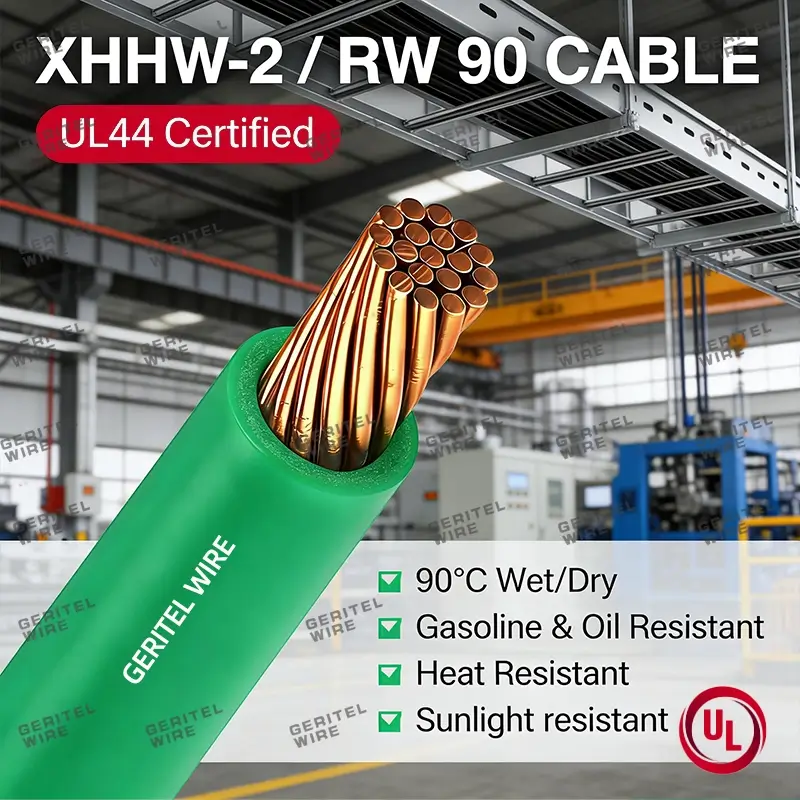
Temperature rating. XHHW-2 is listed in the 90°C column of NEC Table 310.16 for both dry and wet locations. This is a critical advantage over standard XHHW, which is only 90°C dry and 75°C wet. The "-2" rating means you get the full 90°C ampacity even in damp or wet conditions.
Ampacity tables. For NEC 310 XHHW-2 wire ampacity, use Table 310.16 (formerly Table 310.15(B)(16)). The table assumes:
- Ambient temperature of 30°C (86°F)
- No more than three current-carrying conductors bundled together
- Conductors in raceway, cable, or directly buried in earth
For a 12 AWG XHHW-2 wire, the 90°C ampacity is 30A, while the 75°C ampacity is 25A. A 4 AWG XHHW-2 wire has 95A at 75°C and 110A at 90°C. A 250 kcmil XHHW-2 wire offers 255A at 75°C and 290A at 90°C. This difference matters when applying NEC requirements.
Wet and dry locations. XHHW-2 conductors are suitable for use in both wet and dry locations at temperatures not exceeding 90°C. This makes XHHW-2 significantly more versatile than XHHW for a wide range of installations, including underground conduits, outdoor installations, damp mechanical rooms, direct burial applications, and washdown areas.
2. NEC 110.14: The Termination Temperature Rule
This is where many installers make their biggest mistake.
NEC 110.14(C) limits the ampacity of a conductor to the lowest temperature rating of any termination in the circuit. Most terminals—on breakers, panels, lugs, and equipment—are rated 60°C or 75°C. No distribution or utilization equipment is listed for the use of 90°C wire at its 90°C ampacity.
What this means: Even though XHHW-2 is rated 90°C, you cannot use the 90°C ampacity column unless all terminations in the circuit are also rated 90°C. In practice, they almost never are.
Equipment rated 100A or less. Conductors must be sized using the 60°C temperature column of Table 310.16, unless the equipment is marked otherwise. For equipment rated over 100A, conductors must be sized using the 75°C temperature column.
Example: A 1 AWG copper type XHHW-2 conductor has a 90°C ampacity of 145A. But if it terminates on 75°C-rated terminals, the ampacity is limited to 130A (the 75°C column value). This is the NEC 110.14 XHHW-2 termination temperature rule that every installer must know.
Practical rule: Unless you know the terminals are 90°C rated—and they almost never are—use the 75°C column for sizing XHHW-2 conductors. For XHHW-2 wire installation NEC requirements, this is the single most important rule to remember.
Exception for pressure connectors. Section 110.14(C)(2) covers separately installed pressure connectors such as power distribution blocks, which are often rated higher than 75°C. A run of 90°C rated conductors installed between 90°C rated power distribution blocks can be used at its full 90°C ampacity. However, this exception only applies to the middle portion of the run—the ends connecting to overcurrent devices or equipment still require 75°C sizing.
3. NEC 310.15: Derating for Ambient Temperature and Conductor Bundling
The ampacity in Table 310.16 is based on standard conditions. When conditions change, the ampacity must be adjusted.
Ambient temperature derating. If the ambient temperature exceeds 30°C, apply correction factors from NEC Table 310.15(B)(2)(a). For example:
- At 40°C: derating factor 0.91
- At 45°C: derating factor 0.82
- At 50°C: derating factor 0.71
Conductor bundling adjustment. When more than three current-carrying conductors are in the same raceway or cable, apply adjustment factors from NEC Table 310.15(C)(1):
- 4-6 conductors: 80%
- 7-9 conductors: 70%
- 10-20 conductors: 50%
- 21-30 conductors: 45%
Important rooftop exception: Type XHHW-2 insulated conductors are exempt from the rooftop temperature adder requirement in NEC 310.15(B)(3)(c). This means when XHHW-2 is installed on a rooftop, you do not need to add the additional temperature correction that applies to other wire types—a significant advantage for solar and rooftop installations.
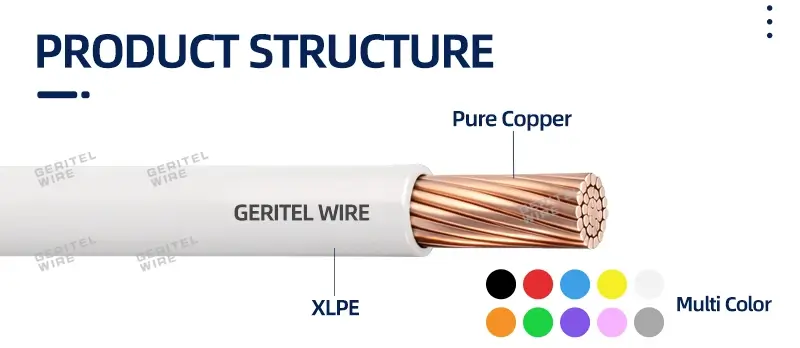
Why XHHW-2 is exempt: XHHW-2 is a thermoset insulation (XLPE), while most other insulations are thermoplastic. An NRTL report showed that XHHW is not damaged by the higher temperatures, providing the technical substantiation for this exemption.
4. NEC 300.5: Underground Installations and Burial Depth
XHHW-2 wire is suitable for underground installations, including direct burial when the cable is marked accordingly. However, NEC 300.5 sets minimum burial depth requirements.
Minimum cover requirements (NEC Table 300.5) :
- Direct burial cable (residential, 0-600V): 24 inches
- Direct burial cable under 120V GFCI: 12 inches
- PVC conduit: 18 inches
- Rigid metal conduit: 6 inches
- Under driveways or roads: deeper (check local codes)
Best practice: Use PVC conduit in areas prone to mechanical stress. Install warning tape above buried cable to alert future excavators. And always verify local code requirements—some jurisdictions require deeper burial than the NEC minimum.
For XHHW-2 wire installation NEC requirements in underground applications, follow NEC 300.5 for depth and NEC 300.5(D)(4) for protection of underground conductors subject to physical damage.
5. Common NEC Compliance Mistakes with XHHW-2
Mistake 1: Using the 90°C ampacity column without verifying termination ratings. This is the most common error. Most terminals are 75°C. Use the 75°C column unless you have verified 90°C terminations.
Mistake 2: Ignoring derating for bundled conductors. When more than three conductors share a conduit, ampacity drops. Apply the correct adjustment factors.
Mistake 3: Forgetting rooftop exemption. XHHW-2 is exempt from the rooftop temperature adder. Do not over-derate.
Mistake 4: Incorrect burial depth. Direct burial requires 24 inches minimum for most residential applications. Check Table 300.5.
Mistake 5: Confusing XHHW with XHHW-2. XHHW is only 75°C wet. XHHW-2 is 90°C wet. The "-2" matters.
Mistake 6: Applying the 125% continuous load rule incorrectly. For feeders and branch circuits, the wire must be sized at 125% of the continuous load, but adjustment and correction factors must be applied properly.
FAQ
Q1: Can I use the 90°C ampacity column for XHHW-2 wire?
Only if all terminations in the circuit are rated 90°C. In practice, almost all terminals are 60°C or 75°C. Use the 75°C column unless you have verified 90°C terminations.
Q2: Does XHHW-2 require derating on rooftops?
No. XHHW-2 is exempt from the rooftop temperature adder in NEC 310.15(B)(3)(c). This is a significant advantage over other wire types.
Q3: What is the minimum burial depth for XHHW-2 direct burial?
24 inches minimum for most residential applications. Check NEC Table 300.5 and verify local code requirements.
Q4: What is the difference between XHHW and XHHW-2 under NEC?
XHHW is rated 90°C dry and 75°C wet. XHHW-2 is rated 90°C wet and dry. This affects ampacity calculations and installation locations.
Need Help with NEC-Compliant XHHW-2 Wire?
Tell us about your project—wire size, installation environment, and conditions. We will recommend the right XHHW/XHHW-2 wire and provide compliance documentation.
Contact us
Dongguan GERITEL Electrical Co., Ltd.
Tel/WhatsApp/Wechat: +86 136 6257 9592
Tel/WhatsApp/Wechat: +86 135 1078 4550
Email: manager01@greaterwire.com
Website: www.geritelgroup.com
 How to Select the Correct XHHW Wire Size for Industrial Projects



 Building 2, No. 40 Luxi 2nd Road, Liaobu Town, Dongguan City, Guangdong Province, China