


 Home
HomeXHHW-2 Wire for Conduit Wiring: Voltage Ratings, Applications, and Selection Guide
 GERITEL
 Jul 10,2026

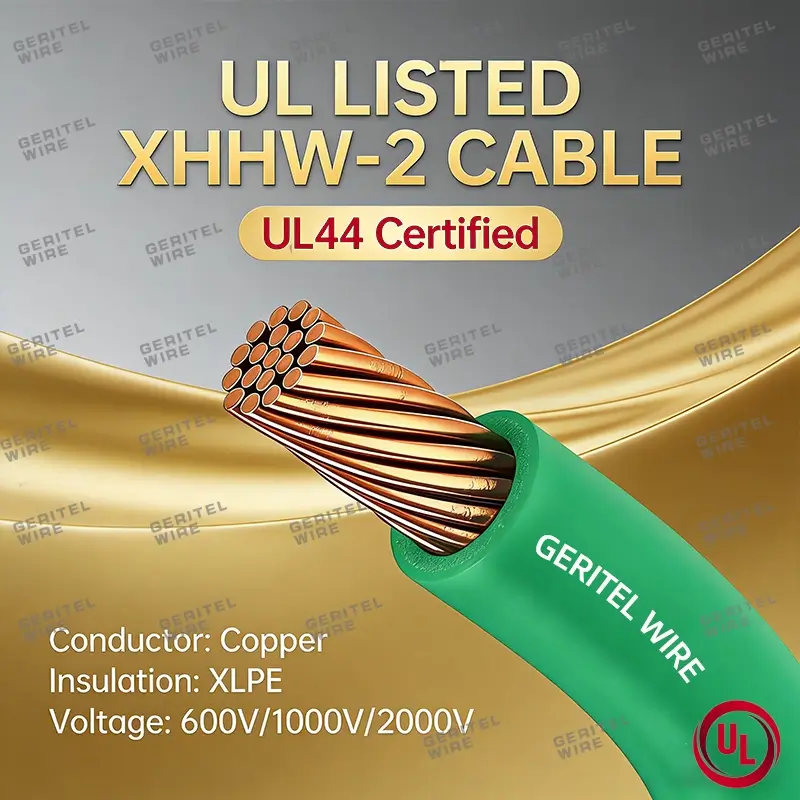
XHHW-2 is one of the most versatile building wires available for conduit installations. Its XLPE thermoset insulation is rated 90°C in both dry and wet locations, making it suitable for everything from standard commercial branch circuits to demanding industrial feeders. Available in 600V and 1000V voltage ratings, XHHW-2 offers the flexibility to match a wide range of project requirements.
This guide covers the voltage rating options, key applications, and practical selection tips for XHHW-2 wire in conduit wiring systems.
1. XHHW-2 Voltage Ratings: 600V vs. 1000V
XHHW-2 conductors are available in two voltage ratings: 600 volts and 1000 volts. Both ratings share the same 90°C wet/dry temperature rating and XLPE thermoset insulation. The choice between them depends on your system voltage and application requirements.
600V XHHW-2 wire is the standard choice for most commercial and industrial conduit installations. It covers:
- Standard 480V and 600V systems
- Commercial building branch circuits and feeders
- General-purpose power distribution
- Most motor circuits and control wiring
1000V XHHW-2 wire provides additional voltage margin for:
- Systems operating above 600V
- Solar photovoltaic applications
- VFD motor leads with reflected wave concerns
- Industrial systems with higher voltage distribution
- Applications requiring extra insulation margin for voltage spikes
For 600V XHHW-2 wire, the insulation thickness is optimized for standard commercial and industrial voltages while maintaining excellent handling characteristics in conduit. For 1000V XHHW-2 wire, the thicker insulation provides enhanced protection against voltage transients without sacrificing the flexibility needed for conduit pulls.
Which to choose: If your system operates at 480V or below, 600V is standard and cost-effective. If your system operates above 600V, or if you have VFDs on long motor leads, consider 1000V for extra margin against voltage spikes.
2. Why XHHW-2 Is Ideal for Conduit Wiring
XHHW-2 is a preferred choice for conduit installations because of several key characteristics.
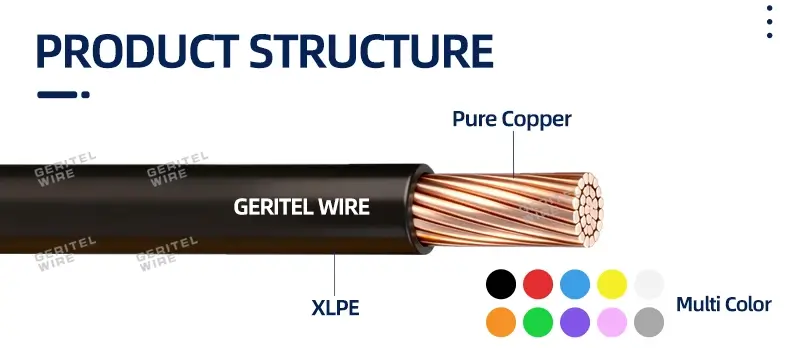
XLPE thermoset insulation. Unlike thermoplastic insulations (like PVC), XLPE is cross-linked and does not soften or deform at high temperatures. It maintains its integrity in both dry and wet locations at 90°C.
Smooth surface for pulling. The XLPE insulation has a smooth, hard surface that reduces friction against conduit walls, making pulls easier and faster.
Moisture resistance. Conduits are not always dry. Underground conduits collect water, outdoor conduits get condensation, and mechanical rooms are damp. XHHW-2 maintains full ampacity in wet locations—a critical advantage.
Chemical and abrasion resistance. XLPE resists oils, chemicals, and abrasion better than PVC insulation. This means fewer insulation failures over the life of the installation.
XHHW-2 wire for conduit wiring is purpose-built for the demands of conduit systems—whether in commercial buildings, industrial plants, or utility substations. Sizes 1/0 AWG and larger can be used in cable trays when identified with “For CT Use” marking.
3. Key Applications of XHHW-2 in Conduit Systems
XHHW-2 is used in conduit systems across a wide range of applications.
Service entrance wiring. XHHW-2 is commonly specified for service entrance conductors from the utility meter to the main panel. The 90°C wet rating is critical here—service entrance conduits often run underground through damp conditions.
Feeder circuits. From main switchgear to distribution panels, XHHW-2 carries power through vertical risers and horizontal conduit runs. The insulation handles the heat generated by continuous high-current loads.
Branch circuits. For lighting, receptacles, and small equipment, XHHW-2 provides reliable power delivery in conduit systems throughout commercial and industrial buildings.
Industrial power distribution. In manufacturing plants, XHHW-2 feeders carry power to motor control centers, heavy equipment, and production machinery. The XLPE insulation resists oils and chemicals common in industrial environments.
Outdoor and underground conduit. XHHW-2 is suitable for outdoor conduit installations and underground runs. The 90°C wet rating ensures full ampacity even in damp conditions.
Healthcare facilities. XHHW-2 is suitable for use in healthcare facilities per Section 517.160 of the NEC where a dielectric constant of less than 3.5 may be specified.
A XHHW-2 wire for conduit wiring installation can serve multiple needs across a facility—from small branch circuits to large service entrances—simplifying specification and inventory.
4. Selecting the Right XHHW-2 Size for Conduit
Choosing the correct wire size for conduit installation follows a practical process.
Step 1: Determine the load. Check the equipment nameplate for full-load amperage. For feeders, add up all downstream loads.
Step 2: Consider the environment. XHHW-2 maintains its 90°C rating in wet and dry locations, but derating factors apply for high ambient temperatures and multiple conductors in the same conduit.
Step 3: Check voltage drop. For runs over 100 feet, voltage drop can become significant. Calculate voltage drop and upsize if needed.
Step 4: Verify conduit fill. The outside diameter of XHHW-2 varies by gauge. Calculate conduit fill to ensure the wire fits in the planned conduit.
Step 5: Select the voltage rating. Choose 600V for standard systems or 1000V for higher voltage or VFD applications.
XHHW-2 wire size ranges from 14 AWG to 1000 kcmil. Smaller gauges (14-10 AWG) are available in solid or stranded construction; larger sizes are typically stranded.
5. Three Common XHHW-2 Sizes for Conduit Installations
Here are three XHHW-2 sizes frequently used in conduit installations.
4 AWG XHHW-2 Wire – Feeders and Large Branch Circuits
This size is commonly used for feeders in large commercial spaces and branch circuits for heavy equipment. The 4 AWG conductor carries moderate loads to distribution panels, works well in conduit runs, and terminates easily on panel lugs. For 600V XHHW-2 wire, 4 AWG is a standard choice for 70-85A circuits in commercial buildings.
250 kcmil XHHW-2 Wire – Main Feeders and Service Entrances
This size handles 200-250A feeders and service entrances in commercial buildings. The 250 kcmil conductor provides substantial ampacity for large loads while remaining manageable for installation crews. For 1000V XHHW-2 wire, 250 kcmil is commonly used where higher voltage margin is required in industrial applications.
500 kcmil XHHW-2 Wire – Large Service Entrances and Utility Feeders
This size carries heavy loads for large commercial service entrances, utility feeders, and main distribution panels. The 500 kcmil conductor delivers maximum ampacity with minimal voltage drop over long conduit runs. For XHHW-2 wire for conduit wiring in large facilities, 500 kcmil is a typical size for main feeders from the utility entrance to the building’s primary distribution equipment.
FAQ
Q1: What is the difference between 600V and 1000V XHHW-2 wire?
600V is the standard rating for most commercial and industrial applications. 1000V provides extra voltage margin for higher voltage systems, VFD applications, and long motor leads with reflected wave concerns.
Q2: Can XHHW-2 be installed in wet conduit locations?
Yes. XHHW-2 is rated 90°C in both dry and wet locations. This makes it suitable for underground conduits, outdoor installations, and damp mechanical rooms.
Q3: How do I choose between 600V and 1000V XHHW-2?
Choose 600V for standard 480V and 600V systems. Choose 1000V for systems above 600V, solar applications, VFD motor leads, or where extra insulation margin is desired for voltage spikes.
Q4: Is XHHW-2 easier to pull through conduit than THHN?
XHHW-2's smooth XLPE insulation reduces friction against conduit walls, making it easier to pull than many PVC-insulated wires. The stranded construction in larger sizes also improves flexibility.
Need XHHW-2 Wire for Your Conduit Project?
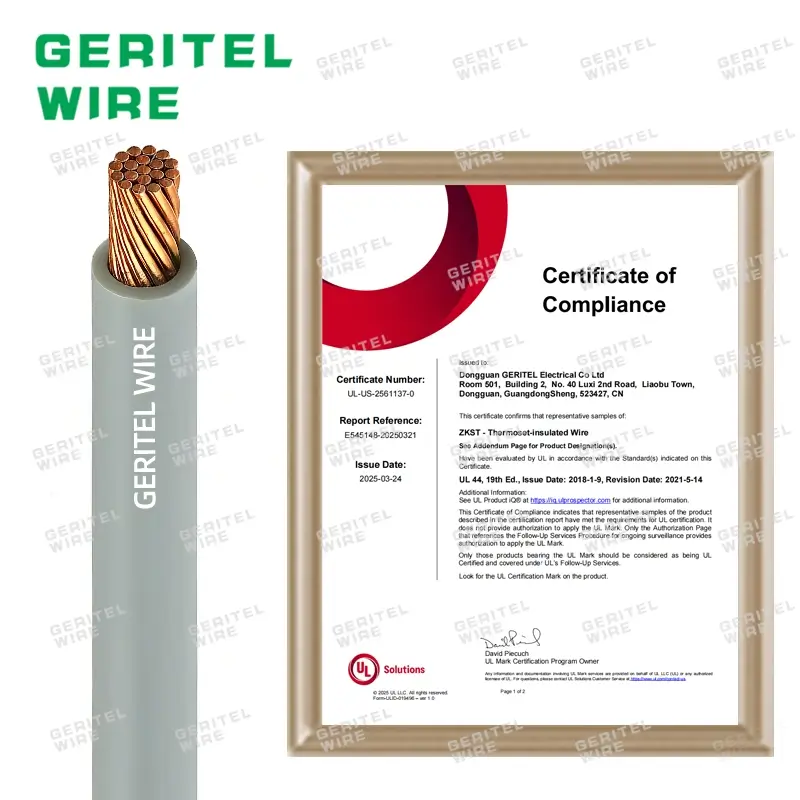
When your project requires reliable conduit wiring, the choice of wire and manufacturer matters. Our XHHW/XHHW-2 copper building wire is UL 44 certified, tested and approved by Underwriters Laboratories to meet rigorous safety and performance standards. Available in 600V and 1000V ratings, our UL 44 certified XHHW-2 wire delivers the reliability your conduit installation requires.
Tell us about your project—wire size, voltage rating, and installation conditions. We will recommend the right XHHW/XHHW-2 wire and provide the documentation you need.
Contact us
Dongguan GERITEL Electrical Co., Ltd.
Tel/WhatsApp/Wechat: +86 136 6257 9592
Tel/WhatsApp/Wechat: +86 135 1078 4550
Email: manager01@greaterwire.com
Website: www.geritelgroup.com
 Copper vs Aluminum XHHW/XHHW-2 Wire: How to Choose the Right Building Wire



 Building 2, No. 40 Luxi 2nd Road, Liaobu Town, Dongguan City, Guangdong Province, China