


 Home
HomeWestern Province Tourism Infrastructure Development Project – Solomon Islands
 GERITEL
 Apr 10,2026

March 2023. At a construction site on the coast of Western Province, Solomon Islands, project manager John stared at the third discarded cable, its sheath cracked and peeling like dried bark. The first two attempts had used standard domestic rubber-sheathed cables. This time, he had upgraded to a European "marine grade" product. The result was identical—under the dual assault of salt spray and ozone, none had survived four months.
This was no ordinary project. It formed the core of the Western Province Tourism Infrastructure Development Project, encompassing luxury eco-resorts, a yacht marina, waterfront restaurants, and island-wide power distribution infrastructure. With the upgrade of Munda Airport completed and international routes opening, the Solomon Islands was attempting to replicate the success of the 2019 Year of Tourism, and Western Province had been designated by the government as a "demonstration destination."
But John faced a brutal reality: without reliable cables, there would be no reliable power; without reliable power, there would be no opening date.
His dilemma was not unique. In South Pacific island projects, cable failure is the most insidious killer. On the surface, it appears as sheath cracking; beneath the surface, it is molecular collapse—the free radical chain reactions of ordinary PVC under ultraviolet radiation, the double bond cleavage of natural rubber under ozone attack, the electrochemical corrosion of copper conductors in salt spray. These issues are difficult to replicate in laboratories, but accelerate a hundredfold under equatorial sun.
The Dead End in the Certification Maze
John's first lesson: cheap things are often the most expensive.
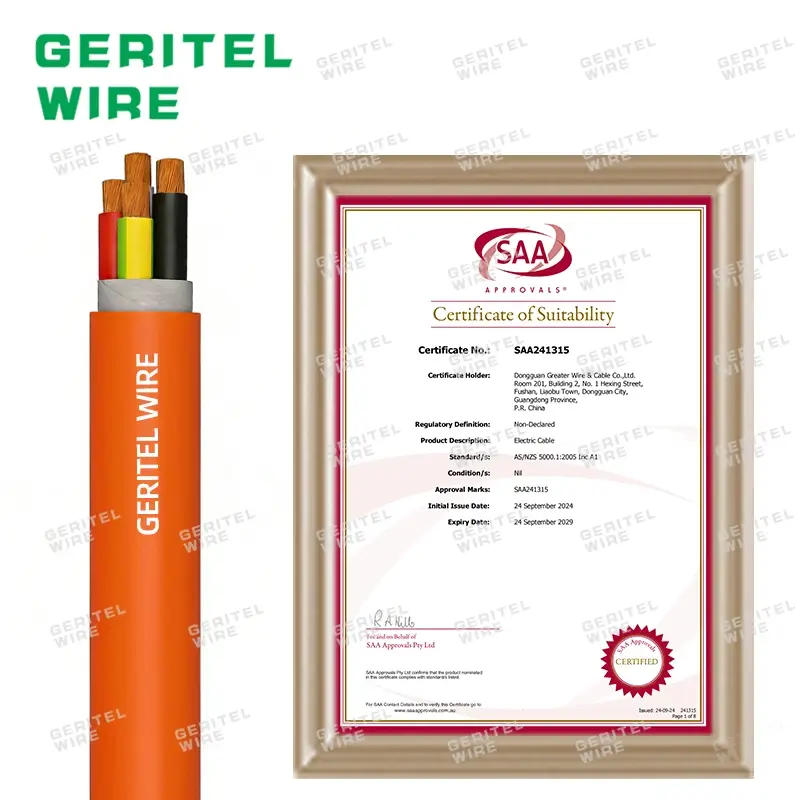
His first procurement went to the lowest-priced trader. When the cables arrived at port, Solomon Islands Power Authority inspectors rejected them outright—no SAA certification, non-compliant with AS/NZS 5000.1. Six weeks of project delay. The penalty clauses alone could have purchased ten drums of premium cable.
The second attempt went to a European brand, with a 40% price premium and CE certification. But CE does not equal SAA. As a Commonwealth member, the Solomon Islands has fully adopted Australian and New Zealand electrical standards. CE certification here is merely a piece of paper. Worse, the salt spray test performance of these "marine grade" cables proved inferior even to the first batch of non-SAA certified products.
John realized he needed not a "brand," but a supplier who truly understood the rules of this game—one who could demonstrate compliance with the full suite of AS/NZS 3191, AS/NZS 1125, and AS/NZS 5000.1 standards, and was willing to provide third-party test reports.
Why Elastomer Cable 3C 35mm² Became the Turning Point
In May 2023, John contacted us through industry referral. We did not quote immediately. Instead, we did something none of his previous suppliers had done: we asked for site environmental data.
UV index: 11+ annually (extreme level)
Salt spray concentration: 50 meters from coastline, chloride ion deposition rate >2000 mg/m²/day
Equipment duty: crane winding/unwinding 30 cycles daily, bending radius requirement <8× outer diameter
Temperature range: 25°C to 45°C, humidity perennially >85%
Based on this data, we recommended a three-tier cable architecture, with the core being Elastomer Cable 3C 35mm².
Why this specification? John's crane was rated at 90kW, requiring approximately 160A calculated current capacity. Applying AS/NZS 3008 correction factors (tropical environment, multi-core cable, sheath temperature 90°C), Elastomer Cable 3C 35mm² with chloroprene rubber insulation fell precisely within the safety margin while avoiding the cost and flexibility penalties of over-design.
But the real difference lies at the materials science level.
Standard YC rubber-sheathed cables use natural rubber or styrene-butadiene rubber for the sheath. Our Elastomer Cable 3C 35mm² uses HFS-110-TP compounded with anti-ozonant additives. The comparison is stark: standard cables crack within 48 hours at 500pphm ozone concentration; our specification shows no cracking after 500 hours at 200pphm. In salt spray resistance, standard cables embrittle within three months; ours remains stable beyond five years. For flexing life, standard cables achieve roughly 8,000 cycles; our Elastomer Cable 3C 35mm² exceeds 50,000 cycles. The conductor treatment differs too—bare copper versus our tinned copper for oxidation resistance.
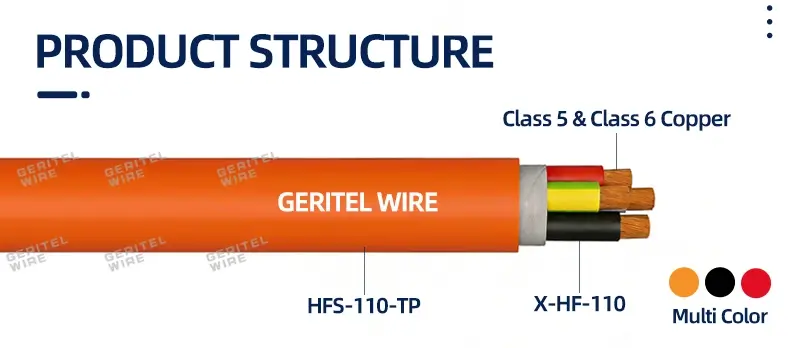
The double-layer chloroprene rubber sheath of Elastomer Cable 3C 35mm² is not simply "thicker"—it is molecular-level defense. The introduction of chlorine atoms disrupts the active sites for ozone attack, while plasticizer migration is controlled below 0.5%, ensuring long-term flexibility. The tinned copper conductor severs the electrochemical circuit for salt spray corrosion.
John asked the critical question: "Why didn't anyone tell me this before?"
The answer is simple: because selling cables and solving engineering problems are two different things.
The Details That Decided Success or Failure
Beyond Elastomer Cable 3C 35mm², we configured for the project:
TPS Cable (Twin + Earth Flat Cable): Full range from 2C 2.5mm² through 3C 10mm². We specifically selected 3C 6mm² and 3C 10mm² for high-load kitchen zones, with UV-stabilized PVC formulations. In the Solomon Islands, even "indoor" cables receive intense indirect light exposure. This detail extended the expected service life of the guest room wiring system from 5 years to 15 years.
SWA Cable (Steel Wire Armored Cable): Range from 3C 25mm² to 3C 150mm². For sections traversing wetlands, we used 3C 95mm² double steel tape armored version with water-blocking tape design. Coral atoll geology features extreme groundwater table fluctuations. Ordinary XLPE cables may gradually degrade due to "water tree" phenomena, while our structure ensures 30 years of zero failure.
But more important than the products was delivery certainty.
John's project had only 14 weeks remaining, and cables were just one of many critical paths. We activated our Project Green Channel: Weeks 1-2 locked in raw materials from Lanxess Germany (the core material for Elastomer Cable 3C 35mm²), Weeks 3-8 parallel production on three lines, Weeks 9-10 conducted 72-hour salt spray immersion plus 50-cycle drum flexing simulation testing, Weeks 11-12 transshipped through Brisbane hub port to Honiara.
When the cargo arrived on schedule at Munda Port, John said it was the first time in two years he had not lost sleep over cable issues.
The Truth After 18 Months of Operation
Now, this project has operated stably for over 18 months, surviving two complete wet seasons.
How has Elastomer Cable 3C 35mm² performed? We received feedback from the site engineer:
Crane mobile power system failure rate: dropped from 2.3 incidents monthly to zero
Sheath surface inspection: no chalking, no cracking, no hardening
Insulation resistance testing: degradation <2% compared to installation (within measurement error)
More surprisingly, the cost accounting. Although Elastomer Cable 3C 35mm² commanded a 35% premium over standard cables, calculated over a 10-year cycle: avoiding three replacement material costs, avoiding two-week downtime losses for each replacement, avoiding potential safety incident risks. Total cost of ownership reduced by 42%.
John later told us his greatest regret was not the first two procurement mistakes, but "why didn't I find a truly technically competent supplier earlier."
Is Your Project Making the Same Mistakes?
This case reveals an industry-wide disease: cable procurement is often treated as "commodity buying," while ignoring that it is actually the core of "reliability engineering."
In the Western Province project, John initially focused on price, then on brand, and finally realized that technical suitability is the only metric that matters. SAA certification is not bureaucratic box-ticking, but proof that the product has passed rigorous testing by the Australian Standards authority. Elastomer Cable 3C 35mm² is not "a more expensive rubber cable," but an engineering solution targeting specific failure modes.
If your project involves any of the following scenarios, this lesson applies equally:
Island, coastal, or high salt spray environments
Mobile equipment power supply (cranes, conveyors, robotics)
Outdoor installation with intense UV exposure
International projects requiring AS/NZS or IEC standard certification
Do not wait until the third cable fails before remembering us.
Let Professionals Do Professional Work
GERITEL proved three things in this project:
First, certification is not paperwork, it is insurance. Our SAA certification covers the full AS/NZS 5000.1, AS/NZS 3191, and AS/NZS 1125 series, ensuring your project will not be rejected by inspectors due to compliance issues.
Second, product is not material, it is solution. From the molecular structure design of Elastomer Cable 3C 35mm², to the UV stabilizer formulation of TPS Cable, to the water-blocking armoring of SWA Cable, every detail corresponds to a specific failure mode.
Third, delivery is not logistics, it is commitment. Fourteen weeks from order to Solomon Islands site is not because we hold inventory, but because we have supply chain agreements and emergency capacity reserves specifically for South Pacific projects.
Your next project deserves to be done right from day one.
Contact our project engineers for technical assessment specific to your application scenario:
Dongguan GERITEL Electrical Co., Ltd.
Tel/WhatsApp/WeChat: +86 135 1078 4550 / +86 136 6257 9592
Email: manager01@greaterwire.com
 Vanuatu Rural Electrification Project (VREP II)



 Building 2, No. 40 Luxi 2nd Road, Liaobu Town, Dongguan City, Guangdong Province, China