


 Home
HomeVanuatu Rural Electrification Project (VREP II)
 GERITEL
 Apr 10,2026

In 2017, the World Bank and the Government of Vanuatu launched Phase II of the Vanuatu Rural Electrification Project (VREP II), an ambitious initiative to bring reliable electricity to 8,400 rural households, 37 public institutions, and five micro-grid systems by 2022. For a nation grappling with some of the most severe energy poverty in the Pacific, where diesel dependency had driven electricity prices up by 28% during the 2022 energy crisis, this project represented more than infrastructure—it was a lifeline.
The contractor faced a triad of challenges that would make or break the project: uncompromising compliance requirements with AS/NZS standards and mandatory SAA certification, extreme environmental conditions including tropical humidity, salt spray, and cyclone threats, and a punishing delivery timeline where delays would cascade across multiple outer islands, depriving thousands of their promised electricity.
The Real Concerns in a Late-Night Email
Through intensive consultation, we uncovered the client's deeper anxieties. They weren't simply buying cables; they needed a risk-mitigation partner who understood the stakes of a World Bank-funded initiative. Three non-negotiables emerged from our discussions.
First, absolute compliance. Having previously experienced customs detention due to non-certified materials, the client knew SAA certification wasn't a value-add—it was the price of entry. Every cable had to carry the authority of Australian and New Zealand standards.
Second, application-specific precision. The project spanned indoor wiring, underground distribution, and mobile equipment connections. Generic solutions wouldn't suffice; each scenario demanded engineered cable selection.
Third, supply chain certainty. With vulnerable South Pacific logistics, the client needed a partner with redundant capacity and rapid response capabilities to navigate unpredictable shipping conditions.
Why TPS cable 2 × 2.5 mm² + E Became the Indoor Wiring Standard
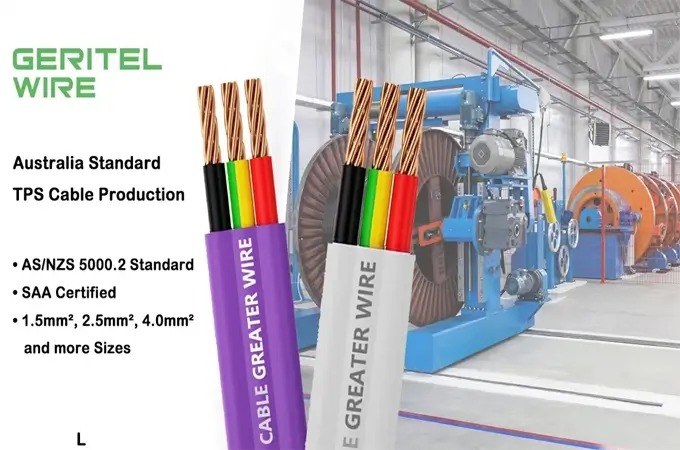
Drawing from AS/NZS 5000.2 and AS/NZS 3191 standards, we engineered a five-category cable matrix, each product backed by complete SAA certification documentation and technical test reports.
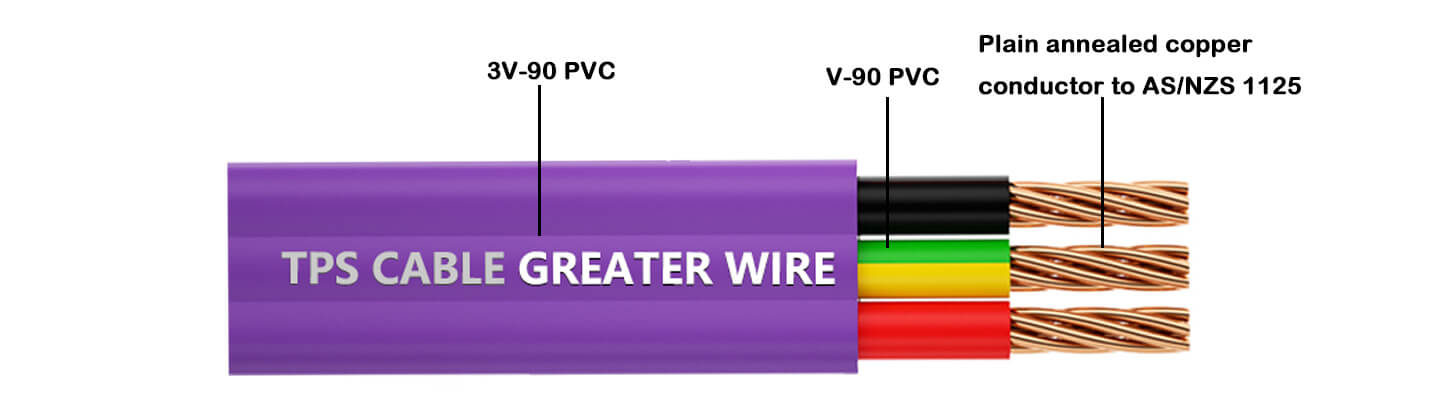
For indoor fixed wiring applications, we specified TPS cable 2 × 2.5 mm² + E. The annealed copper conductor meets AS 1125 requirements, with V-90 PVC insulation rated for 90°C operation and white 3V-90 sheathing providing flame-retardant properties. The flat configuration enables concealed installation within wall cavities, while the integrated earth conductor (E) ensures personnel safety.
In food processing facilities, we recommended enhanced variants with superior chemical resistance to withstand aggressive cleaning protocols. Compared to standard PVC cables, TPS Cable with V-90 insulation demonstrates 30% longer service life in humid tropical environments, resisting the premature aging that plagues inferior products.
The Armor Beneath the Ground: SWA Cable Philosophy for Subterranean Resilience
For micro-grid underground backbone distribution, we supplied 16mm² and 25mm² SWA Cable conforming to AS/NZS 5000.1. The galvanized steel wire armor provides mechanical protection against excavation damage and ground movement, while XLPE insulation maintains dielectric integrity across decades of soil burial.
Recognizing Pacific island soil corrosivity and post-cyclone flooding risks, we enhanced outer sheathing with waterproof and anti-termite properties, engineering a 30-year design life. When Cyclone Harold inundated Efate Island in 2020, submerged SWA Cable sections passed insulation resistance testing without degradation, validating our specifications against real-world catastrophe.
Flexibility in the Salt Air: Elastomer Cable Weathering Secrets
For outdoor portable equipment, generator connections, and frequently relocated tool power supplies, we deployed 4mm² to 6mm² Elastomer Cable meeting AS/NZS 3190.
Unlike PVC alternatives, the ethylene propylene rubber (EPR) insulation maintains flexibility across -30°C to 90°C, with superior ozone and oil resistance. In Vanuatu's salt-laden atmosphere, performance dramatically exceeds conventional rubber-sheathed cables. Field data revealed Elastomer Cable fault rates below 0.5% in coastal high-salinity zones, compared to 3% averages for standard products—a tenfold reliability improvement that minimized maintenance trips to remote installations.
The Nervous System of Machinery: Multicore Flexible Cable Intelligence
Powering solar inverters, battery energy storage systems, and biodiesel backup generators required control and power integration. We provided 5-core × 4mm² and 7-core × 2.5mm² Multicore Flexible Cable per AS/NZS 3191.
Tinned copper conductors resist oxidation in humid environments, while numbered cores streamline installation and eliminate wiring errors. High flexibility accommodates equipment vibration and compact cabinet routing. On Santo Island's micro-grid, this multicore design reduced control cabinet wiring time by 40%, accelerating commissioning schedules when every day of delay meant extended diesel dependency for local communities.
Behind the SAA Mark: Six Months of Factory Scrutiny
Our competitive advantage begins with certification depth. SAA approval isn't a single test—it's a comprehensive regime encompassing type testing, factory audits, and ongoing surveillance. Every production lot undergoes insulation resistance, conductor DC resistance, voltage withstand, and flame propagation testing before shipment, with reports accompanying goods to destination.
This rigor enabled VREP II to pass subsequent World Bank procurement audits without discrepancy. We implemented dual traceability: raw material batch numbers link to finished cable meter marks, enabling precise root-cause analysis if issues emerge. For cross-border projects, this translates to reduced quality dispute risk and accelerated technical response.
The Supply Chain Gambit
With five outer islands requiring synchronized construction, delays would cascade catastrophically. We activated a three-tier delivery assurance protocol.
Capacity pre-locking. Before contract execution, we reserved dedicated production lines ensuring immediate availability for 2,000 kilometers of mixed cable types.
Segmented logistics. We routed through Dongguang Port via Sydney to Port Vila, leveraging our Australasian warehousing nodes to circumvent South Pacific shipping volatility.
Contingency reserves. For cyclone season shipping disruptions, we maintained 10% buffer stock and air freight contingencies. Actual delivery compressed to 45 days, 30% faster than industry benchmarks, keeping island construction crews productively engaged.
The Numbers at the 2022 Commissioning Ceremony
By project milestones in 2022, our cable infrastructure supported 8,400 solar home system connections, 37 public institution electrifications, and five micro-grid distribution networks.
All cable systems demonstrated stable operation in tropical high-humidity, high-salinity environments. Client feedback documented 99%+ installation acceptance rates and zero field rework attributable to materials. Beyond product performance, our technical pre-positioning—including cable selection guidance, ampacity calculation documentation, and installation training—elevated local electrician productivity, compressing electrification timelines for remote communities.
From Single Tender to Strategic Registry
Reflecting on VREP II selection, three differentiated values distinguished our partnership.
Certification authority. We don't merely supply SAA certificates; we interpret AS/NZS standards for specific application contexts, helping clients navigate compliance pitfalls. Unlike commodity suppliers, we function as standards implementation consultants.
Customization agility. Addressing Pacific island logistics and construction realities, we provided reel size customization, precision length cutting, and core color coding—value-added services that reduced field waste and installation errors.
Risk-sharing commitment. During 2020 global supply chain turbulence, we reprioritized production schedules to safeguard VREP II deliveries. This project-first mindset earned enduring trust.
Post-delivery, the client's engineering director noted in project retrospectives: among Asian suppliers for Australasian-standard cables, comprehensive category coverage, demonstrated rapid delivery, and deep technical support remain exceptionally rare. Our performance validated Chinese manufacturing competitiveness in premium compliant cable segments.
Building on VREP II success, the client elevated us to strategic supplier status for Pacific island energy initiatives, with ongoing collaboration across Solomon Islands and Fiji electrification programs.
Your Next Project Deserves the Same Professional Commitment
Whether you're developing renewable energy infrastructure in the Pacific islands or require AS/NZS-compliant cable solutions, we deliver end-to-end service from specification consultation through post-installation support.
Dongguan GERITEL Electrical Co., Ltd.
Tel/WhatsApp/WeChat: +86 135 1078 4550 / +86 136 6257 9592
Email: manager01@greaterwire.com
 Norfolk Island Burnt Pine Guesthouse Renovation Cable Export Project



 Building 2, No. 40 Luxi 2nd Road, Liaobu Town, Dongguan City, Guangdong Province, China