


 Home
HomeTHHN/THWN-2 Cable Selection Calculations and Engineering Examples
 GERITEL
 Mar 26,2026

If your project involves industrial plant wiring, commercial building distribution, underground conduit installation, or outdoor electrical routing, selecting the wrong THHN/THWN-2 cable size can lead to costly rework, excessive voltage drop, insulation degradation, and even serious safety risks such as short circuits or fire hazards. Many engineers and contractors underestimate how critical proper THHN/THWN-2 Cable Selection Calculations are until issues arise during commissioning or operation.
This guide is designed to help you understand how to select the right cable through practical calculation methods and real engineering examples, so you can confidently match cable specifications to your actual project conditions.
1. Understanding the Core Logic of THHN/THWN-2 Cable Selection Calculations
Before choosing any cable size, it is essential to follow a structured calculation process. In real-world engineering, cable selection is not based on guesswork, but on three key factors:
1. 1 Load Current Calculation
The first step is determining the actual operating current of the circuit.
For example:
A lighting circuit in a 1000㎡ industrial workshop with a total load of 3.3kW under 220V:
Current (A) = Power (W) ÷ Voltage (V)
= 3300 ÷ 220 ≈ 15A
This current becomes the baseline for selecting conductor size.
1. 2 Voltage Drop Calculation
Voltage drop becomes critical when cable runs are long. Excessive voltage drop can reduce equipment efficiency or cause malfunction.
A simplified engineering rule:
- Keep voltage drop within 3% for branch circuits
- Increase conductor size if distance exceeds typical ranges
1. 3 Ambient Temperature Correction
Cable ampacity reduces in high-temperature environments. For example:
- At 35°C, correction factors must be applied
- In industrial environments (steel plants, boiler rooms), this becomes critical
Ignoring this factor is one of the most common causes of overheating.
2. Key Parameters and Their Impact on Real Applications
Understanding how each parameter affects performance is essential for accurate THHN/THWN-2 cable size calculation.
2. 1 Temperature Rating and Environment Adaptability
- THHN cable:
Suitable for dry locations only, with a maximum operating temperature of 90°C
- THWN-2 cable:
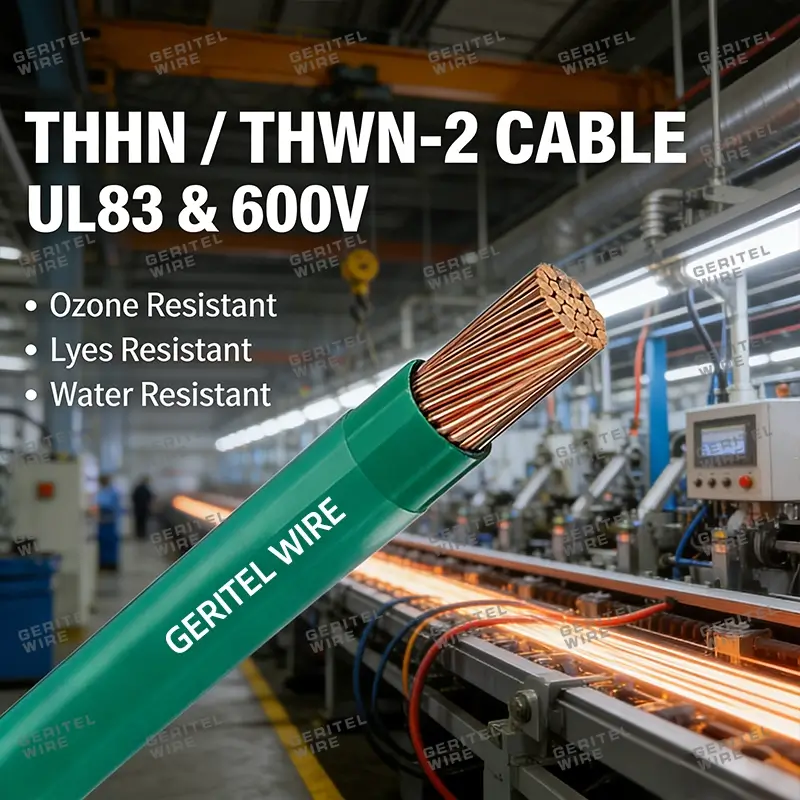
Designed for both wet and dry environments, maintaining 90°C performance in both conditions, with higher tolerance under overload and short-circuit conditions
This makes THWN-2 copper conductor nylon cable ideal for:
- Underground conduit systems
- Outdoor installations
- Humid industrial environments (e.g., food processing plants
2. 2 Conductor Size (AWG) and Load Matching
AWG (American Wire Gauge) defines conductor thickness. The smaller the number, the larger the conductor.
Typical application mapping:
- 14 AWG → Lighting circuits, small loads
- 10 AWG → Medium equipment, HVAC circuits
- 2 AWG → Industrial feeders
- 2/0 AWG → High-power distribution systems
Key rule:
Longer distance = larger conductor size required
2. 3 Voltage Rating
- Standard rating: 600V
- Suitable for most building and industrial systems
- Factory-tested for compliance (e.g., 2.0kV–2.5kV test levels depending on size)
2. 4 Insulation and Jacket (Brief Overview)
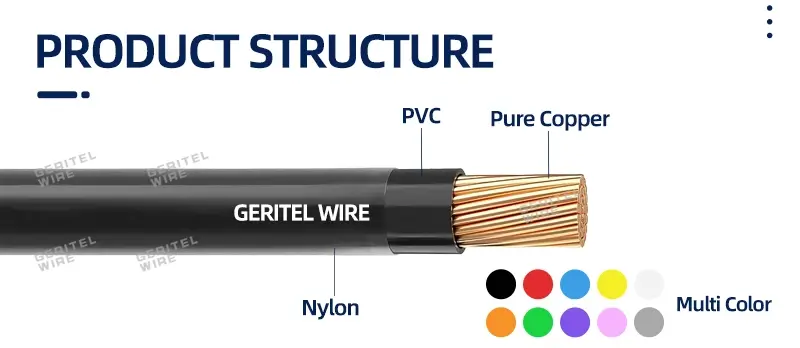
THHN/THWN-2 cables use:
- PVC insulation for electrical protection
- Nylon jacket for mechanical strength, abrasion resistance, and chemical resistance
2. 5 Parameter-to-Application Mapping Table
| Parameter | Low Requirement Scenario | High Requirement Scenario |
| Temperature | Indoor dry | Outdoor / industrial heat |
| Environment | Dry only (THHN) | Wet + dry (THWN-2) |
| Distance | Short (<30m) | Long (>50m) |
| Load | Lighting | Industrial equipment |
3. Risks of Incorrect Cable Selection
Incorrect selection is not just inefficient—it can be dangerous.
3. 1 Using THHN in Wet Locations
Installing THWN-2 wire for conduit systems in underground or outdoor conduits may lead to:
- Insulation degradation
- Moisture penetration
- Increased risk of short circuits
3. 2 Undersized Conductors
Example mistake: using 14 AWG for heavy equipment
Consequences:
- Overheating
- Voltage drop beyond limits
- Equipment instability
- Reduced cable lifespan
3. 3 Ignoring Temperature Correction
In high-temperature environments:
- Cable ampacity drops significantly
- Overloading risk increases
- Safety margins are compromised
4. THHN vs THWN-2 Selection: Key Differences and Boundaries
Understanding THHN vs THWN-2 selection is essential for correct application.
4. 1 Core Differences
| Feature | THHN | THWN-2 |
| Environment | Dry only | Wet & dry |
| Temperature | 90°C (dry) | 90°C (wet & dry) |
| Application | Indoor wiring | Outdoor, underground |
Conclusion:
THWN-2 electrical cable 600V copper offers broader applicability and higher environmental tolerance.
4. 2 Non-Applicable Scenarios
THHN:
- Not suitable for wet or outdoor environments
THWN-2:
- Not suitable for continuous submersion
- Not for systems exceeding 600V
- Not for environments exceeding 90°C continuously
4. 3 Comparison with XHHW-2
While XHHW-2 also supports wet/dry environments:
- Lower flexibility
- Harder to install in conduits
THHN/THWN-2 is preferred for complex routing and panel wiring
5. THHN/THWN-2 Engineering Application Examples
Real-world THHN/THWN-2 Engineering Examples help translate theory into practice.
Case 1: Industrial Automation Workshop (Wet & Oily Environment)
- Load: 25A
- Distance: 50 meters
- Temperature: 30°C
Selection Result:
→ 10 AWG THWN-2
Why:
- Wet environment → THWN-2 required
- Voltage drop within limit
- Larger sizes unnecessary → cost optimization
Case 2: Commercial Building Lighting Circuit (Dry Environment)
- Load: 12A
- Distance: 30 meters
Selection Result:
→ 14 AWG THHN
Why:
- Dry indoor environment
- Meets current capacity
- THWN-2 unnecessary → higher cost without benefit
Case 3: Underground Parking Power Distribution
- Load: 40A
- Distance: 60 meters
- Environment: влажный / underground
Selection Result:
→ 4 AWG THWN-2
Why:
- Moisture exposure → THWN-2 mandatory
- Long distance → larger conductor to reduce voltage drop
- Temperature correction applied
Compliance Assurance
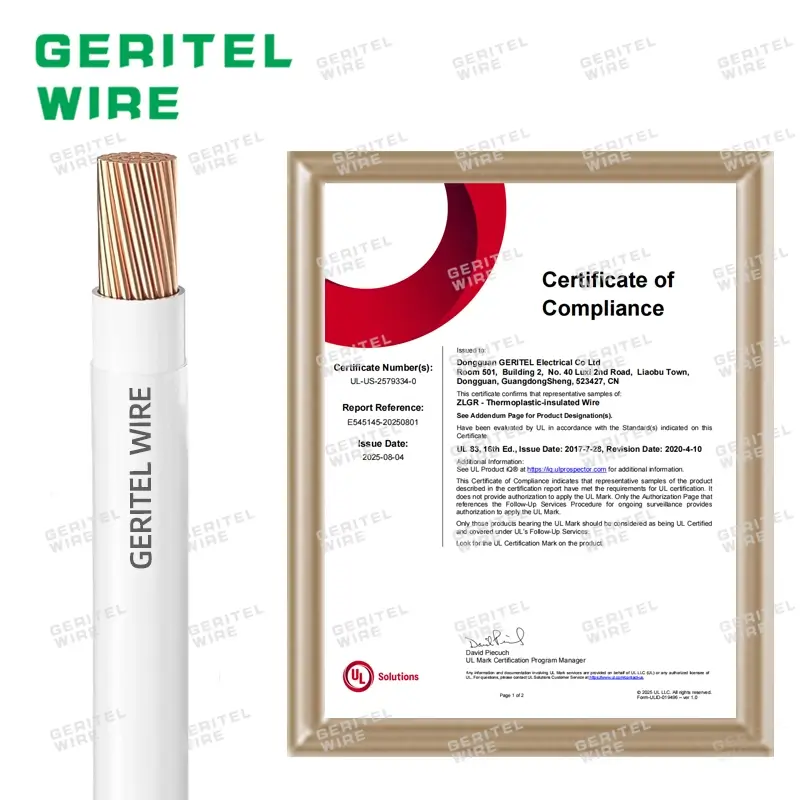
Products are manufactured in accordance with UL 83 standard, ensuring reliable insulation performance and installation safety.
6. Final Thoughts: Why Accurate Cable Selection Matters
Accurate THHN/THWN-2 Cable Selection Calculations are not just technical steps—they directly impact:
- Electrical safety
- System efficiency
- Installation cost
- Long-term reliability
Choosing the right cable means balancing load, environment, and distance, rather than simply oversizing or undersizing.
7. Need Help with Your Project?
If you are unsure how to perform THHN/THWN-2 cable size calculation, or need support selecting the right cable for your industrial, commercial, or underground installation, our engineering team can assist you with:
- Precise load-based cable selection
- Voltage drop calculation
- Environment-specific recommendations
- Cost-optimized solutions
Contact us today:
Dongguan GERITEL Electrical Co., Ltd.
Email: manager01@greaterwire.com
Tel/WhatsApp/WeChat: +86 135 1078 4550 / +86 136 6257 9592
We are ready to support your project with accurate specifications and reliable cable solutions.
 Why THHN Wire Is Widely Used in the United States



 Building 2, No. 40 Luxi 2nd Road, Liaobu Town, Dongguan City, Guangdong Province, China