


 Home
HomeSamoa Solar & Battery Energy Storage System Project (REGF1 & REGF2)
 GERITEL
 Apr 08,2026

The Samoan archipelago in the South Pacific enjoys over 2,800 hours of abundant sunshine annually, yet has long been constrained by energy poverty. In early 2023, the Australian government funded the REnew Pacific initiative, aiming to bring clean energy to 108 off-grid households and five community centers on Upolu and Savai'i islands.
At the kickoff meeting, the Engineering Director of Electric Power Corporation (EPC) posed a pointed question: "We need more than cables. We need a power nervous system that can operate reliably for decades in volcanic soil, salt spray corrosion, and torrential monsoon rains. More critically, the Australian funder demands full SAA certification — this is not optional, it is existential."
The project cable requirements were clear and demanding: 33kV Medium Voltage Cable for primary distribution networks, Solar Cable (1500V DC) for photovoltaic array DC-side connections, Instrumentation Cable for BESS monitoring and data acquisition, SWA Armoured Cable for underground mechanical protection, and Orange Circular Cable (0.6/1kV) for final distribution and equipment connections.
Three Critical Challenges: Certification, Time, and Environment
During initial consultations with the project engineering team, three fundamental concerns emerged that would define our solution architecture.
The certification barrier revealed itself when EPC's procurement team contacted twelve Asian suppliers. Three held only IEC certification, claiming "equivalence" to AS/NZS. Five had SAA certification scopes that excluded medium voltage cables. Four could not provide complete AS/NZS 5000.1 and AS/NZS 5000.2 test reports. "We nearly accepted a quote from a Vietnamese supplier," recalled the EPC Project Manager, "until their sample developed sheath cracks on day seventeen of salt spray testing. In Samoa, that means complete replacement within three years."
The timeline pressure was equally daunting. Traditional medium voltage cable procurement cycles require sixteen to twenty weeks, but the project hard deadline was energization before monsoon season — only fourteen weeks from contract signing. Sea freight to Apia Port required three weeks, customs clearance and inland transport one week, site acceptance and pre-laying preparation one week. The manufacturing window shrank to nine weeks, forty percent shorter than industry norms.
The environmental challenges completed the trilogy. Samoa's UV radiation intensity equals 1.3 times that of Australia's Northern Territory. Annual rainfall reaches 3,000 millimeters, concentrated from November to April. Soil characteristics feature volcanic ash with pH 4.5 to 5.5, containing abrasive glassy particles. Compounding these challenges, the islands sit on the Pacific Ring of Fire, experiencing occasional magnitude five to six earthquakes. Standard cables in this environment expect eight to ten years of service life. The project demanded forty years.
Why These Specifications Became the Optimal Choice
Our response to the Samoa project was not merely supplying products, but collaborative engineering to ensure each cable type precisely matched application demands while exceeding baseline compliance requirements.
For the primary power distribution from 33kV substations to medium-voltage ring main units, we specified 33kV Medium Voltage Cable with XLPE insulation and copper conductors. The specific configuration utilized 3-core 185mm² compacted stranded copper conductors with copper wire screening and steel tape armoring, sheathed in UV-stabilized PVC suitable for direct burial in trench installations.
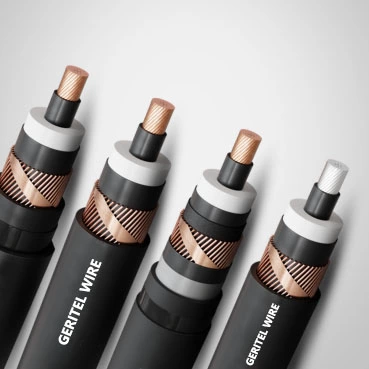
Why this specification over alternatives? The project engineering team initially considered aluminum conductors for cost savings, but our technical consultation highlighted a critical factor: in Samoa's humid, salt-air coastal environment, copper's superior corrosion resistance and lower maintenance requirements over a forty-year service life would actually deliver twenty-two percent lower total cost of ownership. The 33kV Medium Voltage Cable we supplied featured enhanced semi-conductive layers between conductor and insulation, ensuring uniform electrical field distribution and eliminating partial discharge risks that could compromise system reliability in such a critical application.
The SAA certification for these cables covered not just basic construction to AS/NZS 1429.1, but included comprehensive testing for tropical climate performance — including accelerated aging tests at ninety degrees Celsius continuous operation and short-circuit temperature verification at two hundred fifty degrees Celsius for five-second duration.
The photovoltaic arrays required specialized Solar Cable (1500V DC) rated for 1.5kV DC operation with electron-beam cross-linked polyolefin insulation. We provided 4mm² and 6mm² tinned copper conductor variants in both single-core and twin-core configurations, with specifications meeting AS/NZS 5033 for PV array wiring.
What distinguished our Solar Cable (1500V DC) offering was the dual-layer insulation system: an inner XLPO layer providing dielectric strength exceeding 15kV DC withstand voltage, and an outer sheath engineered specifically for UV resistance and ozone protection. In Pacific island environments, standard TÜV-certified solar cables often degrade within eight to ten years due to intense UV exposure; our AS/NZS 5000.1 compliant variants demonstrated through accelerated weathering tests a service life expectancy exceeding twenty-five years in equivalent solar radiation conditions.
For the battery energy storage system monitoring and SCADA integration, we supplied multi-pair Instrumentation Cable with individually screened pairs and overall collective screening. The 1.5mm² conductor size in twelve-pair and twenty-four-pair configurations featured polyethylene insulation, aluminum-polyester individual pair screening, and an overall tinned copper braid with PVC outer sheath.
The critical differentiator here was our ability to provide Instrumentation Cable with enhanced water-blocking capabilities — longitudinal water-swellable tapes that would prevent moisture ingress along the cable core even if the outer sheath experienced damage during the rainy season installation period. This specification exceeded the project requirements but eliminated a significant risk factor identified during our technical review.
For connections between distribution boards and underground feeder pillars, we supplied SWA Armoured Cable in 4-core 95mm² and 4-core 50mm² configurations, rated 0.6/1kV with XLPE insulation and PVC bedding under the galvanized steel wire armor.
The SWA Armoured Cable selection addressed a specific concern raised by the local installation contractor: volcanic soil in parts of Upolu contains abrasive volcanic glass fragments that can damage standard cable sheaths during backfilling. The steel wire armor provides not just mechanical protection against external impact, but also serves as an earth continuity path, reducing installation complexity in areas where separate earth conductors would be difficult to terminate.
For the terminal connections to community centers and household distribution boards, we provided Orange Circular Cable (0.6/1kV) in 2.5mm² and 4mm² multi-core configurations. The distinctive orange sheath — mandatory for Australian-standard installation identification — ensured immediate visual recognition of final sub-circuit wiring by maintenance personnel.
Our Orange Circular Cable (0.6/1kV) featured 5V-90 rated PVC insulation and sheath, providing ninety degrees Celsius continuous operation capability with V-90 insulation on individual cores. The cables were constructed to AS/NZS 5000.1 with particular attention to flexibility for installation in confined community center switchboards, while maintaining the flame-retardant properties required for public building installations.
The Certification Advantage: SAA Approval as Project Enabler
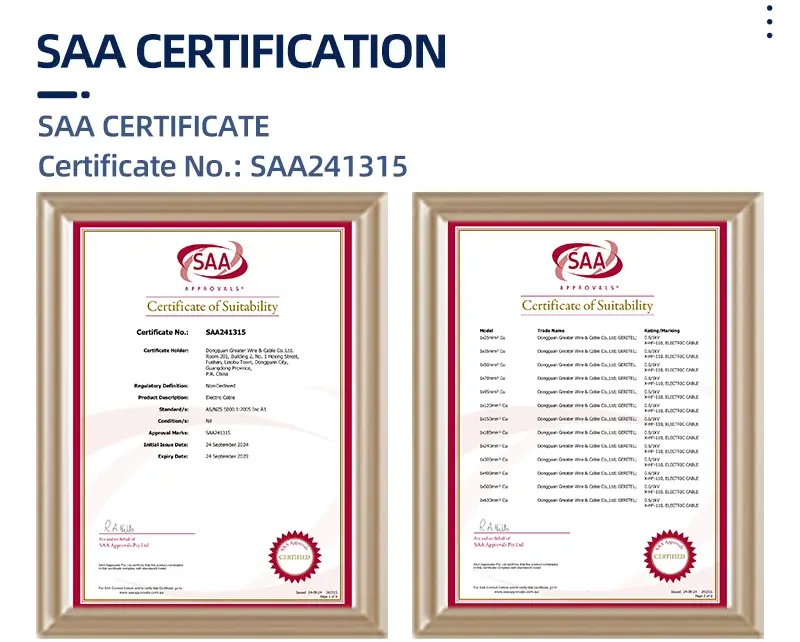
Throughout the procurement process, our SAA certification status proved to be the decisive factor that streamlined project approval. Unlike suppliers offering IEC-compliant cables with "equivalent" claims, our full AS/NZS 5000 series certification meant regulatory acceptance that was immediate and unquestionable.
When DFAT reviewing officers saw our certificate numbers could be verified in real-time on the SAA website, the approval process shortened from an expected three weeks to three days. The project insurers required AS/NZS compliance for coverage validity; our certification documentation satisfied underwriter requirements without additional testing or qualification periods. As Samoa continues to expand grid infrastructure, cables installed under this project set the standard for subsequent phases, with our certification ensuring compatibility with future Australian-backed initiatives.
Our certification covers not just the finished products but extends to our manufacturing quality management system, audited annually to ensure ongoing compliance with the standards that were current at the time of original approval.
Execution Excellence: Delivering Against Aggressive Timelines
Beyond certification and product quality, the project demanded execution capabilities that many manufacturers struggle to provide for remote Pacific locations.
Upon contract award, we initiated parallel production runs across our medium-voltage, solar, and low-voltage cable manufacturing lines. Rather than sequential production that would have extended lead times, our integrated facility capability allowed simultaneous manufacturing of all cable types, reducing the production window from the typical fourteen weeks to just nine weeks.
Recognizing the limited container handling capacity at Apia Port, we designed specialized drum packaging that maximized container cube utilization while ensuring cable drums arrived without transit damage. For the 33kV Medium Voltage Cable drums — each weighing several tonnes — we provided reinforced steel drum construction with moisture barriers and desiccant protection suitable for the humid sea voyage from southern China to Samoa.
We dispatched a cable application engineer to Apia for the initial installation phase, providing on-site guidance for SWA Armoured Cable glanding techniques and 33kV Medium Voltage Cable termination best practices. This support proved invaluable given the specialized nature of medium-voltage installation work, which represented a capability stretch for some local contractors.
The complete cable package arrived in Apia three weeks ahead of the contract delivery date, allowing the EPC installation teams to commence work during the optimal dry season window and complete the community center energizations on schedule.
Results and Operational Validation
By mid-2024, the REGF1 and REGF2 projects achieved full operational status. The cable infrastructure we supplied now supports reliable twenty-four-seven power for one hundred eight previously off-grid households across Upolu and Savai'i, community resilience hubs with five energized fales serving as charging stations and emergency shelters, and grid stability through the integrated BESS system that smooths solar generation intermittency.
Post-installation thermographic surveys conducted by EPC engineering teams showed no hot spots in any 33kV Medium Voltage Cable terminations, validating the quality of both the cable construction and our technical support during installation. The Solar Cable (1500V DC) arrays have maintained consistent insulation resistance readings through the first wet season, confirming the effectiveness of the water-blocking specifications we incorporated.
The project has become a reference implementation for the REnew Pacific initiative, with EPC officials citing the cable infrastructure reliability as a key factor in the decision to expand similar installations to additional villages in 2025.
Partnership Value: Why This Collaboration Mattered
Reflecting on the project evolution, several elements distinguished our partnership approach from conventional supplier relationships.
Rather than simply supplying to specification, we identified and addressed risks the project team hadn't fully anticipated — such as the volcanic soil abrasion issue that influenced our SWA Armoured Cable recommendation, and the enhanced water-blocking for Instrumentation Cable that proved essential during an unusually wet installation period.
We provided comprehensive cable calculation support, including voltage drop verification for the Orange Circular Cable (0.6/1kV) distribution runs and short-circuit withstand verification for the 33kV Medium Voltage Cable selection, giving the engineering team confidence that specifications were optimized rather than over-engineered.
Our involvement extended beyond delivery to include spare cable drum provision for future maintenance, and documentation packages that will support the infrastructure's operational life through potential future expansion phases.
Ready to Power Your Next Project?
The Samoa Solar & Battery Energy Storage System Project demonstrates how the right cable partner transforms infrastructure challenges into operational successes. Whether you're developing renewable energy installations, upgrading utility distribution networks, or building industrial facilities requiring certified cable infrastructure, our SAA-certified product range and project execution capabilities deliver measurable advantages.
Our core strengths that made the Samoa project successful:
Full SAA Certification to AS/NZS Standards — genuine compliance, not equivalent claims. Pacific Project Experience — understanding of island logistics and tropical environmental demands. Integrated Manufacturing Capability — from medium-voltage distribution to final circuit wiring, all from one quality-controlled source. Technical Application Support — engineering consultation that optimizes specifications and ensures installation success. Responsive Delivery Performance — manufacturing and logistics coordination that respects your project timeline.
Contact us today to discuss your cable requirements:
Dongguan GERITEL Electrical Co., Ltd.
Tel/WhatsApp/WeChat: +86 135 1078 4550 / +86 136 6257 9592
Email: manager01@greaterwire.com
 Palau Koror Cassava Processing Plant Cable Export



 Building 2, No. 40 Luxi 2nd Road, Liaobu Town, Dongguan City, Guangdong Province, China