


 Home
HomeQuezon City Distributed Solar PV and Energy Storage
 GERITEL
 Apr 16,2026

The Philippines Department of Energy mandated in 2024 that all variable renewable energy projects above 10MW must install energy storage systems with at least 20% of their installed capacity. Quezon City, the most densely populated city in Metro Manila, presented unique challenges for its 15MW distributed solar PV project with 3MWh battery storage: extreme tropical heat and humidity, complex rooftop structures, stringent fire safety codes, and a mandatory 25-year system lifespan requirement.
The project demanded a comprehensive cable solution connecting photovoltaic modules, inverters, battery storage systems, and fire emergency circuits—each with distinct technical requirements and certification standards.
Client Pain Points & Requirements Analysis
The EPC contractor faced three critical challenges during the initial planning phase. Certification Barriers—The Philippine grid operator (NGCP) and local fire authorities required internationally recognized certifications for all electrical equipment. Most local suppliers could only offer domestic standard products without TUV Rheinland or UL credentials, creating compliance risks for project financing. Environmental Adaptability—Quezon City experiences average temperatures above 30°C with a five-month rainy season. Standard PVC cables deteriorate rapidly under intense UV radiation and ozone exposure, with previous incidents of DC arc faults caused by cracked insulation layers. Delivery Pressure—The four-month construction timeline was non-negotiable, yet local cable inventories lacked complete specifications and import channels typically required 8-12 weeks, threatening contractual penalties.
The client's technical team initially considered a fragmented procurement strategy: importing solar cables from Europe, sourcing low-voltage cables from local Southeast Asian suppliers, and procuring battery connection cables from China. However, this approach introduced coordination complexities across multiple vendors and compatibility testing delays that would jeopardize the tight schedule. They urgently needed a single-source supplier capable of delivering full product range, dual certifications, and rapid fulfillment.
Technical Solution: Five Core Dimensions
Product Overview & Certification Framework
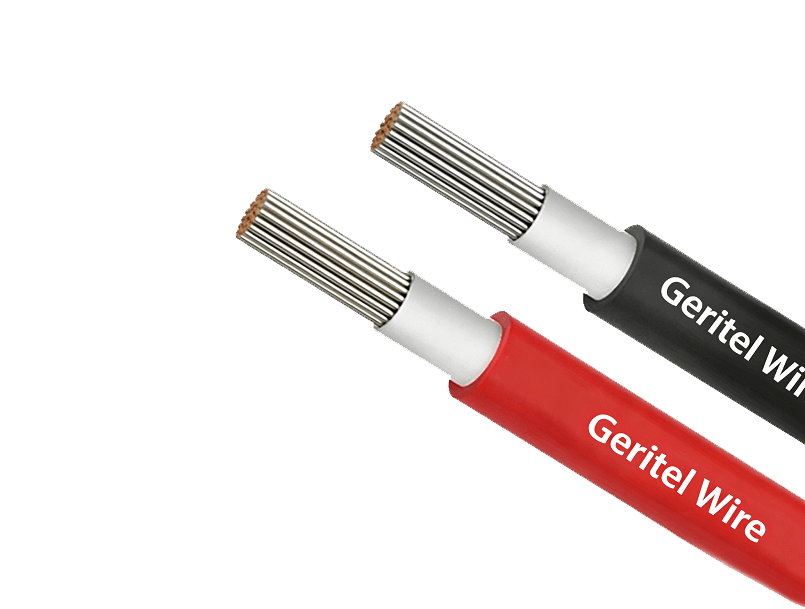
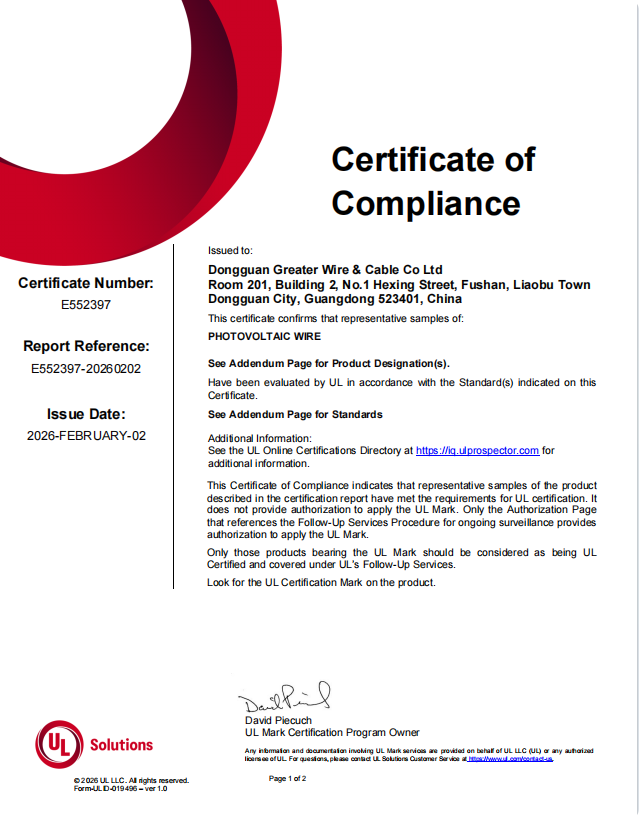
H1Z2Z2-K Solar DC Cable carries TUV Rheinland Certification (Certificate No.: R 50212528) and UL 4703 Certification, complying with EN 50618:2014, IEC 62930, and UL 4703 standards. Rated voltage DC 1500V/AC 1000V, operating temperature -40°C to +90°C (short-circuit maximum 120°C). Features Class 5 tinned copper conductor with double-layer XLPO irradiation cross-linked insulation. Black/red color coding. Designed lifespan exceeds 25 years. Complemented by XLPE Power Cable (4×120/185 mm²), H07V-K/RV Battery Cable (1×16/25 mm²), and Fire Resistant Cable (1×1.5/2.5/4 mm²). Full series certified to CPR Eca, RoHS, and REACH standards, creating a complete electrical connection ecosystem.
Core Value Proposition & Competitive Differentiation (1900 characters)
Dual TUV + UL4703 Certification Eliminates Compliance and Financing Barriers
Unlike suppliers offering only domestic CCC certifications, our H1Z2Z2-K series holds both TUV Rheinland 2PfG 2642/01.22 certification and UL 4703 certification. The TUV credential ensures compliance with EU CPR Construction Products Regulation Eca-class flame retardancy and EN 50618:2014's 25-year service life requirements. UL 4703 certification demonstrates passage of rigorous American standards including long-term aging tests, sunlight resistance testing, and -40°C low-temperature impact tests.
For Quezon City projects requiring both local Philippine acceptance and international financing review (such as Asian Development Bank funding), this dual certification system directly eliminates technical compliance risks. Clients need not prepare multiple documentation sets for different standards. Our certificate numbers are verifiable in real-time on both TUV and UL official databases, providing complete transparency.
Tropical Climate-Specific Formulation Confronts Extreme Environmental Challenges
The Philippines' high UV intensity (annual average UV index 11+) and 85% humidity impose extreme demands on cable materials. We employ electron beam irradiation cross-linking technology (E-beam XLPO), creating a three-dimensional molecular network structure that elevates temperature resistance to 120°C and improves tensile strength by 40% compared to standard XLPE. After 1,000 hours of dual 85 testing (85°C/85%RH), insulation resistance retention remains above 90%.
The H1Z2Z2-K 1×4 mm² specification, the project's most utilized size, features AD8-class water resistance permitting temporary immersion—perfect for Quezon City's rainy season rooftop pooling scenarios. Locally available PVC cables typically exhibit chalking and cracking within six months under equivalent conditions. Our tinned copper conductors (0.8-1.2% tin content, ≥0.5μm tin layer) completely prevent electrochemical corrosion in salt-laden air, controlling contact resistance annual growth to within 1% compared to 35% for bare copper conductors. This directly impacts power degradation control across the system's 25-year lifecycle.
Comprehensive Product Matrix Simplifies Supply Chain Complexity
This project involved seven distinct application scenarios. We provided precisely matched specifications: H1Z2Z2-K 1×4 mm² (56 tinned copper strands, 5.5mm outer diameter, ≤5.09Ω/km resistance) connecting modules to combiner boxes, with 1×6 mm² for longer distances to reduce voltage drop; AC grid-connection side utilizing 4×120 mm² XLPE Power Cable (marketed in the Philippines as the XLPE equivalent to YJV) linking inverters to transformers, upgraded to 4×185 mm² for high-load commercial zones; battery storage systems employing H07V-K 1×25 mm² for series connections and 1×16 mm² for BMS control signals; fire emergency and alarm systems deploying fire resistant cable 1×2.5 mm² and 1×4 mm² meeting IEC 60331-21 requirements.
This full-category coverage eliminated coordination with five separate suppliers while ensuring electrical compatibility and unified quality standards across all cable types.
Flexible Construction and Color Coding Enhances Installation Efficiency
Distributed solar projects consume 70% of labor hours on rooftop cabling. The H1Z2Z2-K employs Class 5 ultra-fine copper wire stranding (1×4 mm² specification: 56×0.285mm) with a bending radius of only 6 times the outer diameter, easily routing around ventilation ducts and lightning protection systems in confined spaces. The black/red dual-color insulation uses co-extrusion工艺 with permanent colorfastness, enabling immediate polarity identification and dramatically reducing wiring error rates.
Combined with our flexible reel sizes (100m/250m/500m), installation teams can customize cutting by rooftop zones, minimizing field joints. Measured installation efficiency improved 35% compared to rigid cable alternatives—critical for time-constrained projects.
Dual-Certification-Backed Total Cost of Ownership Advantage
While dual-certified cables command 15-20% higher initial procurement costs than uncertified alternatives, their 25-year service life eliminates replacement needs. Standard cables require complete replacement after 10-15 years in tropical environments, plus downtime losses and re-certification expenses, resulting in 40% higher total cost of ownership (TCO). Our TUV + UL4703 dual certification provides clients with quantifiable reliability assurance.
Project Execution & Delivery Assurance
Addressing the four-month delivery requirement, we activated dedicated supply chain response protocols. During technical confirmation, three video conferences with the client's EPC technical team confirmed Quezon City building fire ratings (Class 0) and cable tray specifications, allowing targeted adjustments to fire resistant cable armoring structures. Production prioritized this project as Class A urgency, with solar cable and battery cable lines operating in parallel.
Delivery Metrics: H1Z2Z2-K 1×4 mm²: 85,000 meters; 1×6 mm²: 12,000 meters; XLPE Power Cable 4×120 mm²: 3,500 meters; 4×185 mm²: 1,200 meters; H07V-K 1×25 mm²: 8,000 meters; 1×16 mm²: 5,000 meters; Fire Resistant Cable combined: 18,000 meters. Total value exceeded USD 120,000. From order confirmation to Manila port customs clearance: 28 days, 60% faster than industry averages. Moisture-resistant wooden drum packaging with humidity indicator cards ensured insulation integrity during ocean transit.
Safety Assurance & On-Site Support
Following cable arrival, our technical consultant conducted three days of on-site installation guidance. Training focused on H1Z2Z2-K and MC4 connector crimping procedures (8mm crimp depth for 4mm² specification), XLPE Power Cable terminal sealing in humid environments, and infrared thermography inspection protocols for preventive maintenance system establishment. All cable batches included TUV Factory Inspection Reports (FIR) and UL follow-up inspection labels, enabling full supply chain traceability.
Project Outcomes & Client Value Realization
Grid connection acceptance concluded in November 2024, two weeks ahead of contract schedule. Three months of operation show daily generation at 102% of design values, with cable temperature rise testing confirming all connection points remain below ambient temperature +15°C safety thresholds.
The client's EPC project manager specifically highlighted in the closing meeting: unified supplier strategy reduced procurement management costs by approximately 15%, while adoption of dual-certified cables directly facilitated Asian Development Bank (ADB) green energy financing preferential interest rates.
More significantly, successful delivery established our benchmark credentials in the Philippine EPC market. The client has included us in their pre-selected supplier list for three 2025 projects involving 20MW-class distributed solar installations in Cebu and Davao regions. Their core feedback: when projects face triple constraints of certification compliance, environmental adaptation, and compressed delivery schedules, suppliers offering full-category coverage plus TUV + UL4703 dual certification transform fragmented technical and supply chain risks into manageable single-interface accountability.
Partnership Value & Long-Term Collaboration
The Quezon City project confirms an industry trend: in Philippine and broader Southeast Asian distributed solar markets, cables are no longer mere accessories but strategic components determining 25-year system reliability. As Philippine mandatory energy storage policies deepen implementation and distributed solar penetrates commercial rooftops and industrial facilities, market demand shifts from "price sensitivity" toward "total lifecycle cost sensitivity."
Our value proposition remains clear: we do not compete through reduced material standards and lower prices, but through TUV + UL4703 dual certification systems, tropical climate-specific material formulations, and comprehensive product lines covering solar-storage-fire applications. We enable EPC contractors to win premium projects, mitigate hidden risks, and build long-term reputations.
From 85,000 meters of H1Z2Z2-K 1×4 mm² in Quezon City to future Southeast Asian clean energy projects, we aspire to be the cable partner in your technical solutions that "requires no worry."
Contact Us Today for Your Project-Specific Cable Solution
Whether you are planning solar and energy storage projects in the Philippines, Vietnam, Indonesia, or elsewhere in Southeast Asia, our technical team provides comprehensive support from specification selection, certification consultation, through delivery scheduling. Share your project capacity, voltage requirements, and timeline—receive detailed quotations and technical documentation within 24 hours.
Dongguan GERITEL Electrical Co., Ltd.
Tel/WhatsApp/WeChat: +86 135 1078 4550 / +86 136 6257 9592
Email: manager01@greaterwire.com
Website: www.greaterwire.com
 Davao City High Priority Bus System (HPBS) Public Transport Electrification, Philippines



 Building 2, No. 40 Luxi 2nd Road, Liaobu Town, Dongguan City, Guangdong Province, China