


 Home
HomePapua New Guinea Morobe Province Wafi-Golpu Project
 GERITEL
 Apr 09,2026

It was a March afternoon in 2019 when our business line rang, and on the other end was a procurement manager sitting in a Melbourne office, scrambling to source electrical materials for the Wafi-Golpu copper-gold project in Morobe Province, Papua New Guinea — his voice carried that particular anxiety we've come to recognize all too well: he had already approached three cable suppliers, one could only offer GB/T standard products without the SAA certification mandatory for Australian-market compliance, another had export experience but quoted a fourteen-week lead time when his construction network schedule allowed only eight weeks, and compounding everything was the project location in the South Pacific tropical rainforest highlands where extreme humidity, corrosive atmosphere, and rugged terrain made cable selection extraordinarily complex, so he cut straight to the point in that call: "Can you manufacture 3C × 240 mm² Medium Voltage cable to AS/NZS standards and get it to Lae Port within two months?"
That phone call initiated our four-year deep involvement in one of the most challenging mining infrastructure projects in the South Pacific region, and gave us the opportunity to fully validate what happens when a Chinese cable manufacturer truly understands the underlying anxieties of overseas engineering clients and builds end-to-end capability spanning certification compliance through delivery execution — the kind of partnership value that transcends transactional supply.
Understanding the Client's Real Situation Mattered
The Wafi-Golpu Project, developed by international mining majors, sits in Morobe Province, Papua New Guinea, at elevations exceeding two thousand meters in tropical rainforest mountains roughly eighty kilometers from the nearest port city of Lae — a classic overseas large-scale mining infrastructure construction project with its infrastructure peak spanning Q3 2019 through Q4 2023 — and our client, acting as EPC contractor, faced the three typical dilemmas we encounter repeatedly in emerging markets.
The first dilemma was the rigid threshold of certification compliance: as a Commonwealth member, Papua New Guinea's electrical safety regulations directly adopt the Australian and New Zealand AS/NZS standard system, with project auditors requiring complete Standards Australia certification document chains for every batch of imported cable, including type test reports, raw material traceability certificates, and ongoing compliance declarations — yet suppliers the client had previously contacted could only offer Chinese GB/T test reports, or presented so-called "international certifications" that couldn't be verified in Australian official databases, meaning goods could face customs clearance delays upon arrival, or worse, fail owner acceptance after installation, triggering massive penalty clauses or the catastrophic consequence of forced supplier replacement — the client's core need was unambiguous: he didn't need endless price negotiation, he needed compliance assurance that would let him sleep soundly throughout the project lifecycle.
The second dilemma was technical anxiety about environmental adaptability: site survey photos sent by the client's technical team revealed annual average humidity exceeding eighty-five percent, daily rainfall during storm season reaching three hundred millimeters, cable routing requiring passage through multiple landslide-risk zones and termite-active virgin forest, with some sections direct-buried through rock layers and others exposed on temporary supports to atmospheric conditions — the client openly expressed their concerns: they had used performance-proven PVC-sheathed cables successfully in Australian inland desert projects, but PNG's tropical rainforest environment operated on an entirely different magnitude, and they feared conventional cable insulation would suffer water tree aging leading to breakdown under sustained high humidity, worried about mechanical integrity of direct-buried sections under soil settlement and rodent damage, and were particularly anxious that if cables failed three years after commissioning, replacement costs would exceed ten times the initial procurement price because by then the mine would be in production and any power interruption meant millions in losses.
The third dilemma was the precision matching of supply chain rhythm: mining project civil contractors bill by calendar day, with concrete pouring, steel structure installation, and equipment positioning all following strict logical sequences, and cables as the electrical system's bloodstream had to arrive within specific work windows — too early meant occupying limited site storage space and facing deterioration risks in the rainforest environment, too late meant entire electrical installation crews standing idle with labor costs and equipment rental fees burning continuously — the fourteen-week lead time from the client's original supplier had essentially disqualified them from project participation because the construction schedule simply couldn't accommodate such lengthy waiting, and behind this time pressure lay the genuine need for not merely a manufacturer but a supply chain partner who understood international engineering project rhythms and possessed flexible response capabilities.
Our Response: Building Trust Through Certification, Proving Professionalism Through Detail
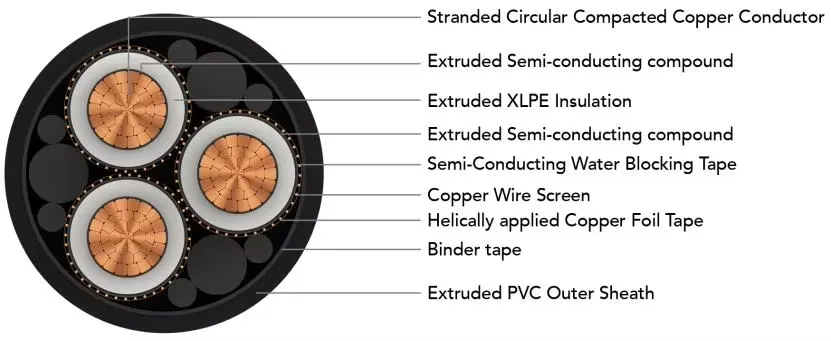
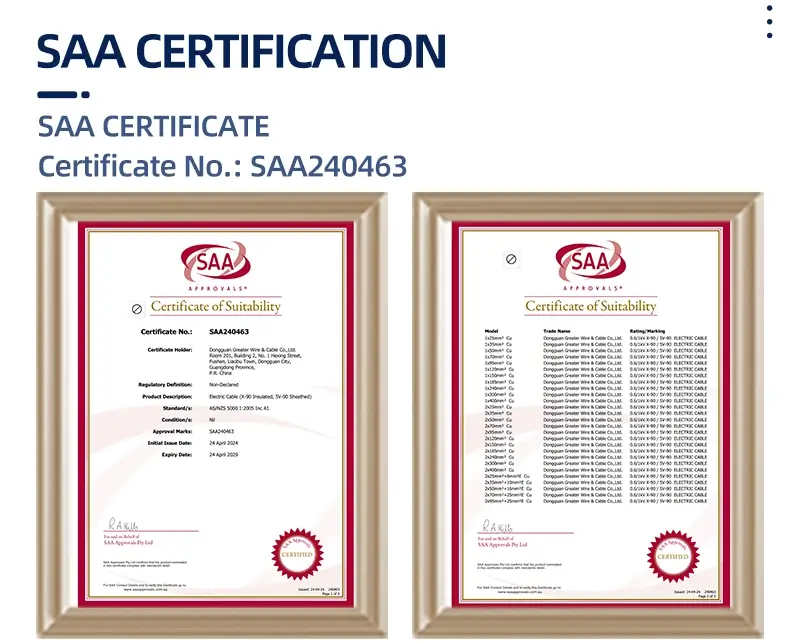
Facing the client's anxiety, we didn't rush to send quotations — instead, in our first video conference we directly shared electronic copies of SAA certification certificates along with their verification links on the Standards Australia official website, this "certification-first" approach stemming from our insight into overseas client decision psychology: for procurement managers who have experienced certification risks, real-time verifiable third-party endorsement carries more weight than any sales rhetoric — for the 3C × 240 mm² Medium Voltage specification the client explicitly named, we further provided complete type test documentation including conductor DC resistance testing, cross-linked polyethylene insulation thermal elongation tests, galvanized steel wire armor layer thickness inspection, and quality assurance letters from raw material suppliers Borealis and Jiangsu Shangshang Copper, constituting a complete evidence chain from raw materials through finished products.
After addressing certification concerns, we constructed solution validity through a series of in-depth technical inquiries — questions covering the percentage of direct-buried sections in total routing length, measured soil resistivity data, whether equipment cables would see fixed installation or frequent coiling with mobile equipment, the operating speed of coiling mechanisms, whether control signals were 4-20mA analog or digital communication protocols, and whether high-power inverters in the vicinity generated electromagnetic interference — this "diagnose before prescribing" working method signaled to the client that we weren't merely traders selling standard products, but solution providers with engineering application experience.
Based on this information, we designed a three-tier power transmission architecture for the Wafi-Golpu Project, each tier precisely addressing specific operational challenges: for main power supply from substations to zoned distribution rooms, we selected 3C × 240 mm² Medium Voltage copper conductor cross-linked polyethylene insulated power cable rated 19/33kV with SWA steel wire armor mechanical protection — this specification choice followed rigorous ampacity calculations, with 240mm² copper conductors delivering continuous current capacity of 455A under PNG tropical conditions, fully covering project peak load demands, while the SWA structure's core value over slightly lower-cost STA steel tape armor lay in providing 360-degree radial compression resistance and smaller bending radius — critical for Wafi-Golpu's frequent mountain curve routing scenarios where steel tape armor would have forced expanded excavation to accommodate larger bend radii, actually increasing civil engineering volumes and costs — we detailed total cost of ownership calculations for both schemes in our technical proposal, and the client ultimately accepted our SWA recommendation.
For mobile mining equipment including drills, excavators, and conveyor systems, we customized Orange Circular mining trailing cable with high-strength Elastomer rubber outer sheath — this orange high-visibility colorway served not merely identification purposes but as a safety design significantly reducing construction vehicle crush risks in PNG rainforest's low-light conditions — Elastomer material's core advantages manifested in its -40°C to +90°C wide temperature range adaptability, plus excellent abrasion, oil, ozone, and UV aging resistance — we specifically configured multiple specifications including 3C × 95mm² and 3C × 50mm², with conductors using Class 5 ultra-fine stranded copper construction allowing bending radius as small as 6 times outer diameter — compared to ordinary PVC-sheathed cable, Elastomer maintains insulation integrity after 100,000 repeated flex cycles, extending service life more than threefold — meaning lower maintenance replacement frequency and higher equipment availability for daily multiple coiling operations.
For automated control circuits and sensor signal transmission, we deployed Instrumentation Cable series including 1P × 1.5mm² single-pair shielded and 2P × 1.5mm² two-pair shielded specifications — all control cables employed multi-layer construction of PE insulation plus PVC inner sheath plus galvanized copper wire braid shield plus PVC outer sheath, with shield coverage not less than eighty-five percent, effectively suppressing high-frequency electromagnetic interference from inverter equipment — particularly considering PNG's frequent lightning activity, we integrated grounding drain wires in Instrumentation Cable forming equipotential bonding with main shield layers, ensuring signal integrity and equipment safety under lightning surge impact.
Delivery Execution: When Plans Meet Reality
During post-contract execution, we split 3C × 240 mm² Medium Voltage cable production and delivery into three tightly sequenced batches — the first 4.5km batch for substation zones, required to reach port before Q3 2019 main transformer positioning; the second 5km batch for concentrator plant zones, coordinating with early 2020 ball mill foundation pouring milestones; the third 2.5km batch for tailings facilities, scheduled for Q2 2020 to avoid PNG rainy season peak logistics windows — this segmented delivery strategy helped the client optimize site storage management and reduce risks from long-term rainforest environment exposure.
Before each batch left factory, we executed strict moisture-proof end-sealing — conductor ends heat-shrink cap sealed, internal desiccant placed, entire cable reels wrapped in aluminum-plastic composite moisture barrier — this detail originated from hard lessons in our previous Indonesia Grasberg project, where forty-five-day sea voyages across the equator saw partial cable internal moisture due to insufficient end sealing, and while drying treatment salvaged most goods, the additional time and cost deeply impressed upon us that for high-temperature high-humidity shipping routes, factory moisture-proof investment far outweighs post-arrival remediation.
January 2020, just before Chinese New Year, we received the client's urgent call — the owner had added mobile crushing stations requiring Orange Circular 3C × 70mm² cable 1.2km, hoped for delivery within three weeks, yet our production line workers were already departing for holiday leave and normal capacity was essentially shut down — facing this challenge, we activated emergency protocols: drawing from our strategic AS/NZS standard conductor inventory maintained year-round for Australian and South Pacific markets, coordinating technical crews for overtime production, and arranging dedicated truck transport to Shenzhen Port to catch the January 15th fast sailing — ultimately delivering to Lae Port in eighteen days actual lead time, three days ahead of the client's installation schedule node — this rapid response capability wasn't accidental but stemmed from our modular production system and strategic raw material reserves specifically built for Australia and South Pacific markets.
Field Validation: A Reliability Report Card in Extreme Conditions
PNG's 2021 rainy season set ten-year rainfall records, and during routine inspections the client's site engineers discovered surface crazing on PVC-sheathed mining cables from another supplier, while our Elastomer sheathed cables withstood the test — Elastomer material's elongation at break exceeding four hundred percent maintained flexibility and sealing integrity through repeated wet-dry cycling and temperature variation — the client subsequently specifically requested Elastomer material weather resistance test reports for their other projects' procurement standards.
By project infrastructure completion in 2023, our supplied cable systems had accumulated over forty-five thousand operating hours, covering twelve kilometers of 3C × 240 mm² Medium Voltage main supply lines, 8.5 kilometers of Orange Circular + Elastomer equipment cable, and fifteen kilometers of Instrumentation Cable control cable — site maintenance data showed zero cable-related failure rates, insulation resistance test values maintained at ninety-five percent or above of factory levels, zero unplanned shutdowns caused by cable quality issues, and one hundred percent first-pass owner acceptance rate.
After project commissioning, the client's procurement director posted on professional social media, the gist being that working in PNG you fear two things most — goods arriving that don't match specifications, and suppliers disappearing when problems arise — while this collaboration delivered certificates upfront, delivery on time, and solid quality, placing us on the priority inquiry list for their next Australian domestic project — this unsolicited feedback, which we value more than any marketing copy, precisely captured the three core appeals of B2B procurement decisions: transparency, punctuality, and reliability.
If You're Planning a Similar Overseas Project
If you're also sourcing cables for mining, energy, or infrastructure projects in Australia, Papua New Guinea, or Pacific Island nations, facing the triple considerations of certification compliance, environmental adaptability, and delivery reliability, we suggest evaluating potential partners through three specific questions: first, request SAA certificate official website verification links rather than PDF scans — true AS/NZS compliance can be real-time verified in the Standards Australia database; second, inquire about backup capacity and emergency lead time solutions during production line disruptions or holiday periods — this tests supplier supply chain resilience; third, understand whether suppliers have practical delivery experience in similar tropical mining environments — this scenario knowledge often manifests in details like end-sealing methods, armor structure selection, and segmented delivery strategies rather than product specification sheets.
We're willing to share complete Wafi-Golpu Project technical archives and delivery experience, providing full-process support from selection consulting and sample testing through customized delivery for your next project.
Dongguan GERITEL Electrical Co., Ltd.
Direct Line: Tel/WhatsApp/WeChat +86 135 1078 4550 / +86 136 6257 9592
Email: manager01@greaterwire.com
Tell us your project location, voltage level, and approximate quantities, and within twenty-four hours you'll receive a technical proposal and preliminary quotation with parameters based on practical experience — not templated responses, but professional judgments validated by projects like Wafi-Golpu.
 Papua New Guinea Paga Hill Estate Tourism & Entertainment Complex Development Project



 Building 2, No. 40 Luxi 2nd Road, Liaobu Town, Dongguan City, Guangdong Province, China