


 Home
HomePalau Malakal Power Plant Upgrade Project (2024)
 GERITEL
 Apr 08,2026

In early 2024, the Republic of Palau launched one of its most significant infrastructure modernization initiatives—the Palau Malakal Power Plant Upgrade Project. This approximately $16 million investment, located in Koror State near the Malakal substation, aimed to strengthen the power transmission network connecting Koror and Babeldaob islands. The scope encompassed installing a second 35-kilometer transmission line, upgrading transformer capacity from 10MVA to dual 15MVA units, and modernizing substation facilities at the Malakal power station along with associated switchgear.
As a core supplier for this Pacific island nation's energy infrastructure, Dongguan GERITEL Electrical Co., Ltd. was tasked with delivering specialized cable solutions capable of withstanding unique tropical marine environmental challenges while meeting stringent international safety standards. The project required three distinct cable categories: Elastomer Cable for high-temperature industrial applications, Instrumentation Cable for precision control systems, and Medium Voltage (MV) Cable for primary power distribution.
Client Challenges: When Standard Products Fall Short
When the engineering consortium approached us in late 2023, they articulated interconnected concerns that had derailed previous procurement attempts. The project manager emphasized that standard cable solutions would prove inadequate for Palau's aggressive timeline and demanding environmental conditions.
Geographic and Environmental Challenges
Palau's tropical marine climate creates a perfect storm of cable degradation factors: constant high humidity averaging 80%, salt-laden air accelerating corrosion, intense UV exposure, and ambient temperatures regularly exceeding 35°C. Previous projects in similar Pacific environments experienced premature cable failures—particularly insulation thermal aging, where service life decreases by approximately 50% for every 10°C rise above rated operating temperature. The client required cables capable of maintaining integrity for 30-40 years without performance degradation.
Certification and Compliance Barriers
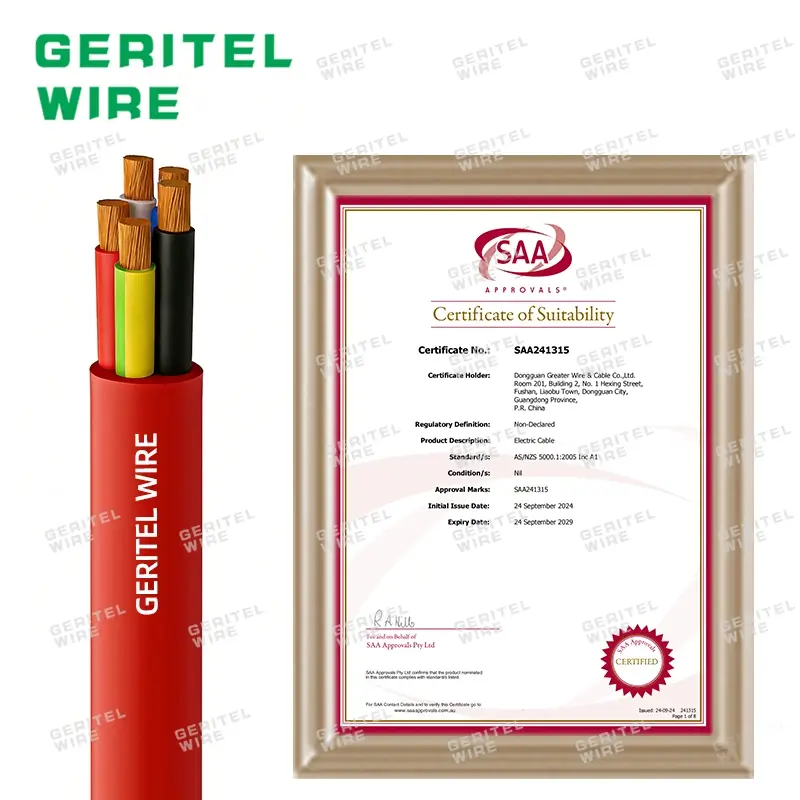
As a project funded through international development partnerships, every component required demonstrable compliance with recognized safety standards. The client specifically required SAA certification confirming adherence to AS/NZS standards—the rigorous Australian/New Zealand electrical safety framework. This certification represents comprehensive testing for dielectric strength, flame retardancy, mechanical durability, and environmental resistance. Many suppliers claimed compliance but could not provide the full certification trail required for audit purposes.
Logistics and Timeline Pressure
With the groundbreaking ceremony scheduled for March 2024 and a fixed completion window, the client faced a supply chain nightmare. Standard lead times from European or North American manufacturers extended 16-20 weeks—far exceeding the project schedule. They needed a partner capable of delivering certified, custom-specified cables within 8-10 weeks without quality compromise.
Technical Solutions: Three Cable Types for Precise Applications
Our engineering team conducted a three-week consultation period, analyzing project specifications against environmental data and operational requirements. We proposed a comprehensive cable suite addressing each application zone with purpose-engineered solutions.
High-Temperature Power Delivery: Elastomer Cable 35 mm²
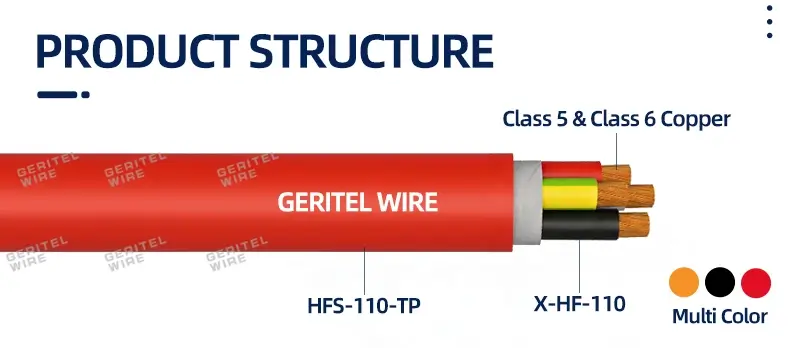
For generator connections, turbine auxiliary systems, and mobile maintenance equipment around the power plant, we specified Elastomer Cable 35 mm² as the primary solution. This was a calculated response to specific operational demands, not an arbitrary selection.
Standard PVC-insulated cables would fail prematurely in this environment. PVC's maximum operating temperature typically caps at 70°C, while areas near turbine housings and exhaust systems regularly experience ambient temperatures of 60-80°C with localized hotspots reaching 90°C. Elastomer Cable 35 mm² utilizes X-HF-110 low smoke zero halogen (LSZH) insulation paired with HFS-110-TP LSZH sheathing, maintaining operational integrity at continuous temperatures up to 90°C with short-circuit tolerance reaching 250°C.
The 35 mm² conductor cross-section provides optimal current-carrying capacity for 125A continuous loads while maintaining essential flexibility for routing through complex industrial layouts. Unlike rigid medium-voltage cables, this elastomer solution permits tight bending radii (6x overall diameter when flexed)—critical for connecting mobile welding equipment and portable power distribution units around maintenance bays.
We delivered this cable in 500-meter drum lengths, rated 450/750V, ensuring compatibility with both Australian installation practices and international IEC 60245 standards. The X-HF-110 LSZH insulation and HFS-110-TP LSZH sheathing form a complete low smoke zero halogen system that minimizes toxic smoke release in fire scenarios while delivering excellent oil resistance, abrasion resistance, and UV stability for maintenance areas and outdoor routing between buildings—meeting modern power facilities' dual demands for environmental protection and safety.
Precision Signal Control: Instrumentation Cable
The modernization of 15MVA transformer systems and switchgear at Malakal substation required sophisticated signal transmission infrastructure. We supplied Instrumentation Cable in multi-pair configurations (1.5 mm² conductors, twisted pair with individual and overall shields) for SCADA systems, protection relays, and metering circuits.
This cable type serves a fundamentally different purpose than power distribution. While Medium Voltage (MV) Cable carries megawatts of generation capacity, instrumentation cables carry milliamps of critical data determining whether that power flows safely. We specified polyethylene (PE) insulation for dielectric stability and individual aluminum-mylar tape shields with drain wires to prevent electromagnetic interference from high-voltage switching operations.
The client particularly appreciated our provision of AS/NZS 5000.3 compliant control cables with X-90 XLPE insulation and 5V-90 PVC sheathing, rated 450/750V and tested for self-extinguishing flame retardancy per IEC 60332-1. These cables connect new digital protection relays to the central control room, ensuring millisecond-level fault detection and isolation capabilities.
Primary Power Distribution: Medium Voltage Cable
The backbone of the transmission upgrade—connecting Malakal power station to Airai substation and extending to Kokusai substation switchgear—required Medium Voltage (MV) Cable capable of handling the island's primary distribution loads.
We supplied Medium Voltage cables rated at 12/20kV (24kV) and 18/30kV (36kV) respectively, with copper conductors ranging from 95 mm² to 240 mm² cross-sections depending on load calculations for each feeder segment. These were not commodity products but engineered for specific installation methods: direct burial in coral-sand trenches, duct bank installation through the island's limestone substrate, and aerial sections crossing coastal wetlands.
Technical specifications addressed Palau's specific environmental threats: longitudinal water-blocking tapes preventing moisture ingress in the event of sheath damage, and UV-resistant polyethylene sheathing for overhead spans. XLPE (Cross-Linked Polyethylene) insulation provides superior dielectric strength and moisture resistance essential for tropical underground installations, with a 30-40 year service life expectancy matching the project's infrastructure timeline.
Certification Excellence: The SAA Advantage
Our ability to deliver SAA-certified cables meeting AS/NZS 5000.1, AS/NZS 5000.2 standards proved decisive in securing this contract. But what does this certification actually mean for a Pacific island power project?
Rigorous Testing Protocols
SAA certification requires comprehensive testing beyond basic electrical continuity. Our low-voltage products underwent dielectric strength testing at 2.5kV, while medium-voltage cables were tested at 42kV AC for 5 minutes—verifying insulation integrity under extreme electrical stress. We demonstrated flame retardancy per IEC 60332-1, conductor resistance compliance with AS/NZS 1125, and mechanical durability testing including abrasion resistance and tensile strength.
Traceability and Documentation
For international development projects, documentation equals accountability. We provided complete material certifications, factory test reports, and chain-of-custody documentation from copper rod to final delivery. Every drum carried permanent marking indicating manufacturer, model, specification, and rated voltage per AS/NZS requirements.
Standards Harmonization
The strength of AS/NZS standards lies in their alignment with IEC baselines while incorporating regional environmental considerations. Our cables met AS/NZS 5000.1 for XLPE insulated power cables, AS/NZS 5000.2 for TPS flat cables used in switchgear connections, Wiring Rules for installation compliance. This multi-standard approach simplified the client's compliance verification—one certification family covered Australian, New Zealand, and Pacific island regulatory requirements.
Delivery Execution: Three-Phase Timeline Breakthrough
Having the right products meant nothing without execution excellence. Our project management team implemented a three-phase delivery strategy:
Phase 1: Emergency Release (Weeks 1-4)
We maintained pre-certified stock of Elastomer Cable 35 mm² and standard instrumentation cables at our Dongguan facility. Upon contract execution, we immediately released 2,000 meters of elastomer cable and 5,000 meters of control cabling for air freight to Palau, enabling the client's early works and site preparation to proceed without delay.
Phase 2: Custom Production (Weeks 5-8)
The medium voltage cables required custom manufacturing to exact length specifications—direct burial installations in Palau's coral terrain do not accommodate excessive jointing. Our production lines operated 24-hour shifts, extruding XLPE insulation over copper conductors, applying semi-conductive screens, and armoring with galvanized steel wire where mechanical protection was required. We completed 15km of MV cable production, testing, and drum loading within 32 days—half the industry standard lead time.
Phase 3: Consolidated Shipment (Weeks 9-10)
Utilizing our established logistics partnerships for Pacific routes, we consolidated the full cable suite—Elastomer Cable 35 mm², Instrumentation Cable, and Medium Voltage (MV) Cable—into containerized sea freight with transshipment through Guam. The entire order arrived at Malakal Port two weeks ahead of the client's critical path schedule, allowing buffer time for customs clearance and pre-installation inspection.
Project Outcomes: Performance Validation and Value Delivery
By December 2024, the Palau Malakal Power Plant Upgrade achieved substantial completion. Our cable infrastructure now forms the silent backbone of Palau's most reliable power transmission network.
Technical Performance Verification
The Elastomer Cable 35 mm² installations near turbine housings have operated continuously since commissioning without thermal degradation or insulation hardening. Maintenance crews specifically noted the cable's flexibility retention despite constant heat exposure—a stark contrast to previous PVC cables that became brittle within 18 months in similar environments. The X-HF-110 LSZH insulation and HFS-110-TP LSZH sheathing demonstrated exceptional weather resistance and mechanical integrity during routine safety inspections, with their environmental characteristics aligning perfectly with Palau's identity as an ecologically sensitive island nation committed to sustainable development.
The Instrumentation Cable infrastructure enabled new digital protection systems to achieve fault detection speeds under 100 milliseconds, exceeding the project specification of 200ms. This rapid isolation capability prevents cascade failures that previously plagued Palau's single-line transmission system.
The Medium Voltage (MV) Cable feeders demonstrated zero partial discharge activity during quarterly testing, confirming the integrity of our XLPE insulation and semi-conductive layer interfaces even in Palau's high-humidity environment.
Stakeholder Feedback
While respecting confidentiality agreements, we can share that the project engineer responsible for electrical systems noted our delivery performance "enabled the project to maintain its international funding timeline" and that cable quality "exceeded specifications required for 40-year infrastructure investments." The SAA certification documentation, in particular, streamlined the acceptance process with Australian and New Zealand engineering consultants overseeing the project.
Partnership Value: Three Core Competitive Strengths
The Palau project exemplifies three competencies that distinguish our approach to industrial cable supply:
Certification Authority and Standards Compliance
Our SAA certification portfolio extends beyond paper certificates—we maintain active compliance with AS/NZS 5000.1, AS/NZS 5000.2, and related standards through continuous factory auditing and product testing. For projects across Australia, New Zealand, Papua New Guinea, Solomon Islands, Palau, Samoa, and throughout Oceania, this certification eliminates regulatory barriers and accelerates project approval processes.
Proven Pacific Infrastructure Experience
Beyond Palau, our cables power schools, hospitals, airports, and road infrastructure across Oceania. We understand the logistical complexities of Pacific island supply chains, the environmental challenges of marine tropical installations, and the documentation requirements of international development financing. This is not theoretical knowledge—it is embedded in our project management protocols.
Engineering Responsiveness and Customization
Standard catalogs do not solve complex infrastructure challenges. Our technical team engages directly with project engineers to specify conductor sizes, insulation compounds, armor configurations, and jacket materials matched to specific installation environments. On this project, only Elastomer Cable 35 mm² featured our X-HF-110 LSZH insulation and HFS-110-TP LSZH sheathing low smoke zero halogen design, while Instrumentation Cable and Medium Voltage (MV) Cable utilized optimal conventional material solutions tailored to their respective application scenarios. We deliver engineered solutions, not merely products.
Take Action: Begin Your Project Success
The Palau Malakal Power Plant Upgrade demonstrates what becomes possible when technical expertise meets responsive execution. Whether modernizing generation facilities, extending distribution networks, or building industrial infrastructure in demanding environments, your cable infrastructure deserves the same engineering attention we devoted to this Pacific project.
Do not compromise on certification, quality, or timeline. Partner with a supplier who understands that cables are not commodity purchases—they are 40-year infrastructure investments that must perform flawlessly from day one through decades of service.
Contact Us today to discuss your project requirements:
Dongguan GERITEL Electrical Co., Ltd.
Tel/WhatsApp/WeChat: +86 135 1078 4550 / +86 136 6257 9592
Email: manager01@greaterwire.com
 Micronesia Nahnpohnmal Power Plant Upgrade



 Building 2, No. 40 Luxi 2nd Road, Liaobu Town, Dongguan City, Guangdong Province, China