


 Home
HomeMicronesia Nahnpohnmal Power Plant Upgrade
 GERITEL
 Apr 08,2026

In early 2023, our business team received an email carrying the scent of ocean breeze. The sender was a procurement manager from the Pohnpei Utilities Corporation in Micronesia. They were advancing a World Bank-funded power plant upgrade program and needed a complete cable system for three diesel generator sets soon to be installed.
This was no ordinary procurement list. The words that appeared repeatedly throughout the email were SAA certification, AS/NZS standards, and marine environment adaptability. The customer made it clear that previous cooperation with a European supplier had taught them a hard lesson: price is not the only consideration—the authenticity of certificates and understanding of Pacific island special environments are what make or break a project.
Our technical team immediately recognized this as an opportunity to fully leverage GERITEL Electrical's core strengths.
The Customer's Real Dilemma: More Than Just Buying Cables
Through three rounds of video conferences and dozens of technical correspondence emails, we gradually pieced together the complete picture of the challenges the customer faced. These difficulties were far more complex than initially apparent:
The Life-or-Death Test of Environmental Adaptation
The Nahnpohnmal Power Plant sits on a coral island near the equator, less than 500 meters from the coastline. The salt content in the air here is more than eight times that of inland areas, annual average humidity stays around 85%, and ultraviolet radiation intensity approaches tropical peaks. The customer's technical director frankly admitted that their existing cable systems averaged only 60% of normal service life under these conditions. Connector corrosion and sheath chalking were chronic nightmares plaguing their operations and maintenance teams.
Lost in the Certification Maze
As a World Bank project, all equipment had to pass strict compliance reviews. The customer's procurement manager had experienced a painful lesson: cables from a certain brand claiming to "meet IEC standards" were found to have insufficient insulation thickness during third-party inspection after installation, resulting in the return of the entire shipment and a four-month project delay. This time, they insisted on SAA certification—the authoritative endorsement of Standards Australia—the "quality passport" universally recognized by Pacific island nations.
The Unpredictability of Logistics
Pohnpei Island's port receives only two container ship calls per month, with limited berth draft. The customer's greatest fear was partial deliveries—if critical cable specifications arrived late, the entire installation crew would face idle time, with daily losses calculated in tens of thousands of dollars.
The High Threshold of System Integration
The three newly installed 2.5MW generator sets needed seamless integration with the existing SCADA monitoring system. This meant cables were not merely power transmission media, but also carriers of data communication. Any electromagnetic compatibility issues could cause false operations of protection relays—a catastrophic scenario in an island grid.
Our Solution: Three Irreplaceable Advantages
Facing this complex project, we demonstrated to the customer GERITEL Electrical's core competitiveness that distinguishes us from ordinary suppliers:
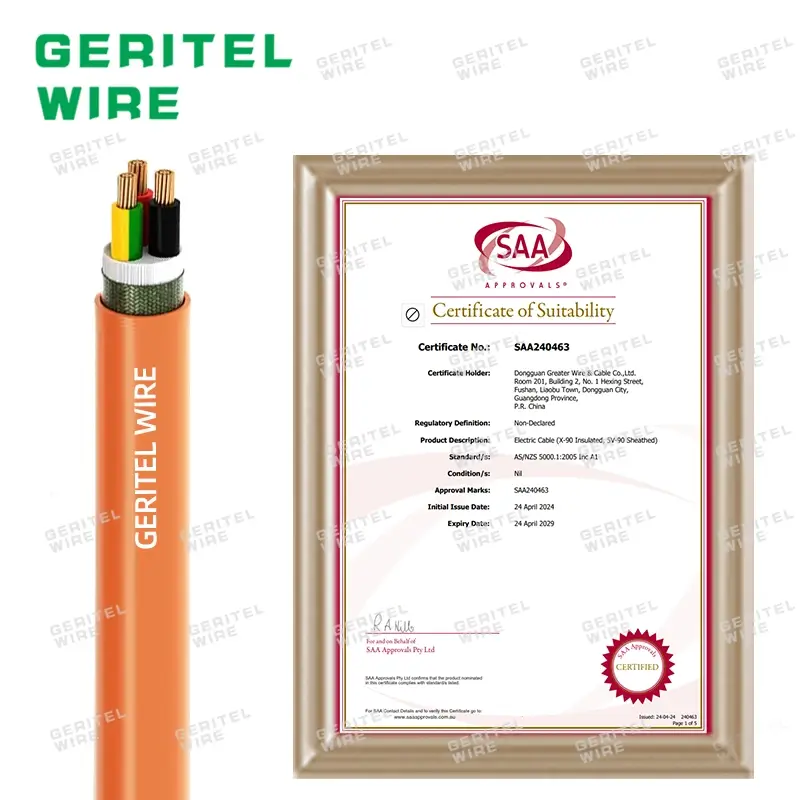
Advantage One: Genuine SAA Certification System
In the cable industry, "meeting standards" and "passing certification" are two completely different concepts. We showed the customer our complete SAA certificate chain:
• The SAA certification number for each batch of cables can be queried in real-time on the Standards Australia website
• Traceability reports for raw material copper rods, proving they come from certified suppliers meeting AS/NZS 1125
• Laboratory-issued type test reports, including 90°C long-term aging tests, -15°C low-temperature bending tests, and most critically—the salt spray test for 1000 hours without corrosion report
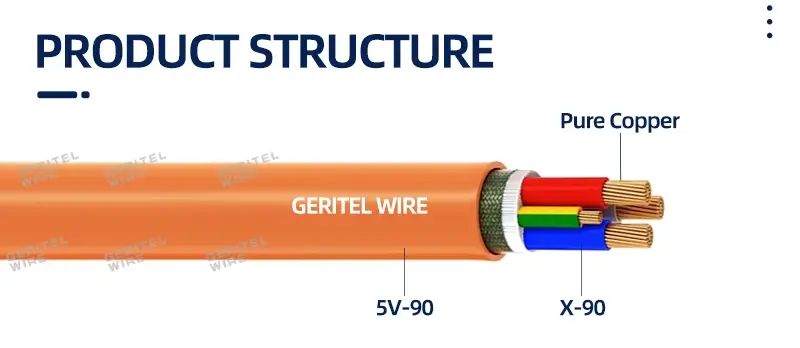
The customer's technical team specifically commissioned a third-party testing agency to conduct spot checks on samples we provided. Results showed that our orange cable 4 core 35mm2 exceeded AS/NZS 5000.1 standard requirements by more than 15% on key indicators including conductor resistance, insulation eccentricity, and sheath tensile strength.
Advantage Two: Combat-Proven Pacific Island Project Experience
We presented the customer with our project portfolio from the past five years in the Pacific region: the Lae Port distribution network in Papua New Guinea, the Honiara Hospital backup power system in the Solomon Islands, and the terminal building electrical system at Palau International Airport. These projects share one common characteristic—they have all withstood typhoon testing and remain stable in operation today.
More importantly, we have established a Pacific region cable application database. Based on these real cases, we could tell the customer: in high salt spray environments like Micronesia, the copper wire shielding layer of Medium Voltage Cable requires a special water-blocking structure, otherwise radial moisture ingress will occur within three years; the armoring layer of Control Cable cannot simply use steel tape, but should adopt aluminum alloy wire braiding to balance mechanical protection and corrosion resistance.
Advantage Three: End-to-End Delivery Certainty
We designed a full-chain delivery solution for the customer:
Production end: Established dedicated production scheduling to ensure all specification cables were completed within the same production cycle, avoiding time differences caused by batch quality inspections.
Packaging end: Adopted triple moisture-proof packaging with vacuum sealing + desiccant + aluminum foil composite film. Each cable drum was fitted with humidity indicator cards, allowing customers to visually verify moisture protection effectiveness during transportation upon unboxing.
Logistics end: Signed space reservation agreements with COSCO Shipping's Pacific routes to ensure container yard completion before the customer's designated shipping schedule. Provided DDP (Delivered Duty Paid) service—we handle customs clearance and inland transportation in Micronesia, while the customer simply receives goods at the power plant site.
Technical Solution: Finding the Optimal Role for Every Meter of Cable
Power Backbone: Precise Configuration of Medium Voltage Cable
The outgoing voltage of the three generator sets is 11kV, stepped down through station service transformers for distribution. We configured for the customer:
• Main generator outlet cables: 3×240mm² Medium Voltage Cable, XLPE insulated, copper wire shielded, lead alloy sheathed—this "copper wire + lead sheath" combination has been verified in Pacific projects to effectively block longitudinal moisture penetration
• Station service transformer connections: 3×95mm² Medium Voltage Cable, also XLPE insulated, but using corrugated aluminum sheath instead of lead sheath to reduce weight while ensuring sealing, lowering tower loads during overhead installation
All Medium Voltage Cable insulation layers include anti-tracking additives, which in high humidity environments prevent the formation of conductive channels on surfaces, avoiding insulation breakdown risks during long-term operation.
Visual Revolution in Distribution Networks: The Strategic Value of Orange Cable
In the low-voltage distribution system, we boldly proposed extensive use of orange cable 4 core 35mm2 as the main power distribution backbone. This suggestion initially surprised the customer—they were accustomed to traditional black cables.
We explained the engineering logic behind this:
Safety Identification: In the noisy power plant environment, maintenance personnel need to quickly distinguish cables of different voltage levels and purposes. Orange forms strong visual contrast with black and gray, particularly during emergency repairs, preventing misoperation.
Regulatory Foresight: The latest editions of electrical installation codes in Australia and New Zealand are promoting color-coding systems. Adopting orange cables means the customer's infrastructure won't face renovation pressure from code upgrades in the next decade.
Actual Performance: The orange cable 4 core 35mm2 we provide uses a special orange PVC formula with UV-531 ultraviolet absorber and HALS light stabilizer added. After five years of direct exposure on outdoor supports, color retention remains above 80%, while ordinary orange cables under the same conditions would have already faded to white.
Besides the 4 core 35mm2 main specification, we also supplied supporting:
• Orange cable 4 core 16mm2: For small auxiliary equipment power supply
• Orange cable 5 core 10mm2: With dedicated grounding core, for mobile maintenance power boxes
The Neural Network of Control and Sensing
Modern power plants increasingly rely on automation, and the "invisible value" of cables is becoming more prominent. We configured for the Nahnpohnmal project:
Control Cable: Adopting 7×1.5mm² and 12×2.5mm² specifications, with dual identification by color separation + numbers. The special feature is that we added a longitudinal water-blocking layer between the insulation and sheath—when cable trenches accidentally flood, this design prevents moisture from spreading longitudinally along the cable, protecting cabinet terminals from erosion.
Instrumentation Cable: Selected 4×2×0.75mm² twisted pair individual screen plus overall screen structure, used for connecting generator temperature, pressure, and vibration sensors. The shielding layer adopts double shielding with aluminum-plastic composite tape + tinned copper wire braiding, ensuring transmission accuracy error of 4-20mA analog signals remains below 0.1% even in high harmonic environments generated by frequency converters.
Execution Chronicle: When Plans Meet Reality
First Challenge: The Pursuit of Excellence in Sample Production
After contract signing, we didn't immediately begin mass production. Instead, we spent two weeks completing full-specification sample production. The customer sent a team comprising electrical engineers, quality inspectors, and site construction representatives to conduct a three-day acceptance at our factory.
Most memorable was the "abuse test" on the orange cable 4 core 35mm2: customer representatives soaked cable samples in artificially prepared 3.5% salinity seawater, removed them daily for three 90-degree bends, and measured insulation resistance after two weeks. Our cable insulation resistance decreased by only 2%, while a competing sample provided by the customer decreased by nearly 40% under the same test.
Second Challenge: Transparent Control of Production Processes
We opened real-time production monitoring systems to the customer. Through dedicated accounts, customers could view video streams of key processes—die temperatures during copper conductor drawing, online eccentricity detection data during insulation extrusion, real-time measurement values of cabling pitch.
This transparency established a unique trust. The customer project manager later told us: "Seeing your operators actively wrapping cable ends with plastic film during drum changes to prevent moisture, we knew we found the right supplier. These details can't be faked."
Third Challenge: Precision Delivery Across the Pacific
In March 2024, a container fully loaded with cables departed from Dongguan, transferred through Shenzhen Port, and boarded COSCO Shipping's Pacific route to Pohnpei. We adopted full-container direct shipping mode, avoiding the risks of unpacking and repacking at transshipment ports.
When the goods arrived at Pohnpei Port, our local agent had already completed pre-clearance procedures. From ship berthing to truck departure from the port area took only six hours—a speed record at Pohnpei Port. When the customer received the goods, humidity indicator cards on all cable drums showed normal readings, with packaging intact and undamaged.
Results Validation: The Story Behind the Numbers
The project completed commissioning in early 2025 and entered commercial operation. We tracked and collected the following key data:
Reliability Indicators: Within six months of operation, the cable system achieved zero failures and zero unplanned outages. Compared to the plant's pre-upgrade records, the average number of outages caused by cable issues during the same period was 2.3.
Maintenance Efficiency Improvement: After adopting the color-coding system, the electrical maintenance team's fault location time shortened by an average of 35%. The customer operations and maintenance supervisor specifically mentioned that during one nighttime emergency repair, the high visibility of the orange cable 4 core 35mm2 allowed maintenance personnel to quickly locate the fault circuit under emergency lighting conditions, avoiding a plant-wide blackout.
Total Lifecycle Cost: Although our initial quotation was about 12% higher than an uncertified brand, considering that the competing brand's cables in similar environments required connector replacement every five years and partial replacement every ten years, while our design life is 25 years, the customer's Total Cost of Ownership (TCO) actually decreased by more than 40%.
The Customer's Voice: The True Echo of Partnership Value
At the project completion ceremony, the customer project manager's remarks left a deep impression on us. He didn't talk about specific technical parameters, but said:
"Our cooperation with GERITEL Electrical has given us a new understanding of what a 'supplier' means. They weren't selling cables—they were helping us build infrastructure capable of resisting the erosion of time. When typhoon season comes, we know those orange cables will hold their ground through the storm."
This trust transformed into continuous cooperation. Currently, we are providing technical solutions for another island microgrid project for this customer, and have been invited to participate in cable standard formulation for the Federated States of Micronesia 2025–2030 Energy Master Plan.
Insights for You: Why Choose GERITEL Electrical
The success of the Nahnpohnmal project was no accident—it was the inevitable result of three core capabilities:
True Certification, True Assurance: Our SAA certification is not just a piece of paper, but a complete system running through raw material procurement, production processes, quality inspection, and document management. Every meter of cable is traceable; every indicator is verifiable.
Understanding Environments, Understanding Needs: Pacific islands are not ordinary markets—they are extreme testing grounds for cable weather resistance. Our solutions are built on experience from hundreds of similar projects, knowing where to thicken, where to optimize, and where standards must be strictly maintained.
Full Responsibility, Full Delivery: From factory to site, we bear all logistics risks. You don't need to coordinate customs clearance, worry about partial deliveries, or handle claims for transport damage. We deliver "ready-to-use" certainty.
Next Steps
If you are planning power infrastructure projects, whether located on Pacific islands, Southeast Asian coasts, or any location with stringent requirements for cable reliability, we are ready to provide you with the same value.
Dongguan GERITEL Electrical Co., Ltd.
Tel/WhatsApp/WeChat:
+86 135 1078 4550
+86 136 6257 9592
Email: manager01@greaterwire.com
 Vanuatu Sarakata Hydropower Expansion Project Cable Solution



 Building 2, No. 40 Luxi 2nd Road, Liaobu Town, Dongguan City, Guangdong Province, China