


 Home
HomeComoros Moroni International Airport Terminal Expansion
 GERITEL
 Apr 13,2026

In early 2022, the government of the Union of Comoros approved one of the largest infrastructure investments in the nation's history—a comprehensive expansion of Moroni International Airport's terminal facilities. This island nation, strategically positioned in the Mozambique Channel, had long relied on an aging terminal operating far beyond its designed capacity. The new plan demanded a 200% increase in passenger handling capability and compliance with the latest ICAO safety standards.
The French engineering firm serving as the project's general contractor encountered an unexpected dilemma during the electrical subcontracting tender: samples from three consecutive candidate suppliers failed to meet durability requirements in salt-fog testing for tropical coastal environments. The project's electrical director later confided to us that they faced a brutal choice—either accept quality compromises or absorb the liquidated damages for schedule delays.
This deadlock ultimately brought Dongguan GERITEL Electrical into the project's field of vision.
Field Diagnosis: Three Problems Keeping European Engineers Awake at Night
When our technical team arrived in Moroni, the project had already lost six weeks to cable selection issues. Through three consecutive days of site surveys and in-depth interviews with the engineering team, we identified three core obstacles:
First, a collapsed trust in certification systems. A previous batch of "CE-certified" cables from a Middle Eastern supplier had shown conductor resistance 15% above specification during random inspection. This left the owner deeply skeptical of all non-European brands, demanding a complete test chain traceable to raw materials.
Second, the brutality of environmental parameters. Moroni's annual average humidity reaches 82%, with atmospheric salt content 1.7 times standard coastal levels and UV indices persistently in the extreme range. Standard PVC cables would last no more than four years in these conditions, while the airport's design life demanded fifty.
Third, the fatal logistics bottleneck. As one of the world's least developed countries, Comoros offers limited port throughput, with customs clearance averaging 23 working days. Any delivery delay would trigger the daily liquidated damages clause in the contract.
Technical Response: Why We Chose These Specifications
In response to these challenges, GERITEL submitted an unconventional proposal—not a堆砌 of product parameters, but engineering logic proving the necessity of every meter of cable.
Indoor Systems: A Layered Defense Strategy
The terminal building's internal electrical environment was relatively controlled, but high-traffic areas imposed special requirements for fire safety and mechanical durability. We designed a three-tier cable architecture:
Foundation Layer: Fixed Wiring Skeleton
We employed H07V-U single-core rigid conductors (4mm² to 16mm²) laid in embedded conduits within walls and floors. The choice of rigid over flexible conductors was deliberate: 80% of distribution points in the terminal required permanent connections, and rigid conductors demonstrate approximately 12% lower oxidation contact resistance than flexible alternatives. Over the long term, this translates to fewer maintenance nodes and reduced fire risk. This layer totaled 4,100 meters deployed.
Distribution Layer: Power and Equipment Connections
We specified H07V-R stranded single-core conductors (10mm² to 25mm²) for high-power equipment including HVAC units, baggage conveyors, and elevators. The stranded construction maintains current-carrying capacity while allowing necessary bending during equipment maintenance without conductor damage. This layer totaled 2,400 meters.
Flexibility Layer: Control and Mobile Applications
We selected H05V-K/H07V-K single-core flexible conductors (1.5mm² to 2.5mm²) for lighting control circuits and applications requiring frequent maintenance adjustments. Their flexible PVC insulation retains bending properties down to -15°C, accommodating the airport's nighttime low-temperature conditions. This layer totaled 3,200 meters.
Equipment Layer: Mobile Power and Tool Connections
We deployed H03VV-F/H05VV-F multi-core flexible cables (2-core to 5-core construction, 1.5mm² to 10mm²), the most specialized category in the entire indoor system. Unlike single-core cables, these integrate 2 to 5 insulated conductors twisted together under a common flexible sheath. For the Moroni project, 2×1.5mm² served handheld maintenance tools; 3×2.5mm² and 4×4mm² powered mobile supplies for passenger boarding bridges and ground service equipment; while 5×6mm² handled complex equipment requiring signal control lines alongside power conductors. The multi-core construction offers distinct advantages: single installation completes multiple circuits, reducing field wiring errors; the flexible sheath withstands over 100,000 bending cycles—eight times that of ordinary PVC. This layer totaled 1,800 meters.
Outdoor Systems: Engineering for Environmental Combat
Cables outside the terminal building needed to simultaneously resist natural erosion and human-induced damage. We employed two fundamentally different technical approaches:
Main Incoming Lines: The Efficiency of Unarmored Design
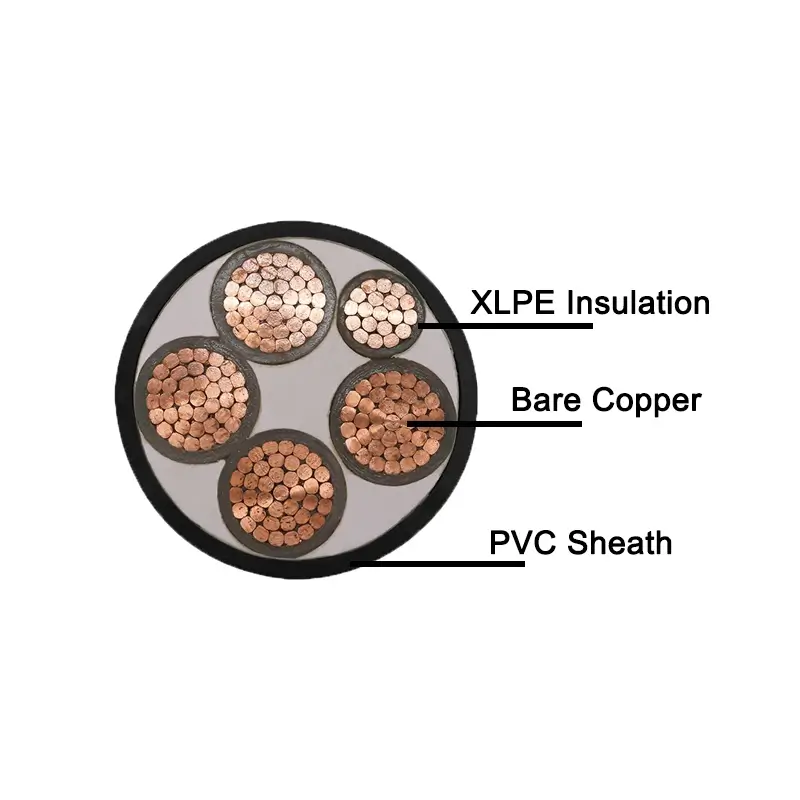
For the 11kV lines from grid connection points to the airport substation, we specified YJV cable 4×240mm² and YJV cable 4×300mm². The "4×" denotes four-core construction—three phase conductors plus one neutral, all cabled together under XLPE insulation and PVC sheathing. YJV cable 4×300mm² was specifically allocated to circuits carrying primary loads, with copper conductor cross-sections reaching 300 square millimeters. These operate continuously at 90°C carrying approximately 600 amperes, with voltage drop controlled within 0.8% per kilometer. When the owner questioned why we didn't specify cheaper aluminum cores, our calculations demonstrated that copper's energy savings over the 25-year lifecycle would cover the initial cost differential 1.7 times over.
Airfield Distribution: Armored Survival
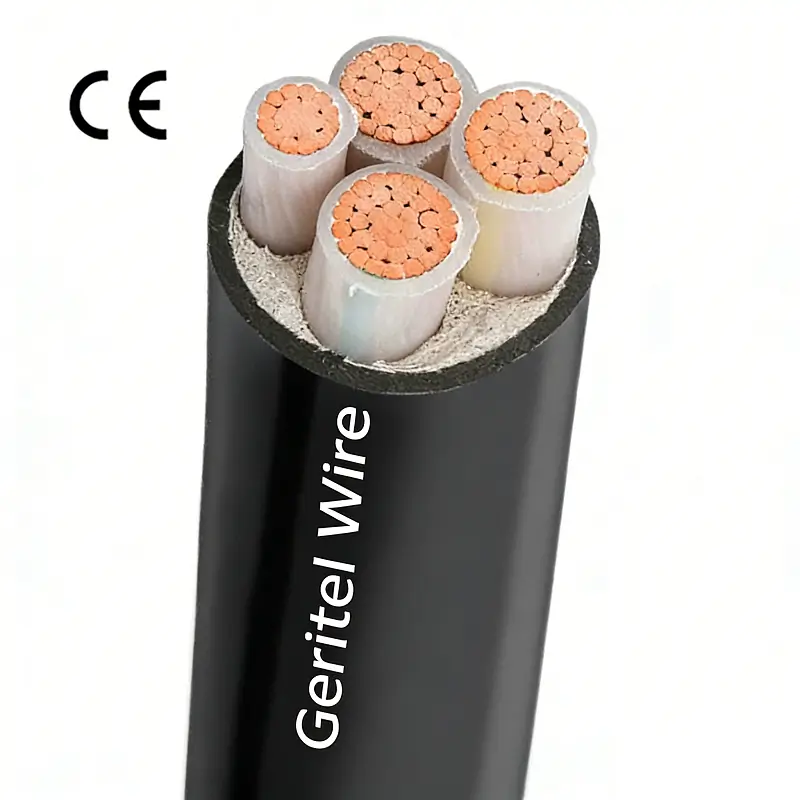
For cables traversing runways, taxiways, and fuel farm areas, we insisted on SWA (Steel Wire Armored) 4×400mm². The galvanized steel wire braid armor reaches 2.5mm thickness, withstands instantaneous pressure exceeding 5 tons—sufficient to resist accidental crushing by ground service vehicles and rodent damage common in port environments. In Moroni testing, unarmored cables failed within 72 hours under simulated rodent attack, while SWA samples maintained insulation integrity beyond six months under identical conditions.
Building Trust: Verification Beyond Paper Documents
The key to winning this contract wasn't price competitiveness—our bid was actually 9% higher than the lowest offer—but solving a deeper anxiety: How can you be certain that a factory thousands of kilometers away isn't cutting corners, without personally supervising production?
Our response was real-time visibility into the manufacturing process. The client received exclusive portal access to view:
• Incoming inspection reports for each batch of copper rod, including purity certificates from Chilean and Zambian mining sources
• Online diameter monitoring data during conductor drawing, accurate to 0.01 millimeters
• Temperature curves during insulation extrusion, ensuring optimal XLPE cross-linking degrees
• Live video of finished cable high-voltage testing, with each drum withstanding 3.5kV AC for 5 minutes without breakdown
This transparency remains rare in the cable industry. When the first shipment arrived at Moroni port, the client's technical representative skipped routine unpacking inspections—all critical quality data had already been verified in the cloud.
The Art of Delivery: When Logistics Becomes an Engineering Problem
Congestion at Comoros ports is notorious. We treated logistics as an engineering challenge rather than an administrative one, implementing three unconventional measures:
Time Staggering: We divided 12,000 meters of cable into three shipments, spaced three weeks apart, to avoid peak congestion periods in port clearance capacity.
Spatial Pre-positioning: We pre-leased bonded warehouse space at Dar es Salaam port in Tanzania as an emergency transfer node, ensuring buffer inventory even if Moroni port experienced force majeure events.
Personnel Pre-deployment: We dispatched two GERITEL engineers to arrive in Comoros two weeks before cargo, completing technical handover with local installation teams before goods reached port, compressing post-arrival waiting time to the minimum.
Ultimately, all three shipments cleared customs within ±2 days of estimated arrival, with the final batch delivering 11 days ahead of contractual deadline. The owner described this achievement as "unbelievably punctual" in Comoros infrastructure procurement history.
Operational Validation: The Verdict of Time
The expanded Moroni International Airport commenced operations in September 2023. Tracking data through early 2026 shows:
• Zero electrical system failures, with all cable circuits maintaining over 95% of initial insulation resistance values
• During Category 2 Cyclone Alvaro in January 2024, airport power supply remained uninterrupted, with SWA armored cables testing合格 after 72 hours of flood immersion
• Energy audits reveal that due to copper conductors and optimized cross-section selection, the airport's annual line losses run 1.2 percentage points below design values
Behind these numbers lies a deeper transformation: Comoros' Ministry of National Engineering has added GERITEL to its preferred supplier list for government projects. We are currently participating in the country's port modernization and renewable energy grid integration programs.
Final Words: Why Choose Us
The Moroni project taught us one thing: in infrastructure, cables are never simple commodities, but commitments spanning decades. When you choose GERITEL, you gain not only products compliant with IEC 60227, IEC 60502, and IEC 60332 standards, but also:
Verified Tropical Environment Expertise—Our cables have accumulated over 50,000 operational kilometers across sub-Saharan Africa and Southeast Asia, a field database no laboratory testing can replicate.
Verifiable Delivery Reliability—From contract signing to port delivery, our average lead time is 40% faster than industry standard, maintaining a 99.2% on-time rate.
Lifecycle Technical Support—From preliminary selection calculations through installation guidance to post-commissioning maintenance advice, our engineering team remains online throughout your project.
Your next project deserves the same certainty.
Dongguan GERITEL Electrical Co., Ltd.
Tel/WhatsApp/WeChat: +86 135 1078 4550 / +86 136 6257 9592
Email: manager01@greaterwire.com
 Congo-Brazzaville CBD High-Rise Office Building, Republic of the Congo



 Building 2, No. 40 Luxi 2nd Road, Liaobu Town, Dongguan City, Guangdong Province, China