


 Home
HomeMohammed bin Rashid Al Maktoum Solar Park (2021–2023)
 GERITEL
 Apr 17,2026

In July 2020, when Shanghai Electric's engineering teams first surveyed the Seih Al Dahal site, they faced a landscape that refused to stay still.Unlike conventional solar projects with stable terrain, the Mohammed bin Rashid Al Maktoum Solar Park—DEWA's flagship 900MW IPP project—presented a fundamental adversary: mobile sand dunes that shift meters monthly, burying previous survey markers and threatening cable infrastructure.
ACWA Power's technical director articulated the core dilemma during initial planning: "We needed cables that could handle not just the electrical load, but the mechanical stress of sand settlement, thermal cycling between 70°C days and 15°C nights, and the sheer distances involved—over 80 meters from array to combiner, then kilometers to the substation."
Standard PVC-sheathed cables failed preliminary environmental testing within six months. The solution required a complete rethinking of material specifications and installation methodology.
Morning Deployment: H1Z2Z2-K in Action
By August 2021, as the first 300MW block approached commissioning, installation crews began deploying H1Z2Z2-K single-core cables for string wiring—approximately 1,850 kilometers total for Phase A.
The specification mattered: 1×4mm² for standard arrays, 1×6mm² for longer string runsswith higher current capacity. Unlike legacy PV1-F rated for 1000V DC, these conductors handle 1500V DC nominal (1800V maximum system voltage), eliminating partial discharge risks in high-virradiance conditions.
Workers noted the difference immediately. At 6 AM, when desert temperatures hover near 20°C, the XLPO double-insulation maintains flexibility—critical for routing through tracker systems with tight bend radius requirements. By noon, when surface temperatures exceed 65°C, the same cables demonstrate thermal stability: the cross-linked molecular structure prevents sheath softening that plagues thermoplastic alternatives.
Each meter carries laser-printed length markings, allowing crews to verify cut lengths without unwinding entire drums in sandstorm conditions.
Midday Heat: Inside the Combiner Box
The transition from DC string to AC collection happens in structures where shade is nonexistent. Combiner boxes in Block B operated at internal temperatures approaching 90°C—ambient air offers no cooling relief.
Standard control wiring would degrade rapidly. Instead, H07V-K 1×6mm² and THHN 1×10mm² cables with explicit high-temperature ratings maintain insulation integrity where standard PVC would fail.
The nylon jacket on THHN variants provides additional abrasion resistance when sand particles infiltrate enclosure seals—a common occurrence in gusty desert conditions. These cables connect inverter monitoring systems and auxiliary power supplies, ensuring consistent data transmission and safety circuit operation despite thermal stress.
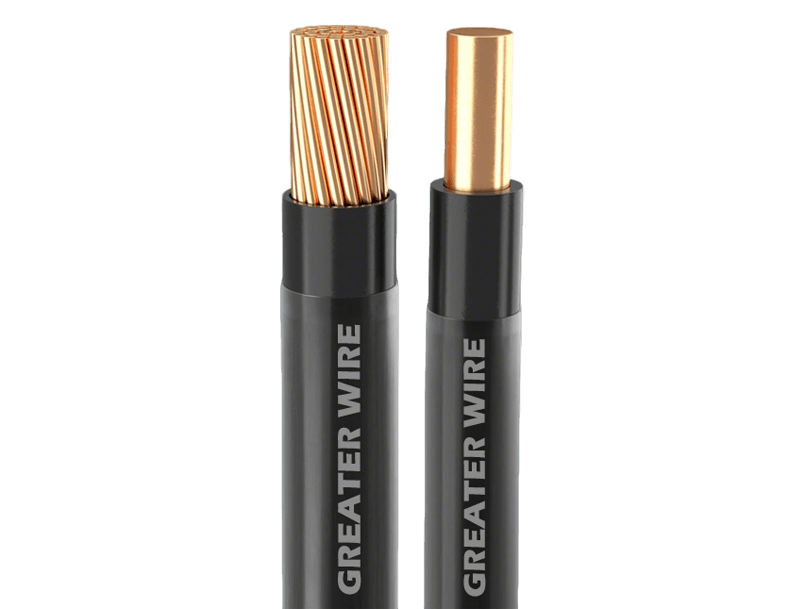
For the main power export from Inverter to transformer, YJV 3×120mm² XLPE-insulated cables handle the conversion load, with aluminum conductors optimized for cost efficiency in long horizontal runs where voltage drop calculations permit larger cross-sections without weight penalties of copper.
The Buried Highway: 33kV Beneath the Surface
Perhaps the most critical installation challenge lay in the medium-voltage collection network. Running 33kV XLPE cables across terrain where dunes migrate seasonally required innovative approaches.
The project specified aluminum conductor 1×300mm² and 1×400mm² single-core cables with aluminum tape armoring (ATA)—not for mechanical protection against digging, which remained minimal, but against the crushing pressure of sand accumulation that can exceed 1,000 kg per meter during wind events.
At 1.2 meters burial depth—below the maximum scouring depth of mobile surface sand—these cables form a 275-kilometer underground highway connecting 300MW-class blocks to the main substation. The aluminum construction reduced installation crew fatigue by approximately 45% compared to equivalent copper capacity, enabling faster trenching progress in soft substrate.
Temperature cycling during 24-hour periods creates expansion-contraction cycles. The XLPE insulation's molecular cross-linking density—higher than standard medium-voltage cables—accommodates this daily mechanical stress without crack propagation that would compromise dielectric strength in conventional materials.
Dusk and the Thermal Shock
As sunset transforms the desert surface into a rapid heat-sink, cables installed during daylight hours contract. The H1Z2Z2-K specification's -40°C cold-bend rating becomes critical—not for the Arctic conditions, but for the desert night.
When surface temperature drops 50 degrees within hours, cables without adequate low-temperature flexibility would experience sheath cracking at bend points. The Class 5 tinned copper conductor maintains ductility where pure copper would fracture, while the XLPO outer layer retains elasticity impossible with thermosetting plastics.
This thermal resilience translates to 25-year service life predictions validated by Arrhenius accelerated aging models—matching the project's depreciation schedule and DEWA's asset management protocols.
Certification and Compliance Architecture
Behind these installations stands a rigorous certification framework. H1Z2Z2-K cables carry TÜV Rheinland certification (Certificate J 50477534) to EN 50618 and IEC 62930 standards, representing 2,000+ hours of UV exposure testing and -40°C cold-impact verification.
The 33kV XLPE medium-voltage cables comply with UL 1072 for North American engineering standards integration,ACWA Power's documentation requirements for cross-border project financing.
Supply Chain Under Pressure
The 2021-2022 global logistics disruption presented unique challenges.With container shipping rates increasing tenfold, Shanghai Electric shifted cable transport from containerized to bulk cargo vessels—accepting longer port handling times to maintain budget parameters for the overall EPC contract.
When subsequent geotechnical surveys revealed沙丘 elevation changes requiring $3 million in additional earthworks, the cable specification flexibility proved crucial. Pre-ordered H1Z2Z2-K inventory with extended delivery timelines allowed installation to proceed without awaiting material arrival, maintaining the schedule that ultimately delivered Phase B 17 days ahead of the contractual completion date.
Performance Validation
Commissioned in June 2023, six months ahead of the original December 2023 target, the 900MW installation now contributes 2.268 billion kWh annually to Dubai's grid—sufficient for 270,000+ residential equivalents with 1.1 million tonnes annual CO₂ avoidance.
The cable infrastructure—H1Z2Z2-K, H07V-K, YJV, and 33kV XLPE—operates at specified parameters without degradation, validating the material specification decisions made during 2020-2021 procurement phases.
Your Project Deserves Equivalent Engineering
Whether your solar Development faces desert mobility, extreme thermal cycling, or logistical complexity, the cable specification methodology proven at Mohammed bin Rashid Al Maktoum Solar Park provides a replicable framework.
Dongguan GERITEL Electrical Co., Ltd. maintains TÜV/UL dual-certified production lines specifically for desert solar applications, with 500+ kilometer常备库存 of H1Z2Z2-K 4mm² and 6mm² specifications, and custom manufacturing capability for 33kV XLPE medium-voltage requirements.
Contact for Technical Consultation:
• Tel/WhatsApp/WeChat: +86 135 1078 4550 / +86 136 6257 9592
• Email: manager01@greaterwire.com
 Rakhshan Energy Pasargad Sirjan Solar PV Park (10MW) – Kerman, Iran (2022)



 Building 2, No. 40 Luxi 2nd Road, Liaobu Town, Dongguan City, Guangdong Province, China