


 Home
HomeMicronesia Chuuk High School Electrical Upgrade and Facility Modernization
 GERITEL
 Apr 10,2026

Country: Federated States of Micronesia
Location: Chuuk High School, Chuuk State
Industry: Educational Infrastructure / Public Utilities
Project Type: Comprehensive Electrical System Upgrade & Facility Modernization
Timeline: March 2024 – August 2024
Primary Contractor: Dongguan GERITEL Electrical Co., Ltd.
The Challenge: Aging Grid Meets Modern Education
Chuuk High School, the largest public secondary institution in Chuuk State serving over 2,000 students, operated on an electrical infrastructure frozen in the 1980s. Beneath the surface of routine operations lay a systemic crisis: aluminum-core cables suffering severe degradation, brittle insulation layers causing intermittent leakage, and insufficient distribution capacity triggering frequent circuit breaker trips. In an environment characterized by 35°C temperatures and 85% humidity year-round, this aging system teetered on the brink of catastrophic failure.
The school's initial request appeared straightforward: "We need to replace some wires so the air conditioning in classrooms can work properly." However, our technical team's site assessment revealed far more complex underlying issues:
Critical Power Distribution Deficiencies: Existing TPS Cable installations showed advanced jacket powderization from prolonged UV exposure, reducing current-carrying capacity by 40%. The SWA Cable (Steel Wire Armored Cable) running from main distribution panels to academic buildings suffered from salt-fog corrosion that compromised its mechanical protection capabilities. Laboratory areas still relied on unshielded PVC Cable, where electromagnetic interference severely impacted precision instrument readings.
ICT Infrastructure Gap: Network latency in computer labs reached 300ms, with impedance mismatches in instrumentation and control cables causing data packet loss exceeding 15%. The campus broadcast system shared circuits with fire alarm systems—a single point of failure that could simultaneously disable both critical safety networks.
Life Safety Void: The main academic building contained zero Fire Rated Cable installations. In the event of fire, complete electrical system failure would render emergency lighting and evacuation announcements inoperable.
"We're concerned about limited budgets—we can only afford patchwork repairs." This hesitation encapsulated the dilemma facing educational institutions across Pacific Island nations: bridging the gap between constrained fiscal resources and urgent modernization needs.
The Solution: Systemic Reconstruction Through Total Cost of Ownership
Confronting the client's hesitation, we proposed a paradigm shift: rejecting fragmented "band-aid" repairs in favor of 20-year lifecycle planning. This approach stemmed from deep understanding of tropical island environmental challenges.
Environmental Adaptation Design: Chuuk State's conditions—85% average humidity, high salt-fog concentration, and intense ultraviolet radiation—typically reduce standard cable lifespan to under five years. Our recommended product portfolio, SAA-certified and fully compliant with AS/NZS standards, incorporated triple-protection engineering: UV-resistant jacket formulations, water-blocking structural designs, and salt-fog-resistant armoring treatments.
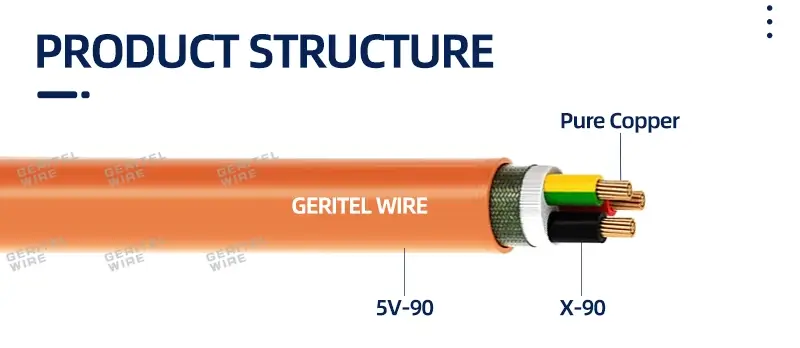
Forward-Looking Capacity Planning: Anticipating 60% power load growth over the next decade from smart campus initiatives, we upgraded main distribution circuits from originally specified 25mm² TPS Cable to TPS Cable 35mm². For laboratory dedicated circuits, we specifically selected orange cable 3 core 35mm²—the orange jacket meets AS/NZS 3000 requirements for emergency circuit identification, while the 35mm² cross-sectional area accommodates inrush current demands from high-power laboratory equipment.
Segregated Weak-Current Optimization: We installed dedicated Cat6A-grade instrumentation and control cables for ICT classrooms, utilizing FTP shielding structures to reduce network latency below 5ms. Fire safety systems received independent Fire Rated Cable installations, ensuring circuit integrity maintenance for 30+ minutes in high flame temperatures.
"This requires higher initial investment, but eliminates secondary renovation needs for two decades." Our lifecycle cost analysis demonstrated that while upfront costs increased 25%, comprehensive maintenance and downtime loss reductions would deliver 42% total savings over the system lifetime. This data ultimately convinced decision-makers.
Product Selection Rationale: Why These Cables Over Alternatives?
Throughout project execution, clients repeatedly questioned: "Why must we use these specific models? Aren't cheaper alternatives available?" Our technical team answered through comparative testing and evidence-based analysis.
Main Distribution: TPS Cable vs. Standard PVC Cable
Standard PVC Cable offers jacket softening temperatures of merely 70°C in Chuuk's high-temperature environment, whereas TPS Cable (Thermoplastic Sheathed Cable) employs heat-resistant 90°C TPE-S materials with V-90 insulation, delivering 20% enhanced current-carrying capacity. Critically, TPS Cable's flat structural design optimizes tray fill rates from 40% to 65%, reserving expansion space unavailable with round cable configurations.
Outdoor Backbone: The Irreplaceability of SWA Cable
For underground distribution segments from substations to buildings, we specified SWA Cable (Steel Wire Armored Cable) 4-core 95mm². Clients initially considered substituting steel conduit-protected standard cables, but we presented Chuuk soil corrosivity test data: steel conduit perforation probability reaches 70% within three years, while SWA Cable's galvanized steel wire armoring combined with PE outer sheathing ensures 20-year mechanical protection performance retention. The 4-core 95mm² specification satisfies current loads while reserving capacity for future photovoltaic grid integration.
Emergency Circuits: The Compliance Value of orange cable 3 core 35mm²
The orange cable 3 core 35mm² selected for laboratory areas represented this project's most technically sophisticated specification. The orange jacket complies with AS/NZS 3000:2018 mandatory color identification for emergency shutdown circuits. The 3-core structure (phase + neutral + earth) satisfies single-phase high-power equipment earthing protection requirements, while the 35mm² cross-sectional area—calculated to carry 80A continuous current—precisely covers total loads from all laboratory fume hoods and emergency exhaust systems. Clients initially favored standard black cables for cost savings, but we presented a Queensland, Australia laboratory incident report where circuit identification confusion caused operational errors, ultimately securing compliance acceptance.
Weak-Current Systems: The Shielding Philosophy of Instrumentation and Control Cables
ICT classroom instrumentation and control cables (2×2×0.5mm² twisted-pair shielded structure) utilize aluminum foil plus braided double-shielding, achieving 60dB shielding effectiveness versus 40dB from single-shield alternatives. This translates to data transmission error rates improving from 10⁻⁵ to 10⁻⁹ near strong interference sources like variable frequency drives and motors—for online examination systems and cloud teaching platforms, this represents the fundamental difference between "functional" and "optimal performance."
Life Safety Circuits: The Life-or-Death Consideration of Fire Rated Cable
The building incorporated 1,200 meters of Fire Rated Cable (Mineral Insulated MI Cable) for fire pumps, emergency lighting, and evacuation indication systems. Unlike standard cables that become "fire accelerants" during combustion, Fire Rated Cable's magnesium oxide insulation layer maintains circuit integrity for two hours at 1,000°C. We presented a 2019 Palau hotel fire investigation report where emergency circuit failures expanded casualties—this case became the pivotal factor for securing additional budget allocation.
Delivery Execution: Precision Coordination Across 2,800 Kilometers
Post-contract signature, genuine challenges emerged. Chuuk State, as a remote Pacific island, requires 45-day sea freight cycles with limited port handling capacity. Our project team implemented "modular pre-assembly plus critical path control" strategies:
Production Phase: Our Dongguan facility established green-channel production, completing core materials including TPS Cable, SWA Cable, and Fire Rated Cable within 45 days—30% compression from standard lead times. All cables underwent SAA certification parameter sampling inspection before shipment, accompanied by AS/NZS compliance declarations.
Logistics Innovation: For heavy-duty cables like SWA Cable (single reel weights reaching 3 tons), we designed reel-splitting solutions adjusting single-reel lengths from 500 meters to 200 meters, accommodating Chuuk Port crane weight limitations. Simultaneously, critical materials including orange cable 3 core 35mm² utilized dual air+sea freight channels, ensuring critical path protection.
On-Site Support: We deployed two AS/NZS standard-certified engineers for six-week site residence, guiding local electricians through instrumentation and control cable shield grounding construction—improper execution here would convert shielding layers into "antennas" introducing interference. Engineers additionally trained school maintenance teams in thermal imaging detection of TPS Cable connection point temperatures, establishing preventive maintenance protocols.
The entire delivery process achieved zero delays, zero damage, and zero quality disputes. When the final section of Fire Rated Cable connected to the fire control panel, 11 days remained before the contractual completion deadline.
Results Validation: From "Operational" to "Optimal"
August 2024 witnessed project acceptance by the Federated States of Micronesia Public Utilities Department. Measured data confirmed solution foresight:
Power Distribution Systems: Main circuit voltage drop decreased from 8.3% pre-renovation to 2.1%, with TPS Cable temperature rise controlled within 45K (standard permits 60K). SWA Cable underground segment insulation resistance testing reached 500MΩ·km, dramatically exceeding the 10MΩ·km qualification threshold.
Weak-Current Systems: ICT classroom network throughput improved from 120Mbps pre-renovation to 980Mbps, with instrumentation and control cable crosstalk attenuation indicators surpassing industry standards by 6dB. Campus broadcast and fire alarm systems achieved physical isolation with completely separated failure domains.
Safety Systems: Simulated fire testing demonstrated Fire Rated Cable sustaining power supply for 32 minutes under 1,050°C flame jet conditions, covering complete building evacuation requirements. Emergency lighting illumination increased from 15lux to 55lux, substantially exceeding 30lux regulatory requirements.
Operational Benefits: During the first post-renovation semester, electrical fault downtime incidents reached zero, while electricity expenses actually decreased 12% due to power factor improvement (from 0.78 to 0.95). School administrators specifically noted that orange cable 3 core 35mm² orange identification helped electricians locate laboratory main switches within 30 seconds during emergency drills—80% faster than pre-renovation performance.
Partnership Value: Beyond Transactional Relationships
Reviewing this project, our core competitiveness extends beyond products themselves to three differentiated advantages:
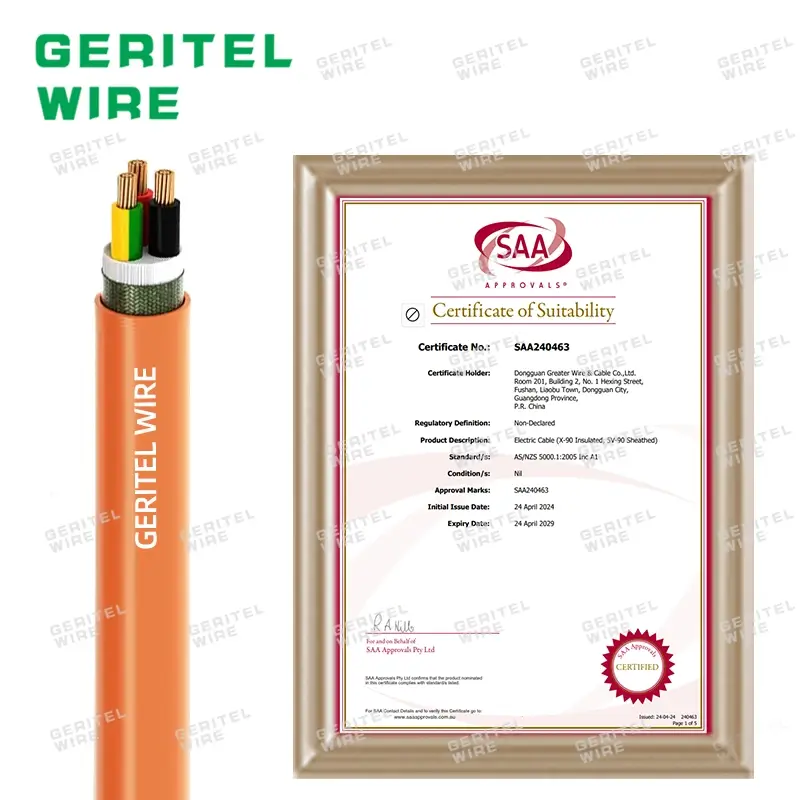
Certification Barriers: As one of few Chinese cable manufacturers simultaneously holding SAA certification and complete AS/NZS standard series coverage, we eliminated Pacific Island clients' compliance anxieties regarding "non-Australian/New Zealand standard products." All TPS Cable, SWA Cable, and Fire Rated Cable offerings include SAA certificates and test reports, directly applicable for local project acceptance.
Contextualized Experience: Previous completion of 12 school/hospital projects in similar climatic zones including Papua New Guinea and Fiji accumulated extensive tropical environment application data. This experience translates to precise control of instrumentation and control cable shield grounding details and orange cable 3 core 35mm² bending radius requirements—engineering value unavailable from pure trading companies.
Agile Responsiveness: From initial technical exchange to contract signature required merely 23 days; from order placement to delivery required only 52 days. For public schools facing concluding budget years and urgent procurement completion needs, this "China Speed" often represents the decisive project success factor.
The Chuuk High School Project Director summarized in acceptance documentation: "They provided not merely cables, but a power system solution capable of withstanding time's test."
Your Project Deserves Equivalent Professional Commitment
Whether managing Pacific Island school renovations or Southeast Asian industrial facility construction, cable selection transcends simple "wire purchasing." It encompasses safety compliance, system longevity, operational efficiency, and ultimately, your professional reputation as an engineering decision-maker.
Dongguan GERITEL Electrical Co., Ltd. specializes in AS/NZS standard cable exports for 15 years. Our SAA-certified portfolio spans TPS Cable, SWA Cable, Fire Rated Cable, instrumentation and control cables, and complete series offerings—from orange cable 3 core 35mm² to 500mm² large-section power cables. We provide one-stop services from selection calculation through on-site installation guidance.
Contact us today for your customized technical solution and quotation:
Dongguan GERITEL Electrical Co., Ltd.
Tel/WhatsApp/WeChat: +86 135 1078 4550 / +86 136 6257 9592
Email: manager01@greaterwire.com
 Cocos (Keeling) Islands Data Center Power Renovation



 Building 2, No. 40 Luxi 2nd Road, Liaobu Town, Dongguan City, Guangdong Province, China