


 Home
HomeMasdar Iraq 1GW Solar PV Project (Basra Solar Power Plant, Iraq)
 GERITEL
 Apr 18,2026

Autumn 2021, Abu Dhabi. The investment committee at Masdar stared at a sobering figure: 4,000 MW. That's Iraq's national power deficit—equivalent to two and a half Three Gorges Dams. In summer, Baghdad residents endured 12+ hours of daily blackouts. Factories burned 15% of their revenue on diesel backup generators.
The dependency stung worse. For years, Iraq relied on Iranian gas and electricity imports. But geopolitical tremors made that lifeline fragile. When US sanctions throttled Iranian energy exports in 2019, southern Iraq went dark. The government finally faced reality: they needed domestic, controllable energy.
Solar emerged as the obvious play. Anbar Province boasts solar irradiance exceeding 1,800 kWh/m²—near Saudi levels—with near-zero land costs. The catch? This is among Earth's most hostile environments for precision equipment: 70°C surface temperatures, sandstorms lasting three days, shifting dunes and hidden bedrock beneath.
Masdar decided to bet. They signed a BOT agreement with Iraq's Ministry of Electricity and National Investment Commission for a 10MW demonstration plant near Kerman, hard against the Iranian border. Not their largest project, but it had to be their most bulletproof—only proven desert viability would unlock financing for the 100MW+ follow-ons.
Three Reasons They Couldn't Sleep
Our first video call came November 2021. The EPC's technical director cut straight: "We've evaluated seven cable suppliers. You're not the cheapest. But we need to talk."
He laid out three insomnia-inducing problems.
First, time. Iraq's political rhythm and construction rhythm constantly clash. Funding releases depend on parliamentary moods. Construction windows must dodge Ramadan and summer heat. This meant cables couldn't arrive all at once, but couldn't arrive late either—800 workers burning $8,000 daily when idle. He needed a supplier who could "breathe with the project," not just ship boxes.
Second, environment. He shared video footage: a 2020 Kuwaiti plant, European brand, year three. Buried cables chewed through by sand rats, short-circuit fire. Repair crews dug three meters through sand to find non-armored PE sheaths crumbling like biscuit. "We operate 25 years," he said. "I don't want to start digging for replacements at year ten."
Third, certification. Iraqi banking regulations remained patchy; international financiers demanded TUV or UL marks on all critical equipment. But: "I've seen too many 'certified' products fail field testing. I want what's behind the certificate—test reports, factory audit records, batch traceability."
We listened. Our response was simple: "18 phased deliveries, 30-day production notice each. Desert environmental simulation testing on every batch. Complete TUV and UL dossiers, including factory audit reports, with first delivery."
He paused. "Abu Dhabi next week. See the site."
5 AM at the Module Field
March 2022. First delivery landed.
Dawn hadn't broken when installation crews unrolled the first PV strings. In their hands: H1Z2Z2-K 1×6mm², fresh from container humidity—the first tranche of 220,000 meters that would eventually connect 28,000 modules.
Lao Zhang, Filipino, eight years in Middle East solar, habitually flexed the cable first. "Softer than PV1-F," he told his mate. "Class 5 stranded, tinned copper." Softness meant easier termination, but more critically, fatigue resistance—desert diurnal swings of 30°C break hard conductors within three years.
He noted the matte sheath, not glossy PVC. "XLPO compound," explained our engineer on-site. "Electron-beam cross-linked, molecular chains restructured. UV won't crack it, 150°C won't melt it." Zhang nodded. He was starting to believe these would survive over 20 years.
Every drum carried labels: TUV B 126326 0001 Rev.00, UL E552397. The project manager photographed everything for the compliance folder the financiers demanded.
Noon at the Combiner Box: Heat's Trial
June. Surface temperature cracked 55°C. Beside a combiner box, H1Z2Z2-K 1×10mm² awaited pulling—part of 45,000 meters of heavier gauge for long-span jumpers.
4mm² and 6mm² lines converged from every direction into the box; 10mm² carried unified current toward inverters. Infrared thermometers showed joints running 18°C above ambient—intrinsic losses at full load.
"Standard PVC would be softening now," our engineer pointed out. "See the XLPO—shape retention intact." Sand dust clung to the sheath, but wiped clean, gloss remained. Abrasion test data: passed IEC 62930's scrape test, surviving 50N vertical pressure through 1,000 cycles.
Some sand infiltrated the box. No matter. The material's hydrophobicity and density made cleaning simple—compressed air after dark.
The Inverter Container's Hum: AC Pulse
Twenty 500kW inverters running simultaneously vibrated the container walls.
YJV Cable 3×240mm²+1×120mm², 18,500 meters, ran from each inverter output to pad-mounted transformers. Low-voltage AC section, 800V, 800A+. Cross-linked polyethylene's dielectric constant: 2.3 versus PVC's 3.5. Same cross-section, lower losses, longer reach.
The concentric neutral's role stayed invisible during normal operation, but the design engineer had emphasized Iraq's grid instability, high harmonic content. Impedance imbalance in neutrals could fool protection relays into mislocating faults, causing cascading trips. Our cables maintained concentricity within 5%, ensuring three-phase balance.
Another batch—YJV cable 3×300mm²+1×150mm², 8,200 meters—handled main inverter room to substation trunk lines. Oversized for future expansion: Masdar was already negotiating 20MW Phase II land rights.
33kV Underground: Armor's Confidence
Above ground: modules and inverters. Below: the project's costliest infrastructure investment.
SWA steel wire armored cable, 61,500 meters—14% of total cable length, 23% of cable budget. The EPC's technical director called it "insurance, not cost."
1×185mm² for main collection loops: 28,000 meters, interconnecting pad transformers. 1×240mm² for trunk lines: 15,000 meters, converging at the substation. Heaviest 1×300mm²: 6,500 meters, direct to main transformer HV side. Voltage class 26/35kV, operating at 33kV—headroom for grid fluctuations.
All direct-buried at 1.2 meters. Desert sand shifts; rare rains percolate. So beneath the armor: bitumen anti-corrosion coating. Galvanized steel wires, 0.8mm diameter, 90%+ coverage ratio.
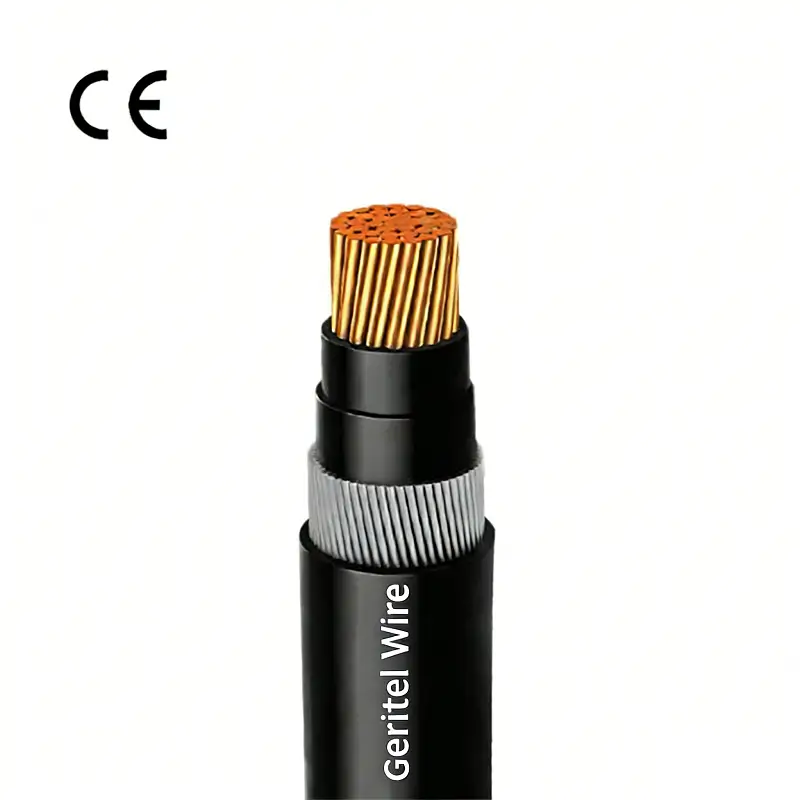
The incident came September 2022. An excavator expanding access roads clipped a buried section. The operator went white. We excavated together: SWA armor deformed 3cm deep, but wires unbroken, XLPE insulation intact, passing hipot testing first try.
"Non-armored?" the technical director reflected later. "We'd be preparing emergency repairs. Three-meter trenching in desert sand—labor costs 10× material, not counting outage losses."
Summer 2023: The Cruelest Exam
First full operational summer. Temperatures hit 52°C—a decade's record.
Operations feedback arrived: H1Z2Z2-K DC side, string output deviation held within 1.8%—joints hadn't loosened from thermal cycling. XLPE AC side, insulation resistance change under 2%, aging within projections. SWA medium-voltage side, partial discharge stable at 3pC, well below 10pC alarm threshold.
The surprise: rodent resistance. Desert foxes and sand rats chew cable sheaths—Kuwait's lesson. Our SWA armor, primarily for mechanical protection, incidentally deterred biological attack. Inspection found gnaw marks on armor surfaces, no penetration.
The project manager's email: "Cable system status: excellent. Recommend identical specifications for follow-on projects."
What the Financiers Wanted
Late 2023, Masdar sought Phase II financing. International bank due diligence teams visited, demanding Phase I equipment dossiers.
We provided: TUV type test reports (Certificate B 126326 0001 Rev.00), covering electrical, mechanical, weathering performance. UL follow-up inspection reports (File E552397), proving factory quality control per UL4703. Batch traceability—from copper rod intake to finished goods dispatch, every drum's resistance, insulation thickness, sheath tensile strength logged.
"Most suppliers give certificate front pages," the bank's technical advisor noted. "You provided complete dossiers, including factory audit non-conformance resolutions. This tells us the marks weren't purchased."
Financing approval came two months ahead of schedule. Cable compliance was a small project slice, but "no surprises" itself held value.
The Phase II Call
Early 2024. The technical director called, tone lighter than our first meeting: "Phase II, 20MW. Same supplier. We've optimized designs, but cable specs unchanged—your H1Z2Z2-K and SWA proved that in Iraq, reliability beats savings."
One detail stuck: Phase I actual copper consumption ran 7.8% below design. We'd calculated precise gauges based on actual 780-meter average string lengths, not the designer's conservative 850-meter estimate. "That savings covered half the armored cable premium."
If You're on a Similar Site
Dongguan GERITEL Electrical has done this for years. Our H1Z2Z2-K carries dual TUV (B 126326 0001 Rev.00) and UL4703 (E552397) certification. SWA armored cables meet IEC 60502 and BS 6622. Applications: Iraqi deserts, Saudi salt coasts, anywhere cables must silently survive 25 years.
We介入 early, helping calculate: what gauge is precisely sufficient, when armor is mandatory, how many delivery phases match construction rhythm. Complete documentation provided—financiers want it, we have it.
+86 135 1078 4550 / +86 136 6257 9592
manager01@greaterwire.com
 Iran Sirjan Solar Power Plant Wire Export



 Building 2, No. 40 Luxi 2nd Road, Liaobu Town, Dongguan City, Guangdong Province, China