


 Home
HomeMarshalls Energy Company (MEC) Power Plant Upgrade & Expansion
 GERITEL
 Apr 07,2026

March 2024. An email arrived in our inbox from the depths of the Pacific.
The sender was the procurement director of Marshalls Energy Company (MEC). No fancy introduction. Just one attachment and a single line: "Our cables are smoking again."
The photo showed the insulation of a Medium Voltage Cable cracking under the tropical sun, copper cores exposed, surrounded by salt spray erosion. This was the 37th batch of cables MEC had replaced in the past eighteen months.
Majuro, capital of the Republic of the Marshall Islands. An atoll sitting just two meters above sea level, thousands of kilometers from the nearest industrial center. Every drum of cable here crosses half the Pacific to arrive. And MEC—the state-owned utility powering 54,000 island residents—stood at the edge of a cliff.
Power Station 1 (PS1), built in 1982, had been condemned as structurally unsafe, requiring complete demolition and reconstruction. System losses ran at 22%, meaning one in every five generated kilowatt-hours vanished in transmission. Worst of all, they were still paying eighteen dollars per gallon for diesel generator fuel—triple the price in the continental United States.
"We've tried three suppliers," the engineering project manager said during the video conference that followed, his voice carrying the weight of exhaustion. "They all promised 'compliance with standards.' But here, standards seem to mean 'survive the warranty period.'"
He displayed a harrowing inventory:
• A batch of Low Voltage Power Cable showed sheath pulverization six months after installation
• So-called "weather-resistant" Control Cable saw insulation resistance drop 60% within three years in salt spray environments
• A shipment of Instrumentation Cable caused 47 false alarms monthly in the SCADA system due to poor shielding grounding
"The World Bank gave us eighteen point seven million dollars for reconstruction. The Asian Development Bank joined in. But if we choose the wrong supplier again," he paused, "we lose not just money. We lose this country's development opportunities for the next decade."
Diagnosis—The Gap Between Standards and Reality
We sent our technical team to Majuro. Not to sell, but to listen.
Beside the ruins of PS1, in humid distribution rooms, in outer island villages sustained by diesel generators, we found the root cause: a disconnect between standards and environment.
AS/NZS 1429.1 and AS/NZS 5000.1 are excellent standards, born from continental Australia and New Zealand. When these cables transplant to the oceanic climate of Pacific island nations, one fatal detail gets overlooked—the triple assault of UV radiation, salt spray, and 100% humidity.
Standard XLPE cable sheaths suffer molecular chain scission under ultraviolet exposure. Salt spray particles infiltrate and form electrochemical corrosion micro-cells. Persistent high humidity keeps insulation layers in a permanent sauna state. This is not the cable's fault. It is application misalignment.
"What you need isn't just standard-compliant cable," we wrote in our technical memo to MEC. "You need cable redesigned for Pacific island nations."
The Prescription—Four Aces
Based on our diagnosis, we proposed a bold solution: not selling products, but delivering "system immunity."
Ace One: SAA Certification—The Foundation of Trust
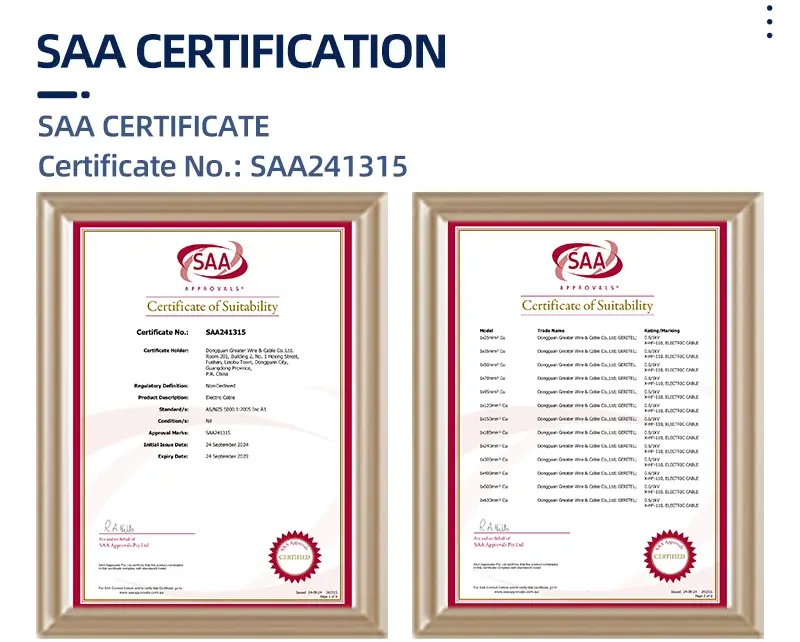
We showed MEC our SAA Certification documents. This was not paper. It was a complete quality ecosystem:
• Full traceability from copper rod smelting to insulation extrusion
• Medium Voltage XLPE Cable (11kV, AS/NZS 1429.1) with 90°C conductor operating temperature and 250°C short-circuit temperature
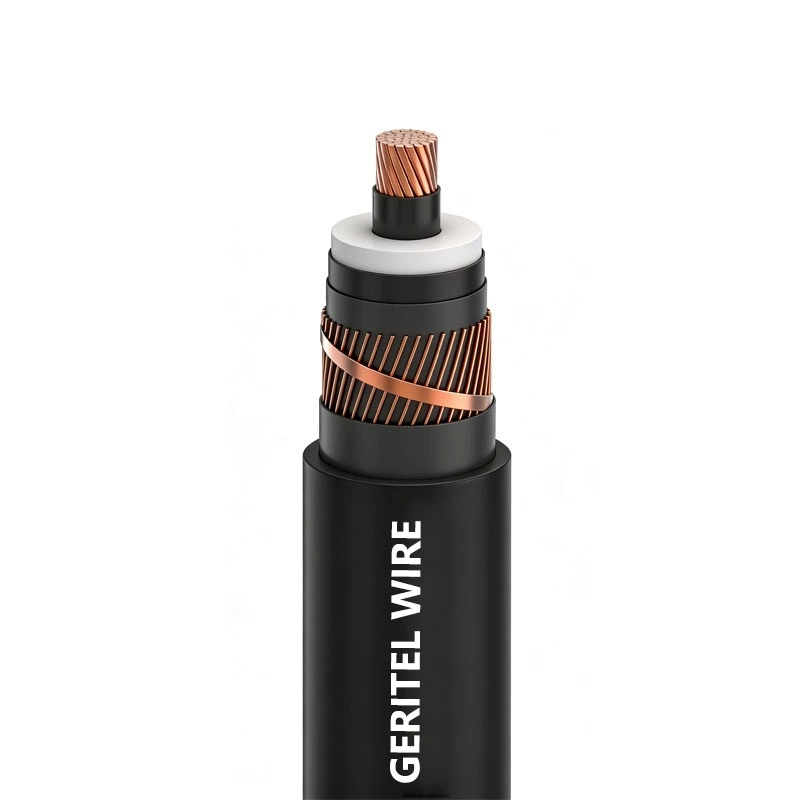
• Low Voltage Power Cable (0.6/1kV, AS/NZS 5000.1) with UV-resistant sheath formulation and 25-year design life
• Control Cable (Multicore, 1.5mm²) and Shielded Instrumentation Cable passing AS/NZS 1125 electromagnetic compatibility tests
"Other suppliers have certificates too," MEC challenged directly. "What's your difference?"
Our answer: We understand the Pacific. Our cables don't just "pass" tests—they are optimized for Pacific environments. For example, our UV stabilizer content is 1.8 times the standard value. Sheath thickness increases 15% to resist salt spray penetration.
Ace Two: Scenario-Based Product Matrix
We didn't give MEC a generic catalog. Instead, we customized solutions for four specific scenarios in their project:
PS1 New Plant Backbone Network
• Pain point: High load plus salt spray corrosion
• Our solution: Medium Voltage XLPE Cable (11kV, AS/NZS 1429.1)
• Specification details: 3-core 50mm² copper conductor, steel wire armored, XLPE insulated, HDPE sheathed
Majuro Urban Distribution
• Pain point: Space constraints plus maintenance difficulty
• Our solution: Low Voltage Power Cable (0.6/1kV, AS/NZS 5000.1)
• Specification details: Mixed 25mm² and 35mm² configurations, compact outer diameter, halogen-free flame retardant
Generator Control Systems
• Pain point: Signal interference plus vibration
• Our solution: Control Cable (Multicore, 1.5mm²)
• Specification details: 7-core, 12-core, and 19-core options, tinned copper conductors, PVC insulated, steel tape screened
SCADA Monitoring Network
• Pain point: Data precision plus long-distance transmission
• Our solution: Shielded Instrumentation Cable
• Specification details: Twisted shielded pairs, aluminum/polyester composite screening, low capacitance design
Ace Three: Supply Chain Resilience
We promised delivery in 10 to 14 days, not the industry-standard 8 to 10 weeks. This relied on our Asia-Pacific pre-positioned inventory strategy:
• Singapore regional warehouse maintains 5,000+ meters of Medium Voltage Cable in stock
• Project-specific production of 7,400 meters pre-locked for MEC
• "Triple protection" maritime packaging: vacuum sealing, desiccant packs, and salt spray-resistant wrapping
Ace Four: Technical Symbiosis
We offered not just cable, but installation technical support. Our engineers stationed in Majuro for three months, training MEC teams in XLPE cable heat-shrink termination techniques, sharing cable tray moisture-proof design experience, and assisting in establishing preventive maintenance inspection systems.
The Campaign—Racing Against Time
Contract signed May 2024. First vessel arrived at Majuro Port in June.
But the real test had just begun.
MEC's new PS1 construction progressed faster than expected. They asked us to compress three planned deliveries into two, with the second batch arriving six weeks early. This meant completing all maritime transport before typhoon season.
Our logistics team made a risky decision: abandon conventional container ships, use roll-on/roll-off direct sailing. Costs increased 23%, but time shortened by four weeks.
"Are you crazy?" our finance director questioned in the internal meeting. "This project's gross margin will be cut in half."
"We're not doing an order," the project director replied. "We're establishing a beachhead. If MEC succeeds, the entire Pacific island power market will see."
August 2024. When the final batch of Shielded Instrumentation Cable arrived, Majuro was experiencing a tropical storm. Our packaging withstood the test—unpacking inspection showed zero degradation in cable insulation resistance.
Rebirth—From 22% to 7.8%
Early 2026. MEC's new grid entered operation.
The numbers tell the story:
• System losses: Dropped from 22% to 7.8%—saving over 1.2 million dollars in diesel costs annually
• Failure rate: Reduced from 4.3 incidents monthly to 0.8 incidents quarterly
• SCADA false alarms: Decreased from 47 times monthly to 2 times monthly
• Zero cable incidents: Eighteen months of salt spray environment operation without insulation failure
The World Bank project audit report specifically noted: "The early delivery and high-quality installation of cable infrastructure was a critical factor enabling the project to progress toward full commissioning by the 2027 target."
But the stories behind the numbers matter more.
In Arno Atoll, a fisherman told us his ice-making plant now runs 24 hours without worrying about voltage fluctuations ruining a boatload of tuna. In Jaluit, a school principal said they can finally use projectors in classrooms without generator noise drowning out lectures.
"You gave us more than cable," MEC's general manager said at project acceptance. "You gave us the confidence to plan for the future."
Legacy—From Customer to Partner
Today, MEC is no longer our "customer." They are our regional partner.
Based on this project's success, we have jointly bid on outer island electrification projects under the World Bank's REGAIN initiative, extending grids to Arno, Jaluit, Wotje, and Rongrong atolls. MEC engineers regularly attend our technical seminars, sharing field experience in Pacific environments—knowledge now feeding back into our product design iterations.
We have established the "Pacific Power Infrastructure Alliance," uniting MEC, local contractors, and international financial institutions to provide island nations with one-stop services from planning and financing to delivery.
Conclusion: Your Project Deserves This Treatment
The Marshalls Energy Company story is not unique. In every seemingly "peripheral" market, there are customers like MEC who need not standardized products, but partners who understand their situation.
If you are managing a power infrastructure project, whether in Pacific island nations, Southeast Asian coastlines, or any challenging environment, remember:
• SAA Certification is not a cost. It is insurance—proof that your cable can withstand time's test
• Scenario-based design is not luxury. It is necessity—standard cable performs excellently in standard environments, but your environment may not be "standard"
• Supply chain resilience is not icing on the cake. It is project lifeline—even the best cable, if it cannot arrive on time, is merely copper and plastic in a warehouse
Dongguan GERITEL Electrical Co., Ltd. has specialized in cable export for fifteen years, serving twenty-three Pacific island power projects. Our Medium Voltage XLPE Cable (11kV, AS/NZS 1429.1), Low Voltage Power Cable (0.6/1kV, AS/NZS 5000.1), Control Cable (Multicore, 1.5mm²), and Shielded Instrumentation Cable carry SAA Certification and have proven reliability in demanding environments across twelve countries.
Do not let cable become your project's weak link. Let us customize "immunity-grade" cable solutions for your next project.
Contact our Pacific Project Specialist Team now:
Tel/WhatsApp/WeChat: +86 135 1078 4550 / +86 136 6257 9592
Email: manager01@greaterwire.com
Company: Dongguan GERITEL Electrical Co., Ltd.
 Palau International Airport Expansion and Electrical Upgrading Project



 Building 2, No. 40 Luxi 2nd Road, Liaobu Town, Dongguan City, Guangdong Province, China