


 Home
HomeHassi R’Mel Solar PV & Energy Storage Demonstration Project, Algeria
 GERITEL
 Apr 11,2026

In February 2024, we received an urgent technical inquiry from an international EPC contractor. They were executing a 220MW ground-mounted solar project in Biskra Province, Algeria—one of the first concrete implementations under Sonelgaz's 3GW national solar program. The site sat at the northern fringe of the Sahara, covering roughly 400 hectares of rocky desert terrain with scattered vegetation.
The client's technical lead was candid about their concerns. This was their first large-scale PV EPC in North Africa's desert environment. They had previously suffered through a painful experience in the Middle East where standard cables degraded prematurely under extreme heat, forcing a wholesale replacement in year four. For Algeria, they wanted TUV-certified product compliant with IEC 62930, and they needed proof of similar-scale delivery experience.
Site Assessment and Technical Alignment
Our engineering team flew to Algiers in early March for three days of field alignment. The climate data from Biskra was stark: over 3,000 annual sunshine hours, summer surface temperatures reaching 70°C, daily temperature swings exceeding 30°C, and frequent sandstorms. These conditions demanded serious validation of cable weathering resistance.
The plant used 580Wp bifacial modules arranged in 23 generation units, each with 6.6MW containerized inverter stations. DC side voltage was 1500V, AC side 30kV. Walking the site with the client's installation team, we identified several cable selection priorities.
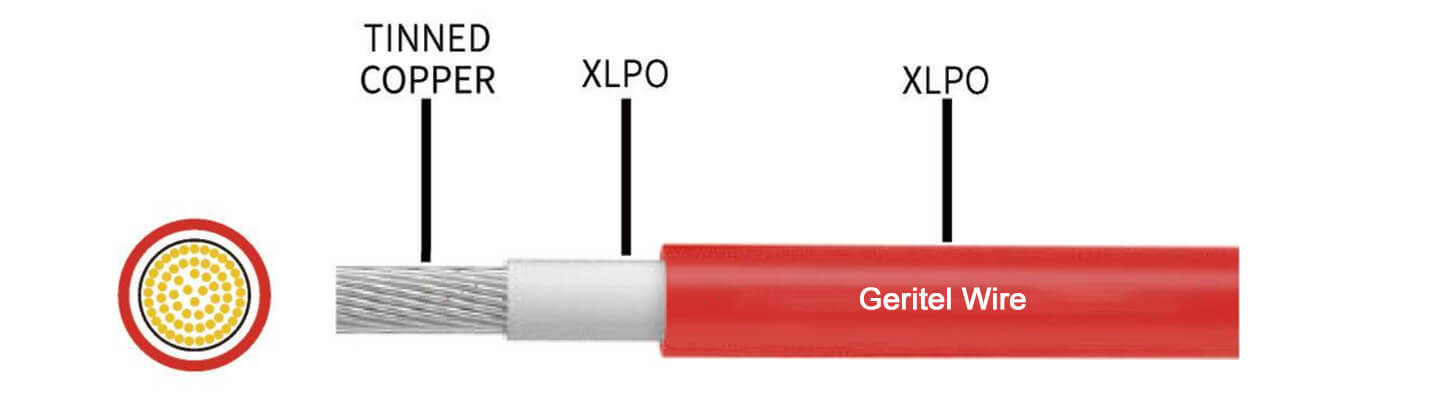
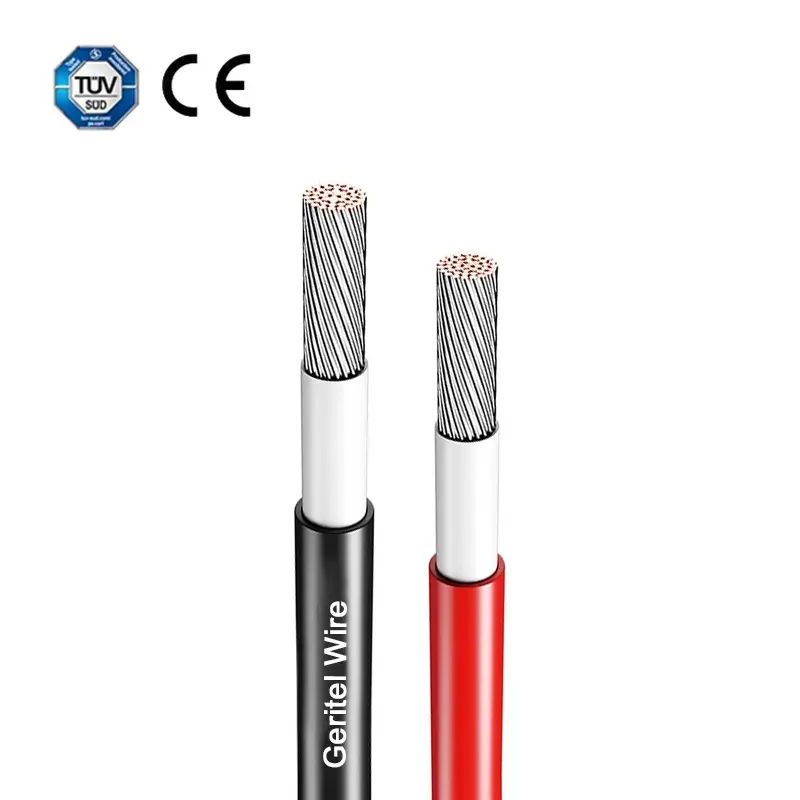
For string cabling, the outdoor exposure was non-negotiable. We specified H1Z2Z2-K solar cable with TUV certification, offering 1×6 mm² single-core, plus 2×4 mm² and 2×6 mm² twin-core configurations. The difference between H1Z2Z2-K and conventional PV1-F mattered significantly here. H1Z2Z2-K uses cross-linked polyolefin (XLPO) double-layer insulation with electron-beam crosslinking, rated for -40°C to +120°C. The sheath thickness runs about 30% heavier than standard. In desert UV conditions where ordinary cables typically show surface cracking within 3-5 years, H1Z2Z2-K maintains integrity across the 25-year design life.
From combiner boxes to inverters, we proposed a hybrid approach. Outdoor exposed sections kept H1Z2Z2-K in 4 mm² to 16 mm² cross-sections. Indoor tray sections shifted to H07V-K, 450/750V rated, still meeting IEC 60228 Class 5 flexibility but optimizing cost by roughly 15%. This balanced reliability where it mattered against budget discipline where environment permitted.
Battery interconnection involved a 30MW/60MWh storage system. Module-to-module links used H05V-K and H07V-K in 1×16 mm², 1×25 mm², and 1×35 mm², with flexible stranded conductors that simplified routing through cramped battery containers.
Control and auxiliary circuits employed H07V-U solid conductor cable for switchgear, lighting and SCADA—1×16 mm² and 1×25 mm² sizes with reliable crimping characteristics. Internal building wiring used H05VV-F flexible cable, 2-5 core 1.5-2.5 mm², for lighting and small equipment loads.
Certification Barriers and Final Approval
With technical configuration settled, the client's quality team raised the certification hurdle. Algeria, as a former French jurisdiction, applies EU-standard electrical product regulations. Sonelgaz mandates original third-party certification for all critical equipment.
Our H1Z2Z2-K solar cable carried TUV Rheinland certification to both EN 50618 and IEC 62930. The distinction matters: IEC 62930 establishes baseline performance for PV cables, while EN 50618 adds Construction Products Regulation (CPR) requirements including low-smoke zero-halogen (LSZH) behavior and EN 60332-1-2 flame retardancy. In Algeria, TUV certification signals that the product has survived the most aggressive third-party testing, allowing local regulators to accept compliance without redundant verification.
The client had received an alternative quote from a domestic supplier, roughly 8% lower, offering only factory test reports. Considering the 25-year warranty exposure and irreversible damage risk in desert conditions, they selected our certified product. This decision validated during factory inspection—when the client randomly sampled and sent to Algeria's national laboratory, our cable exceeded standard tolerances on conductor resistance, insulation thickness and flame performance.
Volume Delivery and Logistics Execution
The purchase order arrived mid-April. Total requirement exceeded 850,000 meters of cable, equivalent to 12 standard containers—our single largest North African order. Production scheduled in three tranches.
First tranche: H1Z2Z2-K solar cable, 150,000 meters, committed for 25-day production, inspection and stuffing. Then the site foundation work accelerated, and the client requested urgent increase to 180,000 meters. We activated contingency capacity, leveraging VMI arrangements with tinned copper rod and XLPO insulation suppliers to secure feedstock within one week. Delivered on schedule.
Second tranche: H07V-K/H05V-K power cable, 380,000 meters, produced in rolling batches aligned with inverter delivery schedules. We used "rolling WIP" methodology—advance conductor stranding, final insulation and testing only after client confirmed specific shipping sequences. This compressed standard 30-day lead time to 18 days.
Third tranche: Control cables and accessories, 50,000 meters, co-shipped with first tranche to ensure complete kit availability for early construction.
Logistics presented genuine challenges. Algerian port clearance involves complex documentation. We prepared certificate of origin, original TUV certification, packing lists and commercial invoices with embassy legalization. All cable shipped on export-grade wooden drums, ISPM15-compliant after fumigation. Against high-temperature, high-humidity sea transit, we loaded humidity indicators and desiccant in each container to protect insulation integrity.
Late May, first cargo arrived Algiers port. Client site inspection focused on visual condition and dimensional verification—all contract-compliant. Full delivery cycle completed 12 days ahead of contract, recovering precious construction window.
Field Technical Support and Problem Resolution
June brought intensive cable installation. We embedded two engineers for two weeks to resolve field technical issues.
First challenge: Bend radius control. Desert diurnal temperature swings stiffened cable overnight. Installation crews, chasing schedule, had forced bends risking internal insulation micro-cracking. We trained crews on H1Z2Z2-K minimum bend radius at 4× outer diameter, supplying dedicated bending guides.
Second issue: Color coding management. Mixed DC polarity, grounding and communication lines had generated wiring errors causing string short-circuits. We urgently coordinated 5,000 meters of red-sheath H1Z2Z2-K for dedicated positive polarity identification against standard black, with subsequent batches produced to client color ratios.
Third situation: Emergency add-on order. Early July, field measurement revealed original string length miscalculations requiring additional 50,000 meters H1Z2Z2-K 1×6 mm². Sea freight couldn't meet construction timeline. We activated air freight—nine days from order to Algiers arrival, tripling logistics cost but preventing racking installation standstill. The project manager later cited this response as demonstrating supply chain resilience.
Project Outcomes and Operating Data
December 2024, Biskra 220MW plant passed pre-commissioning acceptance by Algeria's power grid operator, securing operation and grid-connection permit—first among 20 program segments with full capacity commissioning readiness. National television covered the grid preparation.
Operating data through early 2025 shows annual generation exceeding 400 GWh, supplying roughly 200,000 households and abating approximately 330,000 tons CO₂ annually. Our cable system survived 2024 summer temperatures above 50°C and multiple sandstorms. DC side line losses hold at 1.2%, below 1.5% design expectation.
Actual delivery summary:
For the H1Z2Z2-K solar cable specifically, we delivered 180,000 meters of the 1×4 mm² single-core configuration for standard string connections, alongside 150,000 meters of the heavier 1×6 mm² single-core variant for longer string runs where voltage drop considerations demanded larger conductor cross-section, complemented by 55,000 meters of 2×4 mm² twin-core cable serving duplex string applications and 35,000 meters of 2×6 mm² twin-core for high-current duplex configurations, bringing the H1Z2Z2-K total to 420,000 meters.
The H07V-K power cable segment encompassed 45,000 meters of 1×4 mm² for low-current DC distribution, 60,000 meters of 1×6 mm² serving medium-capacity combiner box feeds, 85,000 meters of 1×10 mm² handling intermediate load segments, and 95,000 meters of 1×16 mm² for primary DC feeder routes to inverter stations, while the H05V-K heavy-duty range comprised 55,000 meters of 1×25 mm² for battery module interconnects and 40,000 meters of 1×35 mm² for main battery cluster terminations, collectively totaling 380,000 meters of power cable across both insulation classes.
Control infrastructure utilized 20,000 meters of H07V-U 1×16 mm² solid conductor cable for switchgear and relay panels plus 15,000 meters of 1×25 mm² for main control room distribution, while auxiliary building services required 8,000 meters of H05VV-F 3×1.5 mm² flexible cable for general lighting circuits, 4,500 meters of 3×2.5 mm² for small equipment loads, and 2,500 meters of 5×1.5 mm² multi-core for integrated power and control applications.
Grand total: 850,000 meters delivered across fourteen distinct specifications.
Total cable delivered: 850,000 meters.
Client Feedback and Long-term Value
Post-completion, the client's procurement director assessed our performance as the "fastest response, most complete certification documentation, highest site cooperation" among their cable suppliers. More significantly, the collaboration shifted their bias toward domestic premium cable—previously they defaulted to European brands, but equivalent TUV certification with superior delivery velocity changed that calculus.
Technically, the project validated H1Z2Z2-K reliability in extreme desert conditions. Against PV1-F, the double-layer insulation and 1500V DC rating make H1Z2Z2-K irreplaceable for large ground-mount plants. The 15-20% price premium translates to demonstrably lower levelized cost of energy (LCOE) through 25-year maintenance-free service. Client calculations show certified cable reducing lifecycle O&M costs roughly 8%.
Our pre-cutting service, color coding management and site technical support created measurable value. Pre-cutting reduced field cutting waste approximately 7%. Color coding dropped wiring error rates from 3% initially to 0.2%. Embedded technical support improved installation efficiency roughly 20%—significant benefits in EPC projects with tight schedules.
Closing
The Biskra 220MW delivery marks our milestone in North African new energy markets. From Sahara sun to switchgear terminations, every meter of cable carries quality commitment.
If your team is developing large-scale solar or storage projects, facing cable selection, certification compliance or urgent delivery requirements, we welcome contact. We provide full-cycle technical support from conductor sizing, routing optimization through installation guidance, ensuring efficient project execution and long-term reliable operation.
Contact Us
Dongguan GERITEL Electrical Co., Ltd.
Tel/WhatsApp/WeChat: +86 135 1078 4550 / +86 136 6257 9592
Email: manager01@greaterwire.com
 Algeria Noor Solar Power Project



 Building 2, No. 40 Luxi 2nd Road, Liaobu Town, Dongguan City, Guangdong Province, China