


 Home
HomeFiji Taveuni Mua Solar Farm Project
 GERITEL
 Apr 09,2026

In Naselsele village on Taveuni—Fiji's "Garden Island"—the first rays of morning sun no longer serve merely as signals to awaken the coconut groves. In early 2024, as the final photovoltaic panel completed its commissioning in the morning mist, this village surrounded by azure waters officially bid farewell to its 18-year companion: an aging diesel generator that had a habit of breaking down in the dead of night, forcing children's homework to rely on the flickering company of candlelight.
This was the Mua Solar Farm Project, a critical milestone in Fiji's march toward 100% renewable energy by 2030. As the cable supplier for this 1.55MW photovoltaic system, we witnessed how the scorching South Pacific sunshine was transformed into stable electric currents illuminating over 300 households.
Project Profile: A New Energy Benchmark in the Southern Hemisphere
• Project Location: Republic of Fiji, Taveuni Island (third largest island), Naselsele village
• Project Type: Ground-mounted centralized solar photovoltaic plant (grid-connected)
• Installed Capacity: 1.55MW PV + energy storage system
• Commissioning Date: Completed early 2024, officially operational January 2025
• Investment Scale: FJD 6.8 million (approximately USD 2.9 million)
• Funding Partners: Korea International Cooperation Agency (KOICA) and Fiji Government
• Energy Contribution: Enabled Taveuni Island to achieve 100% renewable energy supply, becoming the first "clean energy island" among Fiji's 330 islands
The Late-Night Client Call: Cable Challenges in a Tropical Paradise
The story began one rainy night in 2023. The project lead painted an anxious picture: the previous cable shipment had suffered container seal failure during transit, and by the time it reached Suva Port, some cable jackets were already showing mold spots. More troubling, local electricians discovered severe oxidation in the copper conductors, causing contact resistance to spike in the humid environment and leading to frequent overheating at inverter terminals.
"We don't just need cables," the project engineer wrote in his email. "We need electrical blood vessels that can work reliably for 25 years under attack from salt spray, UV radiation, and rain cycles. Every meter must have SAA certification—that's a hard requirement from Energy Fiji Limited."
This is the classic trouble of Pacific island renewable energy projects: extreme maritime climate (off-the-charts UV index, salt spray corrosion, 90%+ humidity), complex logistics chains (remote island transport), stringent certification thresholds (AS/NZS standards), and tight construction schedules (must achieve grid connection before the 2024 dry season).
Cable Selection Decoded: Why We Chose These Five "Tropical Warriors"
After three rounds of technical clarification meetings and site survey data reviews, we customized a five-tier cable protection system for Mua Solar Farm. This wasn't simply a collection of model numbers, but a precise transfusion solution targeting different "organs" of the photovoltaic system:
1. Orange Circular Cable — The Main Distribution "Artery"
• Deployed Specifications: 95mm², 50mm², 35mm² multi-specification combination
• Battlefield Positioning: PV array combiner boxes to main inverters, inverters to low-voltage distribution boards
• Tropical Survival Skills: AS/NZS 5000.1 standard V-90 grade PVC insulation, temperature range -15°C to +90°C. The orange outer sheath incorporates UV stabilizers, offering 3x better anti-aging performance than ordinary cables under Taveuni's 3,000 annual sunshine hours. Annealed soft copper conductors ensure flexibility during high-current transmission.
Why did the client choose this over standard power cables? Ordinary PVC cables develop sheath chalking and cracking within 3-5 years under tropical UV exposure. Orange Circular Cable compliant with AS/NZS 5000.1 must pass 720-hour xenon arc aging tests, with a design life directly matching the 25-year lifecycle of photovoltaic panels.
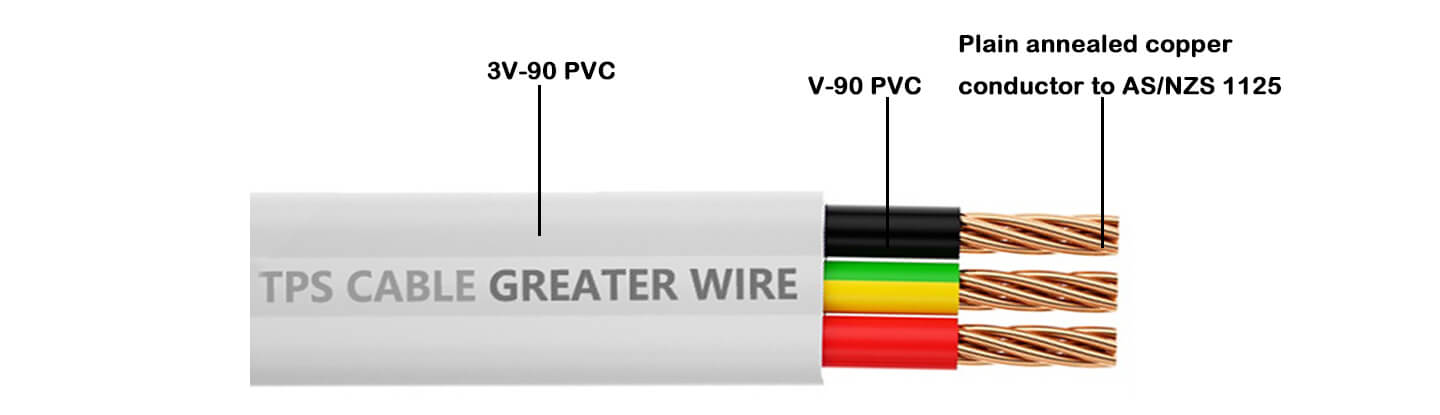
2. TPS Cable — The Control Circuit "Neural Network"
• Key Specifications: 4mm² TPS Cable (mandatory highlight), 2.5mm², 6mm²
• Battlefield Positioning: Inverter control cabinet internal wiring, low-voltage branch circuits, data acquisition systems
• Flexibility Winning Formula: Flat structural design (Twin + Earth configuration) allows it to maneuver gracefully in cramped distribution boxes. We specifically provided 4mm² TPS Cable for high-power branches, whose V-90 insulation layer maintains excellent electrical performance at continuous operating temperatures of 90°C—perfectly matching the high-temperature conditions of inverter rooms.
Differentiated Value vs. Circular Cables: In Taveuni's humid control rooms, TPS Cable's PVC outer sheath features low moisture absorption, while the flat structure saves 40% wiring space compared to circular cables—significantly boosting the installation efficiency of Fijian local electricians, which translates to real money in time-sensitive projects.
3. SWA Cable — The Outdoor Installation "Armored Vehicle"
• Deployed Specifications: 25mm², 16mm² four-core armored
• Battlefield Positioning: Inter-array DC trunk lines, underground crossing sections from inverters to distribution boxes
• Mechanical Defense System: Double-layer galvanized steel tape armoring + PVC outer sheath, with compressive strength of 2000N/cm. Under Taveuni's rocky volcanic soil conditions, direct burial installation requires no additional conduit protection, saving approximately FJD 8,000 per kilometer in piping materials and construction costs.
Client's Core Consideration: Local construction crews lacked precision excavation equipment. SWA Cable's "hard resistance" capability allowed direct burial in certain sections—even when encountering volcanic rock friction or accidental agricultural machinery compaction, the steel tape layer ensures the insulation remains intact.
4. Fire Rated Cable — The Lifeline "Firewall"
• Deployed Specifications: 1.5mm², 2.5mm² multi-core fire-resistant cables
• Battlefield Positioning: Main control room, distribution room, fire emergency circuits
• Flame-Retardant Black Technology: Compliant with AS/NZS 5000.1 flame retardant grade, maintaining power supply for 90 minutes at 750°C without melting. For Fiji, where wooden structures dominate, should a fire break out in the inverter room, fire-rated cables ensure emergency shutdown systems and fire pumps continue operating.
Safety Redundancy Design: Although photovoltaic system fire probability is low, considering that Taveuni Island's fire brigade requires 2 hours to arrive from the main island, any fire protection investment is worthwhile. Fire Rated Cable's ceramic-forming silicone rubber insulation layer creates a hard protective shell after combustion—something ordinary PVC cables cannot match.
5. Earthing Cable — The Safety System "Lightning Rod"
• Deployed Specifications: 35mm², 16mm² yellow-green dual-color dedicated grounding lines
• Battlefield Positioning: Site-wide grounding network, inverter chassis grounding, support structure lightning protection
• Low Impedance Promise: High-conductivity annealed copper with conductor resistance strictly following AS/NZS 1125 standards at 20°C. Under Taveuni's environment of over 120 thunderstorm days annually, reliable grounding systems are the first line of defense protecting millions of dollars worth of photovoltaic equipment.
The Certification Moat: How SAA Certification Became Our "Passport"
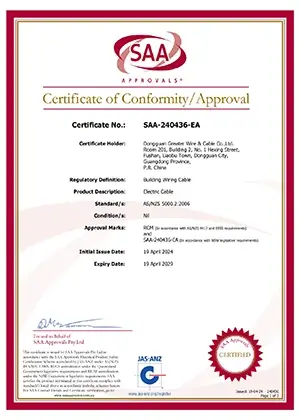
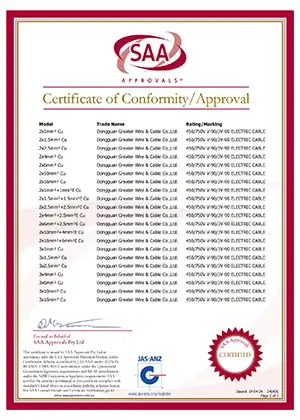
Throughout the bidding process, our SAA certification system played a decisive role. This wasn't merely a certificate, but a golden key opening markets in Australia, New Zealand, and the Pacific Islands:
AS/NZS Standards Compliance: All cables passed Standards Australia certification, compliant with AS/NZS 5000.1 (XLPE insulated power cables), AS/NZS 5000.2 (TPS cables), AS/NZS 3191 (flexible cords), and other core standards. In Fiji, SAA certification is a mandatory requirement under electrical safety regulations—without it, cables cannot even clear customs.
Differentiated Advantage Over IEC Standards:
While IEC standards are the international common language, AS/NZS standards have more stringent testing clauses for the special environments of Australia, New Zealand, and the South Pacific (high UV, high salt spray, extreme temperature cycling). When applying for SAA certification, our cables additionally passed 720-hour UV accelerated aging tests and salt spray corrosion tests—precisely the "proof of survival" the Taveuni project required.
Certification Traceability:
Every cable drum carries a unique SAA certification number, verifiable directly on the Standards Australia website. This transparency saved Fijian power company acceptance engineers significant time during goods inspection.
Three Core Advantages: Why Choose GERITEL?
Beyond the SAA certification "trump card," we stood out in the bidding process with two additional key strengths:
Advantage Two: The "Experience Map" of Pacific Island Projects
This wasn't our first supply to South Pacific island nations. We had previously completed the Samoa Independent State Government Building Photovoltaic Project, the Vanuatu Port Vila Energy Storage Station, and similar projects—familiar with the "pits" and "bridges" of island logistics: knowing how to arrange moisture-proof container transfers at Suva Port, understanding Fiji customs inspection procedures for SAA markings, even anticipating how rainy season construction windows affect delivery schedules. This "been there, done that" experience ensured the client wouldn't become a "guinea pig."
Advantage Three: "72-Hour Response" Agile Delivery
From contract signing to first cable arrival in Taveuni, we took just 28 days—40% shorter than the industry average. This stems from our intelligent warehousing system in Dongguan and strategic partnership with China Southern Airlines Cargo. When the client discovered during construction they needed an additional 500 meters of 4mm² TPS Cable for control cabinet modifications, our air freight专线 completed delivery from Dongguan to Suva within 72 hours, ensuring the project didn't stop for material shortages.
Delivery Execution: When Made in China Met Fiji Time
In August 2023, the first containers set sail from Dongguan's Humen Port. We employed a "triple protection" packaging solution: inner PE film vacuum sealing for moisture protection, middle wooden pallet reinforcement, outer container placement of desiccants and humidity data loggers. Addressing the reality that Taveuni Island lacks deep-water ports, we coordinated with freight forwarders to complete distribution at Suva Port, then transfer to small barges for the final 120 nautical miles.
Our on-site technical support team traveled with the goods, stationed in Naselsele village for two weeks, assisting Fijian local electricians with cable termination training. Particularly for SWA Cable steel tape stripping techniques, we brought specialized tool kits, preventing armor layer loosening caused by improper construction.
Results & Acceptance: Smiles Under the Sun
On January 24, 2025, Fijian Prime Minister Sitiveni Rabuka personally attended the commissioning ceremony. When he declared "this is an important step in Fiji's journey toward a clean energy future," our cables were working silently one meter underground, in inverter rooms, and in distribution cabinets—transmitting electric current.
Project operational data shows:
• System availability: 99.2% (far exceeding the contractual requirement of 98%)
• Zero cable circuit failures (6-month post-commissioning data)
• Voltage drop controlled within 1.8% (design standard <3%)
Naselsele village headman Sekaraia Koroirua反馈 that villagers can now confidently purchase electric ovens and refrigerators—"this is a brand new beginning." For us, the greatest recognition came from the project EPC's follow-up orders—they listed us in their "preferred supplier catalog" for Pacific island projects over the next three years.
Partnership Value: Beyond Transactional Relationships
The true value of this project lies in proving the critical role of professional cable suppliers in the renewable energy ecosystem. We don't just sell wires; we provide:
• Technical Consulting: Helping clients navigate the AS/NZS standards maze to find optimal paths
• Risk Management: Using systematic packaging, logistics, and certification solutions to mitigate tropical transport risks
• On-Site Empowerment: Enabling local construction teams to master proper cable handling techniques
When the client said "you understand Pacific island pain points better than Australian suppliers," we knew this was the best annotation of Chinese manufacturing's transformation and upgrading.
Final Words: Your Next Project Deserves the Same Professional Treatment
From Taveuni's coconut groves to Samoa's coral coasts, from Vanuatu's volcanoes to Kiribati's atolls, the Pacific island nations' energy transition is accelerating. Every solar farm, every energy storage station, needs cable systems that can stand the test of time.
If your next project is located in high salt spray, high UV, high humidity harsh environments; if you need reliable cables compliant with AS/NZS standards and SAA certified; if you want a supplier who understands not just products, but Pacific island logistics and construction realities—Dongguan GERITEL Electrical Co., Ltd. is ready to replicate Taveuni's success.
Contact Us Safeguard Your Renewable Energy Project:
Dongguan GERITEL Electrical Co., Ltd.
Tel/WhatsApp/WeChat: +86 135 1078 4550 / +86 136 6257 9592
Email: manager01@greaterwire.com
 Fiji Suva & Lautoka Cold Chain Fish Processing Facility Upgrade



 Building 2, No. 40 Luxi 2nd Road, Liaobu Town, Dongguan City, Guangdong Province, China