


 Home
HomeEthiopia Metehara Solar PV Project (100MW)
 GERITEL
 Apr 13,2026

In early 2023, a transformative energy initiative took shape in the arid plains of Metehara, Oromia Region, Ethiopia. The Metehara Solar PV Project, with its ambitious 100MWac nameplate capacity, represented not merely an infrastructure investment but a strategic pivot in Ethiopia's national energy matrix. Developed under the World Bank's Scaling Solar program and positioned as one of East Africa's largest photovoltaic installations, this project commanded the attention of global EPC contractors and component suppliers alike.
For Dongguan GERITEL Electrical Co., Ltd., the inquiry that arrived that spring was both an opportunity and a rigorous examination. The project site—situated approximately 200 kilometers southeast of Addis Ababa along the Djibouti corridor—presents one of the most challenging operational environments on the continent. With elevations near 900 meters, surface temperatures regularly exceeding 70°C, and intense UV radiation amplified by the region's proximity to the equator, every cable specification decision carried implications for 25-year operational reliability.
The client's initial requirement seemed straightforward: a comprehensive cable solution spanning photovoltaic DC circuits, battery energy storage systems, inverter outputs, medium-voltage grid connection, and control communications. Yet our technical consultations rapidly revealed that the real challenges extended far beyond product selection. This was a project where cable performance would directly impact national grid stability, and where procurement decisions would be scrutinized by international financiers and Ethiopian Electric Power (EEP) engineers alike.
The Five Critical Pain Points in Utility-Scale Solar Procurement
Through extended technical exchanges with the project's EPC consortium, we systematically identified the core anxieties driving their cable sourcing strategy:
Pain Point One: The Certification Labyrinth
Ethiopia maintains stringent IEC standard compliance requirements for all imported electrical infrastructure. The project's tender documentation explicitly mandated IEC 62930 certification for photovoltaic cables, EN 50618 compliance for European-standard alignment, and third-party validation from TÜV Rheinland or TÜV SÜD. The client had encountered multiple suppliers whose certification portfolios were either incomplete or featured accreditation bodies not recognized by the project's lenders. This created a paralysis in technical qualification—bids were being rejected not on price, but on documentation deficiencies.
Pain Point Two: Environmental Degradation Anxiety
The Metehara site falls within a semi-arid climatic zone characterized by extreme thermal cycling, abrasive dust storms, and intense solar irradiance. The client's engineering team harbored specific concerns about standard PVC-sheathed cables: Would UV exposure trigger premature jacket embrittlement? Could conductor oxidation accelerate under thermal stress? A cautionary tale from a neighboring 50MW installation—where cable failures within 24 months necessitated $800,000 in emergency replacements—loomed large in their risk assessment.
Pain Point Three: Multi-Specification Coordination and Delivery Velocity
With five distinct electrical subsystems requiring cable specifications ranging from 1×4mm² to 3×240mm², the client faced a logistical conundrum. Dispersed procurement risked electrical characteristic inconsistencies between batches, while single-source dependency raised concerns about manufacturing capacity constraints. The project's financial drawdown schedule was tightly coupled to construction milestones; any cable delivery delay would cascade into liquidity complications with development financiers.
Pain Point Four: Installation Capability Gaps
Local contracting capacity in Ethiopia, while growing, presents variable technical proficiency. The client had previously experienced field failures attributable to improper cable bending radii, inadequate conductor preparation, and suboptimal termination techniques. They required a supplier capable of transferring technical knowledge to installation crews with limited exposure to utility-scale solar standards.
Pain Point Five: Total Lifecycle Cost Optimization
Although initial capital expenditure was adequately provisioned, the client's asset management team focused intensively on operational expenditure projections. They sought cable systems with demonstrated 25-year service life—matching photovoltaic module degradation curves—to avoid the catastrophic expense of mid-life cable replacement requiring structural disassembly and module disturbance.
GERITEL's Three-Dimensional Solution Architecture
Rather than submitting a conventional quotation, our engineering team invested two weeks in reconstructing the solution from material science, system architecture, and service infrastructure perspectives.
Material Engineering: Armor for the African Sun
For the photovoltaic DC circuits, we specified H1Z2Z2-K 1×4mm² and H1Z2Z2-K 1×6mm² solar cables in lieu of the client's preliminary RV-cable consideration. These IEC 62930-compliant conductors feature Class 5 tinned copper strands with cross-linked polyolefin (XLPO) insulation and halogen-free flame-retardant sheathing. The critical differentiator lies in thermal performance: whereas conventional cables degrade rapidly above 90°C, our H1Z2Z2-K construction maintains mechanical integrity at 120°C continuous operation, with TÜV-certified UV resistance exceeding 7,200 hours of xenon arc exposure. For inter-module string connections, we deployed H1Z2Z2-K 2×4mm² twin-core flat cables, reducing field joint quantities by approximately 30% and correspondingly lowering connection resistance failure probabilities.
The battery energy storage system integration demanded H07V-K 1×35mm² through 1×95mm² flexible single-core cables. Recognizing the thermal cycling stresses inherent in battery charge/discharge operations, we specified Class 5 high-flexibility conductors with bending cycle ratings exceeding 100,000 operations—far surpassing the 3,000-cycle threshold of standard fixed-installation cables. Insulation materials were specifically tested for electrolyte corrosion resistance, ensuring sustained dielectric performance even in the event of minor battery enclosure leakage.
At the inverter output stage, we upgraded the client's original VV-cable specification to YJV 3×120mm² and YJV 3×240mm² cross-linked polyethylene insulated power cables. The YJV construction's 90°C continuous operating temperature and 250°C short-circuit tolerance translate to approximately 25% higher current-carrying capacity than equivalently dimensioned VV cables. In Metehara's thermal environment, this permitted optimized conductor sizing—reducing both procurement expenditure and cable tray occupancy.
Medium-Voltage Grid Connection: The Critical Role of MV Cable 1×240mm²
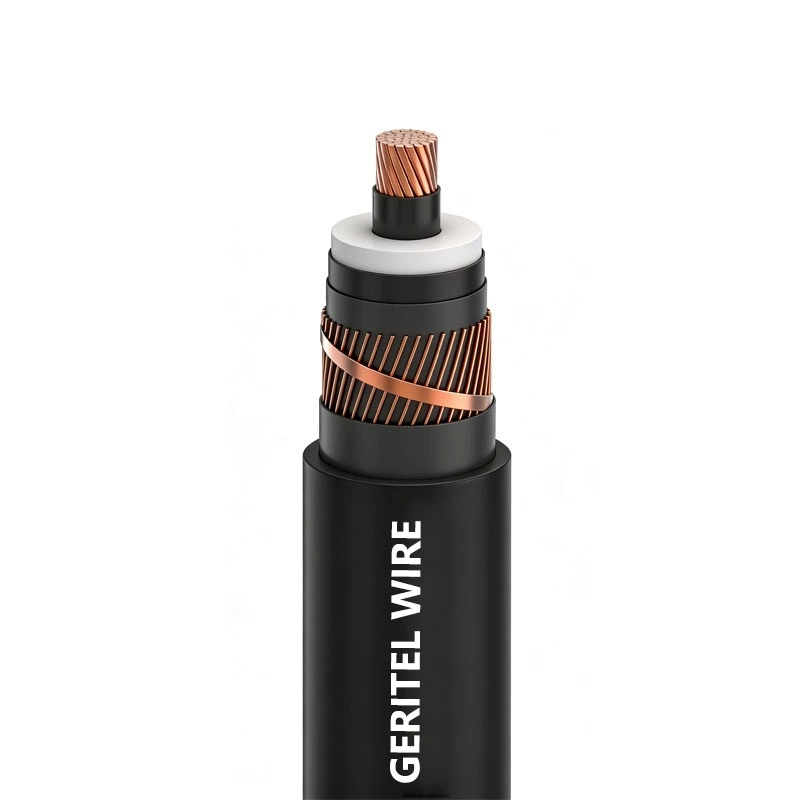
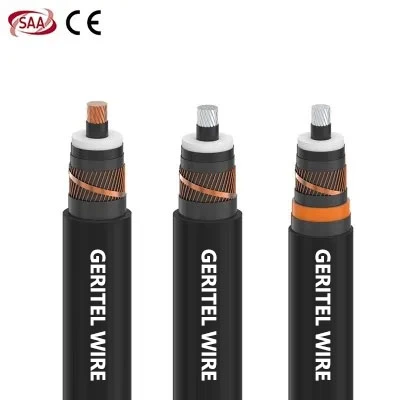
The project's most technically consequential specification involved the 33kV medium-voltage collection system. Here, our engineering analysis determined that MV cable 1×240mm² and MV cable 1×400mm² single-core XLPE-insulated designs would provide optimal technical-economic performance.
The selection of MV cable 1×240mm² for primary collection circuits was validated through rigorous ampacity modeling: under Metehara's 45°C ambient temperature conditions, with soil thermal resistivity of 1.0 K·m/W, this conductor size delivers 420A continuous current capacity—precisely matching the rated output of 33kV/1250kVA collection transformers while preserving 15% operational headroom for solar irradiance variability. Compared to overhead line alternatives, the underground MV cable 1×240mm² configuration eliminates lightning strike vulnerability, salt spray corrosion, and ongoing vegetation management requirements.
Our MV cable 1×240mm² implementation incorporates copper wire screen plus corrugated copper tape dual-layer shielding, with lead-free aluminum sheath moisture barriers. The insulation system utilizes super-clean XLPE with impurity content controlled below 50ppm, achieving 91kV/5min power-frequency withstand testing margins substantially exceeding IEC 60502-2 requirements.
For the control and SCADA communication infrastructure, we supplied KVVP multi-core shielded control cables in configurations from 4-core to 24-core. The aluminum-polyester composite tape plus tinned copper braid double-shielding construction achieves 50Ω/km transfer impedance, ensuring signal integrity in environments with high-frequency inverter switching interference.
Service Infrastructure: Beyond Product Delivery
We established a dedicated Project Manager + Technical Engineer + Quality Inspector task force, maintaining continuous engagement from contract execution through commercial operation date. Recognizing the specific challenges of African project execution, we developed bilingual English/Arabic installation manuals and produced video tutorials covering critical procedures: ferrule crimping techniques, minimum bending radius compliance, and IP67-rated connector sealing protocols. Prior to vessel loading, we facilitated Pre-Shipment Inspection (PSI) by the client's appointed third-party surveyor, with 100% batch testing of conductor DC resistance, insulation thickness, and sheath mechanical properties—non-conforming units were immediately segregated for rework.
GERITEL's Differentiating Value Propositions
The client's ultimate selection of GERITEL Electrical over four competing suppliers rested upon three distinctive capabilities:
Proposition One: Comprehensive IEC Certification Portfolio
Our photovoltaic cable systems hold active TÜV Rheinland IEC 62930:2017 type-approval certification, while our power cables maintain TÜV SÜD IEC 60502-2 compliance and control cables conform to IEC 60502-1 specifications. All certifications are publicly verifiable through TÜV's online database, with quarterly surveillance audits ensuring production consistency with type-tested samples. For Ethiopia's certification-intensive procurement environment, this effectively provided the client with a "technical qualification guarantee"—eliminating the documentation risks that had previously stalled their vendor selection.
Proposition Two: Agile Manufacturing and Compressed Delivery Cycles
Leveraging our Dongguan smart manufacturing facility's MES-integrated production lines, we achieved modular pre-production of standard semi-finished conductors. Upon order confirmation, final extrusion and testing processes were executed with minimal latency. For Metehara's requirement of 37 distinct specifications totaling 280+ kilometers, we delivered complete shipment within 45 days of advance payment receipt—approximately 40% faster than industry-standard lead times for comparable specification diversity. This velocity directly supported the client's construction schedule adherence and financial milestone compliance.
Proposition Three: African Market Deep Competence
This engagement represented neither our first nor our most complex African solar project. Our portfolio includes cable supply for Kenya's Garissa 50MW Solar Plant and Tanzania's Dodoma Distributed PV Program, providing accumulated empirical data on high-temperature, high-UV environment performance. Our logistics team maintains established relationships with Ethiopian customs authorities, facilitating ESA certification and Pre-Shipment Inspection (PSI) documentation to prevent demurrage risks at Djibouti port-of-entry.
Execution Excellence: From Factory Floor to Desert Installation
May 2023 marked the commencement of physical delivery. We orchestrated a multimodal sea-road transportation chain: Dongguan port departure, Singapore transshipment, Djibouti port arrival, and final road haulage to Metehara site—achieving 28-day total transit time from ex-works to site delivery.
Each cable drum received stainless steel identification tags encoding specification, batch number, length, and QR-linked factory test reports—enabling site personnel to access certification documentation via mobile scanning. Packaging employed moisture-resistant wooden drums + polyethylene film wrapping + desiccant inclusion to prevent conductor oxidation during the humid monsoon season transit period.
Upon arrival, our technical engineer deployed to Addis Ababa for three days of on-site training, focusing particularly on cold-shrink termination techniques for MV cable 1×240mm² and 33kV withstand voltage testing protocols. This knowledge transfer directly addressed the installation capability gaps that had previously concerned the client's project management team.
Operational Validation: Illuminating Oromia
March 2024 witnessed the successful completion of 72-hour full-load commissioning trials, with formal synchronization to the Ethiopian national grid. The facility now generates approximately 198 GWh annually—supplying clean electricity to 400,000 residents and avoiding 120,000 tonnes of CO₂ emissions per year.
Our post-commissioning technical audit revealed performance metrics validating specification decisions: YJV 3×240mm² cables in inverter compartments maintained conductor operating temperatures below 75°C—well within 90°C insulation limits—even during peak summer irradiance conditions. MV cable 1×240mm² circuits recorded zero fault incidents within the initial six-month operational period, with partial discharge measurements consistently below 3pC—equivalent to new-manufacture baseline values.
A particularly noteworthy validation occurred during a routine night inspection, when an accidental combiner box short-circuit triggered the H1Z2Z2-K cable's self-extinguishing, low-smoke, zero-halogen safety features. The cable charred but did not propagate flame, and toxic gas emission remained negligible—preventing personnel injury and secondary equipment damage. This "safety margin" performance, not explicitly quantified in initial technical specifications, subsequently became a decisive factor in the client's specification of GERITEL cables for their Awash Wind Farm expansion procurement.
Partnership Value: Transcending Transactional Supply
The Metehara engagement has evolved into a strategic supplier relationship spanning the client's East African renewable energy portfolio. We have been designated as preferred cable vendor for their Ethiopian, Kenyan, and Tanzanian solar development pipeline, with active participation invited for the Gad II (125MW) and Weranso (100MW) tender processes currently under Ethiopian PPP Directorate evaluation.
For GERITEL Electrical, this project delivered more than revenue contribution—it provided market-validated proof-of-concept for our "full-spectrum specification + extreme environment optimization + lifecycle service" business model in emerging markets. The technical documentation, performance data, and installation methodologies developed for Metehara now constitute our reference architecture for comparable climatic zone projects across the Middle East, North Africa, and Central Asia.
Conclusion: Engineering Reliability into Every Conductor
In the Ethiopian highlands, where H1Z2Z2-K photovoltaic cables now interconnect gleaming module arrays, where MV cable 1×240mm² silently transmits megawatts across the desert floor, and where KVVP control lines orchestrate seamless grid integration, the physical infrastructure represents only the visible dimension of project success. The underlying reality is a systematic engineering approach that transformed client anxiety into operational confidence—through specification rigor, manufacturing precision, and unwavering technical commitment.
Dongguan GERITEL Electrical Co., Ltd. has specialized in mission-critical cable solutions for over a decade. We understand that in a 25-year photovoltaic asset life, cables represent a minor capital cost component—but their failure modes can compromise entire system economics. We do not compete on price minimization; we compete on "performance certainty when it matters most."
If your next renewable energy project requires:
• IEC 62930/EN 50618/TÜV-certified cable systems with full documentation traceability
• 4mm² to 400mm² specification coverage from single-source supply
• 45-day delivery commitment with African market logistics expertise
• Field-proven extreme environment performance in high-temperature, high-UV conditions
Contact our project engineering team today:
Tel/WhatsApp/WeChat: +86 135 1078 4550 / +86 136 6257 9592
Email: manager01@greaterwire.com
Company: Dongguan GERITEL Electrical Co., Ltd.
Let us engineer the reliable power pathway your project demands.
 Oyem Solar Power Station in Gabon: 50MW Solar PV Project Cable Design & Electrical Configuration (2023–2024)



 Building 2, No. 40 Luxi 2nd Road, Liaobu Town, Dongguan City, Guangdong Province, China