


 Home
HomeEnergy-Saving Advantages of THHN/THWN-2 Cables in Green Buildings
 GERITEL
 Mar 26,2026

In modern green building projects, energy efficiency is no longer limited to equipment selection or insulation design, but extends to every component that affects power consumption throughout the building lifecycle. Certification systems such as LEED and WELL place increasing emphasis on electrical efficiency, where even small transmission losses can accumulate into significant energy waste over time.
As the “artery” of power distribution, cables play a critical role in determining how efficiently electricity is delivered across different systems. For engineers, contractors, and procurement professionals, a key question arises: how can cable selection contribute to both energy savings and reliable performance across diverse installation environments?
In this context, THHN/THWN-2 cables for green buildings have become a preferred solution, as they combine stable conductivity, thermal resistance, and flexible application across multiple scenarios, making them highly suitable for energy-efficient electrical systems. Among these, THHN solid copper conductor wire stands out for its superior conductivity, laying a solid foundation for energy-saving performance.
1. Structural Foundation of Energy Efficiency
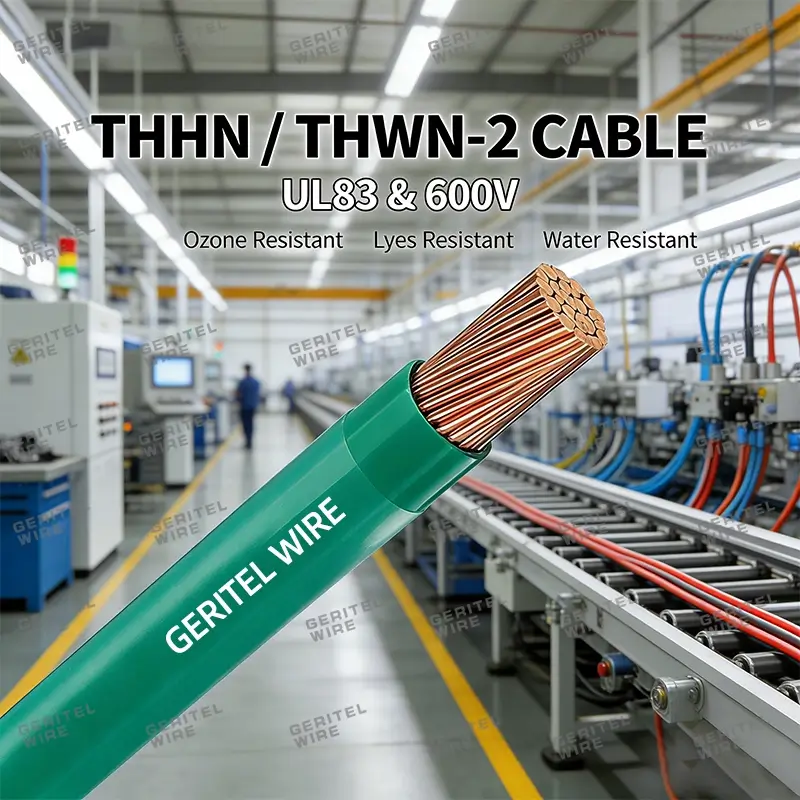
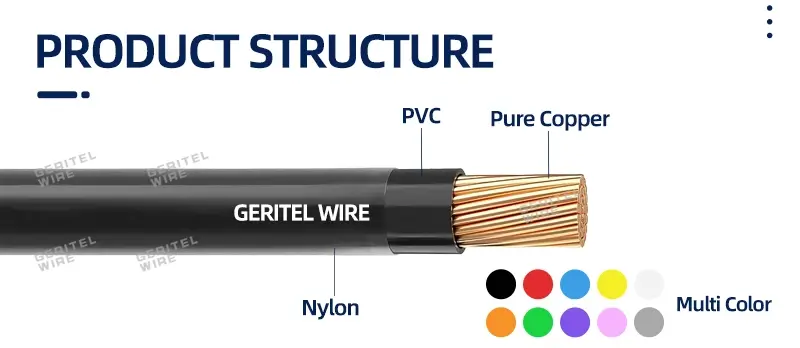
THHN/THWN-2 cables are constructed with high-conductivity copper conductors (ASTM B3/B8 compliant), combined with THWN-2 copper cable PVC insulationand a nylon outer jacket. This structure ensures stable current transmission while minimizing resistance-related losses.
Their compliance with UL 83 and UL 1063 standards guarantees safety and performance consistency, which forms the foundation for long-term energy-saving operation in green building electrical systems.
2. Parameter → Scenario → Energy-Saving Logic (Core Analysis)
2. 1 90°C Temperature Rating: Controlling Hidden Energy Loss
In green buildings, cables are often installed in environments where heat accumulation is unavoidable, such as electrical rooms, underground spaces, or areas with continuous equipment operation. When insulation degrades due to insufficient temperature resistance, conductor resistance increases, which directly leads to higher energy loss.
THWN-2 power cable 90C wet rated supports stable performance in both dry and wet environments at 90°C, allowing them to maintain stable electrical performance even under thermal stress. By preventing resistance increase caused by insulation aging, these cables help reduce continuous energy loss while extending service life, which aligns with the lifecycle energy-saving goals of green buildings.
2. 2 Multi-Size Conductor Selection: Matching Load to Efficiency
One of the most critical factors in THHN/THWN-2 cables energy saving performance is proper conductor sizing. Electrical energy loss follows the principle of I²R (current squared × resistance), which means that in higher-load systems, even small reductions in resistance can significantly reduce energy waste.
THHN/THWN-2 cables are available in a wide range of sizes, enabling precise matching between load requirements and energy efficiency:
- 14–12 AWG: Commonly used in lighting circuits and smart control systems, where loads are relatively low, and right-sizing avoids unnecessary material use while maintaining efficient operation
- 10–8 AWG: Suitable for general-purpose outlets and office equipment circuits, where moderate loads benefit from reduced current density and improved transmission efficiency
- 6–4 AWG: Applied in distribution branches for commercial equipment, including elevators and mechanical systems, where load fluctuations require stable and efficient power delivery
- 3–1/0 AWG: Ideal for larger systems such as HVAC units, ventilation systems, and pumps, where long operating hours make energy loss reduction particularly valuable
- 2/0–4/0 AWG and above: Used in main feeders and primary distribution lines, where optimizing conductor cross-section can significantly reduce total building energy consumption
When properly selected, THHN/THWN-2 cables can reduce transmission losses by approximately 5%–10%, which translates into substantial long-term energy savings in large-scale green building projects.
2. 3 Insulation and Jacket Performance: Reducing System Inefficiencies
Beyond conductor performance, insulation and sheath properties also influence overall energy efficiency.
The PVC insulation used in THHN/THWN-2 cables offers high dielectric strength, which helps prevent leakage currents and ensures stable energy transmission. Meanwhile, the nylon jacket provides a self-lubricating surface that reduces friction during installation, minimizing mechanical damage that could otherwise lead to hidden energy losses over time.
These features contribute to a more stable electrical system, where fewer faults and inefficiencies translate into better overall energy performance.
3. Application Boundaries: Ensuring Energy Efficiency in Practice
To fully achieve the benefits of energy-saving cables, correct application is essential.
- THHN cables are suitable for dry environments only, and using them in wet or humid areas may lead to insulation degradation and increased energy loss
- THWN-2 cables are designed for both dry and wet conditions, but they should not be used in environments exceeding 90°C or in highly corrosive conditions, as this may affect long-term efficiency and durability
Understanding these boundaries helps prevent performance degradation and ensures that energy-saving expectations are met in real-world installations.
4. Risks of Incorrect Cable Selection in Green Buildings
Incorrect cable selection can directly undermine the energy efficiency goals of a project and lead to avoidable operational costs.
For example, using THHN cables in damp environments such as underground parking areas or service rooms can accelerate insulation aging, increasing resistance and causing up to 10%–15% additional energy consumption annually.
Similarly, selecting undersized conductors for high-load systems increases current density, which significantly raises I²R losses, shortens cable lifespan, and increases maintenance frequency.
In addition, using non-compliant or non-UL certified cables can result in unstable electrical performance, higher energy losses, and potential risks to green building certification outcomes.
5. Conclusion: A Practical Path to Energy Efficiency
THHN/THWN-2 cables provide a reliable and efficient solution for green building electrical systems by combining low transmission loss, high thermal resistance, and flexible application across multiple load scenarios. Their ability to support long-term energy savings makes them an essential component in achieving sustainable building performance and improving certification outcomes.
If you are evaluating green building cable selection or need support in choosing the right THHN/THWN-2 cable specification for your project, we can provide customized recommendations based on your load requirements, installation environment, and energy efficiency targets.
Contact Dongguan GERITEL Electrical Co., Ltd. today
Tel/WhatsApp/WeChat: +86 135 1078 4550 / +86 136 6257 9592
Email: manager01@greaterwire.com
Get a free quote and professional consultation tailored to your project.
 What Is THHN Wire? Complete Guide for Electrical Contractors



 Building 2, No. 40 Luxi 2nd Road, Liaobu Town, Dongguan City, Guangdong Province, China