


 Home
HomeCongo Kinshasa National Conference Center Electrical Infrastructure Project (DRC)
 GERITEL
 Apr 13,2026

When the Democratic Republic of Congo embarked on one of its most ambitious public infrastructure initiatives—the complete electrical infrastructure upgrade for the Kinshasa National Conference Center—project stakeholders faced a complex web of challenges that threatened to derail timelines and compromise safety standards. This landmark project demanded not just cables, but a comprehensive power distribution solution capable of supporting a multi-functional facility designed to host international summits, parliamentary sessions, and large-scale diplomatic events.
The sheer scale of this undertaking was staggering: a facility requiring seamless power distribution across vast exhibition halls, state-of-the-art conference rooms, emergency backup systems, and extensive outdoor lighting networks. Each zone carried distinct electrical demands, from delicate instrumentation circuits to heavy-duty external power feeders capable of handling massive load fluctuations.
Understanding the Client's Core Challenges
Our engagement began when the client's engineering team reached out with a familiar story of frustration. Previous cable procurement experiences had left them grappling with three persistent pain points that jeopardized project success.
First, certification authenticity remained a constant concern. In large-scale African infrastructure projects, documentation gaps often surface during critical inspection phases, causing costly delays. The client specifically required cables bearing genuine IEC certification aligned with EN 50525 and IEC 60227 standards—not merely claimed compliance, but verifiable third-party validation that would satisfy both local regulators and international funding body requirements.
Second, delivery timelines presented acute pressure. With diplomatic events already scheduled and international dignitaries confirmed, any delay in electrical infrastructure completion would cascade into contractual penalties and reputational damage. The client needed a supplier capable of manufacturing and delivering substantial cable volumes within compressed windows while maintaining quality consistency across every batch.
Third, technical specification complexity demanded specialized expertise. The project required seamless integration between low-voltage internal wiring, medium-voltage distribution networks, and fire-resistant emergency circuits. Many suppliers could provide standard building wire or industrial power cables, but few possessed the integrated manufacturing capability to deliver the complete spectrum—from H07V-U single-core rigid conductors to medium-voltage armored feeders—under unified quality management.
Our Tailored Solution: Integrated Cable Architecture
Rather than treating this as a simple procurement transaction, we positioned ourselves as technical partners invested in project success. Our engineering team conducted detailed load analysis consultations, helping the client optimize cable selections that balanced performance requirements with installation practicality and long-term maintenance considerations.
Interior Building Distribution: Precision Wiring Systems
For the conference center's internal electrical networks, we supplied a comprehensive range of harmonized building wires manufactured to strict EN 50525-2-31 and IEC 60227 standards:
H07V-U single-core rigid cables formed the backbone of fixed installation circuits, delivering 450/750V rated performance across cross-sections from 1.5mm² to 25mm². These solid Class 1 conductor cables provided the mechanical stability essential for switchgear terminations and permanent wiring in administrative offices, with approximately 45,000 meters deployed throughout the facility.
For areas requiring installation flexibility—particularly modular conference room configurations and equipment connection points—we supplied H05V-K and H07V-K flexible single-core cables spanning 1.5mm² to 25mm² cross-sections. The H07V-K variants, with their Class 5 stranded copper construction, offered the bending tolerance necessary for conduit routing in complex architectural layouts while maintaining full 450/750V operational capacity. Total deployment reached 62,000 meters, with H07V-K 4mm² and 6mm² variants comprising the majority share due to their versatility in power circuit applications.
Multi-core flexible connections for portable equipment, stage lighting systems, and temporary exhibition power points utilized H03VV-F and H05VV-F cables in configurations from 1.5mm² to 10mm². These harmonized flexible cords—totaling 18,500 meters—provided the mechanical durability and oil resistance necessary for high-traffic areas where cables faced frequent handling and repositioning.
Critical Safety Infrastructure: Fire-Resistant Circuit Integrity
Perhaps the most technically demanding aspect involved life-safety circuits. Conference centers hosting thousands of occupants require emergency systems that function absolutely during fire events. We supplied Fire Resistant Cable systems certified to IEC 60331 standards, ensuring circuit integrity maintenance for 90–120 minutes when exposed to temperatures exceeding 750°C.
These mica-tape insulated cables—deployed across 12,000 meters of emergency lighting, fire alarm, and smoke extraction circuits—differ fundamentally from standard flame-retardant alternatives. While flame-retardant cables merely resist ignition spread, true fire-resistant cables maintain electrical continuity during active fire exposure, enabling evacuation systems to operate when lives depend on them. This distinction proved decisive in the client's selection process, particularly given the facility's underground parking levels and complex vertical circulation cores where evacuation routes required guaranteed illumination.
External Power Distribution: Heavy-Duty Transmission Infrastructure
The external power infrastructure demanded cables capable of handling substantial current loads across extended distances while withstanding Kinshasa's tropical climate—characterized by intense UV exposure, heavy seasonal rainfall, and temperature fluctuations.
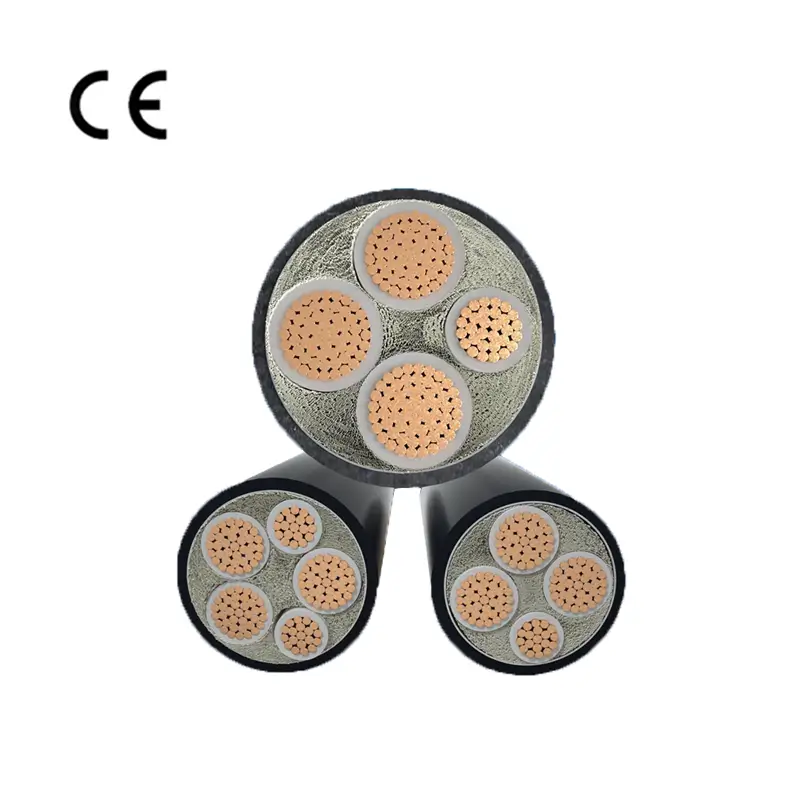
For primary power feeders from the main substation to distribution nodes, we supplied non-armored YJV cables in two critical configurations: YJV 4×300mm² and YJV 4×400mm². The YJV 4×400mm² variant served as the principal feeder for the main conference hall complex, delivering robust XLPE-insulated, PVC-sheathed performance rated for 0.6/1kV operation. This particular cable configuration—totaling 8,500 meters—provided the current-carrying capacity necessary to support HVAC systems, lighting networks, and audio-visual infrastructure simultaneously without voltage drop concerns across the facility's expansive footprint.
Where mechanical protection became paramount—particularly in direct burial sections traversing the campus grounds and areas susceptible to excavation damage—we deployed SWA (Steel Wire Armored) cables in 4×500mm² configuration. Approximately 6,200 meters of these armored feeders provided the crush resistance and rodent protection essential for long-term reliability in exposed outdoor installations.
For medium-voltage distribution segments connecting to the national grid interface, we supplied cables rated at 8.7/15kV and 12/20kV, featuring XLPE insulation and metallic screening compliant with IEC 60502-2 standards. These 3,800 meters of medium-voltage infrastructure ensured efficient power transmission from the utility connection point to on-site transformers, minimizing losses across the distribution network.
Why Our Solution Outperformed Alternatives
The client's technical evaluation process compared our integrated proposal against segmented sourcing from multiple regional suppliers. Three decisive factors distinguished our offering:
Comprehensive IEC Certification Portfolio: Unlike competitors offering partial certification coverage, our complete product range—from H07V-R building wires to medium-voltage feeders—carried unified IEC compliance documentation. This eliminated the documentation fragmentation that often complicates African infrastructure projects, where regulatory scrutiny intensifies during commissioning phases. Our EN 50525-2-31 compliance for low-voltage cables and IEC 60502-2 alignment for medium-voltage systems provided the regulatory certainty the client required.
Integrated Manufacturing & Quality Assurance: Rather than assembling cables from disparate sources, our vertically integrated production ensured consistent material quality, conductor purity standards, and insulation compound formulations across all cable types. This uniformity simplified installation practices—electricians worked with predictable bending characteristics and termination procedures throughout the project—and reduced the risk of compatibility issues between different cable systems.
Accelerated Delivery & Logistical Precision: We maintained substantial inventory positions for high-demand configurations like H07V-K 2.5mm² and YJV 4×300mm², enabling immediate shipment for initial construction phases while manufacturing project-specific lengths for specialized requirements. Our logistics coordination included sea freight optimization and customs documentation preparation, reducing typical delivery windows by 40% compared to standard industry lead times.
From Factory to Installation Site
Project execution unfolded across three coordinated phases spanning eight months. Phase one focused on internal building wire deployment, with H07V-U and H07V-K cables arriving in sequenced deliveries aligned with construction milestone completion. Our technical team provided installation guidance addressing tropical climate considerations—particularly moisture management during storage and PVC insulation handling in high-humidity conditions.
Phase two addressed fire-resistant cable installation in critical safety zones, requiring specialized termination training for local electrical contractors. We dispatched technical advisors to Kinshasa to demonstrate proper mica tape cable sealing techniques, ensuring that fire resistance integrity extended through junction points rather than merely at cable runs.
The final phase involved heavy cable pulls for external infrastructure, where YJV 4×400mm² and SWA armored cables required mechanical pulling equipment coordination. Our pre-shipment cable drum labeling and pulling tension calculations prevented installation damage that often occurs with large-cross-section power cables.
Project Outcomes & Operational Validation
The completed electrical infrastructure now supports one of Central Africa's premier conference facilities, with operational validation confirming our cable selections met every performance benchmark:
Zero insulation resistance failures during commissioning testing across 147,000 meters of installed cables
Fire-resistant circuit testing successfully maintained emergency lighting continuity during simulated fire scenario drills
Medium-voltage feeders demonstrated stable temperature performance under peak load conditions during full-capacity events
External armored cables showed no degradation after six months of wet season exposure
The client's project director subsequently communicated that our integrated supply approach eliminated the interface management burden typically associated with multi-supplier cable procurement, allowing their team to focus on broader construction coordination rather than resolving cable compatibility issues.
Partnership Value: Beyond Product Supply
This project exemplifies how specialized cable manufacturing expertise translates into infrastructure resilience. Our role extended beyond material supply to encompass:
Technical Consultation: Helping the client navigate the distinction between fire-resistant and flame-retardant cables—a critical safety decision that non-specialized suppliers often obscure.
Standardization Guidance: Ensuring all cable documentation aligned with both DRC regulatory requirements and international funding body specifications, preventing the certification gaps that frequently delay African infrastructure commissioning.
Installation Support: Providing field-level technical assistance that transferred knowledge to local electrical teams, building regional capacity for future complex installations.
Your Next Project Deserves Proven Excellence
The Congo Kinshasa National Conference Center project demonstrates our capability to deliver complex, multi-voltage cable solutions for demanding infrastructure environments. Whether your project involves government facilities, commercial developments, or industrial installations, we bring the same commitment to certified quality, technical precision, and delivery reliability.
Why Partner With Us?
✓ Full IEC Certification Coverage: Complete EN 50525 and IEC compliance documentation for hassle-free regulatory approval
✓ Integrated Manufacturing: Unified quality standards from building wire to medium-voltage feeders
✓ Proven Large-Scale Delivery: Demonstrated capability managing 150,000+ meter projects with compressed timelines
✓ Technical Partnership: Engineering consultation extending beyond product supply to installation optimization
✓ African Market Expertise: Specialized logistics and documentation experience for sub-Saharan infrastructure projects
Ready to Power Your Next Infrastructure Landmark?
Contact our technical sales team to discuss your project requirements and discover how our certified cable solutions can eliminate procurement complexity while ensuring long-term operational reliability.
Dongguan GERITEL Electrical Co., Ltd.
Tel/WhatsApp/WeChat: +86 135 1078 4550 / +86 136 6257 9592
Email: manager01@greaterwire.com
 Morocco Marrakech Food Processing Plant Expansion



 Building 2, No. 40 Luxi 2nd Road, Liaobu Town, Dongguan City, Guangdong Province, China